

INTRODUCTION
Until 30 years ago London had few tall buildings, and a general presumption against any repeat of the mistakes of the 1960s. With Richard Rogers’s ‘Towards an Urban Renaissance’ 1998 and developer lobbying, planning policy shifted around 2000: tall buildings came to be considered a key tool in driving London’s growth, a positive element necessary to maintain ‘world city’ status, particularly as a financial centre. They would enable growth towards a more sustainable ‘compact city’ and even help achieve housing targets.
Successive London Plans also claimed the policy reduced carbon emissions by focusing clusters of tall buildings at transport hubs within Opportunity Areas – although they were in fact allowed and encouraged in many other places. At the same time, controls on density were loosened then abolished in favour of ‘design-led’ policies to be developed by boroughs.
Over 120 buildings over 100 meters high have been constructed, with over 600 more in the pipeline — but only around half are located close to transport links. Tall buildings are estimated to have contributed an average 2,400 homes annually over the past decade, or 4.6% of the target — with a very low proportion ‘affordable’ and many owned by overseas investors and left vacant. In fact tall buildings are, by definition, forms of gated communities.
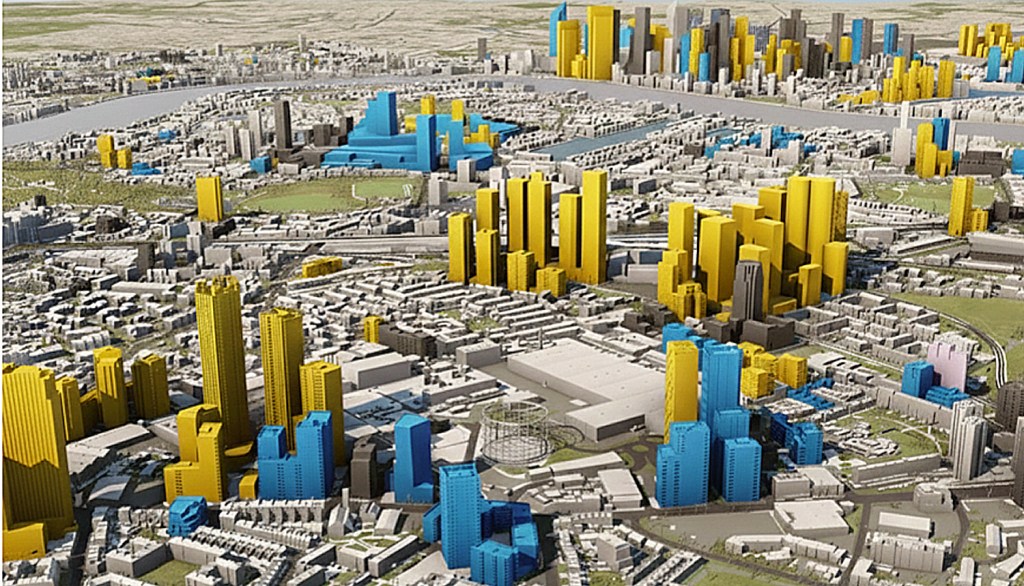
Tall buildings can be immensely profitable for developers, but (as so often) super-profits are made by pushing the policy envelope – proposing a tall building for a site not previously identified, for example. The policy has encouraged a speculative bubble and contributed to the relentless increase in land values, worsening problems of affordability and delivery and exacerbating the housing crisis. And the flipside of speculation is that many approvals are never built, but sites remain vacant and blighted.
It is widely acknowledged that tall buildings don’t easily meet Net Zero requirements. But there is new evidence that tall buildings are also very inefficient in terms of carbon emissions the higher they rise; over 8 storeys the carbon costs rise rapidly, both in terms of construction and ongoing internal environmental control.
There have been campaigns of opposition to tall buildings, particularly from the heritage lobby and the #SkylineCampaign, but mainly on a case by case basis. If planning’s main aim continues to be growth through development, and if the rules remain open to manipulation by developers, tall buildings will continue to be the answer for simplistic decision-makers.
Solutions in our MANIFESTO
A LONDON WIDE MORATORIUM on permission for further tall buildings except for plan-led locations in the City and Canary Wharf
A FULL GLA INVESTIGATION into the impact of tall buildings on carbon emissions, land values, amenity and efficiency (tall buildings are not the most efficient way of using land to achieve higher densities — mid-height blocks achieve similar density with a more communal form and more amenity space)
REINTRODUCE THE DENSITY MATRIX to the London Plan to establish the development envelope, to dampen down land value increases and speculation and to reduce carbon emissions
LINKS, GROUPS CAMPAIGNING ON THIS ISSUE
Tall Buildings | Historic England
Making Tall Buildings in England Safer – New BSR Campaign
Planning and tall buildings | London City Hall / London Assembly investigation 2025
Evidence for this investigation
Just Space’s evidence
What is the future of high-rise housing?| Levitt Bernstein
Policy Exchange| Tall buildings: a policy framework
A disaster foretold: how a decade of high-rise architecture has blighted London’s skyline| |Barbara Weiss (founder of the Skyline Campaign) |Building Design
The AJ/Observer’s Skyline Campaign is not anti-skyscrapers