Our protest to the Mayor on 7 January (text below) must have shamed them into a re-think. The consultation was yesterday extended to 13 February. Thank you.
Dear Sadiq (copied to Assembly Members in the Planning Committee) 7/1/26
As you know, you are legally required to consult on a draft of how to evaluate the impact of a new London Plan. The London Plan team began consultations on a new London Plan in 2023, at which point we requested consultation on the IIA scoping. We have repeated this request several times in the intervening two years, and submitted extensive evidence on this matter in response to ‘Towards a new London Plan’ last June, when we asked “is inclusion an illusion?”
We were reassured that there would be consultation on the IIA scoping “later this year”. We learnt only yesterday that just such a consultation purportedly began on 19th Dec 2025, running for 6 weeks, with a closing date for comments 30th January 2026.
None of us or our extensive network of community groups were notified of this consultation – indeed I spoke to CPRE London this morning who were completely unaware. It would appear from their website that the London Forum of Civic & Amenity Societies remain similarly uninformed.
To slip out under cover of the Christmas break such an important consultation does not demonstrate a commitment to equalities. To slip it out without even notifying many of London’s longstanding networks and organisations runs counter to your claim on the landing page for this consultation: “I want to forge a new consensus on planning that’s fit for 21st century London”.
This is particularly inauspicious given our previous experience in 2019, when the Panel of Inspectors at the Examination in Public were persuaded by us that the draft IIA was of such inadequacy that the London Plan team were required to produce additional appraisals of the impact each and every policy in the draft plan.
We share your aspiration to forge a new consensus, and urgently request that you extend this consultation by 3 weeks in order to cover the time wasted by failing to inform London’s communities of this important consultation and thereby reaffirm your commitment to equality, transparency and consensus.
Yours sincerely. Michael Ball, Just Space Co-ordinator
5 January 2026 The Mayor is legally required to consult on a draft of how they plan to evaluate the next London Plan. They have been postponing the consultation for a year or more and now they have slipped it out under cover of Christmas. Consultation closes at the end of January so nearly half of the period has expired already. We interrupt our work on the alternative plan to alert Londoners to the need for urgent action.
We have no trace of receiving any notification about this, despite us being on the Mayor’s email lists for updates. We discovered today 5 January from a friend who had received an email on 23rd December, telling them that the consultation had started on 19th December. This is very bad practice indeed.
Those who weren’t around in 2016 may be interested to know that the London Plan team initially worked well with Just Space and community groups on the Integrated Impact Analysis for the current (2021) London Plan. [ link ] We failed to agree, however and they went ahead with a process which we considered seriously inadequate. In the event their analysis of impact on inequality was so weak that we persuaded the Panel of Inspectors to insist on more work; then the further work was found still quite inadequate and the London Plan team were sent away by the Inspectors to attempt an appraisal of how each policy in the plan would likely affect each of the sections of the population. The resulting report confirmed our worst fears about the inability of the plan policies to arrest the growth of inequality or reverse it. But it was by then too late to influence the content of the plan. Catch up with that story here: https://justspace.org.uk/2019/04/28/actual-equalities-study-at-last/
‘The IIA includes Sustainability Appraisal/Strategic Environmental Assessment (SA/SEA), Health Impact Assessment (HIA), Community Safety Impact Assessment (CSA), and Equalities Impact Assessment (EqIA). In addition, information from the parallel workstream of the Habitats Regulation Assessment (HRA) will inform this IIA but be reported separately.’
Individuals and groups concerned about the equality and/or environmental impacts of the Plan are urged to read the scoping report (link above) and comment to us so we can prepare a collective response to City Hall before the end of January. If we can, we’ll organise a briefing between now and then.
Cras justo odio, dapibus ac facilisis in, egestas eget quam. Praesent commodo cursus magna, vel scelerisque nisl consectetur et. Duis mollis, est non commodo luctus, nisi erat porttitor ligula, eget lacijghlkjfhdglkdsjfh nia odio sem nec elit. Maecenas faucibus mollis interdum. Praesent commodo cursus magna, vel scelerisque nisl consectetur et. Maecenas sed diam eget risus varius blandit sit amet non magna. Cras justo odio, dapibus ac facilisis in, egestas eget quam.
This is a heading
Cras justo odio, dapibus ac facilisis in, egestas eget quam. Praesent commodo cursus magna, vel scelerisque nisl consectetur et. Duis mollis, est non commodo luctus, nisi erat porttitor ligula, eget lacinia odio sem nec elit. Maecenas faucibus mollis interdum. Praesent commodo cursus magna, vel scelerisque nisl consectetur et. Maecenas sed diam eget risus varius blandit sit amet non magna. Cras justo odio, dapibus ac facilisis in, egestas eget quam. jkfdhg lkdjfhg lkjdfhg lskdjfgh lskdjfhgl kdfjhg lkdfjghl dkjfgh lkdfjg h khgkjhg kjhg
ONE, dapibus ac facilisis in, egestas eget quam. Praesent commodo cursus magna, vel scelerisque nisl consectetur et. Duis mollis, est non commodo luctus, nisi erat porttitor ligula, eget lacinia odio sem nec elit.
Maecenas faucibus mollis interdum. Praesent commodo cursus magna, vel scelerisque nisl consectetur et. Maecenas sed diam eget risus varius blandit sit amet non magna. Cras justo odio, dapibus ac facilisis in, egestas eget quam.
Type your caption here
TodaymaybeThis afternoon will be breezy, with cloud continuing to move in from the west bringing some patchy spells of rain with it.
Tonight Tonight will see outbreaks of rain and showers early diminish later leaving it drier with clear spells. It will start breezy but winds will diminish somewhat later.
Wednesday Tomorrow is expected to be largely dry with a mixture of sunny spells and variable cloud through the day. Breezes continuing to ease away. A warmer day.
Outlook for Thursday to Saturday Thursday looks to be a dry day with partly cloudy skies. A sunny evening. Friday will see sunshine and passing cloud, some bringing the odd shower. Trending warmer by Friday. Saturday will be an unsettled day with showers that will be heavy and thundery at times.
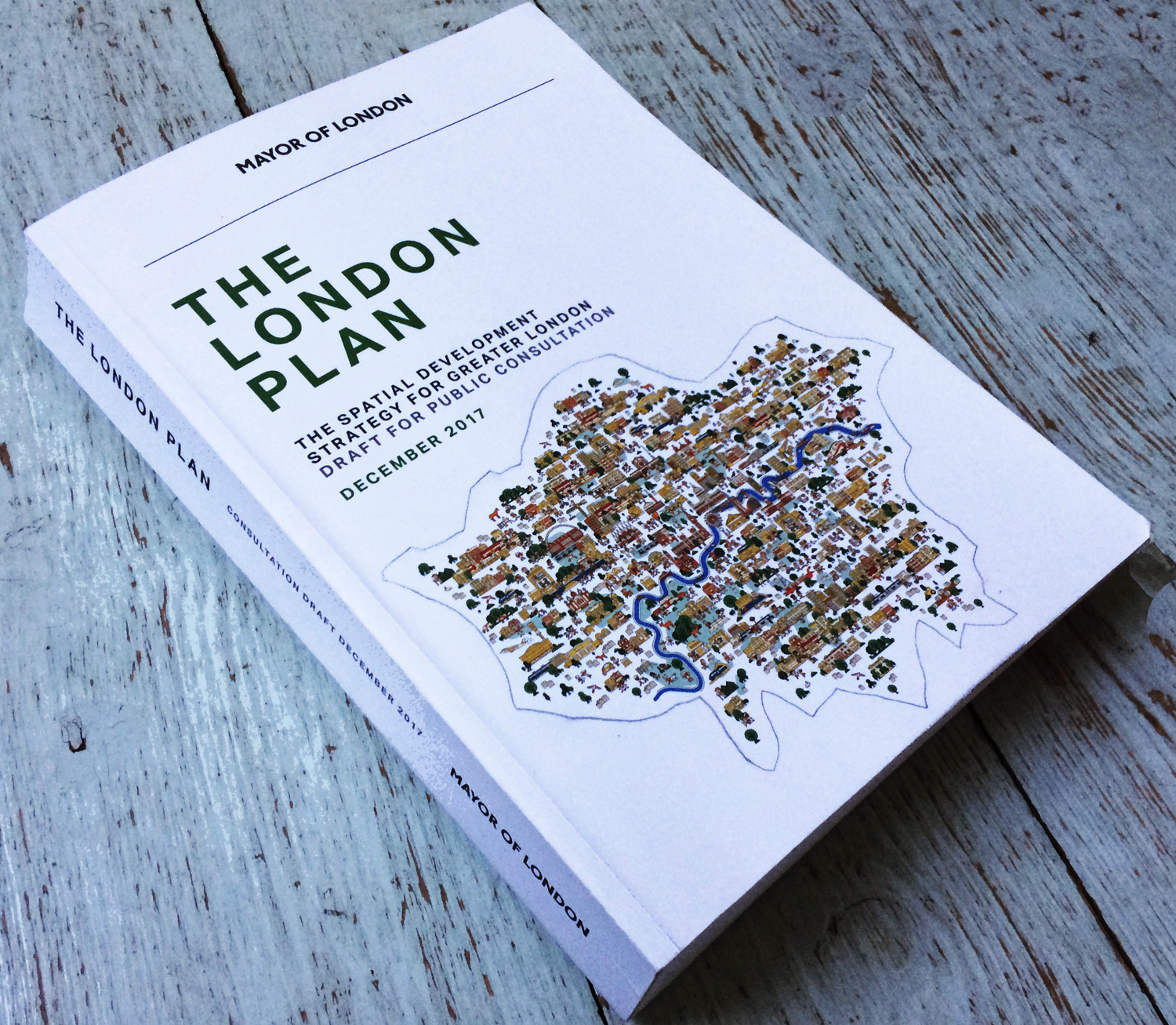
Consultation has closed on the Mayor of London’s Towards a New London Plan. Our response, along with other material, is at http://justspace.org.uk/towards
At the same location are links to earlier publications and policy statements by Just Space and others and information about our conference on 14 June when our member groups put together our submission in response to the Mayor. Consultation closed on 22 June.
6 May 2025: For more than a year the GLA (Mayor of London) has been refusing to start the public processes which would lead to the next London Plan. We protested to no avail.
Now, however, the Mayor of London begins a 6-week consultation on ‘Towards a new London Plan’ from Friday 9th May.
This follows hard on the heels of the Mayor’s depressing ‘build, build, build’ policy sketched out in hisLondon Growth Plan (published in February with minimal consultation) and his appearance at MIPIM in March, the developer’s trade fair in Cannes – where he was seeking ‘investment partners’ for £22bn of projects on public land and estates.
Just Space is hosting a network meeting shortly to prepare our response to the proposals. If you are a member or active supporter you should have an invitation.
We also hope to hold a conference in June to develop our response – an alternative vision for a Caring City. [ We did ]
For a later update see our Towards… page where our own response to the Mayor’s “High Level Paper” is, and all the others we can get hold of. The Mayor’s people are being very obstructive about posting them.
Join us to create a manifesto for a London planned for people not property.
conference on Saturday March 2nd 11am-4pm
Are you affected by the housing crisis?
Do luxury blocks appear in your neighbourhood and stay largely vacant?
Are you losing local shops, green space and local services?
Why are councils demolishing estates?
Why are families moving out to find homes they can afford and space for children, so London schools close?
Why is the planning process so murky, and local councils little help?
We’ll tackle reasons why the growth plan for London doesn’t work for most of us, or the planet. We’ll question common assumptions about growth and developers’ profits, and present alternatives.
With elections coming, a better London Plan is urgently needed – one that tackles the problems in a new way for London’s people and all of its communities.
Join us to create a manifesto for Just Space – sign up here on Eventbrite to reserve a place
Hosted by Just Space, the London-wide network of community groups and campaigns at Coin Street (near Waterloo).
Just Space is meeting on Saturday morning 18 November 2023 to progress our preparations for the next London Plan. Details are in our first Newsletter here:
8 Nov 2022. With all the changes of government and ministers in recent months, many people will have forgotten that the government’s White Paper on Plannning of 2020, on which we commented so thoroughly, did finally lead to a draft law (a “Bill”) being sent to the parliament. It was combined with proposals for “Levelling Up” and thus carries the name Levelling Up and Regeneration Bill (LURBill for short).
Just Space people have been very busy with other things and missed the chance to comment again on government proposals during the summer Committee stage. The Bill soon goes to the House of Lords and there may be scope for lobbying there. More news soon as we work out how we can help our members deal with these issues.
Meanwhile the London Assembly Planning and Regeneration Committee considered the LURBill on 12 October. For once we were not formally represented but we are grateful to Shibo Chen who volunteered to summarise it for us. His summary is here.
In short the government claims that it wants to strengthen public participation but is making proposals which would do the opposite. The key change in this Bill is that National Development Management Policies —not part of the Bill but to be written later by the Minister— would be enforced across England and would override whatever policies local authorities had in their plans. This would be a further colossal centralisation of power and would probably deter citizens from bothering to participate. Provisions for ‘Street Votes’ proved controversial with Assembly Members divided. Plans to streamline Infrastructure Levy were criticised by both Members and GLA planning staff.
The full video record of the Committee meeting is here along with minutes and agenda.
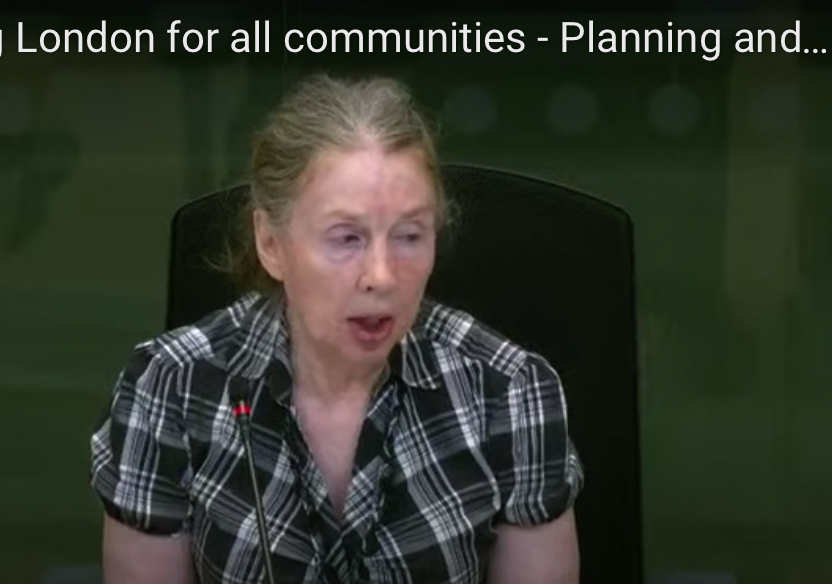
London community groups had a rare hearing at the London Assembly’s Planning and Regeneration Committee on 7 September, making it very clear that a new London Plan is urgently needed, with genuine co-production with Londoners from the outset and a very different kind of London to be forged.
It was a breakthrough by this committee that it devoted an entire meeting to taking evidence from a panel of community activists and invited people whose organisations were among the 60 which had contributed to the Just Space Community-led Recovery Plan for London.
Many of the questions posed by the Committee focussed on participation in the London Plan process. Responses were clear that active and deep participation requires proactive support and resourcing. We have a considerable section in our document on participation that sets out some useful ways or mechanisms. However, not only does the input of communities have to change profoundly but the city itself must be different, prioritising meeting social need, especially of those in greatest need, and tackling the climate and nature emergencies. The current plan is seen as a developers’ charter; ‘recovery’ doesn’t mean getting back to business as usual; the Covid pandemic has shown us that the future really must be different from the past.
The next review of the London Plan is not scheduled until May 2024 onwards and Just Space said to the committee that we cannot wait. We should start now to be more open, free-ranging, supportive and innovative in community engagement.
You can review the whole 3-hour meeting and it may help to have our notes [ download PDF ] beside you which are indexed to the time stamp as the video goes along. A complete official transcript will appear on the Committee’s web site shortly.
All eight of the community speakers spoke with the urgency and authority which came from their experiences of Covid’s awful impacts on top of the cumulative effects of austerity. The existing (old) London Plan, initiated in 2016 and adopted in 2021 was a business-as-usual plan which did nothing to challenge the dominance of real estate profits over identified need. A different kind of plan is needed to give centre stage to meeting the backlog of unmet need, tackling some of the major structural inequalities while taking the climate and nature imperatives seriously.
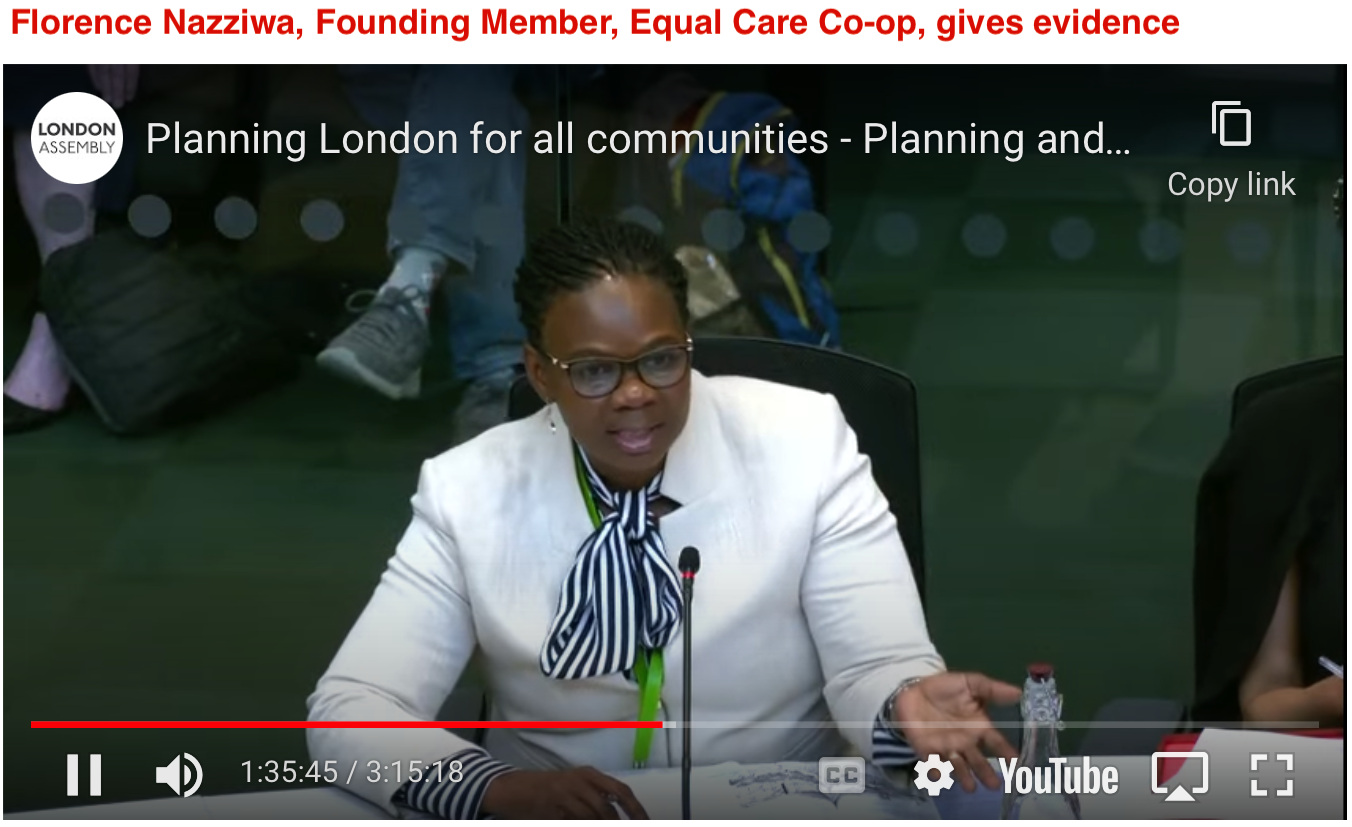
Florence Nazziwa, a practice nurse from the Equal Care Co-op London stressed the work pressures on carers, mostly women from minoritised communities on insecure contracts. She herself has to do 21 home visits daily: 7 in the morning, 7 at lunch time and 7 in the evening. People in her position have to fit in the care of their own families with that work schedule. Asked what could be done to reduce inequality, she said innovation in care commissioning, valuing community development work . A person’s wellbeing depends on the quality of their relationship to the people, places and things that make up the community. She also stressed the need for local care hubs – places that connect care workers to local resources and give them more visible presence in the community – and for neighbourhood mapping which brings communities together.
Asked whether she had ever been involved with the GLA or London planning, Florence said no, but she gave thanks and credit to Just Space for this opportunity to speak and would value more.
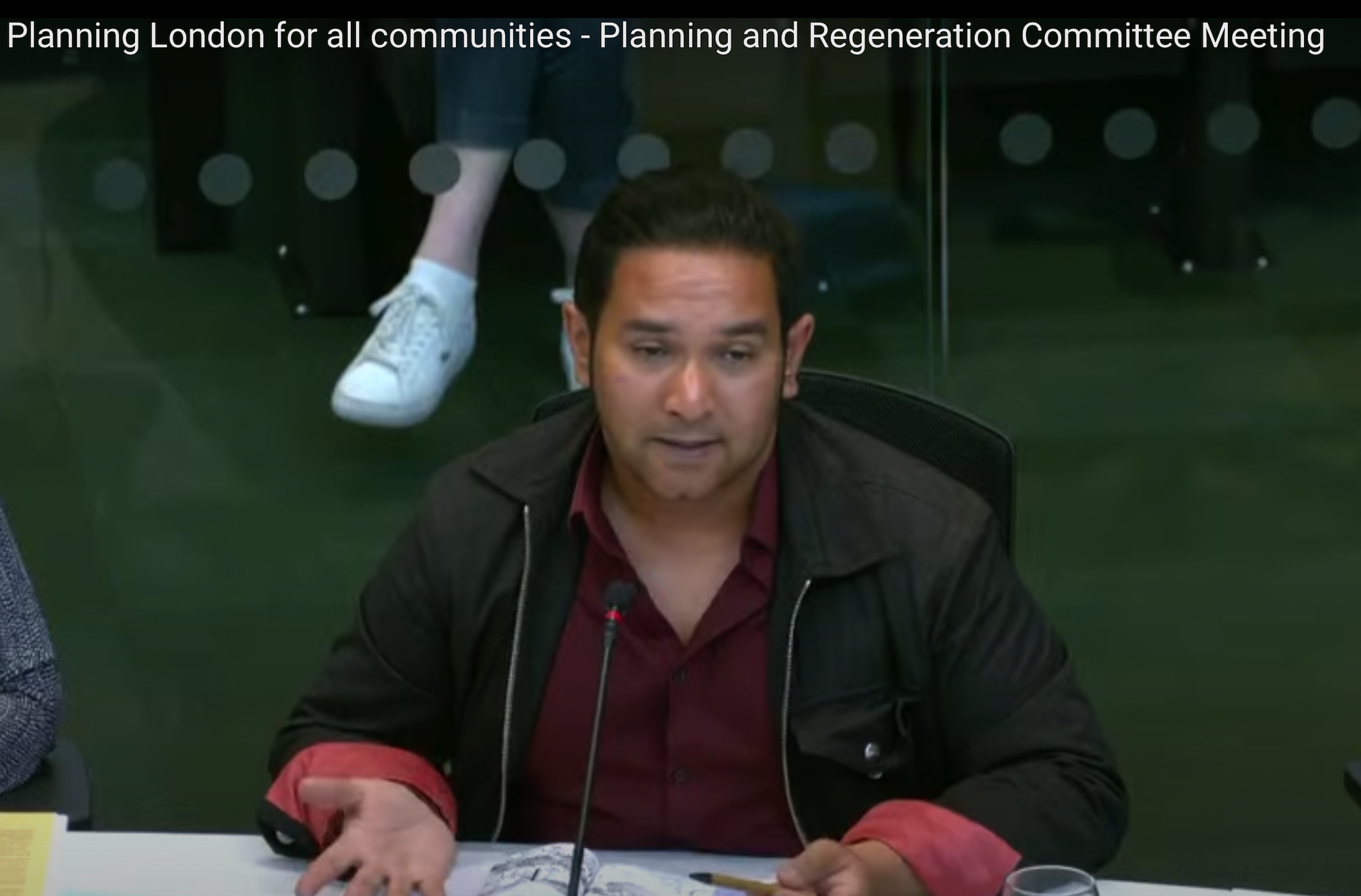
Saif Osmani was a founder of the Bengali East End Heritage Society which was set up in response to the activity of the East End Preservation Society which had been concerned more with the buildings than the people and failed to represent the culture and material life of the strong Bengali community. He spoke of the isolation of this community, especially of the antagonism and lack of interest shown by staff of the councils (Tower Hamlets and Newham) which made Bengali people feel that they were unimportant and their views somehow not valid. The Save Brick Lane campaign challenges the expansion of the City which would decimate the Bengali culture because the land is seen as worth more than the people. Many of the social and community services round Brick Lane have been closed down in recent years. At Upton Park we have been fighting 20 years in the Friends of Queen’s Market which is our source of cheap food for the large households we typically cook for. The market was crucial in feeding people during Covid. Why isn’t this valued?
Asked whether their interaction with the GLA had been any better, Saif said that they had felt listened to by the Assembly and some individual Assembly Members but that did not mean that their needs were any better reflected in policy. The exception had been when Andrew Boff AM had helped draw the Mayor’s attention to a tall block of flats threatening the Queen’s Market at Upton Park and thus got that threat removed –though not out of respect for the market’s crucial role in the food culture of East London and of south Asian communities, but rather on tall buildings policy.
Saif said that few people would engage with planning authorities on the terms usually offered: digesting and commenting on huge PDFs or going to meetings where the talk was of ‘vibrancy’: who experiences their own community in these words? Newham has started Citizen Assemblies, which are in some ways a credit but they have created a huge area of digital disengagement.
Portia Msimang from Renters Rights London focused on the churn imposed on private renters in London, with the average tenancy lasting only 2 or 3 years, as explaining why private tenants were normally under-represented in planning and housing discussions: few people stay put long enough to identify with a locality. The views and needs of private tenants (now a third of Londoners) are systematically under-represented for this reason. People are also too stressed by time and financial pressures to go to meetings. If you want to meet people go to them, where they are. ‘For example I was able to meet a lot of people very effectively by going to the works canteen and meeting workers during their breaks.’
Meeting places in localities can be very important but “most of the community hubs near me have been closed by the councils”. The nearest we have is the office of the housing coop where I live. But most consultation exercises are experienced as tick-box operations and that feeling is reinforced by never getting feedback. Even to be told why your demands are not being met would be better than nothing. It would be invaluable to get people deciding how funds like section 106 payments would be spent. Asked about prior contact with the GLA, Portia said that she had experience only of a (failed) bid for money for a CLT. That had taught her how hard it would be to win such a bid without having a housing association as a partner – but that would have contradicted the central point of their organisation’s approach. A fair bidding process would include investment in some consultancy support for applicants – housing coops in that case.
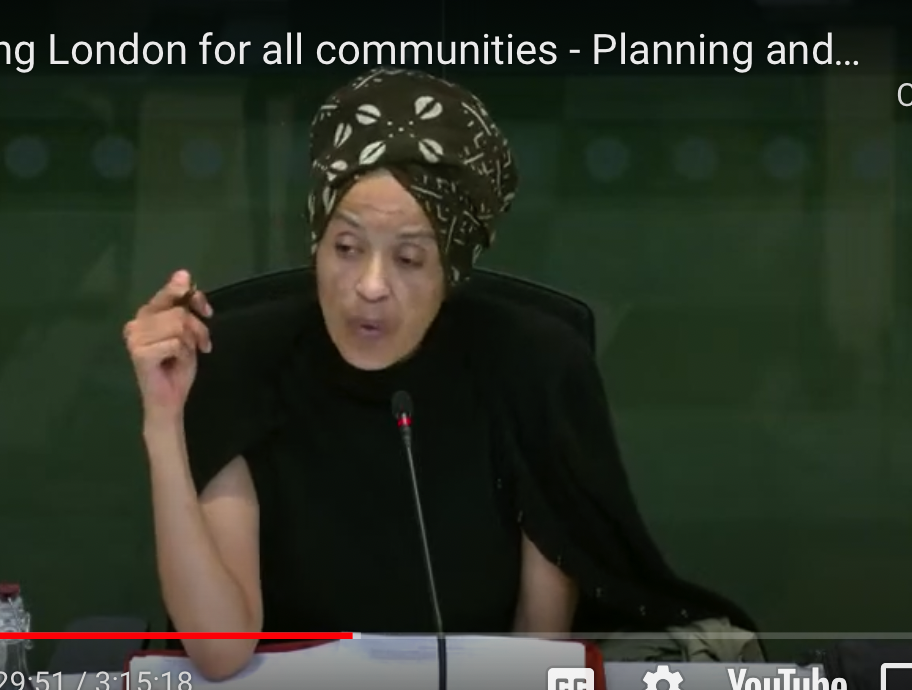
Natalia Perez, brought a very different perspective from Latin Elephant, an organisation set up to support and help the traders threatened with displacement (and now all displaced) from the Elephant and Castle shopping centre as part of a ‘regeneration’. The majority of these traders are Latin Americans, many Colombian, and the struggle to secure reinstatement elsewhere or get viable accommodation via the developers and Southwark was very frustrating. Half the traders remained unable to trade and faced difficulties in dealing with the authorities because of the technicalities and obscurity of planning language and limited English. But Natalia said that the traders had been perfectly well able to understand when they conducted workshops for them in Spanish.
The Equality Impact Assessment needs to include the people affected within the methodology. Latin Elephant had made representations on successive London Plans and had done a report to City Hall on the Social Value of the Latin economy.
Yasmin Moalin
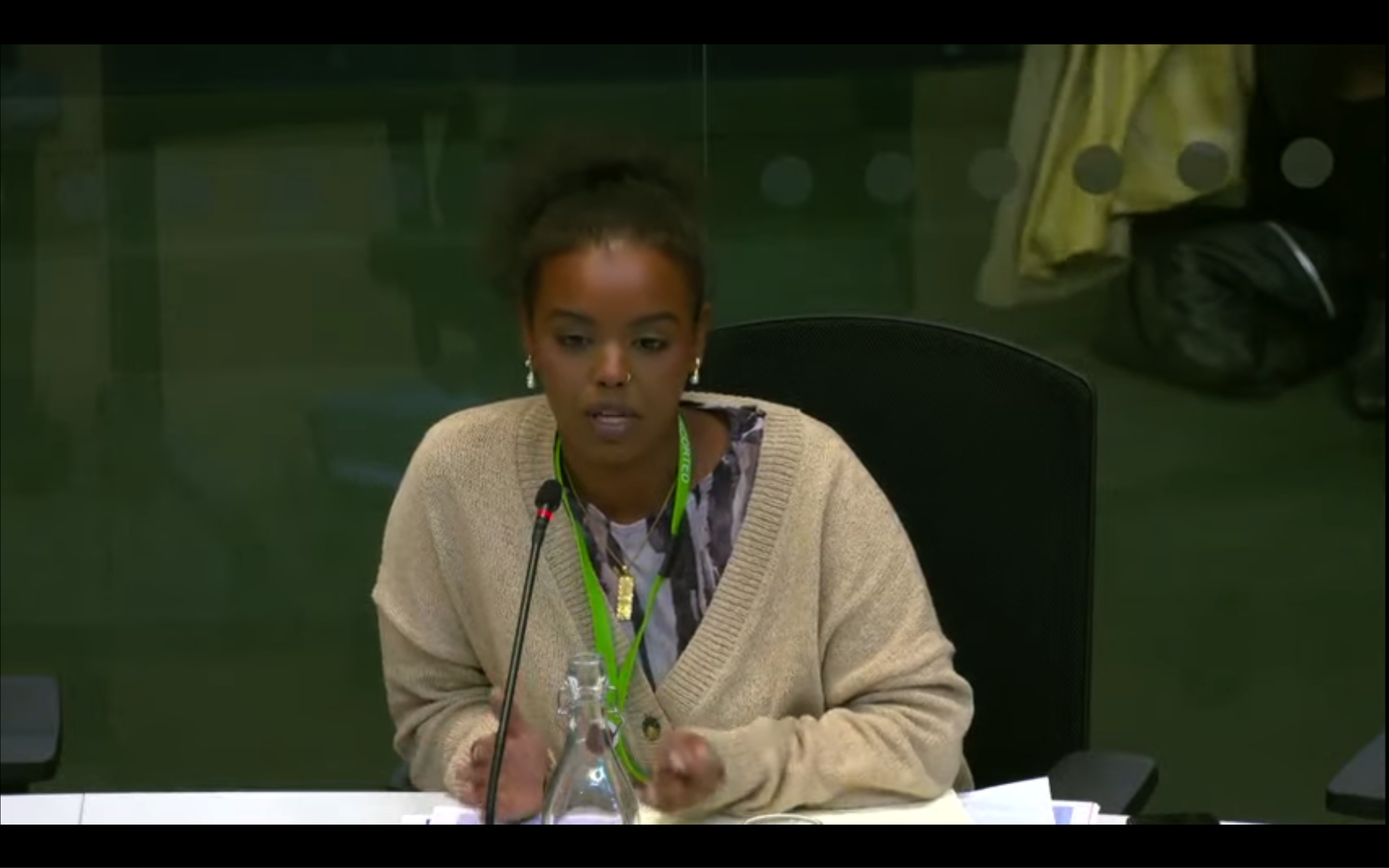
Yasmin Moalin youth engagement lead for the Anti-Tribalism Movement is specially concerned about making things accessible to young people and letting them present their perspectives. Yasmin spoke powerfully of the pandemic’s impact on young people of Somali origin, with whom she works, badly hit by the difficulties in studying in overcrowded homes when schools and colleges were shut.
While coping with their own problems, so many had to help parents navigate their own situations across language barriers with officialdom. She reported very little trust for authorities among young people, especially boys, so participation in planning or policy was out of reach for most. Their organisation has a housing programme which trains Somali women to help them represent their communities in regeneration areas, on boards and committees and this is valuable. Yasmin spoke about the need for access and choice, and to educate and train so that young people are supported and prioritised in the planning process.
Christine Goodall, HEAR
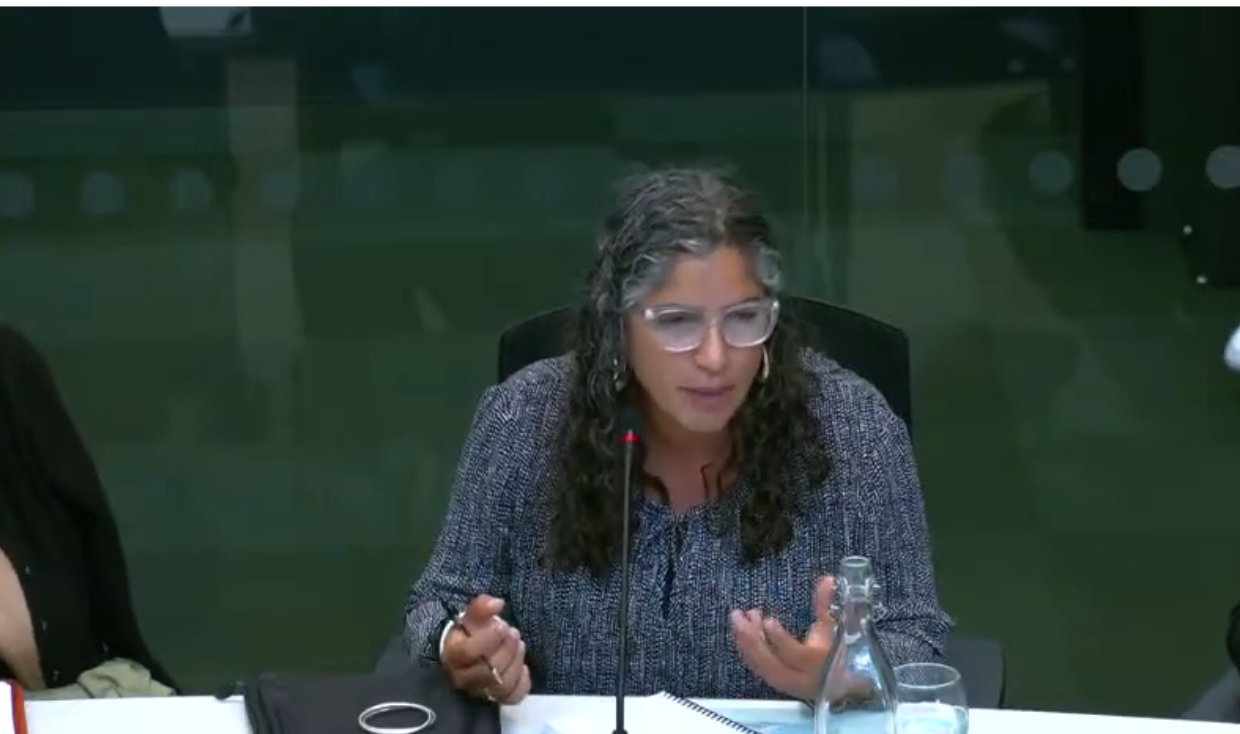
Christine Goodall from HEAR, a pan-equality network of London equality and human rights voluntary and community sector organisations, was forthright on many of the topics of the meeting, stressing the intersecting impacts of multiple protected characteristics and how the pandemic had added to the stresses on those who are poor alongside some other characteristics. She identified the closure of community hubs, libraries and other centres as having been very damaging for individuals, removing digital access and the opportunities for affected groups to meet and self-organise. Putting everything online had caused difficulties to so many people, even though some had gained by remote access. The high cost of internet access and equipment were major barriers alongside lack of familiarity and fluency with IT. She strongly supported the proposals in the Just Space plan for community hubs and spaces where people can get onto free Wi-Fi.
One planning problem in the pandemic had been the imposition without due consultation of many traffic schemes like floating bus stops and bike lanes which – while beneficial for some and contributing to cleaner air which is good for everyone – can have very adverse effects on some older people, children and those with mobility or sensory problems. The problems of households without access to outdoor space at home were bad enough but they were sometimes amplified by the management of parks who had banned people from sitting on benches and thus in effect banned some people from their parks altogether.
Christine and a number of other speakers, asked whether they would favour a Statement of Community Involvement (SCI) or something similar being developed for the GLA gave a tentative support but all emphasised that statements of intent were a waste of time and would further undermine trust. Rules and procedures to govern community involvement in GLA planning could be useful if there were ways for citizens to invoke and enforce them and if they were available in various languages. Public bodies must go to people where they are. Financial recompense for sharing your expertise can be a valuable help for individuals and small groups. Better feedback too should be automatic.
Pat Turnbull, LTF
Pat Turnbull, regional rep for London Tenants Federation, stressed that London Plans so far had failed to meet the basic needs of the majority of Londoners, failing to halt losses of existing social housing, failing to stop the growing backlog of unmet need for social housing and generating acute problems for family households through enabling too many small flats where larger ones were needed. LTF had used every opportunity to try to influence the London Plan and other plans and policies but were endlessly frustrated by the way that all levels of government now attach higher priority to developer profitability than to meeting social needs. The first priority for successful public consultation was that the public body must want to know what people think (they often don’t seem to care). People must also believe that what they say can lead to changes of policy and get feedback and that conformity with key policies will be monitored and enforced. It is a scandal that, even in Opportunity Areas, there is no decent data on whether the social-rent targets, so hard won in policy, are carried through into agreements and actually delivered.
Francesca Humi
Francesca Humi, Kanlungan Filipino Consortium (the word means safe haven) spoke of a community multiply affected by deprivations, by Austerity policies and by Hostile Environment policies. Most Philippine people here are women, a high proportion work in the NHS or care sector jobs in low-paid positions or as private carers or domestic servants, sometimes even living in the homes where they work. Even what may appear to be a living wage can become inadequate because people have to pay for visas for themselves and any children, pay charges to use the NHS if they need it, often pay for solicitors to help secure rights and, in many cases have ‘No Recourse to Public Funds’ (NRPF) so are unable to access many public services or social housing. Finally, many are here to send remittances home. This is a very stressed community and their housing costs are a major burden: often they are reduced to sharing beds to live near enough to their work.
In the pandemic, especially early on, we have been overwhelmed by deaths in our community, because of our jobs, our working conditions, our homes and living conditions. We have supported each other as best we could. Consultation with communities like us should disseminate information widely, often in relevant languages, and a high priority topic within the crucial housing subject would be the need for (London government) to provide emergency accommodation for people in these very very hard conditions.
So far this has been a summary of evidence given. The longer summary here and the complete transcript include also the questions asked by the Committee.
Clearly the Committee was focused on public consultation, especially in the production of the London Plan, and on some specific issues: the need for an SCI, the scope for activating the ‘socio-economic’ dimension of the Equality Act 2010 to make the London Plan less regressive in impact and other ways in which the London Plan could learn from the Covid experience and respond to its impacts.
Insofar as the community speakers focused on consultation the message was that it would need to be a lot better than it has been to secure the commitment of time and energy of people. It would help if people were paid for their time spent in this socially important work. It would help if planners engaged with people where they were gathered for work or other purposes and because true deliberation isn’t done individually but when people listen to each other in groups. It would help above all if consultations were felt to be genuine: if councils and officers were actually wanting to know what people thought and would act upon the results and report back. This set of conditions is rare at the moment. A Mayoral SCI or a differently named document with similar scope might help provided that it could be invoked and enforced by citizens.
The application of the Equality Act was not much discussed but those who responded to this question were clear that Equality Impact Assessments they had seen so far – including the ones on the London Plan – were seriously deficient.
The strongest link with the London Plan was clear: that the next London Plan would need to produce a very different kind of city — a city which housed and cared for the people who make it work, at costs which are viable in relation to their actual incomes. The majority of these speakers had strong demands to voice but the co-production of a new plan would clarify for them which of the issues count as ‘planning’ issues in today’s London and which fall to other spheres of public policy. Co-production just might be getting under way in sessions like this.
The Planning and Regeneration Committee of the London Assembly devoted its entire meeting on 7 September at 2.00pm to presentations and discussion of the future of London Planning, inviting evidence from many of the Just Space contributors to the Community-led Recovery Plan published recently. Here it is:
The following is the Committee’s invitation to Londoners:
Agenda Item 6, Appendix 1
“The Planning and Regeneration Committee is delighted to host a diverse range of London’s voices in the upcoming Committee meeting on Wednesday 7 September 2022 to consider the impact of the pandemic on different London communities, and how approaches to planning can address inequalities and reflect the needs of diverse Londoners.
In preparation for this meeting, members of Just Space1 gave an informal briefing to Planning and Regeneration Committee Members in July 2022, focused on their Community-Led Recovery Plan. The Community-Led Recovery Plan sets out 44 policy proposals for planning in London, which Just Space co-produced through discussions with grassroots groups, with the aim of ensuring that ‘all voices are included in the future planning of London’ as it recovers from the pandemic.2 Subsequently, Just Space has collaborated with the Chair to suggest guests for the meeting, ideas for discussion, and to collaboratively develop the framework for the committee meeting. The full list of attendees has been confirmed and can be found below.
Panel One:
• Florence Nazziwa, Founding Member, Equal Care Co-op; • Portia Msimang, Project Coordinator, Renters’ Rights London; • Natalia Perez, Co-Director, Latin Elephant; and • Saif Osmani, Founding Member, Bengali East End Heritage Society.
Panel Two:
• Francesca Humi, Advocacy and Campaigns Officer, Kanlungan Filipino Consortium; • Christine Goodall, Network Coordinator, HEAR Equality and Human Rights Network; • Yasmin Moalin, Youth Engagement Lead, Anti-Tribalism Movement; and • Pat Turnbull, Regional Representative, London Tenants Federation.
For those watching the meeting, the Committee would like to invite you to tune in to the full 3 hours as we are hoping some of the discussions from the first panel will inform the second panel. We hope that the ideas between the two panels can cross-pollinate and synthesise over the meeting, leading us to some constructive follow-ups.
The meeting will begin with two 5-minute presentations: the first on the work of the London Recovery Board by the GLA; and the second by Just Space representative Robin Brown, detailing their Recovery Plan work. The Committee has also invited representatives from the GLA Planning for London programme to observe the meeting in order to capture the ideas and voices in the meeting, and how these could inform a future London Plan.
We look forward to welcoming our guests on 7 September 2022.
1 Just Space describes itself as an informal alliance of around 80 community groups, campaigns and concerned independent organisations which was formed to act as a voice for Londoners at grassroots level during the formulation of London’s major planning strategy, particularly the London Plan. 2 Just Space, Community-Led Recovery Plan, April 2022 “