After a two year wait, the new draft London Plan slipped its moorings at an underwhelming event last week, with a 13 week consultation stretching to October.
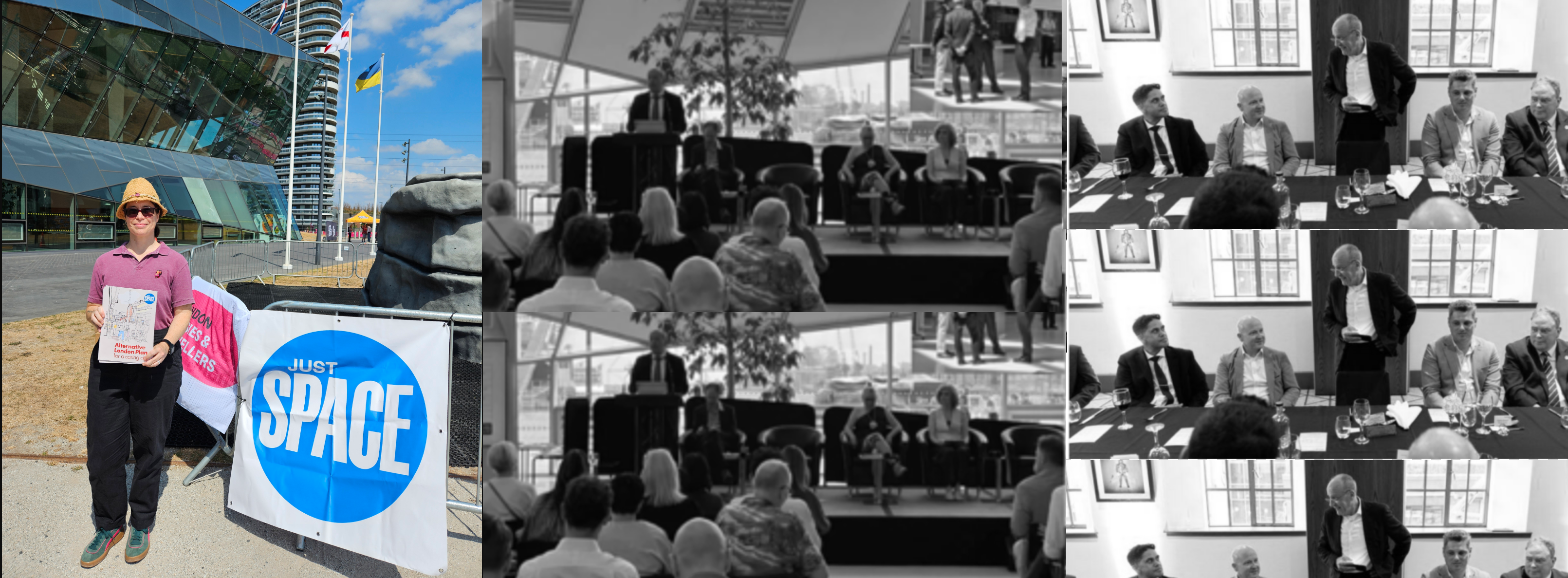
The event at City Hall was poorly attended, with lots of empty seats, invitations having only gone out a few days before – and by the looks of it, only to the usual suspects: assorted politicians, developers and their agents. Just Space and the London Forum were among the very few community groups in attendance.
A handful of Just Space members gathered at very short notice to protest outside City Hall at the exclusive event, giving out copies of our Alternative London Plan for a Caring City to attendees, including Jules Pipe, Deputy Mayor of London responsible for Planning.
Nothing was handed out once inside, and the event lasted less than an hour… And yet what was being announced was potentially momentous. Londoners are being subjected to either slow strangulation through rising rents and unaffordable house prices, or unbearable stress as they are threatened with estate demolitions, evictions and homelessness. The GLA official figures show that we need about half of all new homes to be social rent – about 27,000 a year for a decade to address the backlog which leaves 90,000 children homeless in the capital.
The Mayor’s response? More of the same fantasy growth agenda we have been subjected to for 25 years, which has delivered these assorted inhumanities. The Mayor is at least resisting the government’s absurd overall target of 88,000 homes per year – based on voodoo methodology – and is instead setting a target of 56,000 homes annually, based upon a new assessment of need and land availability (the SHLAA and SHMA).
But this is similar to the current housing target, in a city which has averaged 35,000 new homes in recent decades, and has fallen to around 5,000 in 2025. Worse, there isn’t even a target for affordable housing or social homes – just the overall proportionate target of 50%. That is because the Mayor continues to rely on the speculative housing model, which has produced a glut of overpriced 1 and 2 bed flats and a criminal shortfall of genuinely affordable housing.
As the draft Plan admits “Delivering at a rate of circa 56,000 homes a year would mean that London’s affordable housing need is 60 percent of overall supply.”
And even the overall 50% target is officially unachievable, since the Mayor is reducing the proportion required on public land to 40%, and the outer boroughs requirement to just 20%. Only in the inner boroughs is the 35% requirement for ‘Fast Track’ reinstated after the ‘emergency measures’ end in 2028. Jules Pipe added that even these targets would not be achievable if the government didn’t double or even triple the amount of funding for social housing – a direction Burnham has been at least hinting.
There are additional victims: smaller public open spaces appears to be up for grabs, for example. The Green Belt is expected to deliver 56,000 new homes, and, apart from MOL, current protections enjoyed by all open space are being lifted. Instead only ‘Accessible Green Space’ (AGS) designated in Local Plans would continue to enjoy such protection – appearing to leave vulnerable many small, local spaces essential for amenity, including greenspace on estates, unless the local authority identifies and designates every one.
A density matrix of sorts is being reintroduced, as Just Space has been advocating for a decade – but it’s called an ‘Optimisation Framework’ and sets minimum densities, not maximums! Mid-rise is being heavily promoted, but a new category of Major Metropolitan tall buildings over 100m encouraged. 17 Opportunity Areas are being de-designated or rationalised, but dozens of new locations are identified for development as broad locations of growth (BLGs), strategic growth corridors, brownfield-first Opportunity Areas (BFOAs) and Environmental Opportunity Areas, as well as 35 Green Belt locations. More industrial land is being forsaken for non-industrial uses.
But the most worrying failures are sins of omission. Firstly, not once was equalities, inclusion or diversity mentioned in the presentations, and the explicit commitment to these in the very first Good Growth policy to ‘building strong and inclusive communities’ has been unceremoniously dumped.
Secondly, no significant advance on reducing embodied carbon is proposed. London’s development is a scandalous carbon factory, chucking millions of tonnes of carbon into the atmosphere through the continued over-reliance on concrete, and the wilful demolition of perfectly sound, relatively young buildings which could be repaired and retrofitted. But developers are hooked on selling the new London vernacular of ‘cookie cutter’ flats which are mushrooming everywhere across London, and the Mayor is determined to not stand in their way, instead preferring that London’s climate will eventually emulate a desert.
What to do? We have less than 13 weeks to stop this manual for the slow death of London’s communities, and our planet’s descent to the everlasting bonfire. We must muster all the argument and energy demonstrated in the production of our Alternative London Plan and join forces with the many communities and agencies across civil society who are, unsurprisingly, largely unaware of this slow motion car crash.