Tag: planning

  • New draft London Plan: car crash realism or work of fiction?

    New draft London Plan: car crash realism or work of fiction?

    After a two year wait, the new draft London Plan slipped its moorings at an underwhelming event last week, with a 13 week consultation stretching to October.

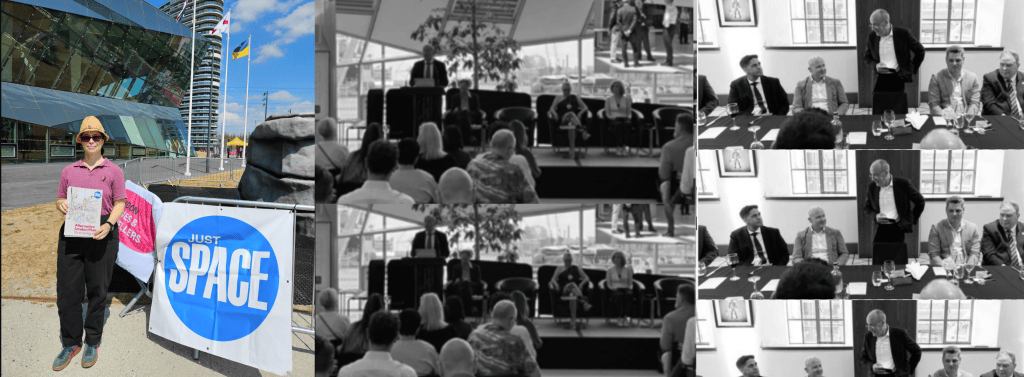
    The event at City Hall was poorly attended, with lots of empty seats, invitations having only gone out a few days before – and by the looks of it, only to the usual suspects: assorted politicians, developers and their agents. Just Space and the London Forum were among the very few community groups in attendance.

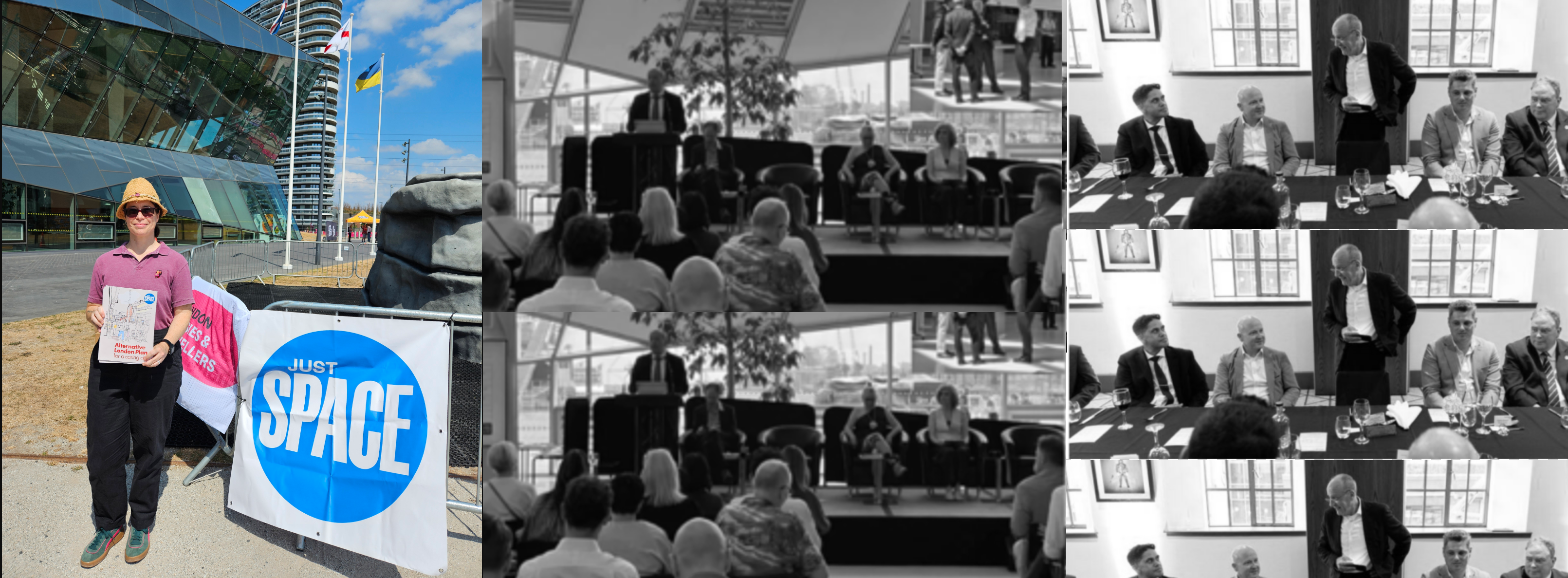
    A handful of Just Space members gathered at very short notice to protest outside City Hall at the exclusive event, giving out copies of our Alternative London Plan for a Caring City to attendees, including Jules Pipe, Deputy Mayor of London responsible for Planning.

    Nothing was handed out once inside, and the event lasted less than an hour… And yet what was being announced was potentially momentous. Londoners are being subjected to either slow strangulation through rising rents and unaffordable house prices, or unbearable stress as they are threatened with estate demolitions, evictions and homelessness. The GLA official figures show that we need about half of all new homes to be social rent – about 27,000 a year for a decade to address the backlog which leaves 90,000 children homeless in the capital.

    The Mayor’s response? More of the same fantasy growth agenda we have been subjected to for 25 years, which has delivered these assorted inhumanities. The Mayor is at least resisting the government’s absurd overall target of 88,000 homes per year – based on voodoo methodology – and is instead setting a target of 56,000 homes annually, based upon a new assessment of need and land availability (the SHLAA and SHMA).

    But this is similar to the current housing target, in a city which has averaged 35,000 new homes in recent decades, and has fallen to around 5,000 in 2025.  Worse, there isn’t even a target for affordable housing or social homes – just the overall proportionate target of 50%. That is because the Mayor continues to rely on the speculative housing model, which has produced a glut of overpriced 1 and 2 bed flats and a criminal shortfall of genuinely affordable housing.

    As the draft Plan admits “Delivering at a rate of circa 56,000 homes a year would mean that London’s affordable housing need is 60 percent of overall supply.

    And even the overall 50% target is officially unachievable, since the Mayor is reducing the proportion required on public land to 40%, and the outer boroughs requirement to just 20%. Only in the inner boroughs is the 35% requirement for ‘Fast Track’ reinstated after the ‘emergency measures’ end in 2028. Jules Pipe added that even these targets would not be achievable if the government didn’t double or even triple the amount of funding for social housing – a direction Burnham has been at least hinting.

    There are additional victims: smaller public open spaces appears to be up for grabs, for example. The Green Belt is expected to deliver 56,000 new homes, and, apart from MOL, current protections enjoyed by all open space are being lifted. Instead only ‘Accessible Green Space’ (AGS) designated in Local Plans would continue to enjoy such protection – appearing to leave vulnerable many small, local spaces essential for amenity, including greenspace on estates, unless the local authority identifies and designates every one.

    A density matrix of sorts is being reintroduced, as Just Space has been advocating for a decade – but it’s called an ‘Optimisation Framework’ and sets minimum densities, not maximums! Mid-rise is being heavily promoted, but a new category of Major Metropolitan tall buildings over 100m encouraged. 17 Opportunity Areas are being de-designated or rationalised, but dozens of new locations are identified for development as broad locations of growth (BLGs), strategic growth corridors, brownfield-first Opportunity Areas (BFOAs) and Environmental Opportunity Areas, as well as 35 Green Belt locations. More industrial land is being forsaken for non-industrial uses.

    But the most worrying failures are sins of omission. Firstly, not once was equalities, inclusion or diversity mentioned in the presentations, and the explicit commitment to these in the very first Good Growth policy to ‘building strong and inclusive communities’ has been unceremoniously dumped.

    Secondly, no significant advance on reducing embodied carbon is proposed. London’s development is a scandalous carbon factory, chucking millions of tonnes of carbon into the atmosphere through the continued over-reliance on concrete, and the wilful demolition of perfectly sound, relatively young buildings which could be repaired and retrofitted. But developers are hooked on selling the new London vernacular of ‘cookie cutter’ flats which are mushrooming everywhere across London, and the Mayor is determined to not stand in their way, instead preferring that London’s climate will eventually emulate a desert.

    What to do? We have less than 13 weeks to stop this manual for the slow death of London’s communities, and our planet’s descent to the everlasting bonfire. We must muster all the argument and energy demonstrated in the production of our Alternative London Plan and join forces with the many communities and agencies across civil society who are, unsurprisingly, largely unaware of this slow motion car crash.

  • A citizens’ plan for London

    A citizens’ plan for London

    We have been silent here for a long time. It must have seemed that City Hall had succeeded in shutting down debate on the next London Plan. See our earlier complaints.

    In fact, though, community groups have been busy, working on an alternative London Plan and will be meeting this Saturday 8 November to make further progress. The new plan is centred on the idea of the Caring City, in many ways the opposite of what we have seen in past plans. Details in events.

    Londoners are impatient for change to response to the multiple crises affecting us: climate change and environmental breakdown, mounting inequality, a catastrophic housing system which is both a symptom and a cause of the inequality and a city which seems to have learned so little from the pandemic. After housing development in London grinds to a halt from falling sales, government and Mayor unite to propose changes to housing and planning which would appease housing developers at everyone else’s expense. And the Mayor’s prospectus Towards a new London Plan seems to be preparing us for a plan in some respects even worse than the previous ones.

    Grassroots pressures are mounting at national and London levels, from private tenants pressing for further reforms on top of the Renters Reform Act, from housing association and council tenants and from leaseholders and tenants trapped by the failure of governments to deal with building safety and tenure issues. At local level two major public inquiries are under way driven by Just Space groups. Communities and traders in the East End are fighting commercial interests at the Truman Brewery in Brick Lane (see also here) and in Peckham there is a major battle between communities and Berkeley Homes who are appealing against the local planning authority refusal of planning permission for their massive over-development of expensive housing at the Aylesham Centre.

    We shall go back to our old habits of posting here more often.

    Meanwhile some bits of news.

    We heard today that Lisa Fairmaner, Head of the London Plan team at City Hall, is leaving (or may already have left) and will be joining Arups. It seems unexpected that someone should leave such a job in the middle of the drafting of the next Plan. Perhaps someone will take over who feels more positive about fostering and contributing to public debate on the big issues facing the capital. We would be delighted to work with them.

    The government’s Index of Multiple Deprivation (IMD) has been modified so that its income component is calculated AFTER payment of housing costs, whereas in the past it has been incomes before housing costs. This should be a great help for the way London is viewed: no longer as just a rich city, but as a city where housing costs are so severe that on average we are struggling while poorer Londoners are in desperate poverty. Central government grants to many boroughs should improve as a result. Guardian article.

  • Is the Mayor restricting our participation?

    Is the Mayor restricting our participation?

    Just Space and many of its member organisations are seriously frustrated by what seem to be reductions in citizens’ role in the formation of the next London Plan. We have today written to Lisa Fairmaner, Head of the London Plan Team at City Hall, as follows:

    16 September 2024

    Dear Lisa,

    Participation in London Plan preparations

                I am writing on behalf of the Just Space network to express our grave concern at what we experience as a narrowing of the scope for community participation in the next London Plan.

                For some years you and Deputy Mayor Jules Pipe have promised that the GLA would produce a document akin to a Statement of Community Involvement. We appreciate that the law which defines and requires an SCI does not apply to the GLA but that the proposed document would cover the same sort of ground. It continues not to appear and in the resulting vacuum we consider that the GLA is reducing the scope of participation and thus undermining the legitimacy of the London Plan.

                We appreciate that over 7000 people have taken part in the ‘Planning for London’  programme and many of us have been part of that process. However that has been a one way traffic: the GLA has harvested ideas from citizens and businesses but with none of the interaction or openness to scrutiny which is an essential feature of valid consultation. Is the Mayor a control freak?

                We also know that you have the open call for submissions and have ourselves submitted our Recovery Plan for London and our Manifesto 2024. Many other organisations and individuals have presumably made submissions but these are all invisible: none of us can see other submissions or even see who has submitted. This contrasts strongly with the proper consultation for Local Plans, or the EiP process, where all consultation responses are online for public access. This one way traffic of ideas further undermines the legitimacy of the Plan and prevents citizens discovering what developers are urging on the Mayor. So much for transparency.

                Last time around, community organisations (ourselves, plus London Tenants Federation and London Forum) were members of the Steering group for the SHLAA/SHMA process, but now you tell us that the SHLAA has become ‘Land4Ldn’, an online interaction with boroughs or ‘a digital SHLAA’. Land4Ldn’s videos suggest that a simplified density matrix is alive and well in calculating housing units per site. A party will input their preferred number of units and height for a site and subject to some constraints it will immediately appear on the SHLAA. It seems a lot of decisions have already been smuggled through in this process and we are shocked not to have been included in any of the thinking behind the system. We can see no way of engaging in it or advising our member organisations. How can the public participate in this new housing site selection by boroughs? The start date for the Land4Ldn call for sites is in fact today, September 16th.  

    Equally for the SHMA. We are relieved by your statement to Pat Turnbull “irrespective of what the headline need figure is, a SHMA is necessary to understand the breakdown of that housing need.” But your statement needs to be fleshed out in scoping the study so that the central issues of affordability relative to the income distribution and family/dwelling size issues are adequately dealt with. London’s failure to produce the dwelling stock its people need is the biggest failure of London Plans to date. The exclusion of us all from these deliberations is another outrage.

    We are equally concerned about the scoping and execution of the IIA and the performance of the Public Sector Equality Duty in particular. The draft Plan can run into difficulties during examination if these processes are inadequate: your predecessors had to go back and re-work the Equality Impact reporting in two successive rounds after community groups persuaded the 2019 Panel that the original work was inadequate. It is really important that the GLA gets it right this time.

    Our concerns in all this are grave and we shall share them widely in the hope that you will agree to rethink your approach. Should we have a meeting?

    Yours sincerely,…

    Copied to: Assembly Planning Committee, All Party Parliamentary Group London, London Forum of Civic and Amenity Societies, London Tenants Federation, London Housing Panel, Deputy Mayors for Housing and Planning. Please copy it widely and to your members.

    Download a copy of this letter

  • End of year wrap December 2023

    End of year wrap December 2023

    rLogo
    Welcome to the second newsletter from Just Space. We aim to keep you updated about what’s going on across the network and share news and stories contributed by you
    Download a PDF version of the mind map which is high resolution and truly legible.
    FROM GATHERING TO CONFERENCE
    November’s Just Space gathering developed the Recovery Plan conversation about housing, land ownership, high streets and markets, the climate emergency, community audits, tall buildings, and putting communities first – a mindmap of the event is above.
    To get a better London Plan that serves communities we need to home in on the issues developed at the gathering and propose planning policy which enhances London life rather than tramples over it.  

    We will be continuing our conversation in the coming months in preparation for a Just Space conference on Saturday 2nd March where we will invite politicians and planners to hear our proposals for the next London Plan. GLA ‘Planning for London’The first task has been responding to the questions raised by the GLA at their autumn events. They want to know which London Plan policies are working and how they are failing or could be improved. The topics have included affordable housing, climate change and biodiversity, inclusive design, tall buildings, industrial land, offices, high streets and affordable workspace, infrastructure and utilities (follow the link for the questions/your response).
    They are accepting written responses up to 31st December, and you can answer directly to the questions or email planningforlondonprogramme@london.gov.uk  or work collaboratively with other Just Space members.  
    However you contribute, please send your comments to Michael-JustSpace@outlook.com – I will be collating all responses received on New Year’s Eve…  

    Community Planning Alliance: Community-led Health Impact Assessments for PlanningThe national Community Planning Alliance have an article about the Community Health Impact Assessment peer-to-peer learning programme, starting in the new year.
    The project is the creation of The Urban Health Council  https://www.urbanhealthcouncil.com/programs/chiat which is operated by the Centric Lab https://www.thecentriclab.com/about-us . Perhaps as an oversimplification, the Urban Health Council is public facing and engaging, whilst the Centric Lab is more research focused although in a very people orientated way. 

    Health Impact Assessments (HIAs) should be more powerful with community voices shaping planning based on health needs. Existing legislation and guidance ‘advise’ on it, but the industry has skewed things to their advantage. The Community Health Impact Assessment peer-to-peer learning programme is for people and groups who feel the same and want to improve planning conditions and the behaviours of development stakeholders in their local areas.
    The project starts 24th January 2024 for 8 evening sessions – ideal for Tenants and Residents Associations, Community Land Trusts, Neighbourhood Forums. Up to £2000 can be awarded to participants who want to develop an HIA using the toolkit with their respective community groups. Sign up online at  www.urbanhealthcouncil.com/programs/chiat

    Consultation on Digital Connectivity Infrastructure guidance
    The GLA is consulting on London Plan Guidance to support Policy SI 6 of the London Plan. The DCI guidance aims to improve digital connectivity infrastructure provision across London through the planning system, so that everyone can have the appropriate digital access where they live or work.
    The GLA are currently out for public consultation until 11th January.
    They have asked our member Hear Equality and Human Rights Network to encourage you to review the draft guidance, which can be found on the dedicated consultation page https://consult.london.gov.uk/digital-connectivity-infrastucture-guidance. _______________________________________________Where’s Richard Lee? Gone to Fairville…   Just Space is partner to a European research project called Fairville.  A project of Horizon Europe, the EU’s key funding programme for research and innovation, Fairville includes 8 cities: Brussels, Marseille, Berlin, London, Calarasi (Romania), West Attica region (Greece), Giza (Egypt), Dakar (Senegal).         A Fairville Lab in each city will gather community knowledge, pilot different participatory methods, co-produce local policies and plans and create a sustainable network of local communities. Read more here   For further information about Fairville, contact Richard Lee:  richardlee50@gmail.com

    please send your news to Michael Ball, Just Space co-ordinator Michael-JustSpace@outlook.comLogoCopyright (C) Just Space 2023. All rights reserved.

    Our mailing address is:
    Michael-JustSpace@outlook.com
    This page was corrected on 27/12/23 to make it clear that the CPA has written about the Health Impact Assessment project but that the origination is by other organisations.

    checked M E 26 july 2025