Just Space and many of its member organisations are seriously frustrated by what seem to be reductions in citizens’ role in the formation of the next London Plan. We have today written to Lisa Fairmaner, Head of the London Plan Team at City Hall, as follows:
16 September 2024
Dear Lisa,
Participation in London Plan preparations
I am writing on behalf of the Just Space network to express our grave concern at what we experience as a narrowing of the scope for community participation in the next London Plan.
For some years you and Deputy Mayor Jules Pipe have promised that the GLA would produce a document akin to a Statement of Community Involvement. We appreciate that the law which defines and requires an SCI does not apply to the GLA but that the proposed document would cover the same sort of ground. It continues not to appear and in the resulting vacuum we consider that the GLA is reducing the scope of participation and thus undermining the legitimacy of the London Plan.
We appreciate that over 7000 people have taken part in the ‘Planning for London’ programme and many of us have been part of that process. However that has been a one way traffic: the GLA has harvested ideas from citizens and businesses but with none of the interaction or openness to scrutiny which is an essential feature of valid consultation. Is the Mayor a control freak?
We also know that you have the open call for submissions and have ourselves submitted our Recovery Plan for London and our Manifesto 2024. Many other organisations and individuals have presumably made submissions but these are all invisible: none of us can see other submissions or even see who has submitted. This contrasts strongly with the proper consultation for Local Plans, or the EiP process, where all consultation responses are online for public access. This one way traffic of ideas further undermines the legitimacy of the Plan and prevents citizens discovering what developers are urging on the Mayor. So much for transparency.
Last time around, community organisations (ourselves, plus London Tenants Federation and London Forum) were members of the Steering group for the SHLAA/SHMA process, but now you tell us that the SHLAA has become ‘Land4Ldn’, an online interaction with boroughs or ‘a digital SHLAA’. Land4Ldn’s videos suggest that a simplified density matrix is alive and well in calculating housing units per site. A party will input their preferred number of units and height for a site and subject to some constraints it will immediately appear on the SHLAA. It seems a lot of decisions have already been smuggled through in this process and we are shocked not to have been included in any of the thinking behind the system. We can see no way of engaging in it or advising our member organisations. How can the public participate in this new housing site selection by boroughs? The start date for the Land4Ldn call for sites is in fact today, September 16th.
Equally for the SHMA. We are relieved by your statement to Pat Turnbull “irrespective of what the headline need figure is, a SHMA is necessary to understand the breakdown of that housing need.” But your statement needs to be fleshed out in scoping the study so that the central issues of affordability relative to the income distribution and family/dwelling size issues are adequately dealt with. London’s failure to produce the dwelling stock its people need is the biggest failure of London Plans to date. The exclusion of us all from these deliberations is another outrage.
We are equally concerned about the scoping and execution of the IIA and the performance of the Public Sector Equality Duty in particular. The draft Plan can run into difficulties during examination if these processes are inadequate: your predecessors had to go back and re-work the Equality Impact reporting in two successive rounds after community groups persuaded the 2019 Panel that the original work was inadequate. It is really important that the GLA gets it right this time.
Our concerns in all this are grave and we shall share them widely in the hope that you will agree to rethink your approach. Should we have a meeting?
Yours sincerely,…
Copied to: Assembly Planning Committee, All Party Parliamentary Group London, London Forum of Civic and Amenity Societies, London Tenants Federation, London Housing Panel, Deputy Mayors for Housing and Planning. Please copy it widely and to your members.
This is a working document, through which we are reflecting on how Just Space can operate the principles of consensus decision-making.
1. Decisions about London Plan activity – the core activity of the Just Space planning network – will only occur at general meetings.
2. Full and detailed information about the matter for decision will be distributed to Just Space members at least 1 week prior to the meeting.
3. If members are not able to attend meetings, they may wish to make written comments which will be added to the discussion and considered within the context of consensus decision-making.
4. We will seek to achieve consensus by taking time to hear everyone’s opinions and concerns. We will acknowledge when member representatives need more time to considerissues and /or need to take issues back to their own membership.
5. Where it is clear that there is no consensus, we will seek to amend positions or proposals, possibly carry out any further evidence gathering that may be needed to help decision-making and/ or come back at a later date to discuss further. Circumstances may change.
6. It may be that a consensus cannot be reached. However, individual members should not feel that they cannot take issues forwards under their own steam and using their own evidence or data, or with any other groups.
7. Non-members * may be formally invited to attend the meeting to contribute on a specific item, and otherwise to observe. They should not take part in the decision making.
8. Where a member group is represented by more than 1 person, the expectation is that they will have a common position on the matter that is for decision.
9. Where a member or non-member acts in a way that is not conducive to reaching a consensus decision, they will be asked to leave the meeting. The code of conduct for Just Space meetings is set out below.
10. We will ensure that members and invited non-members are fully informed of this policy.
Conduct
To be considerate and respectful and to not personalise issues
To recognise that everybody is entitled to express their point of view
To respect different roles and boundaries and avoid giving offence
To declare any interest or activities which may conflict with their role at the meeting
*The Just Space constitution refers to observers being able to attend network meetings, but when we invite people who are non members it is usually to contribute and not just observe.
JustSpace and CPRE_London have today written to the Secretary of State, Angela Rayner and the Mayor of London, Sadiq Khan, pressing for urgent action on 3 fronts as the new government’s housing policies are shaped:
1. The Mayor of London has fewer powers than any other leader of a major city in the Western world. There is a range of devolved powers which the strategic authority needs to address its unique problems, including the regulation of the rapidly growing private rented sector in terms of rents, conditions and evictions. The Mayor also needs the flexibility to direct government housing grant towards the highest need, which is for genuinely affordable housing in the form of social rented homes. The particular conditions specific to London also need the Mayor to have power to suspend or end the Right to Buy, which continues to erode the social stock and discourage councils from adding new council homes. The necessary devolution of powers could be enacted relatively speedily, while we await provisions in the proposed Housing Bill coming into force.
2. The proposed Housing and Infrastructure Bill needs to address urgently the ongoing scandal of s21 ‘no fault’ evictions as well as provide other basic renters’ rights, standards and controls. It also needs provisions to address the growing abuse of homes being kept deliberately vacant, which currently stands at over one million across the UK . It needs powers to address over one million housing permissions which have not been built out (particularly those where implementation has been technically triggered through the expedient of digging a trench): a so-called ‘Use it or Lose it’ approach to planning permissions. And, as part of resolving the crisis in local government finance, the Bill needs to address the absurdity of the average householder in Oldham paying more in council tax than the residents of Buckingham Palace.
3. We understand that the Mayor is likely to instigate a full review of the London Plan later this year, and would strongly urge that communities traditionally excluded from the process of developing the strategic housing needs assessment and strategic housing land assessment are fully engaged from the outset.
We look forward to working together to resolve the housing crisis
Just Space takes the lead in building support for this Housing Charter with CPRE London and further support from Renters’ Rights London, Action on Empty Homes…. More organisations have been invited to sign up and if your organisation would like to join in, please make contact
The Centre for London held a housing conference (“summit”) which we attended. It was almost entirely dominated by speakers for the status quo. A report by our coordinator is here.
As an informal alliance, Just Space hosts regular meetings, workshops and conferences to share ideas and news about campaigns, and to develop alternative policy.
* We produce publications – the Alternative London Plan for a caring city is the latest.
* We encourage participation in planning consultations, planning inquiries and conferences.
* We give presentations
* We work with local groups on issues such as Local Plans, specific policy development or long-term strategic planning.
* We work with student volunteers and academics on projects of benefit to community groups as well as to student learning.
We are only as strong as our members. Every community has knowledge – share yours and keep in touch by contacting us.
ALTERNATIVE LONDON PLAN FOR A CARING CITY: Just Space groups collaborated on this, published April 2026, driven by the need for a different approach to London’s development. See the Alternative Plan page . Make your own comments as the document is further developed online.
Just Space runs or takes part in a lot of project work, based around helping community groups to make their own plans or contribute meaningfully to Local Plans, and other research work. Some current projects include working with tenant’s groups on planning issues for estates under threat of demolition/’regeneration’, in collaboration with the EstateWatch project (see below).
We are also working with students and communities on: — New approaches to greening the public realm after LTNs and traffic calming is implemented — A project comparing different borough approaches to tall buildings — A project protecting central London’s wholesale food markets (Billingsgate and Smithfield) — An investigation into the urgent need for planning policy on data centres — A project around traditional street retail markets — A project to gather historical community knowledge.
Estate Watch provides help and guidance to residents living on estates listed for demolition. The Estate Watch website – https://estatewatch.london/about/ – is maintained as an open-source project and is being kept up to date by voluntary contributors via its Github interface. The website was developed as a resource for communities on estates facing regeneration, to know their rights and to ensure that tenants and residents’ choices will be respected. The intention is to monitor each scheme as it progresses and make space for residents to add updated information about their estate in real time. This can be a precious tool to hold Councils across London and the Mayor to account and make sure that future regeneration schemes benefit existing local communities.
The project was kickstarted in 2020 by Just Space and The London Tenants Federation working together with the University of Leicester and King’s College London on a research project that has provided detailed evidence since 1997 of the displacement of London council tenants and leaseholders through regeneration schemes. We have recently re-energised the project with a grant from Trust for London and updates gathered by students in the UCL Bartlett Knowledge Exhange..
Recent projects:
Thames Life Community Development Trust in Barking Riverside (within LB Barking & Dagenham) is being supported by Just Space which has provided advice on the new Thames Road Vision and Design Code, a critique of the GLA/Barking and Dagenham Opportunity Area Planning Framework, together with various presentations to public meetings.
Grand Union Alliance –https://grandunionalliance.wixsite.com/grandunionallianceance – is a community network from in and around Old Oak & Park Royal connecting resident, business and community groups from Hammersmith and Fulham, Ealing, Brent and Kensington and Chelsea. It is focused on influencing plans for large scale development by the Mayoral Development Corporation OPDC so that they will sustain and enhance existing communities and neighbourhoods. Currently supported by Just Space following the end of grant funding from a UCL international research project.
Fairville is a European collaboration funded by the EU and the UK which enables Just Space and London communities to take part. This contributes to our policy development on tackling poverty and inequality through the caring city, co-production. Details of the whole collaboration are at https://www.fairville-eu.org. Just Space enabled the Fairville (London Lab) to transition into an autonomous body as a Community Interest Company.
This version has a minor correction to one organisation’s name and supersedes the version posted a few hours earlier.
London is booming. London is bursting. London is breaking.
Things are not OK. We’re not building the things Londoners need. London’s development is driven by financial interests and hot money. London is a carbon factory.
2024 sees elections for the London Mayor, the London Assembly and national government. But much of what is promised is more of the same.This is our chance for change.
The Just Space Manifesto will be a key tool in spreading grassroots knowledge – learnt the hard way – about how to plan for a better, fairer, caring city.
This manifesto has been prepared by many Just Space groups in working parties since our March conference. Supporting documents from that conference and today’s event are here,
r Welcome to the second newsletter from Just Space. We aim to keep you updated about what’s going on across the network and share news and stories contributed by you Download a PDF version of the mind map which is high resolution and truly legible. FROM GATHERING TO CONFERENCE November’s Just Space gathering developed the Recovery Plan conversation about housing, land ownership, high streets and markets, the climate emergency, community audits, tall buildings, and putting communities first – a mindmap of the event is above. To get a better London Plan that serves communities we need to home in on the issues developed at the gathering and propose planning policy which enhances London life rather than tramples over it.
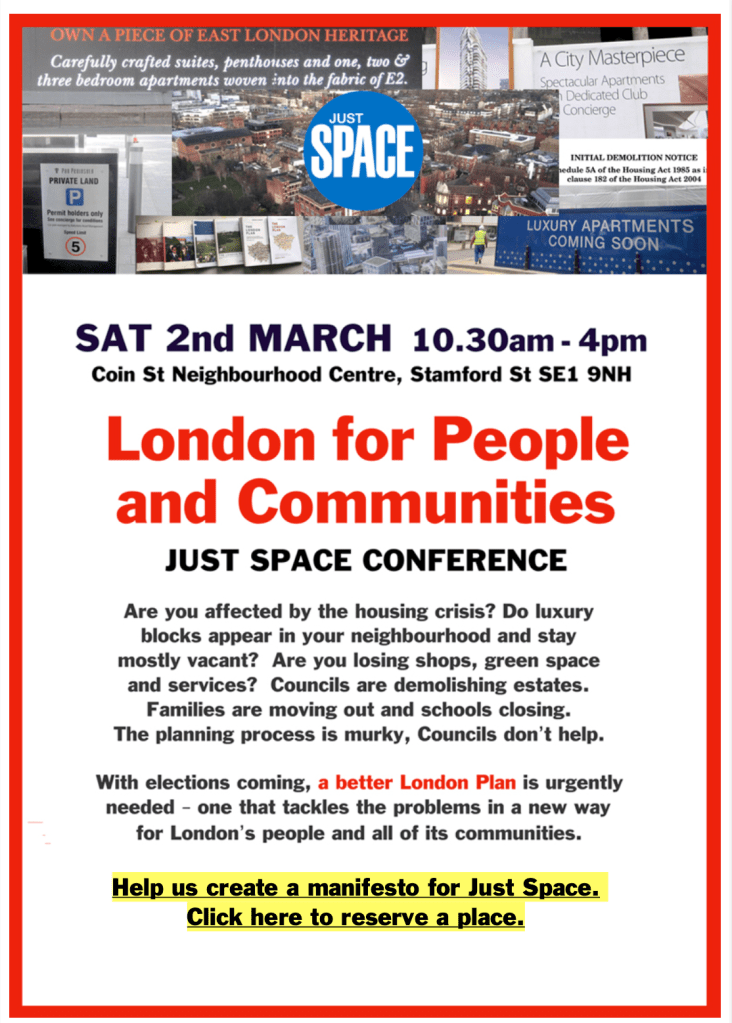
We will be continuing our conversation in the coming months in preparation for a Just Space conference on Saturday 2nd March where we will invite politicians and planners to hear our proposals for the next London Plan. GLA ‘Planning for London’The first task has been responding to the questions raised by the GLA at their autumn events. They want to know which London Plan policies are working and how they are failing or could be improved. The topics have included affordable housing, climate change and biodiversity, inclusive design, tall buildings, industrial land, offices, high streets and affordable workspace, infrastructure and utilities (follow the link for the questions/your response). They are accepting written responses up to 31st December, and you can answer directly to the questions or email planningforlondonprogramme@london.gov.uk or work collaboratively with other Just Space members. However you contribute, please send your comments to Michael-JustSpace@outlook.com – I will be collating all responses received on New Year’s Eve…
Health Impact Assessments (HIAs) should be more powerful with community voices shaping planning based on health needs. Existing legislation and guidance ‘advise’ on it, but the industry has skewed things to their advantage. The Community Health Impact Assessment peer-to-peer learning programme is for people and groups who feel the same and want to improve planning conditions and the behaviours of development stakeholders in their local areas. The project starts 24th January 2024 for 8 evening sessions – ideal for Tenants and Residents Associations, Community Land Trusts, Neighbourhood Forums. Up to £2000 can be awarded to participants who want to develop an HIA using the toolkit with their respective community groups. Sign up online at www.urbanhealthcouncil.com/programs/chiat
Consultation on Digital Connectivity Infrastructure guidance The GLA is consulting on London Plan Guidance to support Policy SI 6 of the London Plan. The DCI guidance aims to improve digital connectivity infrastructure provision across London through the planning system, so that everyone can have the appropriate digital access where they live or work. The GLA are currently out for public consultation until 11th January. They have asked our member Hear Equality and Human Rights Network to encourage you to review the draft guidance, which can be found on the dedicated consultation page https://consult.london.gov.uk/digital-connectivity-infrastucture-guidance. _______________________________________________Where’s Richard Lee? Gone to Fairville…Just Space is partner to a European research project called Fairville. A project of Horizon Europe, the EU’s key funding programme for research and innovation, Fairville includes 8 cities: Brussels, Marseille, Berlin, London, Calarasi (Romania), West Attica region (Greece), Giza (Egypt), Dakar (Senegal).A Fairville Lab in each city will gather community knowledge, pilot different participatory methods, co-produce local policies and plans and create a sustainable network of local communities. Read more here For further information about Fairville, contact Richard Lee: richardlee50@gmail.com
please send your news to Michael Ball, Just Space co-ordinator Michael-JustSpace@outlook.comCopyright (C) Just Space 2023. All rights reserved.
Our mailing address is: Michael-JustSpace@outlook.com This page was corrected on 27/12/23 to make it clear that the CPA has written about the Health Impact Assessment project but that the origination is by other organisations.
UCL’s prof Pablo Sendra has published an article on how the tricky term co-design should properly be defined and used. He writes “There is a lack of definition in policy of the term co-design, and yet local authorities and developers are increasingly using it. To avoid this term becoming meaningless, it is essential to define how to run co-design processes ethically. Building on case studies, professional experience, collaborations with communities in Just Space and elsewhere, and a Participatory Action Research approach, this paper defines a set of principles on how to run a co-design process ethically and genuinely including communities in decision-making. Departing from the legal Principles for Fair Consultation in England and Wales, the paper expands them and results into ten ethical principles for co-design.





 FROM GATHERING TO CONFERENCE
 The national Community Planning Alliance have an article about the Community Health Impact Assessment peer-to-peer learning programme, starting in the new year.
  Where’s Richard Lee? Gone to Fairville… Just Space is partner to a European research project called Fairville. A project of Horizon Europe, the EU’s key funding programme for research and innovation, Fairville includes 8 cities: Brussels, Marseille, Berlin, London, Calarasi (Romania), West Attica region (Greece), Giza (Egypt), Dakar (Senegal). A Fairville Lab in each city will gather community knowledge, pilot different participatory methods, co-produce local policies and plans and create a sustainable network of local communities.
  Copyright (C) Just Space 2023. All rights reserved.