Warning: Just Space and UCL are trying to make available some sort of record of what happens in the EiP for the benefit of community members. Notes are being taken by students and checked/edited so far as possible by more experienced staff and others. Neither Just Space nor UCL offers any guarantee of the accuracy of these notes. If you wish to depend on what was said at the EiP you should check with the speaker or with the audio recordings being made by the GLA. If you spot mistakes in these notes please help us to correct them by emailing m.edwards at ucl.ac.uk
Delivering good design
Note: Un-rehearsed alliance between Just Space, Footwork architects and NHS.
GLA:
GLA: Policy D1 sets out extensive criteria; focused mainly on physical attributes of design. Physical as well as experience; safe, inclusive —what design leads to in terms of what you experience in environment. Drawing on work of Jan Gehl— how you experience urban environment – how does the human interact with the city. Number of factors that combine to make experience. Physical leads to experience.
Defend that policy is London-shaping.
London Tenants Federation
Question/concern in references of ‘character’… it’s not just about design, its about social content, what kind of communities live there, what is their economic status. Has huge impact.
Expressed concern of Harlesden residents with huge development coming to Old Oak Park Royal opportunity area. How does this design policy shape or form to protect that kind of existing community?
London Forum
D1/2: These aren’t policies they are process/procedures better dealt with in guidance, however problem with that as they then aren’t scrutinized.
Very worried about democratic deficit, lack of openness/transparency and community engagement as negotiated in private between LAs and developers etc – community only get to see the output of this, don’t get to see input.
Community want greater transparency and say over future of development
In a city for all Londoners, Mayor wants communities to feel comfortable with nature and scale of development…however there is a MISMATCH of mayor’s aspirations with what we have here —which is a technician document!
Worried that D1/D2 cut people out process.
CPRE:
Welcome changes made to draft on local distinctiveness and welcome given comments regarding human-centred approach outlined by GLA of Jan Gehl approach..… however they ARE NOT FOLLOWED THROUGH IN D1/D2. There is huge gap between that spirit and way which policy is expressed here.
Particular concern way in which plan as a whole is silent around NIEGHBOURHOOD planning approaches to resolving tensions. In order to understand local distinctiveness, would Like to see communities encouraged to go down neighbourhood planning route.
London is made up from a number of villages… we don’t want London Plan to lead us down road to change/development in London that is uniform, ‘anywhere places’ which leech distinctiveness away from London. This can be overcome by engaging communities more proactively.
Just Space
D1B needs to demonstrate the community engagement process undertaken at appropriate time and how it influences the design.
Instead of using social indices of multiple deprivation as a headline, our idea is to have this mechanism of social impact assessmentto find out which of these assets are important to people, which directly relates to what is designed and planned there.
Footwork architects:
Define good design in policy?
Agree with Just Space and others that emphasis on this policy informing area planning is important in that it’s an understanding of the social contextof places before a red line appears around a site that then informs quality of development proposals put forward.
In the mayor’s introduction, he defines good growth and acknowledges that there is social process to design.
Design can’t claim to be good If doesn’t acknowledge local context or people’s needs, wishes and what people value in a place. Then can act on this in how an area can be protected and enhanced.
Need to define mechanisms for understanding local character and social context prior to development, need a proper assessment and early intervention and a requirement to act on this information
Need to show an understanding of likely social impact of development
Promoting inclusivity requires an understanding of existing social makeup and what well-integrated communities are in order to avoid displacement of existing communities and businesses.
To avoid formless places? Acknowledge SOCIAL HERITAGE alongside built heritage, reference to local identity as to what makes each place unique.
HBF:
GLA has said LP is a different type of document from local plans and therefore NPPF 2012 doesn’t necessarily apply, which we take issue with! As it has been our understanding throughout that the soundness of LP is assessed against NPPF…
GLA shouldn’t get away with ‘cherry picking’s what it gets away with
D2 We have an issue with as it is wordy and difficult for applicants to interpret and navigate and comply with. REMOVE D2 as we think design matters are better addressed at local levels
London NHS
What is missing is what contribution design makes to social interactions, well-being and health.
no mention of impact on people’s lives and communities’ health and wellbeing in policy design.
City of London Corporation:
Good design is not always about aesthetics
It’s how people feel welcomed irrespective of economic position
Way designs are translated to public and we welcome concept of 3D virtual reality – to engage Londoners in understanding design proposals
Inclusion London:
D1: need fully funded access panel with people who understand things for large development and local developments – inclusive expertise. Access and inclusion panels and forums to check over development again and again;
Need to challenge assumptions and habits. Rethink and revisit
Inclusion actions aren’t referenced throughout
Friends of the Earth
Agree with above that D1: missing crucial elements such as environmental sustainability
Need to acknowledge that London characteristics is not just about heritage features but of public spaces/squares and green cover.
GLA response:
Feel that exclusion of communities from process/democratic deficit is dealt with in D2. Also view that issue of local distinctiveness and requirement for London boroughs to do something with initial evaluation and use this to inform policy is dealt with in D2.
Plan must be read as a whole!
RESPONSE TO GLA
Impact on mental health is major failing!! (NHS London)
Need to have further clause specifically relating to engagement and collaboration (footwork architects)
The (profit) numbers are going to continually trump everything else (in reference to HBF), and public participation will be seen as block not benefit. We need to put something in plan where we stop just using the numbers. Where is the limit? (Just space)
Plan needs direct reference to how community engagement can be useful in process, (CPRE)
D1/2 are NOT London specific. We Agree with HBF that these aren’t policies. Tokenistic additions are not going to solve fundamental problem. (London Forum).
Concern over capacity of LBs to undertake the work, with lack of resources and skills in place making. Since 2014 mayor undertaken surveys to see what place-shaping capacity they have; results are revealing over 1/3rdlack confidence in place-making skills and large % difficulty in retaining their place-making staff (London Assembly Planning Committee)
**BREAK**
NHS:
Concerned by the focus on appearance OVER impact and outcome on community using it
In reference to analytical tools, which are visual and environmental, we propose including HEALTH IMPACT ASSESSMENT IN THERE.
London First:
Support use of master plan, design code and review where appropriate
Footwork architects:
THERE’S a WIDESPREAD VIEW that retaining the initial design team is important
Protection of design integrity is something that has been compromised particularly on major schemes.
Design review is important process as it ensures development proposals deliver on their promises. Communities often feel disenfranchised and that their power to influence schemes is limited. Good design review according to guideline can ensure that these social requirements are adhered to or at least respected in process
Just Space:
Local input is important. Going outside borough in this policy, there isn’t place for the local consultation results.
Best way this can work: if applicant brings consultation results that have already happened to the design review so people know what the local feeling is.
Local consultation comments should be introduced to benefit design review
London Forum:
Securing initial design team involvement could be required
“Design code” – needs explanation
Just Space:
Master planning ought to have consultation component in it
Do not agree with 150 M policy over there in City of London – far too high – more City of London buildings should come to the mayor
POLICY D3: INCLUSIVE APPROACH
GLA:
Is it necessary? Principles are embedded in plan to remove barriers to inclusion, it is necessary to ensure that focus continues. Include as many Londoners as possible.
Design council:
Inclusive approach positive
Well expressed
HBF:
High standards of inclusive design is vague – applicant wouldn’t know or decision maker know how to respond to that. ‘highest standards’ is too vague.
Footwork:
Inclusive design is defined in such a narrow way!!!
Only reference to physical barriers NOT SOCIAL BARRIERS !!!
Social accessibility needs to be cleared up
Just space:
Build on/ amplify what Footwork Architects said (without prior collaboration).
Create inclusive communities; Age friendly cities/communities.
Design for aging population is a life course approach. To support aging population you need social cohesion to avoid inter-generational conflict and to facilitate downward and upward transfer of resources and knowledge between people in different age groups.
Needs of young, excluded groups, families – all need to be included.
If just talking about physical barriers – when we think about the lifts in A3: those also with cognitive and sensory impairment – who could have issue exiting in emergency
Community engagement: resourcing issue. Find it hard to reach groups with valuable voices such as; LGBT, older generation and minority groups. Reaching those has to be done through voluntary organisations who often have the capacity, contacts and knowledge but can’t respond effectively without resources.
London Forum:
Support policy but seek changes
British standards institution 2005: define inclusive design with regard to access to services and in design policies there is not enough emphasis on this. There are barriers to access to services as well as points that people want to meet!
Proposed that more emphasis on walkable communities and maintenanceof those walkable neighbourhood.
NHS London:
Inclusive design in terms of social aspects addressed
As GLA say it’s focused on physical barriers
Suggestion: inclusive design statements and the fact that there’s no requirement of master plans and design codes to embed and document inclusive design at policy level
reference to British standards by London Forum: they’re broader then physical aspects , also touch on neuro-diverse individuals and their experience. Broader aspect bringing the social is important!!
Glossary importance: no mis match between this and policies.
Friend of the Earth
Policy doesn’t fully reflect the internal access of buildings. Often, buildings call themselves accessible but internally have no accessible toilets etc
Reference to refurbishment – existing buildings are often hopeless – so many places that doesn’t bother with physical access anymore – how we can make London more accessible in the physical sense? Policy needs to refer to refurbishment as well as new building, especially for shopps and town centre uses – and even where planning permission not required.
Assembly planning committee:
Support need for broader definition in policy, not just access issues.
GLA:
Mis match between inclusive design between glossary and use in policy.
D3: DOESN’T touch on social and attitudes to design.
DESIGN FOR THE MIND********* should COVER PEOPLE NEuRO-DIVERSE CONDITIONS
Moved on from lifetime neighbourhoods to inclusive neighbourhoods
Warning: Just Space and UCL are trying to make available some sort of record of what happens in the EiP for the benefit of community members. Notes are being taken by students and checked/edited so far as possible by more experienced staff and others. Neither Just Space nor UCL offers any guarantee of the accuracy of these notes. If you wish to depend on what was said at the EiP you should check with the speaker or with the audio recordings being made by the GLA. If you spot mistakes in these notes please help us to correct them by emailing m.edwards at ucl.ac.uk
This is a rough draft posting with many corrections still to come (1 March)
London Plan EiP Other housing matters. 01/03/2019
Size mix M28.
Panel questions: Would Policy H12 provide a justified and effective approach to achieving the dwelling size mix to meet London wide and local needs? In particular:
a) Does the dwelling size and mix identified in the 2017 SHMA provide a robust and realistic assessment of London wide needs?
b) Would policy H12 provide an effective and justified strategic framework to deliver the mix of homes needed? What is the justification for preventing boroughs from setting prescriptive dwelling size mix requirements for market and intermediate homes and would this approach be effective? Would it provide sufficient flexibility to meet local needs? In light of this and the need to optimise density would it make a sufficient contribution towards family homes?
c) Overall, would it meet the objective of Policy GG4 to deliver the homes Londoners need?
Assembly Planning Committee SHMAA. Table 1 is based on an entirely hypothetical scenario. This is contrary to paragraph 3. Table 1 means that all rooms are occupied. That means that if someone has a spare room, it means there is someone else lacking a room. Table 1 is a scenario that is not going to happen. You can’t direct people to scenario in table 1.
You have many scenarios and you need to have a single scenario that is evidence-based. The plan needs to provide this scenario.
Assembly Conservative Group Shortage of family size properties. The Mayor can take different approaches to address that. The planning system, the housing strategy. There are no incentives in the planning system nor in the housing strategy to build family size housing. There should be funding for this.
Problem overcrowding. Even if you address the issue of under-occupation, you will still have a problem of overcrowding.
London Tenants Federation (LTF) If you don’t have a degree of prescription, properties of 3 and 4 bedrooms will be squeezed out.
A low provision of market family size housing will put even more pressure into social family size housing.
The bias should be towards more family-size social housing.
Assembly Planning Committee Importance of London Living Rent for nurses, teachers, junior doctors, etc. Many of these need to go out of London to find anywhere they can afford.
Family housing is the most flexible form of housing and it suits London’s need.
Inspector to GLA: What evidence you have on size mix?
Mayor’s team We are not presenting a criteria based policy.
Inspector What evidence you have for those policies.
Mayor’s team (?) She is talking about the referable applications ??
Inspector
Disadvantages of small units and advantages of family homes.
Does this policy ensure that enough family homes are built?
Mayor’s team
Developers will build what is more profitable.
Many of the family homes are not occupied by families, they are occupied by sharers. The need is an affordability issue here. We say that these family homes should be build where they are more affordable.
Inspector
Concern: there are 3 scenarios embodied in the three versions of the table. The last one is the only one that is evidence based.
Removing the table from the London Plan seems to be welcomed, but it needs to be replaced by one scenario.
Mayor’s team
We have tried to be as transparent as possible on how we have arrived to each of these scenarios.
The problem with the local evidence is that is not that transparent.
There is a need for better guidance from the government on this.
They suggest an SPG that will bring the evidence to the area-wise size mix target.
Inspector
Anything else you would like to respond to?
Mayor’s team
There is an issue about very large units being delivered. Paragraph 3.4.3 to resist those too large dwellings.
If there is a requirement to build homes that are not highly demanded by the market, this will slow development. This is why we believe there should be no prescriptions.
London Forum
? missing bt
Just Space
Horrified by the push to build smaller and smaller units. People cannot have children and it’s being assumed that they won’t.
Planning needs to accord to the reality that many people do have children.
Inspector: Request for a more positive policy that sets criteria for the local authorities.
Mayor’s team: We feel we have that criteria in policy H12.
LA Planning Committee
SPG: It is important that it is evidence-based.
LTF
It is not acceptable to say we cannot provide family size housing because it costs a lot if this is what people need.
Levitt Bernstein
Requirements for particular ethnicities should be taken into account.
Vacant Building Credit
Panel Question: M25. Would Policy H9 be consistent with national policy? Is the approach taken justified?
Inspector; What evidence do you have that brownfield land will come for development anyway?
Mayor’s team: This is what we have seen.
Clarify the circumstances in which the credit should be used (Vacant building credit). The purpose of this clarification is that it will be difficult to falsify vacancy to benefit from the credit.
Inspector: Expand on the point that it is in accordance with government policy
Mayor’s team: (didn’t get what she said)
Inspector: Some people say it should be a matter for London boroughs to expand. Respond to that.
Mayor’s team: There is a huge need on affordable housing across London. The London Plan needs to tackle that. Leaving it to local authorities would be to risky since the affordable housing needed might not be delivered.
Home Builders Federation
We haven’t heard about the incentive to deliver more homes. So more sites come forward.
NHS property:Benefits to the VBC that has been overlooked. It might incentivise building in brownfield land rather than on green belt.
NHS have a number of vacant buildings that could benefit from VBC. Many of them listed building. Listed buildings should be prioritised through additional text.
The proposed 50% affordable housing puts a lot of burden on the NHS sites. If VBC is brought forward, NHS property should be exempt if they can demonstrate strategic enabling…
Inspector
Asks the Mayor about whether a reverse policy would have been more effective.
Mayor’s team
They don’t agree that overall housing need and affordable housing need are two separate things.
VBC is very rarely if at all applied in London. That is because the viability tested route does its job.
Redevelopment of Housing and Estate Regeneration Panel questions: M26. Would Policy H10 provide a justified and effective approach to the redevelopment of existing housing and estate regeneration? In particular, would the approach to affordable housing be justified? In light of Policy H5, would the requirements be clear? In the context of local need and objectives for redevelopment or estate renewal, would it be effective? What is the justification for provision of affordable housing floorspace rather than units? Would it provide sufficient flexibility to reflect local circumstances and support housing and estate regeneration? Overall, would the approach taken meet the objective of Policy GG4 in delivering the homes Londoners need?
Inspector
What happens when there is a potential loss of housing.
It says that it should be replaced with at least the same floor space overall.
All should go through the viability tested route.
I would like to ask on something on what LA Green Group (Sian Berry) said.
Mayor’s team
4.6.14 Estate regeneration is not covered by the policy.
And it is reiterated saying it does not going through viability route.
It is controversial in London and it is best that it is out in the public.
Incompatibility with delivering the number of new affordable housing.
Still Mayor’s team?It should be replaced with the same quality, with the same floor space of low cost rent.
When social rent with tenants’ right to return, it should be replaced with social rent. When there is no right to return, it could be replaced with either social rent or London affordable rent.
Floor space is the best way to keep mixture of unit sizes and ensure the floor space
Inspector
Why not number of units.
Mayors team
With number of units you could lose floor space as small units replace larger ones.
London Property Alliance
Small scale schemes. It does not distinguish between small schemes and estate regeneration. Particularly in inner London, where it is far more mixed. Some of these buildings might be available for redevelopment. The fact that all of them have to go through the viability tested route is a disincentive for redevelopment. (He seems to be proposing the 35% fast track route)
London Assembly Planning Committee
Estate regeneration is not clearly stated in policy H10.
They believe that policy H10C should be reinstated.
All estate regeneration should provide at least the same tenure and floor space.
Improvement of existing housing, new affordable homes, and improvement of…
A cross reference to the Mayor’s guidance on estate regeneration would be helpful here.
LTF
Refurbishment rather than demolition should be the norm. The presumption in H10 is demolition and they reject that. A new H10C should be instated that prioritise refurbishment vs demolition.
Keep the existing, refurbishment, and add new social housing.
When a block is earmarked for demolition, while its wait its demolition, it goes through a state of under maintenance and disrepair that is not good for the residents.
They don’t want social rent replaced by London Affordable Rent. The rent is much higher.
Ballots: we’d rather not to be in a position where we have to ballot the demolition of a estate, because it is a lot of stress and a lot of work.
We think that ballot should be a planning requirement, not a condition to GLA funding.
Inspector
Go back to the Mayor. Is this policit about redevelopment of existing housing or about estate regeneration?
Mayor’s team
It is attempting to do both.
Inspector
About the plan prioritising demolition
Mayor’s team
We would say it is the opposite compare to the previous plan, which identified estates as sites for more housing.
We just say that when demolition is going to happen, it should follow this policy.
Just Space
Council rent can be replaced by higher rents and this has never been said before.
I am also worried that this policy has already been implemented by the GLA through the planning system. Provides examples of Lewisham and Merton where policy H10 has been implemented and they justify the replacement of social rent with London Affordable Rent. This plan should not be implemented because it is still being examined in public.
From 105 to 152 pounds week (SR to LAR).
Vital issues should be not in the footnotes and reword it: replaced with no increase in the rent and no increase in service charge.
“Regeneration” has been misused for many years.
Health and wellbeing: we propose an additional paragraph about the mayor making an assessment on the health and wellbeing of people living in the estate before these schemes. Brings a report on the impact of displacement of residents: health, death. It is quantified in cost.
Not mitigate. Does it need to be make at all.
Footwork Architects Ltd
We cannot consider an existent estate as silos detached from its context.
A lot of discussion around the definition of the term regeneration, for the reasons just stated by Just Space. There should be a definition of it.
Policy H10 for such a contentious issue, it is incredible sparse. There is nothing here about the need for engagement with exisiting communities. There is nothing here to protect from displacement. There is nothing about the need for an initial assessment to know about the exisiting communities.
If it is not here, where are we going to do it?
LB Barnet
Floor space rather than units: we support the policy. (added some point but did not get it)
London Forum
We think this is a very bad policy. It is going to cause harm and it does not address the subject matter. Redevelopment of existing housing is different from redevelopment of estates.
To make this a policy that would work for estates. We need to have boroughs to make clear what they want to achieve. Appraisals consider. Social and environmental issues should be taken into account into these appraisals.
Leaseholders offered like for like replacement.
The policy is going to continue things that have gone wrong in the past.
The policy need to tell residents what is going to happen to their estates.
Assembly Planning Committee
There might be a case to separate policies from housing redevelopment from estate regeneration.
The policy is about demolition. It does not mention refurbishment. Is there goingto be a policy on refurbishment.
SPG on estate regeneration?
Inspector
Estate regeneration is a contentions issue. Comment on the point of separating housing redevelopment from estate regeneration.
Mayor’s team
We believe it is right to have that one policy.
We do not suggest this is a form of supply that boroughs should follow, but if it happens, how it should happen.
Inspector
Footnote 50a. Comment on that.
Mayor’s team
If you compare it to previous plan, this policy goes much further (the previous was talking just about replacing affordable, not specifying tenure).
We think we have gone considerably further.
About rent being identical. This is to the negotiations between landlord and tenants.
About making ballots part of the policy: we cannot oblige developers to do what the ballot result says, so we have done it through our funding.
LTF
We would like the GLA to reconsider what we are proposing: H10C edited. Refurbishment needs to be considered.
The preference is always demolition. The policy should say about considering refurbishment.
Rent to be negotiated between landlord and tenants? This is not realistic. These people need to be protected and it should be in the policy. Maintaining the same rent should be in the policy.
If you don’t consider all the options before demolishing, we are going to end up with many demolitions.
Public funding should all be spent on additional social housing units, NOT on demolishing and replacing units which are perfectly sound structurally.
Just Space
Comes back to the point on rents going up by 44-45 pounds a week.
Equality Impact Assessment: Impact of raising the rents on particular disadvantages groups such as Black & Ethnic Minority groups.
Suggest additions to the policy: a robust equality impact assessment that looks at whether these groups can afford to buy or rent housing on the new development.
Footwork Architects Ltd
Tenure mix and social infrastructure. How are we going to address this concerns.
On a process of community engagement. Regeneration schemes should put these aspects in discussion.
Policy needs to be rephrased.
London Forum
About GLA referring to the estate regeneration guidance: Guidance is how to implement policy, and we do not have any policy. The policy does not say anything about how renewal of estates should be approached.
Mayor’s team
In terms of planning process. We do have the guidance.
Suggestions for different clauses: This should not be seen in isolation as the only policy that applies to estate regeneration. She refers to other policies discussed in previous weeks. She says this policy refers to replacement of tenure.
They have incorporated security for those residents that have right to return, while previously C didn’t do that.
We have done some of these things in the good practice guide, but it is just a good practice guide, which shows different ways of doing things, which can not be put in policies.
Footwork Architect Ltd
Displacement: in order to avoid the lack of trust that exists around this issues. There needs to be some wording on how to avoid unnecessary displacement. She has written some wording.
The comment she heard in a half regeneration estate is: This is social cleansing!
These things do need to be in this policy. They need to be stated where they need to be applied.
Just Space
Footnote 50a. Right to return. It is a pity that this policy is not stated in a more positive way. There should be a right to REMAIN, so people do not have to leave and then come back.
A lot of pressure are put of people to leave their homes so the council has vacant property.
Point about ballots and residents making decisions.
All comes from the top down. It should be about residents making decisions.
We have to extend the ballot to using the planning power to oblige all boroughs to implement ballots.
Inspector
About including more details to the policy and all are claiming
Mayor’s team
They think it provide enough details. She refers to the guidance and that these things on the guidance should not be on the London plan.
Footwork Architect Ltd
What are we doing here if after a session like this, the Mayor’s team says after all this that they believe nothing should be included in the policy.
She would like to see the Mayor’s team acknowledging this.
Warning: Just Space and UCL are trying to make available some sort of record of what happens in the EiP for the benefit of community members. Notes are being taken by students and checked/edited so far as possible by more experienced staff and others. Neither Just Space nor UCL offers any guarantee of the accuracy of these notes. If you wish to depend on what was said at the EiP you should check with the speaker or with the audio recordings being made by the GLA. If you spot mistakes in these notes please help us to correct them by emailing m.edwards at ucl.ac.uk
Overview of week 4 – Monday 11 and Wednesday 13
Week 4 of the Examination in Public aimed to complete the review of the New London Plan’s (NLP’s) strategy in relation to housing supply and targets (started on Friday 8th& concluding Feb 11th) . This short summary of discussions aims to highlight a couple of issues with the approach used in the NLP, particularly with regards to the delivery of housing targets and the focus on small sites to unlock additional housing provision (Feb 13th). This overview was written before the examination of monitoring and gypsy and traveller accommodation (Feb 15th).
The credibility of housing targets set out in the plan has been a running concern from community groups, London Boroughs (particularly Outer Boroughs), Wider South East Local Authorities and some representatives of the real estate/house building industry since the beginning of the examination. In previous weeks, various stakeholders have indicated these targets were very unlikely to be met and might encourage unaffordable, and very dense housing developments, thus threatening local communities and the preservation of local heritage across London. Just Space indicated that the EiP has repeatedly shown that this draft plan would not succeed in meeting its own estimation of London’s housing needs, let alone catching up with the unmet backlog of need for social rented/ low rent housing.
Furthermore, we highlighted that this situation was not new. We have been here before, and if the panel recommends the adoption of a deficient plan, subject to an early review of the market demand, social need, capacity and policy situations a few years down the line, we know what is going to happen. London will keep staggering from Plan to Plan, and it is the situation not only of low- and medium-income Londoners but of almost everyone across and beyond Greater London, that will deteriorate. We thus urged the panel to advise for a complete new approach to target setting and housing delivery. This requires new thinking and new models of land markets, in order to consider policies that do not contribute to, benefit from and incentivize land price escalation and that take seriously the role of non-market housing sectors and of the stock of homes. This will also require to reconsider how development viability is estimated and framed. This will imply engaging more closely and frequently with London’s communities, community organizations and universities as well as local governments. We observed this had been fruitful in the last weeks and we are even more hopeful that this can lead to more just results, especially as we have seen a renewal of the GLA team, coming up with fresh ideas and willing to invent the future.
The introduction of the Small Housing Sites (policy H2) in the NLP represents one such innovation, and was discussed on Wednesday Feb 13th. The GLA team emphasized the novelty of this policy, which radically differs from previous London Plans focusing on densification and provision through large scale redevelopments. The team also stressed that this strategy aims to incentivize SMEs to enter the housing market and has the potential to create more mixed communities and to encourage the provision of affordable housing. To them, barriers to the widespread use of small sites are not economic or technological but deliberate policy choices.
Whilst the policy itself was broadly encouraged – particularly by community organizations, several issues were raised in relation to its design and implementation. The Examiner first highlighted recurring concerns, notably from the Boroughs, on the modelling of small sites capacity. The assumption and evidence behind the 1% growth target was questioned by community groups and the Boroughs – with the exception of the London Borough of Islington. The GLA team responded they thought the 1% assumption was realistic given the availability of stock and the appetite of small builders in terms of growth of their business, and the rate of growth to serve the population to fill those homes. The London Tenants Federation pointed out that its was unclear how this policy would benefit low-income households. A representative of the Federation flagged that there is a backlog of needs for social rented homes which has gone unmentioned in this strategy of endless subdivision of units. It is unclear how the strategy contributes to the actual needs of Londoners.
More generally, barriers to the delivery of small sites were highlighted by the Boroughs and London First. South London boroughs argued that the policy was simply replicating existing tools which were already being used (meaning a step change in delivery was unrealistic). Furthermore, concerns were raised on a number of points threatening the delivery of this policy:residents might oppose intensification; landowners might be unwilling to bring forward properties; it takes a large amount of planning time to bring applications forward as small developers are not necessarily experienced; boroughs do not have the resources to undertake detailed design code work and do not have the capacity for additional planning application work. London Forum expressed concern regarding whether boroughs had the necessary skills and resources to deliver; they felt this policy weakened the role of Neighbourhood Plans. London Tenants Federation made a strong statement regarding how community led developments on small sites have successfully brought forward social rented housing with genuine community benefits. They proposed specific wording to increase policy support for community, social rent and self-build. Both they and Just Space pressed for social housing contributions to be required from small sites of 0-9 dwellings as well as larger schemes, as practiced sucessfully by a number of Boroughs already. Islington council spoke up in strong suppport based on their experience.
In addition, it was flagged that even when housing provision increases as a result of small sites development, problems emerge in relation to transport and service provision. A representative of the NHS worried about how small sites intensification would impact access to social infrastructures. Just Space added that the spirit of small sites policy should be linked with lifetime neighbourhoods, including investments in local social infrastructure. The London Forum indicated that social infrastructure provision needs to inform decisions about developments and a mapping of these facilities should be undertaken to guide where there is capacity for development. Several organizations indicated that PTAL estimates needed to be taken with care when assessing the accessibility of small sites. For instance, the West London Alliance highlighted that PTAL should be a starting point for a more nuanced approach which considers development levels beyond London wide modelling to look at specific differences.
The Inspector raised at the end the possibility of adopting different ways of setting targets: SHLAA, trend based (as boroughs argued for more realistic setting of targets based on what had been achieved historically), policy-led approach based on identifying sites and local feasibility. It was noted that so many Minor Suggested Changes had now been made to the policy it had become opaque and hard to read!
Warning: Just Space and UCL are trying to make available some sort of record of what happens in the EiP for the benefit of community members. Notes are being taken by students and checked/edited so far as possible by more experienced staff and others. Neither Just Space nor UCL offers any guarantee of the accuracy of these notes. If you wish to depend on what was said at the EiP you should check with the speaker or with the audio recordings being made by the GLA. If you spot mistakes in these notes please help us to correct them by emailing m.edwards at ucl.ac.uk
M20 Housing on small sites, policy H2
Key points from the morning:
Minor changes issued by GLA yesterday meant participants didn’t have enough time to formulate responses
Small sites are a key part of GLA new housing policy, with a 1% growth target which is based from no empirical research but partly judgement and partly choice.
In relation to M20, question a, participants raised concerns about this 1% growth target:
1% based on an assumption that 1 in 5 properties sold will increase their units, this is based on no evidence and is unrealistic
1% is a subjective choice by the GLA, whereas paragraph 48 of the national planning policy says evidence must be proportionate and compelling
GLA say 1% is reasonable but it has a profound effect on output. In many boroughs this output increase in unachievable considering current rates of development.
Therefore, the London wide modelling does not work in this instance as the targets are unachievable in many places
Citizens have experienced the results of small-scale intensification without adequate service provision as negative
In discussion of the PTAL, participants raised concerns at its lack of engagement with communities:
General agreement that the PTAL is a good starting off point to identify areas which lack accessibility but needs a more nuanced approach which examines specific differences and development levels
The following notes from the morning session follow a chronological order, and have tried to be comprehensive, however, some comments have been excluded to aid in representing how the flow of discussion took place. The numberings therefore follow how discussions played out.
Preliminary proceedings:
The panel welcomed early comments from participants
Generally, participants commented on the minor changes that were received yesterday (12/02/19), stating that participants have not had enough time to adequately read and formulate comments on these changes to policy H2.
GLA: a lengthy discussion of policy H2, responding to some of the written responses from participants. London has a housing crisis so more homes are needed, but must ensure good growth.
Whilst the previous London plan focused on large sites the focus is now on the important role small sites must play. Push on small sites represents fundamentally different approach to previous plans.
Need more SME builders to deliver small site goals
This approach will deliver more mixed communities. For example, older people can downsize and stay in local community. Opens up more opportunities to open up affordable housing.
People’s concerns include:
accessibility of these sites? However, we’re talking about planning in a big city that is already well connected
Character concerns? The character of London has always evolved, and will continue to do so
Modelling concerns. Modelled approach provides spatial logic and unbiased approach.
In summary, small sites development is a new way of working, encouraging development in areas that haven’t experienced development in recent years. Barriers to widespread use of small sites are not economic or technological but deliberate policy choices and lack of focus on this form of supply in the past.
Panel: Please discuss recent minor changes made
GLA: the changes involved conservation area changes, and a removed of more detailed points relating to other policies in the London plan being removed.
a) Is modelling of delivery from small sites in the SHLAA justified, including reliance on PTALS?
The first part of this discussion was focused on modelling, not PTALs.
Discussion between the panel and the GLA only:
Panel: In terms of the modelling I am aware of concerns by boroughs on the way the methodology came about, as far as I’m concerned, I’ve got enough information to reach a view on that. However, paragraph 48 talks about the need to have a windfall allowance, what is your view about what you’ve done in relation to paragraph 48 and the windfall allowance?
GLA: the modelling was based on projected future trends, and historic delivery. What we are unable to rely on is the historic delivery rate is because we will be going forward on the new policy. So it was a combination.
Panel: So because of what happened in the past, and what will happen in the future, there is compelling evidence for paragraph 48?
GLA: Yes
Panel: Have there been case studies to test it?
GLA: No, we based it on our general understanding.
Panel: Small sites have been set as schemes of less than 25 units or under 0.25 hectares. Why have these numbers been chosen? The national policy is less than 10 homes,
GLA: the SHLAA has used 0.25 hectares for a while. For the 25 – we did consider a number of different thresholds. We thought that 10 would act as a ceiling to development, and larger than 25 we thought there would start being greater impacts on the areas than a small site should.
Panel: You didn’t include a source on the allowance on the intensification of flats. Why?
GLA: The intensification of flats would usually come under large sites. We have already removed houses that have already been converted into flats from the modelling. But, we considered that flats are much more complicated for the modelling. We would support intensification of flats, and if that capacity exists that would help boroughs to reach their targets.
Panel: So intensification of flats wasn’t included but that doesn’t mean its precluded from developments?
GLA: yes.
Panel: Where does the 1% growth assumption used generally (not in conservation areas) come from? In SHLAA it says it’s a reasonable estimate, but I’ve seen others saying it should be lower.
GLA: When determining the rate of growth we were careful that it shouldn’t be so high as to disrupt the character of the neighbourhood, but couldn’t rely on an unrealistic housing growth. So, we thought the 1% was realistic given the availability of stock and the appetite of small builders in terms of growth of their business, and the rate of growth to serve the population to fill those homes. We thought that 1% represents a fairly modest rate of growth. We were aware of the undesirability of having a low growth rate, that would hinder London’s ability to meet London’s growth needs.
Panel: So, the 1% figure was partly a policy choice, partly a judgement, not based on empirical evidence?
GLA: Yes.
Panel: Some criticisms say that the 1% growth rate doesn’t make allowances for boroughs, for example that it shouldn’t include garden land. What do you say to this?
GLA: we would say the intensification figures are robust, based on a pan London sample to increase sample size. I would argue we haven’t included garden land in the intensification factor.
The panel then opened up the discussion to the floor, regarding concerns about modelling.
Panel: Any other questions about modelling?
London Forum: General deep concerns about these policies. But on the question of the assumption of the 1%, you justify that on the basis that 5% of properties are sold each year. But the 1% suggests that 1 in 5 properties sold involves an increase in the number of units. Sounds reasonable, but there is no evidence of that. Most sales involve adjustment of the property, or an extension of the property, but not necessarily an increase in units.
CPRE: In relation to open space and modelling, clarification in relation to general public open space and how this has been taken into account in the modelling process.
London Borough of Islington: Generally in support of the policy. Significant delivery of small sites is deliverable even when there are seemingly lots of constraints. We wanted to come along and provide support. Linking delivery to past trends isn’t going to cut it anymore to meet future needs, so in my mind this is a good approach that enforces a proactive mindset in other boroughs.
SW London: It was heard the 1% was a subjective judgement of the GLA, we think it should be formed by evidence not judgement. This same argument applies to conservation areas, why 0.25%? The GLA say that 1% is reasonable but it has a profound effect on the output, we think it should be justified by robust evidence. Additionally, terraced and semi-detached houses should not be modelled in the same category; a more nuanced approach was required to deliver the notional capacity and it would’ve given a more realistic output. Moreover, we have a large social housing estate, totally unsuitable to deliver what policy H2 expects. We are not anti-growth, we accept the responsibility, but when a new housing target is released, we must objectively assess it, and it is not possible to reach this.
Havering: We have got to question if the 1% growth assumption is realistic. It’s too large. No evidence that 1% will happen. When the numbers are actually crunched, the outputs are undeliverable
Bexley: Must reflect on what a ‘modest’ target actually means. Across London it would mean a 6-fold increase would be required. In Bexley, a 5-fold. If you look at applications for small sites we would need to more than double the small sites applications, and then approve them all. Our policies are permissive currently. We have done an analysis on our policies, to show that our policies are permissive in relation to what the draft London Plan sets out as permissive local policies. In terms of the 1%, it would be interesting to know what the historic growth rate is. In Bexley, it is 0.2% currently, so we would need a 5-fold increase in our small sites almost immediately. Additionally, the methodology emerged after the large sites figure was found. The 1% figure covers the gap to meet building need, that’s not evidence, that’s reverse engineering
West London Alliance: it is important to look at the scale of change these numbers envisage. A 238% increase on historic delivery. Paragraph 48 of national planning policy says evidence needs to be proportionate and compelling. The evidence here is not, therefore this is not sound.
London Tennants Association: Whilst Islington council may see their small site development strategies as successful, citizens have seen the results of intensification as negative. There is a backlog of needs for social rented homes which has gone unmentioned in this strategy of endless subdivision of units. How does this contribute to the actual needs of Londoners?
GLA: We overstated the 5% churn in relation to 1% growth. Inner London figures haven’t changed as much as outer London as much of the intensification has already happened/is happening. We need to meet the needs of overcrowding and homelessness. The policy approach is based on robust evidence base.
West London Alliance: Lack of evidence on change in relation to new planning environment. No evidence or engagement with homeowners.
Bexley: Agree- householders do not directly engage with policy.
London Forum: 1 in 5 homeowners are not going to divide their unit. This is something developers do, not normal homeowners. To intensify/build additional units into your home you need to have somewhere else to live through the building process and most homeowners do not have that
The Panel then moved on to discuss PTAL parameters directly.
TFL: 800m from transport is conservative, in an analysis of London residents and use of transport most 800m is walked. Acknowledge that PTAL has limitations, and are trying to work with these limitations as alternatives would also be limited. PTAL in practice will vary between and within areas.
NHS: Worried about access to social infrastructure
Pettswood: PTAL assumes you use the transport you live near to and this is unrealistic; many will drive
London Forum: PTAL is good at scoping the areas where development couldtake place, by looking at average accessibility, but needs more engagement.
West London Alliance: PTAL should be a starting point for a more nuanced approach which considers development levels by go beyond London wide modelling to look at specific differences
Just Space: Spirit of small sites policy should be linked with lifetime neighbourhoods. Investment in local social infrastructure as well as just housing supply brings a number of benefits whilst coping with increasing pressure.
Hadley wood: PTAL needs to consider differences between inner and outer London – different consequences of lack of accessibility
Morning notes above from Zoe Rasbash and Lily Downes. Afternoon session below from Jenny Robinson.
During the session, the Inspector raised a number of questions of the GLA directly, and other topics attracted attention from London Borough representatives, who were there in force.
Is there nothing new in this policy?
GLA argued the policy is needed to encourage boroughs to proactively identify and bring forward new sites. Certainty, with design codes and an SPG on design will bring forward more development. South London argued that the policy was simply replicating existing tools which were already being used (meaning a step change in delivery was unrealistic). Evidence concerning how current borough policies impede small site development was cited but contested that it had not been made available (except in a press release).
Difficulties of bringing forward small siteswas an issue raised at length by London Boroughs and London First. Concern that residents might oppose intensification, landowners might be unwilling to bring forward properties, that it takes a disproportionately large amount of planning time to bring applications forward (small developers not necessarily experienced or working with experienced architects); that boroughs do not have the resources to undertake detailed design code work, and do not have the capacity for additional planning application work (GLA noted that the policy could yield 30 applications per year for Sutton, for example). Outer boroughs felt their circumstances were very different from that of eg Islington where this strategy has yielded considerable proportion of the targets (50% delivery 2005-18). Islington noted that outer boroughs2should accommodate change and take the communities on journey with them. Proper design codes should mean development did not disturb local conservation areas. Concern was expressed that undeliverable targets could have an adverse effect on the boroughs and the GLA through the anticipated Housing Delivery test and its consequences. The example of Croydon was noted where considerable effort had already been undertaken on design codes and small sites, but the increased targets from what has been delivered (592) to 1500 are unrealistic to achieve. The GLA observed on this that the new policies there had not yet had time to have an impact.
Viability of development and in relation to affordable housing: The GLA has an addendum which tests viability which they suggest exists on most sites (less viable on low value sites), and talking to small and medium developers have identified an appetite for development. A study put forward by some of the boroughs (undertaken by JLL) which shows challenges on viability was contested by GLA as assuming relatively high profits for developers (12% on affordable, 18% on private as well as assuming a 60/40 social rent -Intermediate split, which could be adjusted to have less social rent to increase viability. JLL speaker used the telling phrase “…market prices paid for land do not leave space for affordable units.” Enfield argued that small sites overrule market forces in terms of expected land value – sites are not currently at the £7000/m2level, more like 4-5000. Debate on land value and viability, importance of developing close to transport nodes where values will be higher. Enfield noted there was no principle of CPO for this policy, to resolve issues of multiple landownership. Islington stated that they took 50-60k per unit in affordable contributions on sites of 1-9 houses. Viability evidence could justify lower payment in exceptional cases. Would like discretion on when to accept payment (commencement or completion).
Availability of sites and feasibility of the step-change in delivery required. The GLA said they were going to monitor this very closely. A lot would be windfall not allocated sites. GLA felt that with clearer signalling they can incentivise the boroughs.
London First expressed support for the strategy, but were concerned about deliverability because the housing target relied overly on targets for small sites. They spoke on behalf of their members (being small and large developers, housing associations) and pointed out that small applications are time intensive, with many neighbourly issues, impact on neighbours, only 50% of land?home-owners want housing in their area – they saw the need to support London Boroughs to resist the social and cultural issues behind this opposition. Overall they felt that relying on small sites for this level of delivery was too risky and that a Plan B was needed. They later expressed support for contributions to affordable housing from sites less than ten units, but observed there was less opportunity to cross-subsidise at this scale for Housing associations and raised viability issues and the need for more grant.
Community Voices: London Forum expressed concern regarding whether boroughs had the necessary skills and resources to deliver; they felt this policy weakened the role of Neighbourhood Plans, and had an issue with the removal of constraints on what London Boroughs had to consider (presumption in favour of developing small sites?). Affordable housing delivery was supported but this was not (and should be) focussed on low cost rent which is at least 47% of housing need. The Further minor suggested changes have weakened the framework for this. London Tenants Federation made a strong statement regarding how community led developments on small sites have successfully brought forward social rented housing with genuine community benefits. They noted the generous green spaces of some social housing estates and that there were TMOs who were interested in bringing forward community led developments, as well as CLTs such as Peach, Russ, Phoenix? They proposed specific wording to increase policy support for community, social rent and self-build. LTF also stated that they support policy H2(h) requiring contributions from all developers to affordable housing – this could be off-site contributions. Not seeking affordable housing from these sites when they will make a large contribution to future housing supply would be to lose out on a lot of affordable. Pat argued that there was no direct correlation between viability and the size of the development. Michael Bach of London Forum suggested London was always ahead of the national policy on requiring affordable from smaller developments. Just Space wished to make a comment on the Interim Period, but the Inspector refused this. Striking out policy H2 (h) JS argued would lose 1000s of homes for social rent, and a number of boroughs already take contributions from developments less than 10 houses, inclding Islington LB who were there and testified. In the concluding discussion London Forum (Bach) made the point that the London Plan’s Good growth ambitions, and the need to create communities, means that what is needed is the right development in the right places – areas or locations. Social infrastructure provision needs to inform decisions about developments and a mapping of these facilities should be undertaken to guide where there is capacity for development.
London Assembly planning committee: felt the targets were more likely to be met if there was flexibility not to meet a certain proportion on small sites, which they acknowledged were difficult to bring forward.
The relationship between causing unacceptable harm and the benefit from building housing [what kind of housing constitutes such a public benefit?] was raised at length by LB Bromley, who had done a study on appeals against refusing planning approval – those they had successfully contested approved recognition of harms such as overbearing impact on gardens, reduced light, discordant features. The presumption being introduced would muddy the waters on making judgements about harm vs public benefit. The GLA argued that the design codes would assist with making this decision.
The Inspector raised at the end the possibility of adopting different ways of setting targets: SHLAA, trend based (as boroughs argued for more realistic setting of targets based on what had been achieved historically), policy-led approach based on identifying sites and local feasibility.
Inspector asked about concern that was expressed regarding issues of net loss of green cover, and need to reprovide – could inhibit delivery of housing? GLA stated that major developments had to conform to LP policy, for small sites no net loss could be accommodated through measures like trees and green roofs, or offset in area through greening in area eg tree planting. An SPG is planned on this.
It was noted that so many MSCs had now been made to the policy it had become opaque and hard to read!
Was the presumption of development on small sites necessary or justified? The GLA is seeking to make best use of land. The MSCs have adjusted the policy to mimic PD rights eg not develop on more than 50% of garden, design codes to ensure overlooking can be accommodated. Some boroughs have policies to protect gardens – these might be out of kilter with London Plan, and the presumption of development will prevail. The Inspector refused to hear any discussion of this as he had written comments from participants. He also suggested he did not want to hear any further discussion on affordable housing.
House Builders Federation: The Mayor’s approach to assessing capacity is novel – normally this needs to be based on identifying specific sites – unusual to adjust policy to expect a greater trend in windfall supply, which has not been identified. The NPPF expects boroughs to identify more small sites, but can you rely on the high level assessment in the London Plan to bring forward this increase? HBF support the policy but need specific sites to be identified for development.
Morning notes from Zoe Rasbash and Lily Downes. Afternoon session from Jenny Robinson.
Warning: Just Space and UCL are trying to make available some sort of record of what happens in the EiP for the benefit of community members. Notes are being taken by students and checked/edited so far as possible by more experienced staff and others. Neither Just Space nor UCL offers any guarantee of the accuracy of these notes. If you wish to depend on what was said at the EiP you should check with the speaker or with the audio recordings being made by the GLA. If you spot mistakes in these notes please help us to correct them by emailing m.edwards at ucl.ac.uk
Housing strategy M19 (policy H1) The overall size of the “need”/requirement target had been debated on Tuesday (matter 17) including the adequacy of the needs assessment (SHMA – Strategic Housing Market Assessment). The compatibility of all that with the overall aims of the Plan (Good Growth policies) was debated yesterday Wednesday (matter 18). Today was the first half of matter 19 Housing strategy: supply and targets which includes the capacity study SHLAA (Strategic Housing Land Availability Assessment). The panel had lots of sub-questions, a-f covered today; g onwards on Monday.
The Panel asked: Are the overall 10 year housing target for London and the targets for the individual Boroughs and Corporations set out in Policy H1 A and in Table 4.1 justified and deliverable? In particular: a) Are the assumptions and analysis regarding site suitability, availability and achievability and development capacity for large sites in the Strategic Housing and Employment Land Availability Assessment (SHLAA) reasonable and realistic?
b) Have the environmental and social implications of the proposed increase in housing targets been fully and properly assessed?
c) Policy H1 B 2) a)-f) identifies various sources of capacity. Will these be sufficient to meet the ten years targets and what proportion of housing is expected to be delivered by means of the different types? How much is expected to be delivered on existing industrial land in the context of Policies E4-E7?
d) Will the focus on existing built up areas rather than urban extensions using GB/MOL provide sufficient variety of house types and tenure?
e) Is the emphasis on development in outer London consistent with the intention in Policy GG2 that seeks to proactively explore the potential to intensify the use of land on well-connected sites?
f) Does the Plan adequately consider the cumulative impacts of other policies on the deliverability and viability of housing?
[This blog mostly pieced together from tweets; if you have better notes please let us have them. It’s lop-sided because we include a full text of Mark Brearley’s intervention. The blog is not structured to follow the sequence of the panel’s questions above.]
There was a lot of general critique of the SHLAA process and criteria including Just Space explaining how they had, from the outset, challenged the continued attrition of industrial and employment land, the inclusion of council estate ‘regeneration’ not yet approved by ballots or proper planning processes and the application of much higher densities to all sites than normal. Strong statements from Highbury Group, especially on how the study had embedded the densities observed in (mainly) non-compliant schemes.
About 40,000 dwellings per year were expected from ’large’ and 25,000 from ‘small’ sites. Some of the large sites (only 1% of dwellings) were regarded as ‘low probability’ of being developed for a variety of reasons.
Ian Gordon (LSE) points out that almost all the extra capacity compared with 2013 SHLAA is from increased density assumptions; otherwise only about 3k dw/year added.
London Tenants Federation LTF stress that the targets are (wrongly) just for TOTAL housing (mostly market) when we know that the need is massively for social housing. Need a table broken down by affordability/tenure in place of Table 4.1.
GLA Jennifer Peters insists only a “tiny” proportion of identified sites involve demolition of occupied housing. Some numbers were read out and will be communicated to us by James (and we’ll insert here).
Christine Whitehead (LSE) reported LSE research for GLA which had examined new London housing purchased by foreign buyers, concluding that very few held the dwellings vacant; the vast majority rented them out or used them for family etc purposes. Michael Bach (London Forum) responded that international buyers may not keep flats empty (cf LSE research findings) but they don’t house people off housing lists! Putting it another way, Peter Eversden insisted that meeting 137% of the requirement for market housing in London year after year while under-achieving low-rent housing can’t go on. It takes up land essential for meeting real needs.
On the continued attrition of industrial floorspace, yardspace and workspace, manufacturer Mark Brearley for Just Space said [his text]:On behalf of Just Space I am Mark Brearley, proprietor of Kaymet, tray and trolley manufacturer since 1947, whose factory in Peckham near the Old Kent Road is proposed for erasure by our local authority who did not ask us. Our Vital OKR business association, with over 300 members, speaks up for the threatened industrial and high street economy of our area.
Delivery of a significant quantity of housing on industrial land has been built into GLA figures. This is a threat to London’s substantial industrial economy, and how it serves London, and the approximately 450,000 people employed, in the context of escalating accommodation shortages.
Some housing delivery will, of course, come from industrial land release already in progress, with permissions, in adopted plans. But estimates going beyond that, assuming the exercise of Policies E4 – E7 as currently drafted, are incompatible with the intention to retain sufficient industrial accommodation capacity. The further loss of industrial capacity that Policies H1 B 2) d) and f) imply would run counter to the conclusions of the GLA’s own careful research evidencing a trajectory towards industrial land shortfall of some 585 ha.
I highlight that justification for Policies E4 – E7 points to the need to halt loss of industrial accommodation across London, and Policy E4 states that retention and provision of industrial capacity should be planned monitored and managed having regard to Table 6.2, a table showing 32 boroughs in either Retain or Provide Capacity categories.
Policy H1 B 2) d) and f), that assume redevelopment of anachronistically labeled ‘surplus’ industrial sites, with additional mention of utilities sites, in ways that would deliver housing, depend on Policies E4 – E7. [refers to Vital OKR submission.] Housing delivery assumptions should be revised accordingly, as should the wording of Policy H1 B 2). Much less delivery of housing on industrial sites should be assumed. This source should be tapering away. We already have an industrial accommodation crisis causing large scale loss of enterprise. We must now stop looking there for significant further housing capacity.
Policy H1 B 2) d) that refers to the redevelopment of surplus utilities and public sector owned sites should be deleted. Who owns land is not a relevant matter, and to additionally highlight utilities (and to extend this to transport functions also as later in the draft plan at 6.4.5) is not consistent with the studies that are the key evidence base, in which predicted changes to demand from a range of sectors (including utilities and transport) were considered, and nil net loss was the conclusion.
Policy H1 B 2)f), that refers to ongoing releases of industrial land, or shifting it into LSIS designation thus allowing co-location with housing, should be amended to make clear that such release should not be ongoing. In order to be consistent with the powerfully evidenced London-wide no net loss policy this source of housing capacity should be presented as finite, only relating to what has already been allowed through planning permissions and adopted development plans.
Finally to chime in with concerns about the targeting of big format retail, as well expressed by Halfords already yesterday. Policy H1 B 2) b) is also in need of amendment. The strip-out of bigger format retail capacity is a concern. An example: In my own Old Kent Road a major application just in for a site where a B&Q store now is. The developers claimed that B&Q do to not want to stay, but now B&Q say they do & have not had their needs considered.
Just two miles away from where we are now in City Hall, around the Old Kent Road, hundreds of businesses are being forced out, their premises listed as housing capacity based on scenarios that do not give us a future. We need a London Plan that helps the likes of us, across this city, and allows for the growth of appropriately located industrial activity. [end]
Caroline Shah (Just Space, Kingston) stressed the damage posed to biodiversity and environment by the densities being imposed on many parts of London, together with the damage to heritage, urban qualities and social infrastructure capacities. The use of Opportunity Area designations to enforce these measures —often by-passing any local democracy or even consultations— is especially alarming and the Kingston case represents a whole new scale of damage: using OA status as a surreptitious blanket coverage for an entire borough. She went on to insist that most of the plan policies designed to regulate development were worded in such soft, imprecise and purely qualitative terms that they would have little or no impact on the outturn: terms like “Emerging Skyline”, “Evolving Context”
Christine Whitehead LSE on deliverability of the housing targets said “We need to be very cautious.” London First has apparently done a rival ’viability assessment’ which casts doubt on the financial viability of some/many of the proposals. John Wacher of the GLA viability unit said that they had tested 35 housing development typologies. Found development should be viable everywhere but different forms likely in diff places. Difference with London First was that GLA had taken care to use baseline land values which had been through scrutiny and were thought to reflect full impact of planning policies, whereas LF had used market transactions, often higher. (John previously at LB Islington and had led on the famous Parkhurst Road territorial army hall case.)
Foreshadowing the session on “small sites” Andrew Barrie Purcell (head of London Plan in the Johnson period), acting for West London Alliance of boroughs, mounted a critique and called for a much more nuanced approach to suburban densification. Echoed by Just Space which called for a rescue of the “lifetime neighbourhood” concept as embodying a bottom-up approach with reduction of the need to travel by getting people closer to services. 800m from town centre boundary or from ‘a station’ not an adequate basis for defining densification zones. GLA must do something better or ensure that boroughs do.
Note edited by Michael Edwards from own notes and various people’s tweets. Please suggest corrections and additions in box below.
End of Friday. Session resumed on Monday 11th. No notes here (yet) on Monday morning.
Afternoon:
Just Space: Thank you for letting us have a few minutes for final reflections on the Housing Strategy and capacity debates of the last few days.
Many of us have been saying in the café that the emperor has no clothes, or words to that effect. So much of the evidence has been to the effect that this draft plan cannot succeed in meeting its own estimation of London’s housing needs, let alone catching up with the unmet backlog fof need for social rented/ low rent housing (which makes up 78% of total need estimated in the SHMA).
We have been here before. The risk is that you (the panel) recommend the adoption of a deficient plan, subject to an early review of the market demand, social need, capacity and policy situations a few years down the line.
Thus London staggers from Plan to Plan, each of which sees the aggravation of the housing crisis affecting low- and medium-income Londoners (and almost everyone else in various ways). This serial process is simply not acceptable and Just Space urges you to recommend some completely fresh thinking.
That thinking will differ from the past, particularly by including analysis, understanding (and even modelling) of the land market. The land market has never had adequate attention from City Hall but is one of the main roots of our problems and the Mayor will have to consider how to avoid policies which contribute to land price escalation, link this with his lobbying on property taxation and local government finance, and take seriously the role of non-market housing sectors and of the stock of homes. The appointment of Mr Wacher and his viability unit give us hope but they have a lot to do besides ‘viability’.
The UK economy is now generally understood to be dangerously a ‘rentier’ economy and there are national as well as regional moves to re-think the dominance of the property sector over our lives.
Another key feature of the next plan must be a closer and more frequent collaboration between the Mayor, his professionals, London’s communities, communty organisations and universities as well as local governments. We have seen how fruitful this can be in the last weeks. Imagine if it were a continuous process of co-production of the plan.
Finally we should say that we have some sympathy for the GLA teams, despite our criticisms. They are a new and young team, as they say, and have been asked to innovate in squaring the circle (which they do not quite say). They have this big new idea of the small sites policy which in many ways we support as a progressive move. But they are being heavily criticised because it is a departure from trend which they can’t demonstrate will come true. Our view is that the future MUST be different from the past, for reasons of equality and dealing with the climate emergency. We must invent the future between us.
[Final comments were also made by Christine Whitehead (LSE), Sharon Hayward [LTF] and Michael Bach (London Forum). To follow, we hope.
Warning: Just Space and UCL are trying to make available some sort of record of what happens in the EiP for the benefit of community members. Notes are being taken by postgraduate students and checked/edited so far as possible by more experienced staff and others. Neither Just Space nor UCL offers any guarantee of the accuracy of these notes. If you wish to depend on what was said at the EiP you should check with the speaker or with the audio recordings being made by the GLA. If you spot mistakes in these notes please help us to correct them by emailing m.edwards at ucl.ac.uk For this day we had no note-taker so would especially value corrections and comments from those who were present.
These were the panel’s questions: M18 Will the housing policies achieve the good growth objectives in Policies GG1, GG2, GG3 and GG4 relating to building strong and healthy communities, making the best use of land, creating a healthy city and delivering the homes Londoners need? In particular how will the provisions of GG4E regarding ambitious and achievable build-out rates be put into effect? Will the provisions of Policy H1 B-F provide an effective strategic context for the preparation of local plans and neighbourhood plans?
(pieced together from tweets and emails)
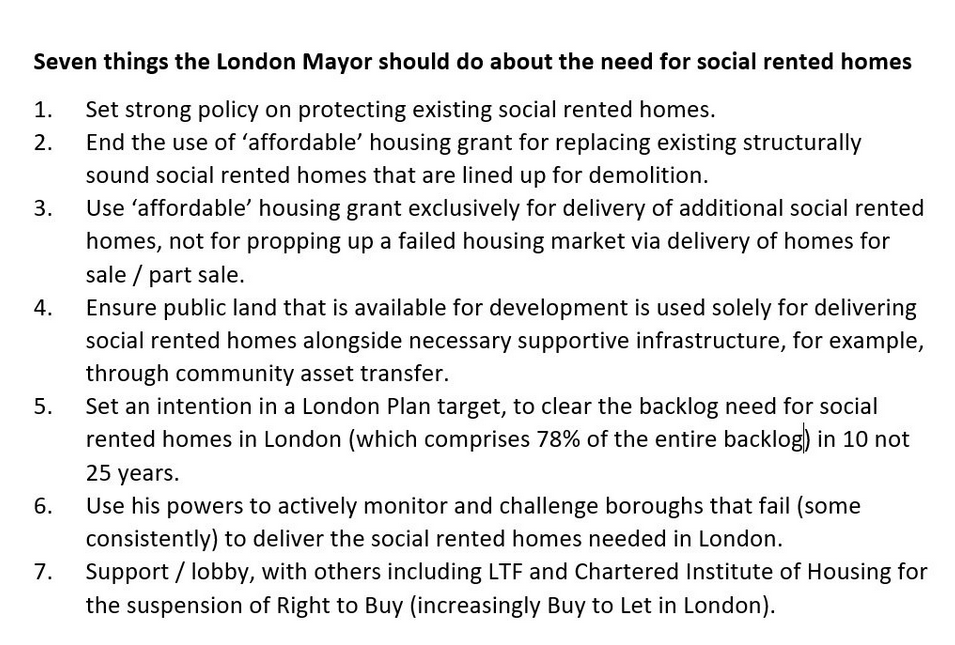
London Tenants Federation LTF: seven things the London Mayor should do about the need for social rented homes The Mayor’s office said at the #LondonPlan examination 06.02.19 that lack of funding prevents delivery of the SR homes needed in London. Of course, we encourage him to lobby Government on this, but …..
Halfords had a seat at the EiP session on Housing Strategy. They were objecting to Policy H1 B2b which lists retail parks. Their written statement is here.
The Inspector was very interested in what Halfords had to say and gave them the floor for 10 minutes. They talked about losing sites due to residential dominance, how town centres need retail parks and H1 should link more closely to the town centre policy SD8, how retail is being lost in central and inner London, need robust tests/mechanisms and engagement with existing businesses to demonstrate replacement floorspace is fit for purpose (sometimes they are only offered one tenth of existing floorspace), retail warehouse sector being lost.
The Inspectors’ questions – Retail parks are a possible source of housing capacity so is it as bad as you are making out? and Why does this loss matter in a planning sense? These were both very helpful.
[The last bit of the day was captured by volunteer Lyuboslav Petrov and his notes follow.]
Ballymore group – There should be an understanding of the need for delivery. 60% of targets are going to be delivered on large sites – these are complex. The incentivisation has to be realistic. There are other matters which have an issue for implementation – the planning process in London is complex – conditions are a significant issue for them. In terms of part E, they don’t know what “ambitious” really means – realistic and achievable is better. There should be particular trigger points – targets should be achieved within a certain time frame through a collaborative approach.
HBF: Planning policy in London is complex – length of time for getting a planning permission and discharging conditions is a lengthy process – it can take up to 2 years. This is a local matter. A matter for a dialogue between а developer andаlocal planning authority. Some authorities struggle with policies and local plans.
London First: They welcome the opening GLA comments – a range of interventions, they are making for diversity of the providers for building more homes in London. Their concern is with the language used in GG4E – lacks context – don’t refer to setting rates – a report encourages the diversity of the provider – but when looked in isolation, GG4 does not provide this point. Thus, a realistic approach is needed. Also, a clarification of a diversity of who is building is needed – GG4 needs to make a reference on that.
London Forum: GLA have been emphasising the need for market housing and affordable homes – that’s often not the right kind of affordable homes. Government insists that intervention by mayor through government money prioritises intermediate housing. Quotes Jennifer Peters earlier in the EiP: “80% of what is built is affordable to 8% of Londoners”. They are pleased to hear that there are funds for site acquisition – but what about the ability of boroughs to build social housing – it is suppressed. The more housebuilders build market homes, the more we are increasing the stock of homes above the price levels needed by Londoners!
Assembly Planning committee: The overall target and borough targets are ambitious. One measure they really welcome is the 35% mechanism threshold – they believe it drives up the level of affordable housing. The 2 year viability review mechanism will speed up things further. They also agree with mixed affordable housing. Some of the other matters – government funding is vital and we need a reform on compulsory purchase powers – not yet implemented. What needs more focus is modular housing – there should be a policy, cross referenced by GG4, and that is not taken forward.
London Forum: 60% of what we need will come from large sites. Mayor has declared site allocations – they are called opportunity areas. But what can they deliver? What about local plans? Unless opportunity areas are revisited carefully and in detail, how it can be known what can be delivered? Figures are aspirations. What the massive contribution will actually mean? The opportunity areas are so significant – mayor can intervene and stop the wrong things being delivered in them.
HBF warmly welcomes small sites policies, but the complexity of planning policy environment is there. GLA needs to be careful. One other point also needs emphasis – true concern for safety and performance.
Inspector: 3 things need discussion: First, the whole issue about diversity of provider, second – the incentivisation problem, third – modular housing.
GLA: Both targets and diversification are needed – housebuilders – they need some clear incentives that this is built quickly. Incentivize – there are issues with shorter planning permissions. Good example is the threshold approach. That acts as an incentive.
Inspector: Modular housing?
GLA: Modular – quality and safety concerns and whether is a panacea or not. One of the benefits of modular housing – it can control quality. They say they need to take it slowly and avoid mistakes in the past (e.g. government picking a winner).
Inspector: affordable housing points will come again at another day.
Warning: Just Space and UCL are trying to make available some sort of record of what happens in the EiP for the benefit of community members. Notes are being taken by postgraduate students and checked/edited so far as possible by more experienced staff and others. Neither Just Space nor UCL offers any guarantee of the accuracy of these notes. If you wish to depend on what was said at the EiP you should check with the speaker or with the audio recordings being made by the GLA. If you spot mistakes in these notes please help us to correct them by emailing m.edwards at ucl.ac.uk For this day we had no note-taker so would especially value corrections and comments from those who were present.
Housing need & overall target
The Panel asked: M17. Is the need for 66,000 additional homes per year identified by the Strategic Housing Market Assessment (SHMA) justified and has it been properly calculated for market and affordable housing having regard to national policy and guidance? In particular:
a) What weight, if any, should be given to the revised household projections published in September 2018?
b) What weight, if any, should be given to the potential impact of Brexit?
c) Has the Mayor adequately considered increasing the total housing figures in order to help deliver the required number of affordable homes in accordance with the PPG (ID 2a-029-20140306)?
James Gleeson (@geographyJim) is defending the Strategic Housing Market Assessment (SHMA)
Why is London method different from national model? GLA defends backlog approach in which the demographic growth forecast then has extra ‘need’ added to represent catching up the accumulated backlog of under-provision (within which 78% is need for social rent). This differs from the NPPF which instead makes an arbitrary uplift for “market signals”. Various views expressed. Just Space supports the London backlog approach but notes that the phasing over 25 years is outrageous (and probably means the backlog would grow). More important still the social housing numbers & percent in the targets disregard the findings of the SHMA.
Highbury expert group (Duncan Bowie) eloquent in support of this position, as is LTF.
Christine Whitehead LSE: the London approach better than national. suppressed demand should be met.
James Stephens (HBF) strongly supports use of a standard national method of estimation. Consistency most important. GLA method is rather a black box.Stephens: “market signals” approach more focused on exclusion from owner-occupation, a key concern of government. Bowie: yes and that’s irrelevant for Londoners in housing need for whom owner-occupation is out of sight.
Some discussion of household formation rates and migration.
LTF argues migration misleading because so much of London’s need is exported through forced moves of hh displaced by LAs. Some discussion on this. GLA says that hh accepted by LAs as statutory homeless are included in the “backlog” whether they are housed in London or elsewhere.
CW/LSEStresses that hh formation needs to be approached carefully, taking account of turnover. Rapid churn has fewer households; new migrants take 10 years to adopt settled habits and form smaller households..
Bowie. We need more knowledge of migrations… constrained choice, choice, compulsion. Contradiction that compact city is supposed to meet London needs, but actually exporting so many people, with environmental and cost problems for people having to travel back to work. Understanding of migration motives etc has implications for bedroom size mix. If we assume that people who can afford it will all move out of London for adequate rooms. . It’s a policy issue embedded in a technical process.
James Stephens: latest projections of population/hh so much a reflection of policy failure, so would be a dereliction of duty to base the Plan on a projection of those trends.
Main outcome of the discussion on migration, brexit and household sizes is that the uncertainties are huge, alternatives should be explored, and the situation closely watched. Next SHMA envisaged by GLA to start in a couple of years. Govt submission today seeks a review of the #LondonPlan right away !! https://www.london.gov.uk/sites/default/files/m17_mhclg_2631.pdf … {note that they write this and then fail to show up and use their seat.)å
Inspector Smith asks why such a shift up in need for 1 and 2 bedroom flats since the previous SHMA and plan? Doesn’t get a good answer.
New option now presented in GLA submission for table 13/5, with different assumptions about under-occupation. Gleeson unwilling to choose, though original table 13 probably most likely. Strong support for the new alternative table to be the basis for the plan – expressed by Assembly Planning Committee (Nicky Gavron), JS, LTF, Highbury…
Paul Burnham (Just Space) urges need for housing need surveys- to establish income, savings, debt, ethnicity etc of those in housing need.Very evident in Tottenham, for example, that many (includingdisproportionate BME, disabled, women-only hh) can’t possibly access the kinds of ‘affordable” housing requiring advance deposits or part-buy.
GLA responds that they have used data from English Housing Survey: 7-8000 London hh over the 3 years they have used.
Backlog: Inspector says representations have stressed 25 years far too long. Duncan Bowie (Highbury Group) stresses former MHLG guidance was to catch up in 5 years; first London Plan 2004 spread it over 10 years (the range of the housing targets) and then the Boris Johnson Plan spread it to 20 years. JS and LTF in strong support.
CW/LSE: we would all agree that 100% of the output should be “affordable” (what does this mean?Out of context)
CPRE stresses political character of the backlog issue.
Should the #LondonPlan target be increased to get more “affordable” housing? Just Space and LTF arguing quite the reverse: the super-high housing targets drive all the damaging aspects of the whole Plan including estate demolitions which reduce social housing. Widespread agreement that building more housing in total does not produce more affordable housing. LTF has charts in their submission.CW/LSE however argues that the two statistics move broadly up and down together.
This note pieced together afterwards by M Edwards. Corrections & amplifications specially welcome, either below or by email.
This page records activity up to mid-2018. The story since then is taken up on the front (news) page as blog posts and most recently by the page on the Examination in Public: Hearings / EiP / 2019
Summer 2017: a group of masters students at UCL has prepared a report for Just Space: Opportunity For Whom? How Communities Engage With Land Value Capture in Opportunity Areas. It is available to download at ucljustspace.wordpress.com The authors are Amy Curtis, Jessica Cargill Thompson, Lidija Honegger, George Kafka, Wenlin Liu, Alessia Montero, David Mountain, Johanna Salmi and Naomi Seow
Towards a community-led plan for London 4/2/2016
Workshop session briefing note here. Scroll down to green heading for notes of the workshop discussion.
LAND VALUE CAPTURE / viability assessments / S106 etc
The market value of land and property in London is very high and has risen very fast in recent decades.
Crossrail 2 will cost £27bn & would create property value uplift of £15bn (TfL) for housing alone.
Massive state investment in infrastructure boosts values; so does investment in buildings and services. Hardly any of this is taxed or captured to pay for London’s services and needs.
Long-term / big issues
Taking land out of the the market by compulsory purchase at existing use value, thus socialising the uplift on that land.
What would be the benefits and disadvantages of moving towards a system of taxing land and property values across London?
Which of these current taxes could be replaced?
Council Tax
Business rates (NNDR)
Capital gains tax
Stamp Duty on transactions (SDLT)
Others?
Could it replace taxes levvied just on new developments?
Section 106 agreements
Borough Community Infrastructure Levy (CIL)
Mayor of London’s CIL
Would site value taxation
Encourage owners to develop?
Be feasible without strict zoning which the UK does not have?
More immediate issues:
making Council tax fairer
incentives for developers to build faster
transparency and enforcement of S106 social housing %
securing social infrastructure and timely services
Conference document statement (in the housing section):
The policy objectives are:
Bring land forward for development at lowest possible cost
2. Ensure most effective use of land and property in relation to public policy objectives
3. Land and property value appreciation should be captured for public policy objectives
Further research is needed to inform debate on the policy options that include:-
Tax on land that has been consented for development but not started on site,
Higher council tax rates for higher value properties and council taxes related to level of occupation,
Capital gains taxes
Land value tax.
Local Plans should be explicit as to the land use for any development site, including specification of density, tenure mix, affordability, bedroom size mix and built form
Boroughs should designate land for housing and then have powers to acquire the land at existing use value through a Compulsory Purchase Order if necessary.
Boroughs to retain equity stakes in development to ensure that the public benefit from the uplift in value.
Justification
The land issue is central to debates about planning. A systematic review of the relationship between planning, land ownership and development is critical to securing the housing supply and infrastructure that is needed. To ensure that housing is affordable to those on lower incomes, the profit requirement and the dependence on development finance need to be taken out of the equation.
Francesca Medda, Land value capture finance for transport accessibility: a review, Journal of Transport Geography 25 (2012) 154–161, www.elsevier.com/locate/jtrangeo (probably ££, so obtain via a university or other library)
Working groups on housing in recent months considered that a wider discussion of land values, land value capture and taxation would be a valuable element in the conference, as a deeper way of approaching “viability”, Section 106, CIL and so on. After all, those devices are all attempts to “capture” bits of land value growth for collective purposes.
London’s communities engaged with planning have become more and more involved with issues surrounding S106 and land values and how these affect the delivery of social housing and social facilities. Property values in London are astronomical and they have been growing incredibly fast and recovered quickly after the property crash. There is now a new property boom; the largest growing occupational category in London is estate agents. There needs to be a discussion about how to get around these issues in a more strategic way and in the broader framework of social benefits to London people, rather than on a case-by-case basis. The mayoral campaign is also an opportunity to elaborate what we can do in the next months. (Michael Edwards, facilitator, opening discussion.)
Duncan Bowie: The history of land nationalisation and land value taxation to support civic infrastructures goes back a long way. In London value capture worked well between 2004 and 2008 but started to fail after the recession.
In London the battle to extract more value from developments has become very hard due to the very high value of land.
– Local authorities should have more powers to acquire land at pre-housing costs (i.e. non-residential use values) in order to build what they need at low cost.
– S106 and CIL do not capture long term value increases.
– Property and land taxation must be calibrated so that land gets developed.
– Capital gain on property should be taxed especially where land /properties are underused.
– Need more research on this.
George Turner explained what viability is and its importance in relation to the discussion of value capture. The Planning system is the mechanism to share land values, so the land value uplift might not matter if it is better redistributed. The planning system has been obliged to subsidise development when it is likely to produce profits below private developers’ expectations. The subsidy takes the form of a reduction in duties under S106 or duties to provide affordable housing or social infrastructures.
– Viability studies are the mechanism to assess whether a development is below profit expectations. The fact that developers in London are not building social infrastructure and still making profit demonstrate that the mechanism is not working. Developers are being dishonest in their assessment.
– Confidentiality is not inscribed in legislation but it has become standard practice for local authorities’ officers to deny full disclosure of viability studies to the decision makers and the public. The practice has also been upheld by a number of court judgements such as the Shell Centre case.
The system is designed to facilitate corruption.
-Recent campaigns have put councils and councillors under pressure to disclose assessments and some London’s boroughs have developed policies for this (Islington, Southwark, maybe Hackney). Southwark’s council will only request disclosure if the development chooses to go below the 35% share of “affordable” housing.
– Nicky Gavron is proposing that the mayor should introduce such policy and JS should ask all candidate mayors to do so. (Note Nicky Gavron letter to the Mayoron behalf of Assembly Planning Committee a few days ago)
Pat Turnbull. (HA but previously) Council tenant, involved in two regeneration schemes in Hackney since 1999. The residents worked on a scheme that was put on hold during the recession after several years of discussions. The council now wants to proceed but “viability” demands increase in density with two new 16-20-storey towers
Bonnie Vandesteeg. Negotiation on viability can include changes to the hectarage of the development (see Bishopsgate Goodsyard and Kentish Town)
Stephen Hill. Viability studies are done by a variety of professionals. Some are qualified surveyors; some have no training.
– the charter of RICS requires its members to work in the public interest. It goes back to the 19th century and requires them to get the optimum use of land for social and economic value. Residents and campaigners should take issues with the professional bodies to the High Court and challenge that, even if they are not doing anything illegal or corrupt, they are behaving against the public interest.
Catherine MacArthur. Suggested that Agenda 21 is the reason why local authorities are against social housing. Their interpretation of the Agenda is supportive of high density residential hubs around transport nodes.
xxxxx: If land is owned by the council, its value should not be included in the valuation of the costs of development.
Duncan Bowie: local authorities are now going against their own planning policies in order to get as much money value as possible from disposals of their own land. Short-termism is understandable due to cuts to councils’ budgets. TfL is doing the same on its own land with the collaboration of the London Mayor.
Duncan Bowie, Steve Birak and others on the role of planning in land value.
– Local authorities should keep their land and if they don’t they should get longer term benefits. (This must be wrong – ed)
– A stronger planning system can restrict those transfers of value from social to private.
– Our main demands should be to keep our land in public ownership or occupy it if needed.
Anne Gray: Haringey Council has based its evidence for the local plan on data and figures taken during the recession, so can it be considered unsound because of not-up-to-date values? Duncan Bowie says yes.
xxxxxxx: adequate information is essential, especially on land valuation: how value arises in the first place and becomes part of the circulation. The terms of land buying and selling are crucial.
– Most valuable short-term tactics is to get more information. (Michael Edwards replied that Just Space will engage with the production and circulation of more information)
Glenn Power
– law that allows Local Authorities to sell land or interest in land at below market value is extended to TFL and Network Rail.
– Housing associations did not have to pay for the land when the transfers from local authorities were made. HA should now be required to deliver much more than the 35% that is requested from private developers who have to pay for the land.
Anne Gray and others on privatisation of housing deliver.
– Hackney is building housing on their land but they have to sell to private market 1.5 units for every 1 social housing unit they build.
– Haringey willing to give public land to a joint venture company that is 50% private and 50% public. It is a threat to public accountability.
END – note by Elena Besussi
The following had signed up in advance for this workshop, though not all took part. Others may have joined in as well.
Michael Edwards – Bartlett Planning UCL Workshop facilitator
Duncan Bowie – University of Westminster
Robin Hawkes- West Ken & Gibbs Green
Betsy Dillner – Director Generation Rent
Anne Gray – Our Tottenham, Haringey Green Party
Steven Boxall – FORGE/ Regeneration X
Melissa Fernandez – LSE London
Dee Searle – Green Party/ IF project
Glenn Power – Tower Hamlets Tenants Federation
Stephen Kenny – Grove Park Neighbourhood Forum
Santa Pedone – Ubele
Bonnie Vandesteeg – Tower Hamlets Renters
Alastair Murray – Housing Justice
Barbara Lipietz – UCL DPU
Timothy Toh
Daniel Fitzpatrick – UCL Planning
David Farnsworth – Freelance Consultant
Sarah Sackman – Barrister, Francis Taylor Building
Catherine MacArthur – Bruce Grove Residents Network
Kathleen Egan – Age UK London
Pat Turnbull – London Tenants Federation
Marie Bernard
Maddie Guerlain – Sustain
Tony Linforth-Hall
Beth Stratford
Robin Grey – Three Acres and a Cow
Kathryn Johnson – Sustainable Hackney
Jo Meehan – Old Kent Road People
Isabella Coin – Shared Assets
Elena Besussi – UCL Bartlett
Liam Kelly
Rob Logan – Community Food Growers Network
Michel Prigent – London Housing Federation
Dr Michael Parmar – DharArt Ltd
Stephen Hill – Future Planners
David Boardman – Kennington Oval and Vauxhall Forum
Link to Michael Edwards blog post criticising the withdrawal of maximum density controls because of the effect on land prices.
2 Nov 2017: Yesterday’s Just Space community conference on the draft London Housing Strategy was attended by 60 people from a very diverse range of groups. Outcomes will be added here as they become available, and the coming month will be spent drafting a collective JS response to the GLA – which will also be raw material which groups may find helpful in drafting their own responses. As many responses as possible should reach City Hall by 30 November (individuals) or 7 December (groups). Details of how to submit are on the GLA page linked above.
During the summer there have been various meetings between Just Space and the City Hall Plan and Housing teams. The Mayor’s draft London Housing Strategy is out for consultation and Just Space groups are meeting on 1 November to consider responses (see events page). The GLA’s consultation ends in late November for individuals and 7 December for groups.
February 27 2017: Just Space writes to the GLA about how the Strategic Housing Market Analysis (SHMA) should be done.The key issue is to ensure that forecasts of need and demand for housing are done in relation to the income distribution of Londoners (with and without benefits) – and thus kept entirely separate from the ever-changing categories of housing supply: “affordable rent”, “London Living Rent” and so on. js-on-shma-feb-2017
January 2017: Just Space comments to GLA on how the Housing Land Availability Analysis (SHLAA) should be done. Our main concerns are that workspace (industrial, office and retail) must be protected to enable the diverse economy of London to flourish and that existing social housing stocks should be conserved. Detailed submission is here.
This is one of a number of pages/topics about the work of Just Space groups preparing positions and demands for what goes in the next London Plan and related strategies. The Next London Plan menu takes you there.
Most recent postings first; scroll down for earlier material.
February 28 2017: Just Space will submit observations on the GLA’s draft guidance on Affordable Housing and Viability assessment. Outline here.
Written in spring 2016: Housing is such a crucial and vast topic that two working groups may be needed, for example one on affordability, targets for housing of various types, densities and land supply; another on development mechanisms, tenure and ownership forms, diversifying the forms of housing…
Scroll down to find the February 2016 briefing document and, further down, with a red heading, notes from the workshop discussion.
Relevant sections of the October 2015 Visions… document are:
Housing that is genuinely affordable
London Plan targets for social-rented homes have always been set at a lower level than GLA evidence suggests is required. At the same time, targets for both market and intermediate housing have been at higher levels than needed. Annual monitoring reports of the London Plan show that social housing targets have, since 2004, only been half-met. The result has been that housing waiting lists and overcrowding continue to rise.
The official definition of affordable housing suggests that anything other than market housing is ‘affordable’. This definition is inaccurate and misleading. This “affordable housing con” has risen to a new level with the introduction of ‘affordable rent’ homes.
Delivery failures of social-rented homes are exacerbated by continued unnecessary demolition of council estates.
Increasing evidence shows that lower income households are being forced out of London.
Key issues
1. To meet London’s housing need, a majority of all homes built should be social rented
2. An accurate description of affordable housing should be developed. Having paid housing costs, a household should still have sufficient left to meet all other needs without having to claim housing benefit.
3. Public land should be prioritised for social rented homes.
4. Demolition of council estates should not occur without a full analysis of the benefits and impacts (social, economic and environmental) compared to refurbishment and a ballot of tenants and leaseholders.
Alternative forms of housing delivery, ownership and management
The attention given to alternative forms of housing provision and delivery should be strengthened. In particular:
1. Research and studies should further explore the contributions which could be made by the expansion of alternative forms of housing delivery, ownership and management to meeting the needs of low- and middle- income households in London and to making best use of the available land and the building stock.
2. The London Plan (and other Mayoral strategies) should focus especially on cooperative, co-housing, community self-build and Community Land Trust approaches which could ensure the permanent affordability of existing and newly-developed housing and potentially meet the needs of an ageing population and of groups needing community support as well as distinct expressed needs such as those of BAME groups and Gypsies and Travellers.
3. Plans for the new London Land Commission should prioritise the use of some of London’s publicly-owned land for this purpose and ensure that large development sites always include some alternative forms of housing.
Briefing document on private renting for the 4 February 2016 conference:
Housing issues are always central in London planning and are becoming more controversial as the years pass. The Housing working group has been developing housing policy by drawing on community groups’ ideas, campaign groups, evidence drawn from current work and looking at possible implementation mechanisms. The issues are all the more urgent as welfare reforms have affected the way in which housing is being accessed, along with potential changes accompanying the Housing and Planning Bill 2016 currently going through parliament.
Most of the current London Plan’s “affordable housing” is not affordable to the majority of households in London. Therefore the term “affordable housing” should be removed from any Mayoral or borough planning documents. The greatest levels of unmet housing need in London ae for not-for-profit rented homes.
Evidence shows that increasingly low income households are being forced out of London, or to live in poor quality or over-crowded homes with detrimental consequences to their health and well-being. Delivery failures of social-rented homes are exacerbated by necessary demolition of council estates. It is essential to maintain, retrofit and refurbish existing homes, for social, economic, and environmental reasons and benefit. The seriousness of the housing crisis requires each new home to be an additional rather than a replacement home.
For many years, the private rented sector (PRS) has been seen as the poor relation of housing and at best has been viewed as a temporary stop-off on ‘the journey to home ownership’. According to the New Policy Institute 2015, there are 2.2 million people in the private rented sector in London, 860,000 are in poverty (38%). However, buying a home is not a realistic option for majority and policymakers need to come to terms with the PRS as a permanent home for a growing proportion of the capital’s residents.
The Mayor to seek devolved housing powers from Central Government to the GLA and Boroughs to address London’s Housing Emergency. This could include powers on rent control, taxation and land acquisition and disposal.
Justification
Research is required into specific devolved housing powers and analysis of the existing housing powers that lie with Central Government, Mayor and Boroughs
The Mayor to seek devolved powers to introduce city-wide rent control, based on Living Rent formula. Rent control will include both residential and commercial rent.
Justification
The London Living Rent is currently being calculated by Matt Padley and other researchers at Loughborough University’s Centre for Research in Social Policy. Further research will be undertaken, including into the relationship with the minimum Income Standard. Shelter, Generation Rent and the Highbury Group recommend that rent control should be set at 30% of lowest quartile income (across each Borough). The average London rent is £1,500 a month (Generation Rent, 2015). In 2013, the Ealing Borough figure for lowest quartile median income was £19, 958. Rent set at 30% would be £496.50 a month.
The Mayor to set up a London Landlord License scheme OR support proposals from Boroughs to set up mandatory licensing schemes AND expand and enlarge social letting agencies. These will requires landlords to offer 5 year assured tenancies for private tenants and achieve energy efficiency and decent homes standards.
Justification
5 year tenancies are essential for family security and stability. Around half of the Boroughs are planning to introduce some form of landlord licensing scheme, but lack of resources and weak enforcement mean these may not work properly. A London wide scheme or GLA support Borough schemes is required. This has been recently achieved by Bristol City Council, who approved a landlord charter submitted to them by Acorn Housing campaigners. Schemes must be mandatory, not voluntary schemes like the London Rental Standard. Energy Efficiency measures should be a compulsory part of a London landlord license, so that private renters do not have to go without heating in poorly insulated homes.
The Mayor to set up a private renter’s forum that gives voice to private renter groups in policy making and gives them representation on the London Assembly Housing Committee. The revamped Homes for London forum will be the Mayor’s key engagement structure for Housing, its remit including policy, delivery and monitoring functions and with a full complement of tenant and community representation.
Justification
Housing policy in London needs to recognise the growing numbers of private renters in the capital, and ensure that any future strategy has tenant engagement and input at its heart. Such an approach will allow the GLA to reflect the diversity of the sector but also to ensure that private renters can provide information and data that is currently unavailable to government bodies.
Resource and local groups working on housing issues
Lipietz, Barbara, Richard Lee and Sharon Hayward, 2014. “Just Space: Building a community-based voice for London planning”, CITY, 18(2): 214- 225 free download http://tinyurl.com/zdrstbn
Scanlon, K. and B. Kochan, Eds. (2011) Towards a sustainable private rented sector London, LSE London http://eprints.lse.ac.uk/56070/ and see her other and more recent publications
Just Space workshop on private renters: Living rent model and landlord licensing 4th February 2016 3pm
Robert Taylor
Camden Federation of Private Tenants – facilitator
Agnes Deboulet
Apuuii, Paris
Alessandra Mossa
LSE research fellow on informal housing in London
Alistair Murray
Housing Justice – Christian charity on housing and homelessness
Anne Gray
Our Tottenham, Haringey Green Party
Chris Graham
LTF – Islington council tenant/leaseholder
Daniel Fitzpatrick
UCL Bartlett School of Planning
Debbie Kennett
London Gyspy and Traveller Unit
Deborah Grayson
GLC story project – how do you organise private renters?
Dolly Mace
LTF
Gabriella Toma
Advice4renters
Glenn McMahon
Tower Hamlets Renters
Katherine Wilkinson
Advice4renters
Kathleen Egan
Age UK London
Michael Cunningham
Advice4renters – Brent
Michael Edwards
UCL Bartlett School of Planning – Just Space
Sue Ansarie
Just Space
Thomas Hoepfner
New Garden City Alliance
Renters Rights London introduced the meeting by talking about the project funded by Trust for London which is campaigning on rent issues, evictions the speaker having herself been living in 15 houses over 15 years as a private renter and feeling ripped off by letting agents, living with strangers, having no-fault evictions, and living in poor damp conditions, repeatedly. Private renters in London are familiar with all this. So what do we do? Renters Rights London as a small project: 2.5 million people rent in London but who have no time, energy or inclination to things like occupying buildings or fighting the police because of jobs and other commitments that come first. Therefore it is important to arm people with the right knowledge so they can face up to harassment from landlord or refuse to pay extortionate letting agents fees. So we are interested in changing everyday behaviour and everyday awareness. Have to introduce the concept of Renters’ Rights to a generation that has no notion they exist at all. Deregulation happened in 1989, so many people don’t understand there could be such a thing as renters’ rights – so that becomes the baseline we are aiming for and then you add detail on top. It is common to hear: “It’s my landlord’s house, they can do what they want”. No – that is untrue and there are basic rights that renters have. It is the landlord’s property, but it’s your home. There are some basic rights and that’s the first step. So we try and develop people’s understanding, do a newsletter, policy news, media work, and try to raise awareness of the existing powers that councils have so that renters can actually have some influence locally. It’s not a very sexy area of politics. But that’s the way we get real social change – it can be through these tiny little details in policy documents. So we try and get people to understand what the council can and can’t do.
For example, if you look on the website [http://www.rentersrightslondon.org] there’s a Renters Index which compares local councils so you can see what they are doing. Some councils are really trying, like Islington, Camden; Newham are trying hard and it’s interesting to see what they are doing for private renters. We try and structure people’s anger as they often rush in to protest without being aware of what they are protesting about and so basic things like informing them about legislation, such as Section 21 (a ‘no fault eviction notice’), possibly the worst bit of housing legislation there is, introduced by the 1988 housing act, where the landlord can evict you for no reason – because they don’t like you – anything – and it is totally legal. The basic situation of housing in London is that you have a legal right to 6 months security of tenure and if lucky 12. Security of tenure means how long you can stay without being evicted. Completely uncontrolled rents and very very low standards. The only exits from private renting are home ownership or social renting, both of which are blocked in London, unless you have inherited wealth and social housing waiting lists are decades long. This is detailed in a book coming out next month “Rent Trap”. It is bleak but there are a few glimmers of hope.
There has been tiny change in section 21, which has been slightly restricted by 20 years of hard lobbying and struggle by housing organisations especially Shelter, but it is tough to change the law as there is a very strong landlord lobby, which I detail in the book. There is a bit of hope in licensing as a thing councils can do for all private landlords, who in return for the license would have to meet certain conditions, including inspections, and so they are visible not only to renters, but to the taxman, which is a reason most landlords object. It is not going to solve everything and some councils are doing it in a very weak way so they give out a license and they don’t check standards – but as a tool that can be used it is there.
The Housing and Planning Bill is about national policy not London, involves destroying social housing, but there are a few good points. In particular five things are good for private renters, and shouldn’t be amended:
Rogue landlord database that councils can share
Banning orders for worst landlords if they are not meeting standards
Extension of rent repayment orders, if standards are low then councils can recoup their money if renters on housing benefits, and if not on housing benefit renters can get their money back
Councils can sue landlords in civil courts and keep the money they get
Tougher ‘fit and property person’ tests for landlord licensing
On the negative side there is the new abandonment procedure, which will make it easier for landlords to evict more quickly when a flat appears to have been abandoned by tenants – but the minimum is 12 weeks, there are loopholes like if tenants are in hospital or have gone away, but in reality is not much quicker than S21.
In terms of housing organising and housing campaigning for renters rights – we need a spectrum of groups. People inside the tent engaging with policymakers and engaging with politicians, and people protesting on the streets – and they have to work in tandem – we can’t have one without the other. The best campaigners put the cause first, rather than their interest. The best ones want to campaign themselves out of existence. There’s a lot of tribalism, narcissism, small differences, but like climate change campaigning, it needs a lot of heavy lifting from government. So you can do some campaigning through the media and protest, but the bigger picture needs to be done by engaging with politicians which can be demoralising sometimes.
Our idea for a London Renters manifesto is important. Mayor does not have much power at the moment so we have to understand the sorts of powers the Mayor has, and working out which bits need to be changed. London Renters has prepared a “What renters can do locally” guide as groups or individuals and a “Know your rights” guide based on common things that are heard.
London Manifesto – we need to introduce a London Housing Bill so that London, as prime property capital of the world, can raise its own taxes on property. That will give the Mayor devolved power to actually make housing policy that fits London’s unique circumstances. Housing in Scotland is devolved; housing in Wales is devolved; there’s no reason t shouldn’t be devolved in London – in most European cities it is devolved to local level and then we can make it fit more to London’s circumstances. That would be a bold thing for the Mayor to do – Introduce a London Housing Bill, to go through parliament and they would have to threaten to resign if it did not passed.
We would like to see proper private rental tenant representation at GLA. We are talking to Sian Berry next week, who has an idea for funding a London Renters Union. That would have to be more than a talking shop – a lot of councils say we would like to have a renters union or consulting forum for renters – it would need to have some political bite.
Keep the Olympic precept, (variable depending on councils but about £25 a year per household) is added onto council tax to pay for the Olympics, which is due to be phased out, but it could be changed into a housing precept used to fund social housing programme for London.
Affordability – we need to scrap “affordable” as a term which is defined at 80% market rate which is not affordable.
We need to encourage landlords to charge the Living rent – Matt Padley calculating what a London living rent should be and rather than just a proportion of income it is also based on circumstances – kids, whether you live on your own or share a house. It would be like the London Living Wage – and could be a condition of a London landlord licensing scheme.
Rent control: Lots of successful models across Europe, for example the Berlin recent reform model is permitting rent increase to a maximum of 10% above median rent of an area; Sweden is based on a points system that depends on housing size and quality and the features it may have or facilities it has nearby; there is also the flexible model – voluntary rent cap but anything plus is taxed at 50% – so it is an incentive for landlords and anything extra collected would be used to pay for social housing.
Welfare Reform: It’s a national thing but this has meant that Local Housing Allowance (LHA – the name for the Housing Benefit paid to private tenants) has been frozen between 2015-2020, and with rents going up all the time it’s a disaster which has serious implications on affordability – we need to end that freeze.
Planning-wise: Encourage councils to stand up to the bullying of developers, who run rings around councils. Viability assessments that developers have to do: see [http://tinyurl.com/q4vakmd]; Council staff sometimes don’t understand viability assessments, didn’t have the software to open documents, and the confidentiality makes planning process not transparent.
Subsidies need to remain in property in perpetuity – rather than current model where schemes can have discounts for buying flat and then it can be sold at market rate, so subsidy is absorbed by private home seller.
GLA set up a housing bank. Do away with shared ownership schemes which take worst of both worlds.
Landlord licensing scheme with council schemes for landlords joined up. Scrap voluntary regulation, which only 2% of landlords have taken up on.
Make energy efficiency measures so people can heat; Decent homes standards which applies to social housing, should be applied to private sector; Security of tenure: not just an issue in London, but 3-5 years tenancy have begun to be offered by institutional landlords – who can absorb shocks more easily – but could be made a condition of Landlord licensing.
Robert Taylor then introduced the experiences of Camden Federation of Private Tenants (CFPT) set up in 1980 for tenants to have a voice, funded by the local authority. Traditionally, the core of organisation were the older regulated rent controlled private tenants and assured short term tenancy members but membership has changed.
Private rent control system is extremely bureaucratic and not particularly sympathetic to tenants. The Valuation Office Agency (VOA) ran it and its going to be transferred into HMRC. The rent officers handbook is obscure, along with the rent formula which relates to inflation+5%, and with current interest rates does not make sense. Rent control needs devolved powers to work – for the Mayor to run a rent control system.
Alessandra Mossa (LSE Research fellow) presented a PRS project they carried out last year on different aspects including the process of finding a home, the imbalance in the relationship between landlords, agents and tenants, the poor conditions, the feeling of insecurity. This year her project is on “informal housing” in London and translate a concept that has been used to describe slum settlements in Latin America to describe the housing situation in the Global North. There are some aspects of the PRS that might be defined as informal, such as overcrowding and substandard conditions. We are focussing on the recent deregulation of short term lettings, through airbnb and other platforms, which take flats off the market and consequently increase the prices of the private rented sector. Looking at the data it’s a huge phenomenon in some parts of London as popular tourist destination. There are people with 100+ properties, pretending to be a landlord sharing spare room, but the data suggests that it is becoming a business. Multi-listing hosts that are actually real estate agents, renting for more than 90 days which is the limit that governments have set up or people who rent for more becoming pseudo hotel, without paying taxes, decreasing number of available flats on the market. Getting data from airbnb and applying to see if local authority landlords can do something – legislation has allowed landlords to rent through airbnb without registration, or control and local authority is without any power to enforce. Research being funded by LSE grant. Its aim is to collect evidence on changes to short term letting and what sort of impact it has on rental market sector. There is the impact of tourists, there are also anecdotal evidence of people jumping from house to house, without any kind of protection. Very similar to another housing phenomenon in London which is that of property guardianship phenomena. People living in this scheme – with no rights as a tenant – signing a commercial deal for the protection of warehouses/commercial buildings – see blog [https://propertyguardianresearch.wordpress.com ] on property guardianship, which started 15 years ago as a cheap option to renting.
It is good that airbnb is being talked about as a problem. Overlap between council housing and private renting, as once people do RTB and they become private tenants and can become landlords, then its let out on airbnb, and they become absentee landlord – with no management skills to cope. It also changes the character or fabric of the neighbourhood and different services are needed locally.
To see the impacts – Insideairbnb.com – gives a snapshot in September and gives an idea of impact of properties at borough level.
This is useful for a critique – for example currently working on a Haringey Borough Plan critique – and how much private rented is wasted through airbnb. Haringey solidarity group is working on exposing lettings agencies for exorbitant fees and conditions that they place on tenants, discriminating those on benefits, reference checking fees, contracts fees etc. Upfront costs can be up to £1000. How can we regulate lettings agency in the same way employment agencies are regulated?
Nationalisation of letting agencies by either the GLA setting up or local authorities. Same applies to licensing schemes on borough wide basis. Should it be GLA controlled – or local authorities would be better at doing it? This is the public sector intervening into the private sector. Are these ideas worth pursuing?
Islington Council is setting up scheme and Camden is doing it on a very small scale – but it needs to be scaled up and can local authorities scale up? There has also been talk of setting up this Homes for London by GLA.
If local boroughs are doing it now then we ought to see how it works there. But a cautionary thing is whether we should be demanding that the Mayor of London has these powers – we have to be careful in how it concentrates a lot of power in one person. Livingstone successfully argued that some budget should be devolved from Westminster to London, along with other powers in the Housing Act. Boris took over and reallocated this budget away from social housing and serious need, towards the so-called “affordable”, middle market and shared ownership schemes. Mayor could force recalcitrant boroughs Bromley and Bexley, but then we might have deeply reactionary Mayor then worse than having powers with the boroughs. We have to be careful in formulating our demands – gives the Mayor a lot of power.
Katherine (Advice4renters in Brent) told the group that Advice4Renters fights the council but at the same time try to stay close. The lead member for housing came into the office recently and wanted to find out about the Landlord licensing campaign – so what about the Ethical Lettings Agency idea – but its not happening.
It was pointed out that there could be a role for Mayor could work with the boroughs at a more sub-regional level. But local authorities tend to be risk averse, not very entrepreneurial and scared of license scheme – they spent £4million on developing a landlord licensing scheme but licensed very few. The mayor could be a facilitator – but risk in who becomes Mayor. Maybe not a role for state but for the charity sector- like CAB or a housing associations, then ask the good boroughs to join in.
Alistair Murray (Housing Justice) talked about the enabling role that charities can have such as St Mungos reletting scheme managing to let properties to people on benefits. The new Right to Rent legislation is concerning as it puts duties on landlords to report on people’s immigration status. Trying to encourage good landlordship is part of the story. Some other examples mentioned included charity Street Souls who have developed a scheme based in a warehouse where they recycle furniture and homeless work there and can live in flats at the top.
The discussion moved onto rent control and whether the Mayor seeking powers for rent control that happens in other cities – operating rent control at a city wide level rather than done nationally through the VOA – is rent control a blunt instrument?
In Brixton in 1970 rent was £3 a week with rent control. There was a problem in that there was not enough money from rent to keep the place going and adjustment was needed for emergency repairs etc and proper rent control is the way forward but it needs to be properly tuned.
London Living Rent has to be looked at in detail. If its 30% average median of income, that’s a way to say what is really affordable, regardless of tenure or who owns – council, private – the issue is affordability.
But – if you look at OECD statistics across developed countries 18% of income typically goes on housing costs, including heating bills etc. What is proposed in here is upside down – If you look back at the costs to run and manage council flats and what it costs to run +5% = rent ought to be then compared. Then multiplied by 5 to get the living wage. Not the other way around – median income but start with the costs. Tradition is not a third of income but 20%.
Rent control – there are some bad examples too where there is in an area a mixture of low rent rent controlled and market rent properties, ie what happened in parts of new York, or older (pre 1984) tenants in London where landlords try and get them out, therefore need to find a system that can be applied across the board.
Katherine (Advice4renters) pointed out that there was a big debate on rent control. Landlord organisations say that will make them retreat from the market – maybe that’s good and maybe it will take steam out of market bubble but it is risky. When houses become empty – municipalise.
Michael Edwards (UCL School of planning) mentioned the importance of the different groups represented here to bring together the different ideas on PRS issues that must be joined together and formulated systematically with the other demands on housing. He pointed out that he has a group of 3-4 students who will be working on supporting this work, to document the international literature better or work out the arithmetic of different formulae.
Anne Grey (Our Tottenham) introduced the problem of foreign investors because ~2/3 of property in London bought by foreign companies either to let or keep empty in order to make vast capital gains. Put some block to “buy-to-leave” and a scheme where local buyers should get first option to buy.
The Housing and Planning Bill: A lot of groups looking at it and mobilising, while going through the Lords very fast. People have been involved in the “Kill the Housing Bill” campaign with the position we have to stop the whole thing, but there is some good things in it and so we need to unpick it more carefully. And how do all the different groupings come together in a bit more of a united way? And is that possible? The question came up whether there were bits that were positive and what bits were being opposed and where there can be amendments? Are people involved in the broader campaign? [ Note that London Tenants Federation has briefings on H&P Bill ]
It seems like the Housing and Planning Bill is trying to play off tenures, tiny gains for private renters and with huge losses for social tenants. We have to resist that. But unless private renters go to meetings regarding the Housing Bill then most meetings (held for example in Camden) end up focussing on issues on social housing. There are crumbs of comfort – currently there seems to be a very unsophisticated view and we need a more sophisticated approach to that piece of legislation. But people have to be in the same room and all groups be represented. Meetings (organised by council) tend to focus on council tenants, because of the landlord function. We have been to multi-tenure meetings – but private tenants get sidelined as well as housing association tenants. Bring together those constituent groups – what is good for us, whats bad for us. What is needed is meetings for all tenures and then get the group to work together – then individual tenure groups can have separate breakout sessions.
There were mutli-tenure meetings but were they of any value? The London Tenants Federation used to attend a meeting like that at GLA with Duncan Bowie as chair of the housing supply for London sub-group of the Housing forum for London, and mainly developers were round the table, with only one voice representing renters. The whole concept of people renting would have never been looked at, especially in thinking what its like to live in new schemes and in planning terms.
Everyone should be signed up on the delegate list under the workshop.
The discussion then moved back to discrimination against people who are on housing benefits. Advice4renters talked about doing a survey on Willesden Green high street where there’s 30+ letting agents and seeing No DSS signs. Renters rights groups are now fighting but how to persuade lettings agents. A lot of charities are specifically aimed on people with housing benefit- but housing benefit is currently not viable in any case in London. Brighton Housing trust – if you can pay you pay lower than high street fee and subsidises people on lower income.
A parallel survey was carried out with local renters in Brent to see if was easy to comply with current regulations and they asked what the reason was for landlords to say No DSS – because councils so slow in payment through delays. Went to a meeting organised by the council – a landlord fair – where the council was saying do business with us – the council was saying we accept we haven’t been so great, but we are going to be better. It was pointed out however, that perhaps lettings agents also influence landlords. And it becomes through hearsay – its best not to.
The discussion moved onto forms of informal housing – for example, friends live in a warehouse development in Manor House where there is invisibility of quite a lot of people. So the improvement of private renters’ rights also means improving voting. Voter registration is also important and there must be ways of registering without permanent address, for example being able to register at work or trade union offices.
Every borough needs to have a renter group – one third of households rent privately and it is important to have groups to articulate demands. There is a growing private renters organisations which need to work together.
Discrimination – policing landlords looking at people’s immigration status for example, and also gypsy traveller community too. This needs to be included in a Landlord licensing scheme and how do you do that. There is an organisation called the Joint Council for welfare of Immigrants they are collecting evidence on the right to rent.
March 2015. The GLA is preparing to issue a consultation draft of Supplementary Planning Guidance on Housing. Just Space was invited to a meeting to comment on what the planners are preparing.
Just Space is in difficulty commenting because an SPG is supposed to elaborate policies already established in the London Plan, not make or modify policy. Since many of the housing policies contained in the London Plan have been fiercely and consistently opposed by Just Space and its member organisations, commenting is almost impossible. One member describes it as ‘embroidering the emperor’s new clothes’ and there is mention of deckchairs on the titanic. All we can do is to welcome the positive elements and seek to mitigate the worst impacts of the Mayor’s policies.
Just Space looks forward to commenting in detail on the Draft SPG, publication of which is expected on 11 May, just after the General Election (when the next round of draft Alterations to the London Plan are also expected).