Category: London Plan 2016-21

  • London Plan 2021

    London Plan 2021

    London Plan 2021

    This section of the site groups material from roughly May 2016 when work began in City Hall on a new London Plan until the final publication of an adopted Plan in early 2021.

    The London Plan sets out strategic policy for the whole of London. It covers
    housing, design, social infrastructure (health, education, sports), the economy, heritage and culture, green space and the natural environment, sustainable infrastructure (air quality, emissions, waste), transport and strategies and places for growth.

    Legally it is part of the development plan and must be taken into account by the 32 London Boroughs in their decision-making. (The City of London too, plus the Mayor’s Development Corporations at the Olympic Park and Old Oak Common.) The ‘Local Plans’ prepared by these boroughs have to be ‘in general conformity’ with the London Plan

    Work in City Hall began on the new Plan after Sadiq Khan’s election. It is the third major version of the Plan since the Mayor of London and Greater London Authority were created in 2000. Just Space started earlier and its preparations are described in this page and its branches.

    The draft was opened up for a 3 month public consultation that ended 2 March 2018. After amendments, the Draft version was examined by a Panel of planning inspectors at an ‘Examination in Public’ (EiP) from 15 January to 17 May 2019.

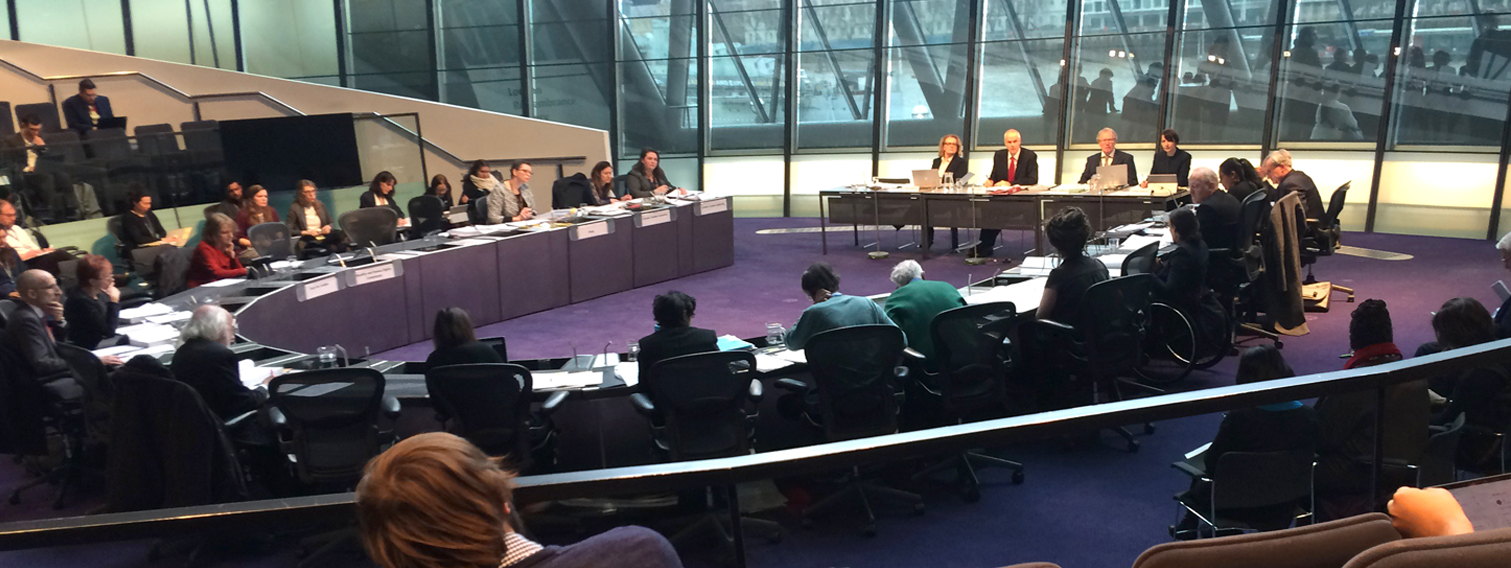
    The EiP was open to the public at City Hall, The Queen’s Walk, SE1 2AA. Sessions begin at 9.30am and 2pm see Hearing programme

    At the EiP each set of policy topics in the Plan is discussed at a Hearing, with the Inspectors sitting between the GLA planners (who wrote it) and the people disputing it. Some of those who responded to the consultation and asked to speak have been chosen by the inspectors. The inspectors’ written questions form the basis of each Hearing.

    See the Mayor’s website on the New London Plan

    Just Space and the London Plan

    Just Space has a seat at almost all the Hearings. Being a large network of groups with expertise on many issues, different people use our seat according to the topic.

    The main work of Just Space since even before Sadiq Khan was elected Mayor has been to develop ideas about what a London Plan would be like if it were to prioritise the interests of its citizens, its environment and its smaller, interlinked economies – instead of the emphasis on private development and the global economy. We worked to shape research and policy development by the GLA planning teams early on when they began this full review of the London Plan.

    Just Space is a network of many different groups and interests but we share common ground and a joint vision for the planning of an environmentally responsible, fairer London. In 2015 we decided to write our own document Towards a Community-Led Plan for London: ideas for discussion and debate. 62 different groups contributed to its making. The GLA engaged in some discussion, though they refused to add it to the strategy options for the Plan.

    February 2018: final drafts of submissions about the next London Plan [link]

    (Summer 2017) Just Space wrote a concise statement of the Community-led Plan which the GLA invited us to submit for consideration in their evaluation of strategic options: part of the ‘Integrated Impact Assessment’ (IIA). A detailed agreed report of the 2 August meeting with GLA is here (PDF): JS LP IIA meeting 20170802

    Just Space comments (21 March 2017) on the draft scoping study for the Integrated Impact Assessment of the next London Plan: Impact Assessment: is it real?

    Read Just Space submissions to the EiP. Just Space links the Inspectors’ questions with our responses and some notes on what happens in some sessions, so far as there are people to take notes. There were also briefing sessions organised by Just Space with UCL in weeks when the EiP was not happening.

    April 2019 We report on the important exchanges about the inadequacy of the City Hall Equiality Impact Assessment in a blog post.

    The Panel of Inspectors submitted their Report to the Mayor and the mayor published it in October 20119. Here it is.

    Revisions to the draft in the light of the Inspectors’ report and responses (ours and others) to the resulting version. Narrative in our blog post of January 2020.

    There was prevarication from the national government and the Secretary of State delayed the final publication of the plan until 2021.

    Page not yet complete (editor 11 June 2025)

    Back to the introduction page about the London Plan

  • Breaking: Minister boxes Mayor’s ears

    Breaking: Minister boxes Mayor’s ears

    Today, Friday 13th 2020, the Secretary of State wrote a very aggressive letter to the Mayor of London, chastising him for the inadequate performance of earlier plans (notably the under-production of housing) and using his powers to direct changes in the London Plan.

    The Plan is thus – in effect – in Special Measures.

    Letter and an annex specifying re-wordings are here: https://www.gov.uk/government/publications/london-plan-letter-from-the-secretary-of-state-for-housing

    He takes it for granted that escalating house prices are the result of inadequate building and that more building would be the solution, so he is extremely critical of the Mayor’s failure to build and will not accept the Plan without a list of changes (detailed in the Annex).

    The government priority is the housing ladder and not social rented housing. He favours family housing but otherwise most of his points are contrary to the aims of Just Space and its member groups. We were already highly critical of the Plan on multiple grounds of worsening inequality and on environmental grounds. How much worse it’s going to be now.

    — Mandatory residents’ ballots on regeneration estates, which have been a key win for us (& are recommended in his own ministry’s guidance), he calls ‘onerous’;
    — Expansion of Opportunity Areas and proposes further jacking up densities there and in other already-dense areas;
    — Wants the low-to-mid density areas (ie the suburbs) protected with ‘gentle densification’;
    — Deletes “No Net Loss” of Industrial Land;
    — Metropolitan Open Land quantum can be reduced.
    This drastic action by the minister would have made it impossible for the Plan to be revised and adopted before the pre-election shut-down (called purdah) but the election has now been postponed until 2021 so the Mayor can go ahead…
    Please let us have comments below or links to assessments and analysis. We’ll report further soon.
    A first summary is by a firm of planning consultants, Lichfields, who comment from an implicitly pro-developer standpoint: https://lichfields.uk/blog/2020/march/13/housing-secretary-directs-amendments-to-the-draft-london-plan
    Meenakshi Sharma (Ilford NOISE) writes:  I have received a tweet from Assembly Member Andrew Boff saying We can only convene if the Mayor presents a plan to us. If he does so we will’. I have asked him if it is solely up to the Mayor to present the plan or if the other LA members can ask for him to do so.  

    Checked by M E 21 07 2025. later parts garbled and not yet sorted out.

  • Labour leader defends Plan

    Labour leader defends Plan

    Following our letter of 3 February asking members of the London Assembly to reject the Plan (our letter is the previous post here), we received a prompt reply on 5 February from Nicky Gavron, planning spokesperson for the Labour group of AMs. She writes:

    Thank you for your recent email regarding the upcoming Plenary Session at the London Assembly to approve the Mayor of London’s new London Plan. [1000h at City Hall, Thursday 6 February, open to all – ed]

    Writing and implementing the London Plan is one of the most significant powers the Mayor has, and as Assembly Members our responsibility to scrutinise and approve the plan

    As Planning Spokesperson for the Labour Group on the Assembly, I am responding to the points you raised with my colleagues below.

    Procedure

    Although the Assembly is considering this Plan before the final version, with any amendments from the Secretary of State, is available, one of the primary responsibilities of the Assembly is to scrutinise the work of the Mayor, and the version we are considering on Thursday is the London Plan as the Mayor intends. It means we can scrutinise the Mayor’s policies and decisions, rather than allow issues to be deflected to the Secretary of State.

    The Assembly has also agreed that if/when the Secretary of State does respond to the Intend to Publish version of the plan with significant revisions, we will hold a further session to scrutinise the impact of any changes. We have also received legal advice that the relevant legislation does not allow for the Assembly to reject directions made by the Secretary of State to the Plan.

    Policy

    The London Assembly Labour Group has worked now over two and a half years to challenge the Mayor and his team, with views from community groups, constituents and our own research, to improve the Plan at each stage of consultation. Through our work, we have secured significant improvements to policies including: affordable housing, family-sized housing, industrial land, biodiversity assessments, air quality mitigation and waste capacity.

    The Mayor’s Plan sets out a bold vision to deliver sustainable economic growth for London in the coming 20 years, and will help the city tackle some of the biggest challenges we face, not least the housing crisis and the climate emergency. We do not believe that it is a perfect plan, but it is a significant step forward from the policies of the previous Mayor – which delivered record low numbers of social housing – and the London Assembly Labour Group will continue to pressure the Mayor so that any supplementary guidance and revisions to the plan best meet the needs of all Londoners. We will continue to hold the Mayor to account and monitor the delivery of development

    The Plan seeks to deliver high levels of affordable housing to meet London’s urgent needs, and sets a strategic target of 50% of all homes to be affordable, of which up to 70% should be at social rent levels – matching the ambition set out in the first London Plan in 2004, since lost by the last Mayor. We pushed the Mayor to increase this further to reflect the massive and urgent need for social housing in London, and will continue to make this case in the coming months and years.

    The new Plan introduces many policies which will protect existing social and other types of low cost housing. Policy H8 makes clear that all alternative options should be considered in full before the demolition of existing affordable homes. Any social rent homes that are demolished must be re-provided with the same or increased floorspace, and in order to receive Mayoral support, there must be a ballot of residents ahead of any estate demolition, in line with the Mayor’s Good Practice Guide to Estate Regeneration, implemented in 2018.

    The Plan must also be seen in the context of non-planning and national Government policies. The planning system alone cannot deliver the levels of social housing we need. The Mayor has joined many others to state that the current “cross-subsidy” model – whereby private sale developments fund affordable housing through Section 106 – is broken and will never deliver what we need in London.

    Direct grant funding is responsible for the majority of affordable housing in London, but grant has been cut considerably since 2010. The Mayor has secured £4.82 billion from Government over five years, and has delivered a record number of affordable housing starts since City Hall took responsibility for this in 2012. But in order to build what London needs would require £4.9 billion per year in funding from Government, seven times what London currently gets. Furthermore, councils and the Mayor are hampered in their efforts by the continuation of the Right to Buy, which over 40 years has drained London of much need council homes. Since the Government “reinvigorated” Right to Buy in 2012-13, councils have been forced to sell more homes than new social homes have been built in London.

    The first Good Growth objective is about building strong and inclusive communities and talks specifically about tackling inequalities and building a more inclusive city. Independent Planning Inspectors agreed that the Plan’s policies will tackle the disadvantages faced by groups with protected characteristics, and the Plan implements much better policies for marginalised groups, including Gypsies and Travellers. The Mayor has resisted Government and introduced a more progressive and encompassing definition of this group to ensure that the community’s needs are properly assessed. The Mayor will lead a new London-wide needs assessment of Gypsy and Traveller accommodation, and ensure that new targets are set to all boroughs. In addition, 10% of all new homes should be fully wheelchair accessible, and all others should be accessible and adaptable for people with disabilities.

    The London Assembly Labour Group has worked to improve the industrial land policies of the new Plan to ensure better protections for “behind the high streets” light-industrial premises and workspaces. These are the kind of SMEs that ensure London thrives, but are often “non-designated” industrial sites, which makes up 36% of all industrial land in London. The Plan has been strengthened to better protect these sites from residential development, as part of an overall “no net loss” approach to industrial land across the city. The Plan also sets out London-wide policies on affordable workspace for the first time, encouraging boroughs to secure below market-rate workspace for community groups, charities and social enterprises.

    The Plan seeks to meet the Mayor’s target for London to be 50% green by setting requirements for development proposals to incorporate green infrastructure, achieve biodiversity net gain, avoid damaging mature woodlands and protect Metropolitan Open Land and Green Belt. The Labour Group and the Mayor have stood firm in protecting green belt designations, despite Government objections. This is one of the key areas of disagreement between the Mayor and the Government. Biodiversity net gain, a policy adopted early on in the development of this London Plan, has now been brought forward at national level. Labour Group secured an improvement in the Plan by noting that biodiversity net gain must be achieved within a limited distance from the original loss.

    The Plan builds on the Mayor’s targets to clean up London’s air, we secured a requirement for all development proposals to be at least air quality neutral as well as major developments being air quality positive, i.e. improving London’s air quality. In practice, this means they must use cleaner heating technologies that do not emit toxic fumes, promote clean travel and contain green infrastructure.

    The Plan contains some of the most ambitious energy efficiency policies of any planning policy across the country. The Mayor has set a requirement for new developments to reduce their carbon emissions by 35% above what is required by current buildings regulations, in large part through energy efficiency measures. This means that London’s new buildings will be some of the most affordable to run in the country. Furthermore, by promoting the uptake of new low- and zero-carbon heating technologies, the Plan is helping to prepare the industry to fully decarbonise heat, which has historically been harder to decarbonise than electricity. Major developments are required to offset the rest of their operational carbon by contributing cash sums to local funds. This is helping to move London towards meeting the Mayor’s target to be net zero-carbon by 2030 and zero-carbon by 2050.

    [end]. Just Space letter, to which this is a reply.

    Checked by M Edwards 21 07 2015

  • Assembly urged to reject Plan

    Assembly urged to reject Plan

    Call to reject this London Plan

    Letter sent to all Members of the London Assembly on 3 February 2020

    On 6 February the Assembly will consider the Mayor’s draft new London Plan before the GLA has received the Secretary of State’s formal response to the Plan.  The SoS has written that he will provide his response on or by 17 February, so the 6 February debate is procedurally unfair and irrational as Assembly members should have an opportunity to study the response before deciding on the Plan.  We question the logic and lawfulness of this 6 February decision and urge Assembly Members to defer their decision to the 6 March meeting.

    The draft new London Plan should not be adopted. Just Space and its many member groups challenged the draft plan on many deficiencies throughout its progress, have chalked up some small gains but it remains a Plan which will further deepen inequalities in the city and fall badly short on environment.

    The emperor has no clothes. We call upon the Assembly to send it back for a complete re-think.

    Like its predecessors, the London Plan reinforces the dominance of property and financial interests in the development of the city, at the expense of low- and middle-income Londoners, the environment and the ordinary economy.

    Specifically, the draft Plan is bad because of its…

    • Deepening inequalities and poverty, particularly in the provision of cheap housing;
    • Failure to discharge the Public Sector Equality Duty (PSED) from the outset of the planning process. If the Mayor had considered the PSED properly from the outset – and the duty to consult those groups properly – he would have had some chance of achieving the ‘Good Growth’ he favours.
    • Failure adequately to consider alternative strategies, notably the Just Space community-led plan of 2016. (LSE London made a similar challenge, arguing the need for an explicit evaluation of alternative strategies beyond the London built-up area.)
    • A mistaken approach to housing based on maximising total housing numbers, rather than protecting and growing the stock of council and low-rent housing which is London’s overwhelming need. This mistake will lead to the backlog of unmet housing need getting even worse in the coming years, families being sent miles from home if they become homeless and to those who do find housing spending so much on rent that they can neither save nor enjoy London.
    • Failure adequately to protect the jobs and services in London’s industrial areas, in and behind high streets and in town centres as land is switched to produce yet more expensive homes. This failing makes the economy less robust, increases the need to travel and would have regressive effects on many protected equalities groups.
    • Weak approaches to climate change and bio-diversity, lacking urgency, tangible measures and timelines of target outcomes. failure to meet the requirements of the UK Habitats Directive in concluding that the London Plan will not have adverse impacts on Natura 2000 sites, and the last minute removal without consultation of Policy G6 C(3) which required Boroughs in their development plans to provide net biodiversity gain when harm to a SINC is unavoidable. [Second sentence added on web after the letter was sent to Assembly Members.]
    • The absence of convincing ways of paying for social and physical infrastructure without cutting the provision of low-rent housing; contributing to unsupportable increases in housing density and land price inflation, especially in Opportunity Areas which are supposed to contribute so much of the housing we need.
    • Continuing failure to devise and require transparent and democratic mechanisms for the designation, planning and implementation of Opportunity Areas.

    Download PDF version of this letter: Reject this London Plan 03022020

    Checked M.E. 21 07 2025

  • M88 Centres 15 May

    M88 Centres 15 May

    EiP 15 May Notes

    Draft London Plan Examination in Public (EiP):
    Town Centres, High Streets and retail policy

    Warning: Just Space and UCL are trying to make available some sort of record of what happens in the EiP for the benefit of community members. Notes are being taken by students and checked/edited so far as possible by more experienced staff and others. Neither Just Space nor UCL offers any guarantee of the accuracy of these notes. If you wish to depend on what was said at the EiP you should check with the speaker or with the audio recordings being made by the GLA. If you spot mistakes in these notes please help us to correct them by emailing m.edwards at ucl.ac.uk 

    Admin announcement from GLA: Won’t be individual responses from GLA on comments made in the EiP. There will be a vresion of the draft plan consolidating ALL the suggested minor amendments, but no date announced.

    Panel questions: M88. Is the town centre network set out in the Plan justified and would it be effective in ensuring that identified needs for main town centre use developments are met in appropriate locations in accordance with national policy? In particular:
    a)  Is the existing town centre network classification of (i) international, (ii) metropolitan, (iii) major and (iv) district centres illustrated on Figure 2.17 and set out in Table A1.1 justified?
    b)  Given the definitions of the classifications of town centres set out in Annex1 and Figure 2.18, is the identification of centres other than “international” and “metropolitan” in the Plan justified and consistent with national policyrelating to town centres and compliant with legislation relating to the purpose of a spatial development strategy?
    c)  Are the future potential changes to the town centre network illustrated on Figure A1.1 and set out in Table A1.1 justified?
    d)  Are the classifications, as set out in Table A1.1 and described in Annex 1, for (i) night-time economy functions, (ii) commercial growth potential, and (iii) residential growth potential justified?

    Matter M88 town centre network.GLA opens: Longstanding approach to have this hierarchy in the Plan. District town centres allows more comprehensive evidence base. Goes through potential reclassification of Stratford and Shepherds Bush. Shift towards the polarisation of retail.

    Sometimes high streets have no ‘town centre’ designation. Boroughs should look closely at high streets and consider their designation. Could also designate them as business areas or local parades.

    Panel: “Consider the protection of out-of-centre high streets” is not very clear, make a note to change it.

    London Forum: Strongly support the whole approach to town centre hierarchy. Most robust set of policies in the whole spatial framework.
    A local detail on Night Time NT labels: South Ken NT1 designation is incorrect. Should be NT3.

    Just Space: Pleased to see inclusion of high streets in th policy. Key concern is the protection of workspace and local services to reduce the need to travel. Particularly in smaller town centres. Many high streets are not captured or protected in the Plan. Employment space is under threat from residential.

    In some instances classification lacks complexity and ignores the diverse rnage of centres we have. Green Street in Southall, for example, provides for many Asians from far and wide, and should be classified as international.

    Policy needs to be flexible to allow more specialist centres to emerge in London.

    Historic England: Would be helpful to have more clarification on high streets from GLA.

    Merton: Colliers Wood centre designation is unjustified because it is based on inaccurate evidence. Town centre classification only measured two sites, only measured two sheds. Should classify it as a district centre.

    GLA: Night time economy classification for South Ken is due to Royal Albert Hall.

    To Just Space, keen to encourage protection of workspace. SD7 does this. Policy E1 too. Interested to hear more about the town centres that we may have overlooked but would expect Boroughs to do this better, health check can only go so far.

    London Forum: Classification will encourage an even greater move to A3 uses. Needs all the support possible to support retail functions.

    Just Space: On specialisms, would like to see recognition of diversity of ethnicity. Queens Market East Ham and Ridley Road market are other examples.

    Chair:Moving on to M89-90.

    Panel questions: M89. Would policies SD6, SD7, SD8, SD9 and E9B provide an effective strategic framework for the preparation of local plans and neighbourhood plans relating to town centres and all types of main town centre use development (including bulky goods retailing), that is consistent with national policy?
    M90. Is the approach to development management set out in policies SD6, SD7, SD8, SD9 and E9BA justified and consistent with national policy and would it be effective in terms of:
    a)  ensuring that identified needs for all forms of main town centre uses, including bulky goods, are accommodated in appropriate locations in accordance with national policy;
    b)  requiring large scale commercial development (over 2,500sqm of A Use Class floorspace) to support the provision of small shops and othercommercial units (including “affordable units” where there is evidence oflocal need); and
    c)  supporting Policy GG4 “delivering the homes Londoners need”?

    GLA: About 400k m2 of comparison goods floorspace in the pipeline. We don’t look at these too closely because there are many uncertainties.

    Retail is a main town centres use and should dominate there.

    Could have gone further on out-of-centre conversion to residential use.

    No definition of affordable commercial workspace in plan. Un-affordability tends to be concentrated in inner London.

    Smaller units inspired by High Streets for All publication.

    Further suggested change from last week under policy SD7 welcomed by Just Space but might have further comment after study.[ 2.7.3A It is important that boroughs plan positively to meet the needs of their communities. Being able to access convenience retail, specialist shops and services is important for supporting the daily lives of Londoners and for creating and sustaining strong and inclusive communities. Many town centres and high streets and marketsserve specific communities, for example they may provide specialist food or clothing that meet the cultural or religious needs of one or more particular group often drawn from wide geographic areas. Boroughs should use their evaluation of the area and engagement with local communities and stakeholders to draw up local development plan policies, designations and site allocations, and develop town centre strategies that seek to meet the needs of their communities. ]  The words in red in the above are insertions which Just Space suggested in an email at the time. They may or may not be accepted.


    Sainbury’s: Presumption against out-of-centre retail development. Inconsistent with national policy. Currently looking to redevelop Hendon centre on Edgeware Road. ‘Discourages’ should be removed from the policy.

    Accessible Retailing: Plan is not supportive enough of out-of-town retail. Rise of online is making retail parks more attractive to chain traders who are trying to compete. This means that out-of-town should not be considered as soft targets for change of use. Out-of-town and retail park retailing provide roughly a third of retail employment.

    Just Space: Our position is from the standpoint of reducing the need to travel and meeting more employment needs locally. Extremely glad to see the inclusion of high streets. Experian report indicates a range of floorspace demand, GLA takes the top of the range. Parts of centres which are lost in ‘consolidation’ are often the secondary and tertiary areas where ethic minority, small and innovative businesses flourish. Concern that there will become just primary cores of town centres remaining.

    JS comment To Accessible Retailing, retailers have no need for the airspace above out-of-town retailing centres, which could be turned to housing or other uses.

    Just Space Lucy: market policy is not effective (E9) or justified. Evidence that is available has not been used. Markets Board report on markets not reflected in the policy. Referring back to the document is not sufficient. No mention of traders. Preserving markets like Ridley Road not possible with current paragraph in the Plan.

    ‘Support’ is the only word used. Strategic role needs to be elaborated on, only role mentioned is a tourist strategic role. Searchable list of markets should be referred to in the plan, instead of just naming a few. Wording for the protection of markets should be included.

    Markets are being threatened; emphasis should be on keeping the existing ones. Key is protection and understanding of the role of markets within town centres and elsewhere.

    London Forum: Clean up the policy.

    Assembly Planning Committee: Comments on SD6 and SD9. We support the need to promote residential development in town centres but policy needs to provide adequate social infrastructure where this happens. And mayor should include support for community engagement. Just Space mentioned 47% employment within or near high streets, we have concerns that this type of use needs to be protected in policy. SD9 should be strengthened, to require re-provision of non-designated employment sites.

    GLA: Contracting demand for retail from Just Space, the GLA is closer to Just Space than it appears on this, we do talk about the demand issues in London. For retail, we think that the comparison goods will continue to decline. We’re careful to state ‘declining demand’. We’ll support town centres through diversification (although unclear what type of diversification).

    On markets, we take a similar approach to the Markets Board.

    On London Forum: we do recognise the importance of social infrastructure in town centres, SD9 includes wording around community engagement.


    Afternoon

    M91, hot food takeaways:  Panel questions

    M91. Are policies E9C and E9D relating to proposals containing hot food takeaways justified and consistent with national policy and guidance about healthy communities and limiting the proliferation of certain use classes in identified areas22. In particular:

    a)  Is the development of hot food takeaways and associated planning conditions a matter of strategic importance to London, or a detailed matter that would be more appropriately dealt with through local plans or neighbourhood plans?
    b)  What evidence is there indicating high levels of obesity, deprivation and general poor health in London?
    c)  What evidence is there of over-concentration and clustering of hot food takeaways in London?
    d)  Would restricting development of hot food takeaways within 400 metres walking distance from the entrances and exits of existing and proposed primary and secondary schools positively support the delivery of policyGG3 “creating a healthy city”?

    GLA: Only four London boroughs have obesity levels below the rest of England. Strategic approach is needed – not at the individual level. Concentration of takeaways around schools is worst in London.

    Only 5% of the meals on offer from the main 6 fast-food outlets are below recommended meal calorie level. Children less likely to go to full restaurants than hot-food takeaways.

    Boroughs don’t all have the resources to conduct their own research on this. This is why they’ve asked the mayor for help on this.

    Evidence that if there are lots of takeaway outlets that are further away they are less likely to be used by schoolchildren. Where the balance is mixed and not just fast-food there is likely to be a healthier diet.

    Waltham Forest have not published any data on changes on behaviour with regards to their fast food policy. Childhood obesity has increased there, but might have increased more without.

    Policy could potentially have an impact on minority ethnic businesses, and in some areas would have a disproportionate impact. Won’t result in closing down vendors.

    Street markets are beyond what can be controlled with this policy.

    Proliferation of takeaways outside school zones is a potential unintended consequence. But local authorities have policies that can control clustering under E9BA9 and also E9D.

    A1 uses provide a broader range. If we see a significant impact and they change their use type we’d have to address that in a future London Plan.

    London First: E9C is a blunt policy tool, takes an overly simplistic approach to a complex problem. Unhealthy options are available from A1, A3 and A4. Ban targeting just A5 will not address the root cause. Prevents the healthier hot food takeaways coming forward, which is a growing sector.  Plan is overly detailed and prescriptive. It sets an unwelcome policy precedent. More nuanced geographically specific approach needed, set by Boroughs.

    British Retail Consortium: Support the statements of London First. In effect this is a London-wide ban. It’s anti-competitive, locks in place existing A5 uses and makes them more viable. Much better to have a locally focused approach. Croydon found similar policies unsound. Support the healthier catering commitment (HCC), more targeted and effective direction to take.

    KFC: Would like first two sentence of E9C to be deleted. Perceived unhealthy foods are also available from A3 and A1 outlets. Unintended consequences would impose a blanket ban, would prevent healthy hot food vendors. Not consistent with national policy, which is to promote competition and town centre uses. Best approach is to add A1 and A3 to apply to the HCC. Include the HCC to the appendix so that it can be scrutinised.   A1 and A3 suppliers constitute 80% of children’s out-of-home calories.

    McDonalds: E9 a blunt instrument. Oxford Study did not find any strong evidence for proximity limitations. Support the HCC going forward.

    Accessible Retail: Causal link has not been established.

    London Councils: Support GLA’s position. Welcome profile raising of HCC across food businesses in London.

    SHA London: Consider this to be a strategic issue for the London Plan. Obesity emergency is deep in London. Higher than in other wealthier countries. Sutton Council prides itself but has childhood obesity of 32%. One of the proposals is to put more weight on the HCC. One problem is that not enough research is done into this. Three supplies for all the independent takeaways. Hard to get independent outlets to follow HCC – can’t rely on HCC.

    Research from SE London, parents saw fast food outlets as a problem. Mayor has to understand how to incorporate grass roots voices.

    Just Space: Welcome the attention to concept of deprivation that has been associated with childhood obesity; need for systematic approaches to food and health. Wonder if it is mainly a symptom of deprivation and whether targeting a symptom will solve it. Independents from a range of ethnic communities (Caribbean, Moroccan etc.) not much attention to relationship between these and their neighbourhoods.

    Want a more nuanced approach to hot food takeaways, think it should be strategic at London level. But need to go back to the drawing board to see how it relates to deprivation and inequality.

    Hot food outlets do provide jobs. If you do restrict them, you’ll take-away employment options for people. International centres are underpinned by hot food outlets (eg McDonalds, Westfield). With children spending their leisure time in these types of centres they are likely to consume these foods – there is a contradiction from the GLA here by supporting larger centres.

    Guy’s and St Thomas’ Charity: Supportive of the policy. Deprivation gap in obesity is significant. Causative associations will always be limited. Important to look at lived experience in these cases, in our study issues around money and time availability influence families to choose less healthy options. Often on journey from school to home that visits are made.

    London Forum: NPPF talks about restaurants without making the distinction. Most of the main representatives here operate with A3s, not A5. At what point of the decision making do you add the HCC? Can only make it when the planning decision is being made.

    British Retail Consortium: Problem with the policy, it is not about being near schools but across most of London. London has a high density of everything.

    KFC: New policy will impact smaller independents – this is why it should be an annex to the plan so that others can make comments. GLAs evidence, although good, does not link together to support the policy direction.

    McDonalds: Our locational strategy is directed by high footfall and high population, not by schools. Many of our restaurants have mixed A3/A5 designations.

    London Forum: Thinks that the policy is tractable.

    Just Space: No overall vision for food in Good Growth, there should be. Also, what is intended to replace the hot food businesses?

    KFC: A lack of causation evidence is not unavoidable, the GLA could conduct longitudinal studies.

    Guy’s and St Thomas’ Charity: Don’t forget the urgency of this issue.

    GLA: The government has supported our approach. More deprived areas have higher densities of hot food takeaways. KFC and McDonald’s – you’re looking for gold-plated evidence, this is unrealistic.

    Notes by Sam Colchester, mainly.

    Back to EiP main page: https://justspace.org.uk/hearings-eip-2019/#M88

  • M60 Affordable workspace March 20

    M60 Affordable workspace March 20

    Warning: Just Space and UCL are trying to make available some sort of record of what happens in the EiP for the benefit of community members. Notes are being taken by students and checked/edited so far as possible by more experienced staff and others. Neither Just Space nor UCL offers any guarantee of the accuracy of these notes. If you wish to depend on what was said at the EiP you should check with the speaker or with the audio recordings being made by the GLA. If you spot mistakes in these notes please help us to correct them by emailing m.edwards at ucl.ac.uk

    Low Cost and Affordable Business Space (panel questions)
    M60. Are policies E2 and E3 justified and would they be effective? In particular:

    a)  Are they necessary to address the strategic priorities of London, or do they extend to detailed matters that would be more appropriately dealt with through local plans or neighbourhood plans?
    b)  Would they be effective in helping to ensure that the accommodation needs of all micro, small and medium sized businesses, including those wishing to start up or expand, could be met in all parts of London?
    c)  Or would that objective be better achieved by market forces in the context of other policies in the Plan, including E1A, E4A, E4H, E5C and E6, as well as any relevant policies in local plans and neighbourhood plans?
    d)  How would policies E2 and E3 affect the implementation of policy GG5 “growing a good economy”?

    A brief note from outcomes of 20 March discussion on low cost business and affordable workspace.
    1.  The arrangement of speakers around the table (anticlockwise) was :
    •  .GLA officers
    • Assembly members  (Pro affordable workspace)
    • London Property Alliance, London First, Canary Wharf Group , Workspace group (Anti)
    • FSB, London Forum, Vital OKR, JustSpace, Hear   (Pro)
    2. Inspector indicated he didn’t want repeat of written submissions but additional material to address his points and to improve clarity. Policies E2 and E3 were taken in turn separated by a break.
    3. Panel took input for E2 Anti clockwise.
    4.   The GLA came under pressure from inspector to explain:
     a) Why use classes B2 and B8 were excluded.  GLA made it clear that their approach had been to draft policies according to use class:  E2/E3 = B1 use class, E4-E7 policies were B2 and B8.
     b)  lack of clarity on how they were meant to be implemented: Development plan documents, planning management policies or on case by case basis?


    The anti group made three main points: –
     – E2 refers to local effects so need to be dealt with locally.  It’s not a strategic issue  (and they didnt buy evidence of need for policies),
    –  LPA arguing it shouldn’t apply to CAZ
     – low cost business space was generally offered in old tired buildings so this was condemning developments to remain old and tired
     – policy was too prescriptive.
    The pro group made a number of points:
     – The evidence points to lack of low cost business space
     –  policies were strategic (and undeveloped from NPPF), and prescriptive nature recognised differences in application at the local level, disingenious to say localised effects mean a local policy is needed
     – E2 needed to be extended to B2 and B8
    – Assembly members came out strongly in favour of policy
     – redevelopment could occur and still provide affordable space: the anti group had already indicated there was a range of prices offered
    Overall Inspector seemed to be leaning towards:
     –  the policy might present an additional barrier to redevelopment
     –  the policy application of : “where it can  be demonstrated that there was a shortage of low cost business space, it should apply to all types of business space i.e. not just low cost business space
     – needed to include B2 and B8.
    Anti groups didn’t do well on this one and raised the prospect of restricting the application of policy in practice using viability assessments
    E3  (speakers taken clockwise after GLA questioned)
    GLA was under pressure to  explain how E3 A to F was meant to work (step by step assessment or simultaneously) and inspector raised concerns about clarity.
    Pro groups argued that there is market failure to address – lack of access and affordability.
    Anti groups argued the policy was wholly unnecessary, interference in market, anti competitive, smacked of state aid (so could be illegal) (workspace) no market failure to address and even if policy was adopted, it was too prescriptive and particularly E3 F was limiting. Workspace argued that if policy was adopted it needed to be more prescriptive (i.e. limited in its application)
    Assembly members argued strongly for links to GG1 and GG5.
    LPA managed to be made to backtrack by Hear and Just Space by saying of course there was a need to consider voluntary, community & third sector workspace in CAZ as part of strategic function of CAZ  (from which it follows this policy justifies providing affordable workspace in CAZ as well)
    Overall it seemed that:
    Inspector saw it could be implemented by S106 agreements, section F needed widening
    Inspector called for more references to evidence, saw the policy as needing to be evidence driven and called for probably a re-write from GLA to improve policy wording and clarity
    Overall a GOOD DAY FOR PRO LOBBY
    The anti lobby intend to look for ways to limit at the viability stage so this will be a key upcoming fight.
    Michael Parmar, Just Space
  • M67 Sustainable Infrastructure 29 March

    M67 Sustainable Infrastructure 29 March

    Sustainable Infrastructure
    Minimising Greenhouse Gas Emissions, Energy Infrastructure and Managing Heat Risk
    Written statements in response to M67 may be up to 3,000 words in length.

    Panel questions:  M67. Would Policies SI2, SI3 and SI4 assist in creating a healthy city in accordance with Policy GG3 and provide an effective strategic context for the preparation of local plans and neighbourhood plans? How would they affect the implementation of Policies GG4 and GG5 on delivering the homes Londoners need and growing a good economy? Are these policies and their detailed criteria justified and necessary and would they provide an effective basis for development management? In particular:
    a)  In seeking to minimise greenhouse gas emissions does Policy SI2 provide sufficient clarity about the zero-carbon target and how and when it is to be achieved? Is the target justified and consistent with national policy and other policies in the draft London Plan? Are all the criteria and supporting text necessary
    b)  How are unregulated emissions and whole life-cycle carbon at Policy SI2 DA and DB to be calculated and is this justified?
    c)  Are the provisions in Policy SI3 relating to energy masterplans justified? Should they be limited to large-scale development locations and is the list of items to be identified comprehensive?
    d)  Are the provisions in Policy SI3 relating to major development proposals within Heat Network Priority Areas justified? Is the sequence and content of the heating hierarchy justified having regard, amongst other things, to greenhouse gas emissions?
    e)  Would Policy SI4 adequately address the contribution of the design of outdoor space to urban cooling without creating other adverse impacts and does it consider overall thermal comfort?
    f)  What is the justification for the cooling hierarchy as set out in Policy SI4B?
    g)  Do the policies place sufficient emphasis on the use of renewables and energy efficiency?
    Just Space submission in full: M67 Greenhouse emissions Just Space

    Policy SI2 to start with. Panel asks Mayor: What is “NET zero carbon”? GLA speaker gabbles. Zero = Net zero. Same thing. Panel: 2050 target is not in the Plan; it’s elsewhere. Too slow? Too fast? Milestones on the way. The target for the LP is for new development. London Env Strategy is for the whole city… (another gabbling GLA speaker). On interim targets: the LES does set 5-year interim targets. SI2 applies only to major developments: why not all? GLA: boroughs can take an approach to smaller ones. And we’d like to see the building regulations updated to cover these.  Panel: why was construction omitted? GLA says it’s covered by other parts of the policy. What about JS’s call for more detail on monitoring. GLA: we are working on that and will publish…  Panel: offsetting? GLA: it’s in use already and we are doing more. Something about costs…  Panel: MHLG advice on retrofitting? GLA: major refurbishments should be covered by the plan. Outside of the LP the Mayor has other instruments to use on existing building.

    Kate Gordon FoE: offsetting price too low, not a strong enough incentive. // Promise of later guidance n design and construction is too vague: make it stronger. // Need a strong statement on non-major development, not leaving it all to boroughs. // 2050 taget too late //

    JS  2030 target should replace 2050. IPPC report conservative…  National policy is anyway under review, and other cities M/c, Bristol, Reading have already deviated. Progress alreaday made (ref to a Mayoral document) shows that a much more ambitious approach is feasible. // Offsetting must be a last resort, and price much higher.

    Fuel Poverty Action: support JS and FoE. Reject fuel poverty being used in some places to justify less ambitious policies. // Offsetting: far too easy for developers to pay to pollute. Breeds cynicism too. // Worried about offsets used to pay for district heating – can just boost the profits of for-profit firms..

    Mr Simon Sturgis:

    London Energy Initiatives: Support the policy but made some detailed suggestions.

    Public and Social Services Union PCS: Net zero and Zero are NOT interchangeable. // we think more analysis is needed on what companies are doing about their offsetting.

    CIBSE: there were problems with offset initially. too soon to judge and it’s a useful mechanism.  Do not agree with Sturgis: we should keep operational carbon and embodied carbon separately. //

    Cory: policy not consistent with NPPF which just calls for LOW, not Zero…

    Levitt Bernstein: very important to reduce initial embodied energy (?). Fabric improvements also reduce other costs (plant rooms etc); the more we do on site, the less we need to use offset. Must avoid reducing on-site improvements.

    London First: Practical problems: unintended consequences: detail required in energy strategies is onerous; requirement to achieve 15%…too broad for all non-domestic buildings. SI2Ac.  revise so 15% just becomes an “aim”

    Assembly labour group: methodology should be in SPG so everyone knows what the Zero / Net zero distinction is.//  Refers to an Assembly Resolution calling for 2030 to be the deadline. // Mistake to apply the policy only to major development.  Can’t leave to  boroughs or wait for building regs // Plan must refer explicitly to details in Env to add weight. // Must include embodied carbon. // Refers to Assembly research and reports.

    Panel asks GLA: definition ? include embodied carbon? GLA don’t want to confuse the established practices; but embodied and whole-life emissions to be developed separately. Panel: JS points to unambitious targets. GLA: It is ambitious enough as the 35% will become harder to achieve (? as gas/elec mix changes?) .

    Now on to Da Db. Panel: This is all over and above NPPF standards. GLA: govt has expressed no view on this policy. It’s in line with the (turbulent) way govt thinking is going. Unregulated and whole life emissions are an ever-growing share of total. Panel: can a spatial development strategy help? GLA: yes…..

    Whole life cycle: is there a RICS methodology which should be referenced? GLA gabbles. Panel: why limit it to referrable cases? GLA: it’s a new policy and we want to get it right on a limited range of cases.

    Demolition: Panel asks. It will be covered in later detailed advice. Inspector Smith: it would be clearer if the policy makes that clear. Retrofitting should thus be given priority over demolish (esp estate regen).

    Labour Group: Calls for post-completion estimates for effective monitoring and offset charging. // Support priority for retrofit over demolition. //  MUST require all schemes to…and not just the biggest ones. //  Mayor should be (tougher) on unregulated emissions.  // Do favourthe RICS approach to whole life cycle.

    London First: Fine…  but so difficult and uncertain to predict life-cycle energy… (trying to soften it).

    Veolia: plan should signpost to methodology.  We support life-cycle evaluation.

    Cory: Need transparency for all such evaluations.

    CIBSE: agree should refer to RICS, though others may emerge. //  supports Assembly view that on-completion reports are needed as well as early-stage ones.

    Env Services Assn: (can’t follow speech.)

    ??

    RIBA/RICS: Embodied energy now likely to exceed emissions in use. Savings are immediate, not spread over the years. Treasury supports view that low carbon buildings save money too. Professional procedures etc are now very advanced, stabilised, and there is no justification for delay. So we urge that embodied and life-cycle assessment should be done – with post-completion part- in an integrated way from the outset. Include medium size schemes.

    Fuel Poverty: Stresses post-completion assessments: yes residents do know… Nothing in here about consultations with residents post-Grenfell. //  should be provision for requiring district heating pipework to be built in to estate designs…  Maybe it should be built in everywhere but…


    Just Space: Wording should be stronger:  ”’required..  ”   // Not just large developments . // Stress role of workers in workplaces and residents in homes can contribute to unregulated emission reductions.  Must stress working with unions and residents.

    FoE. Agree.

    GLA: asked to comment on JS inclusion of workplaces: policies apply to everything needing planning permission.

    GLA sees carbon assessment and circular economy assessments will develop in parallel.

    Policy C (gap in blog – discussion between panel and GLA on heat networks)

    GLA will look at how heat networks can be monitored.

    CIBSE: Support monitoring. Fast-=changing technology and plan needs to allow for that.

    Assn for decentralised energy: good networks operated well can contribute well. Updated code of practice forthcoming and could usefully be mentioned. Low temp networks may not always be best. Retrofit important to develop. // Add ref to on-site generation.

    xxx  We’d especially like to see Mayor backtrack on public energy company. There should be a London-wide energy strategy, and one way round terrible things like the Myatts Fields North which locked residents in to a PFI contract removing ay choice.  Must be done with workers, union and communities. Swedish experience is that only publicly-owned models can bring rapid emissions reductions with workers and residents fully contributing. Has important implications for skill development for fitters(merging elec/gas and usage skills. We welcome no new connections to gas after 2025.

    Env Services Association. We do see energy from waste as one of the elements in a solution, sometimes linked to CHP. New developments should be CHP-enabled. Perhaps GLA could guarantee demand to encourage providers.

    London Energy Transition Network: (couldn’t hear)

    Fuel Poverty Action: we see nothing in the Plan to prevent a repeat of Myatts Fields North. Call for planning consent stage to take full account of prices for final consumers. All too vague. No provision for cost to residents to be considered in Heat priority Networks. Accountabilities and incentives are NOT designed to produce good outcomes for existing or new ones.  Southwark has many out of date systems. One Elephant Park building has logged outages..  The Heat Trust is not up to the job, can’t deal with cost. Audits secret. Ombudsman also useless – dealing only with individual, not estate-wide schemes.  Mayor is the only possible source of effective regulation. Also a training issue where a strong public role is needed. Clearer criteria needed for CHP…

    Just Space. we agree on 5 ///  ref grantham Institute on need for upskilling for carbon transition. SI3a. Retrofitting must be included in this policy section, aligns Good Growth, workforce development, equity and climate change. (Adds new wording.) Importance of small developments also be included. Ref Assembly report on scope for solar PV on half of London rooftops.

    FoE is very specific. We need a policy requiring ALL development to contribute to zero energy. Need to add material on how the layout and design of developments should also contribute. Could boroughs be asked to do more? Why can’t they be got to

    (leaving now. Others will add.)


  • M65 Green Belt & MOL March 26th

    M65 Green Belt & MOL March 26th

    Green Belt and Metropolitan Open Land
    Panel questions: M65. Would Policies G2 and G3 provide an effective strategic context for the preparation of local plans and neighbourhood plans? Are the policies and detailed criteria justified and necessary and would they provide an effective basis for development management? In particular:
    a)  Is Policy G2 on London’s Green Belt consistent with national policy and, if not, is this justified?
    b)  Is the ‘swapping’ of Metropolitan Open Land (MOL) referred to in paragraph 8.3.2 and allowed for by Policy G3 AC justified? Do the other detailed criteria provide sufficient clarity about inappropriate development and how any boundary alterations should proceed? Should parts of the River Thames be designated as MOL?

    [This is one of the few Matters on which Just Space has not been invited as a participant.]

    Focus on Policies G2 and G3. We have already heard about spatial development strategy, relations with the rest of the south east and with housing targets. Please don’t say it all again, says Panel.

    Panel asks Mayor: if G2 is consistent with national policy, do you need it? GLA: policy provides a clear spatial guide, so yes.  Panel: policy that developments should be refused IS inconsistent with NPPF which provides for ‘exceptional circumstances’. GLA: we don’t consider it is inconsistent. Panel: what do you mean by “appropriate multi-functional uses”? GLA: recreation and so on. Panel: isn’t this enhancement? GLA: our aim here is to ensure more people can use GB.

    HBF: Mayor is over-reaching himself in dictating green belt policy, in conflict with NPPF. Powers lie with Boroughs and perhaps Neighbourhood Forums.

    Crown Estate: if we are right sand housing tragets are not going to be met, the GB would permit it. Development round CR2 stations: (My clients own a lot of land round one of the stations, and development there as an “exceptional circumstances” could be much better than more intensification elsewhere.

    Alan Mace (LSE London) There is a delivery question since most GB is private land.

    London Green Belt Council: where does it say in NPPF that an LA must do a green belt review? Not there. Mayor had this in his manifesto. London Green Belt Council put in a paper on Monday – 202,000 dwellings threatened in Metro GB. LAs are releasing GB land in pref to the brown field land identified by CPRE. Cites divergent views on Enfield capacity.

    Eversden (London Forum) we support protection because lack of infrastructure and because the housing that would be built is not the kind we need.

    CPRE  Entirely OK for Mayor to defend the parts of the MetGB which lie within GL. It is NOT a local issue. It’s national as well as regional and London importance.

    S E Authorities. Very pro-GB. Favour a Mayor’s review for consistency and looking for opportunities to change boundaries in some cases.

    Enfield opposes the prohibition of any review of its green belt. LP has refused to grapple with a key strategic issue. One of our strategic options in our planning process includes green belt and that must remain possible. Mayor hasn’t even contemplated this choice. GLA policy is NOT just an emphasis on national policy!

    Kingston: 1/3 of target for Kingston is undeliverable and green belt could be needed. We have infrastructure in our GB. We have Chessington theme park which will need to develop. Removing “exceptional circumstances” is dangerous.

    GLA: Some boroughs seek to use GB on grounds that they can’t otherwise meet their targets. But if we had included green belt in the SHLAA these boroughs would have got bigger targets!

    Gavron: Assembly strongly supports mayor’s protection of GB. Exceptional circumstances should perhaps be mentioned in the text but should not undermine the protection.  We attach special importance of fostering the intensification of London. We do know there is degraded GB, much of it run down by owners (including some councils) looking for hope value.  Keen on enhancement of GB (which contains so much of the the protected areas on England). Refers to an Assembly meeting which found so many ways in which GB could be strongly enhanced. (Reads out suggested new policy section.) Favours inclusion in Plan of Natural Capital Accounting.

    Stevens: I do see it’s a strategic issue. But duty to cooperate applies and he might have to cooperate in a coordinated review of GB if his Plan A fails. Alternative strategies must be provided for in LP or at least not prevented. But  there has to be some flexibility.

    London Chamber LCCI: Concerned about affordable housing (esp for emergency service workers – and thus hazards for emergencies). We have found some GB degraded land which could be developed to the benefit of emergency services.

    LSE Mace: GB review should have been part of developing the plan. The approach is a kind of greenwash, and poses issue as all or nothing. The GB is huge and various. Some bits good for forest, some for access, some for food… and closing down the analysis and debate in the Plan is a mistake. GB benefits and impacts very unevenly distributed. Refers to IIA too.

    Telegraph Hill Assn: plan needs to contain flexibility, since ever more density in inner/.central London may not be acceptable.

    London GB Council: I have never heard of a single affordable home built on green belt. Developers won’t forego the expensive markets.  What about emergency services workers. What about Ebbsfleet?  PP was given in 2006 and only 1000 homes have been build there (and he looked as though he was going to say none of them were affordable, but he left it unsaid or implied).

    CPRE Sinden: we support Assembly proposals for enhancements. Our research shows that GB development add massively to car traffic.

    London First favours a GB review and also land swaps.

    GLA comment on emergency services workers: other policies in the plan address this.

    Panel: we asked Mayor to consider how a review might be done. We asked Q65. Too slow to do it as part of this plan. Must be part of a later review.  How do you know it should be sacrosanct without serious study? GLA: our emphasis is on role of a strong GB in focusing development pressure on brownfield with in the city.

    What do people think about mechanics of a review?

    Borough of Kingston: we’d favour a quick review (option 4) and expect an increase in housing targets in some boroughs, falls elsewhere. Should look at whole GB.

    Redbridge: also support GB review. We have recently released 2 areas and it has enabled us to meet targets which we otherwise could not have done. GLA should lead review.

    Enfield: the review might help but too late. We need the flexibility NOW.

    SE Leaders: welcome a review.

    CPRE: assumption behind the question: we question the fundamental starting point. First ned a debate on whether London’s Objectively Assessed Housing Need can be met within admin boundary. Mechanisms: must look at the WHOLE MGB (of which GLA Part is only 7%). Many such reviews have failed adequately to consult, and full engagement / transparency CRUCIAL. Must include scope for expansion of GB. Very hostile to land swaps.

    London Forum: our members would be concerned if development halted while developers wait for hope value on MGB.

    FoE: review not necessary.  Close to public transport not enough. Need to ensure that no more car-dependent development.

    Lon Green Belt Council. A review would have to be requested by GLA but I see no sign of it. Deal with derelict land by forcing owners to deal with it.

    LSE: need pro-active Mayoral approach to ensure we don’t get piecemeal development; how to ensure we get affordable homes; wrong to suggest a review would stall development within London.

    LCCI: supports review. Option 2 probably best.

    Crown Estate: we do regard GB as a strategic matter and GLA should set out criteria; CR2 crucial. Scope for more affordable housing because land cheaper.

    Prologis (Rory Brooke)  GB could be released for industry and often good for that: road access and poor public transport, releasing more industrial land in London for housing use.

    Lousada:   we believe that the review should be jointly instructed by boroughs and “the development industry” as well as the public.

    Stephens: This whole review proposal has arisen because the boroughs find they can’t meet the targets of the draft Plan, derived through such “novel modelling”. Must therefore contain flexibility and the Mayor is in effect defying the Sec of State to find it unsound.  HBF wouldn’t be too concerned if the current draft was stalled. Old one not bad. But if you wan’t recommend declaring the plan, you must give boroughs flexibility of GB and set the review in train.

    Gavron: If there is a review to be done, there will also be new demographic, economic and post-brexit changes.  What we need is for criteria to be set out in this plan. Criteria established in 1940s need a re-think including ownership etc.

    GLA: GB flexibility on the current targets would not work. // Not surprised HBF willing to carry on with current plan – because its affordable housing requirements were weaker.

    BREAK – now Metropolitan Open Land (MOL)

    Panel questions b)  Is the ‘swapping’ of Metropolitan Open Land (MOL) referred to in paragraph 8.3.2 and allowed for by Policy G3 AC justified? Do the other detailed criteria provide sufficient clarity about inappropriate development and how any boundary alterations should proceed? Should parts of the River Thames be designated as MOL?

    Panel: what does “where appropriate” mean? Please SAY what would constitute…. GLA: we aren’t seeking change. We just need to accept that there may be exceptional cases.

    QPR supports general review of MOL (most be a story behind this – ed)

    FoE: strongly support amendment which would help protect MOL.

    Friends of green space: support amendments; but opposed to the review advocated by developers. It would lead to social unrest if any of those spaces were lost.

    Eversden: many threats to MOL come from boroughs who want to put schools on it because they have not planned ahead. Need new policy stressing boroughs must plan ahead for schools and social infrastructure to avoid claims on MOL. // Use of MOL for commercial events is becoming a big problem. 1967 GL parks and OS Act should prevent this. Supposed to limit to 1/10 of a space. Being ignored or overwhelmed by a later law which enables boroughs to do anything in the interests of entertainment. GLA invited to set limits and to empower the 1967 Act.

    Neil Sinden CPRE agrees. GiGL research stresses huge disparaities across London. Crucial in inner London, lowest in Islington; Camden 17.4% and some have more.   Policy should try to reduce the disparities between parts of London. Erosion needs turning round to become enhancement. MOL introduced 1969 GLDP. Took until 1989 to get full protection. Danger in the list of hardstandings, courts, etc which adds up to attrition of GREEN space.

    London First disappointed by deletion of land swap. Swaps can be flexible and valuable and FoE wrong to view it as erosion.

    London Assembly Planning Committee: Caution on criteria…  Very concerned by amount of recent losses.

    Panel: what about the Acts Peter Eversden refers to? A: we’ll respond direct to PE.


    Back to EiP Narrative page


  • M64 Green Infrastructure March 26

    M64 Green Infrastructure March 26

    Agenda:

    This Matter was originally programmed for two sessions on the mornings of Tuesday 26 March and Wednesday 27 March. Rather than divide the Matter into two the hearing session on Tuesday 26 March will now deal with Matter 64 and Policies G1, G4 and G5 in totality. If further time is required then the session will be extended and take place on Wednesday 27 March.

    The Mayor has now published further suggested changes to Policies G1 and G4. [FSC/15]

    Panel’s Opening Announcements

    M64. Would the policies for green infrastructure assist in creating a healthy city in accordance with Policy GG3 and will they provide an effective strategic context for the preparation of local plans and neighbourhood plans? Are Policies G1, G4 and G5 and their detailed criteria justified and necessary and would they provide an effective basis for development management? How would they affect the implementation of Policies GG4 and GG5 on delivering the homes Londoners need and growing a good economy?

    a)  Does Policy G1 provide an adequate framework for green infrastructure including the role of waterways (blue space) and the access to it?

    b)  Does Policy G4 provide sufficient protection for the amount and quality of all green and open space including private gardens and on housing estates? Is the categorisation in Table 8.1 justified? Should the policy refer to the improvement of existing spaces?

    c)  Is the expectation that Boroughs develop an Urban Greening Factor based on Policy G5 and Table 8.2 justified with particular regard to viability and practicality?


    Panel opens with Q on definitions. Answered by GLA (speaking too fast). Green infrastructure is an over-arching policy, policy G1 covering both publicly accessible + private ownership. Panel elaborates overlap with other parts of plan (biodiversity, sports etc)

    Q: What about ‘blue’ spaces? Included in definition, but no specific policies for waterways. A: enumerates blue policies elsewhere in the Plan.

    Q: :green open spaces’ is an undefined term.

    Bromley LB No ref to private residential gardens in G1. There should be ref to the policies of boroughs, esp in outer London where there are fewer public open spaces.


    CPRE (Neil Sinden) : Policy welcome and welcome the minor changes. Important to exclude green roofs and walls from definition which should be for ground-level.  Need also to ensure it is real green cover – not paving and astroturf.  Needs also to be a ref in G1 to “London Green Grid”.

    Just Space (Del Brenner) new footnote on waterways should refer to the blue ribbon network as that includes the docks, lakes etc as well as just the canals and rivers. // Importance of heath.. but is it working? Is it a losing  battle with development? Who pays for the open space? (Inspector curtails wider reflections).

    London Forum (Peter Eversden): unhappy that changes have removed ref to need for boroughs to plan for biodiversity and flooding. We suggest inserting “…to support biodiversity…”…  2. Removal of flood management is bad; must be reinstated or cross-referenced; 3. Area-based strategies (?) should say “and site allocations” to have more effective bite.  … 4. Private Open Spaces often very hard – e.g. More London – and welcome powers to influence them.

    London Friends of Green Spaces (Dave Morris). Green spaces should be expanding and improving, not deteriorating and shrinking. Essential and we welcome their inclusion. But we don’t yet have strong enough policies to protect them. In particular LAs are tempted by developer offers to build on them. Add word “expanded” into policy. IN G1D green space expansion targets should be set in borough plans, and monitored. Need green space opportunity zones where expansion needed.

    Telegraph Hill Society. No distinct policy in G1 on private gardens. Agree with Bromley but stress dependence of Inner London on private garden space, esp on pollution and heat island effect. Combined with the small sites policy this will be very damaging.

    Savills on behalf of Gwyneth Howing Trust:   Danger that all this inhibits some sites from coming forward for development. Should instead focus on need to consider sites on a case-by-case basis. Not a blanket policy. EG a site in Barnet mentioned in our written development. Policy should instead focus on areas of greatest need.

    Sport England: what about skate parks, synthetic pitches etc etc are included? Important that they are included, along with their renewal and improvement.

    Natural England likes it. Welcomes inclusion of ‘expansion”

    Assembly Green Group (Caroline Russell). welcomed refs to heat island and also the educational purposes. Policy G18.13 aiming at 50% of London to be green: need a better measured baseline as we may already have achieved the 50%. Must be stronger on climate change.

    Assembly planning committee: Need to strengthen generally, add synthesising introduction and reinstate the passage on multi-functional role of green infra. Add ref to “green grid” in to policy wording; ditto refs to blue networks. Blue Ribbon Network was a good and effective policy in the previous Plan.

    Just Space: Robin Brown welcomes the more integrated approach but blue elements need their own comprehensive policy, but footnote is not enough.

    FoE Kate Gordon calls for gardens to be included, especially with the added threat of Small Sites.

    HBF: No. You can’t protect gardens without totally invalidating the Plan which depends on garden developments to meet its small sites housing targets.

    GLA: latest analysis is that 48-51% green. Aspiration should now be to beyond 50%.// GLA can’t give clear answer on hard sport facilities. Case by case. Rather inconclusive discussion of tennis courts etc etc… // Waterways? Private Gardens? We DO have a new note which mentions the Blue Ribbon Network.

    National Park: Precise % measure useful but quality as important as quantity.

    CPRE: essential to extend the protections for green space by expanding MOL.  alarmed by recent re-definition of some MOL as “previously developed” because it had some hard-standing.

    FOE: on gardens: alarmed by the bit in housing policy which says that the character of some areas will have to change…  and fears it could be a loophole.

    Bromley: 4% of tree canopy in in private gardens; 14% of green cover is private gardens; SUDS benefits of private gardens.  Disagree with HBF on clash with small sites targets.

    Stephens HBF: Prohibition of back garden developments would make the LP unsound. Probably halve the small sites housing yield from 25 to 12 thousand dwellings per year.  Needs a joined up approach by public bodies and NGOs.

    POLICY G4 b)  Does Policy G4 provide sufficient protection for the amount and quality of all green and open space including private gardens and on housing estates? Is the categorisation in Table 8.1 justified? Should the policy refer to the improvement of existing spaces?

    Clarifying the table: GLA agrees intensity of use important and ?? (not clear). G4 AA 1b is about areas facing change: panel asks why only here? recognising opportunity for new open space is low outside OAs.  Panel asks why policy for needs assessment applies only to “protected” spaces? A: boroughs should identify space for growth.

    Assembly planning committee: urge revert to previous title. // Losses of open space outside areas of deficiency must stress that the replacement MUST be in same immediate locality —mainly with groups in mind who have limited mobility.  Micro and local spaces need much stronger protection. // Must retain emphasis on ground level green – walls and roofs only substitute a limited range of benefits.

    Green group: adds strong opposition to change to “green and local space”.//

    Natural England:  what about the green spaces on estates?  Very important in London. Should include in protections.

    Telegraph Hill Society strongly defending allotments & gardens; attacks roofs and walls as substitutes. Refers to Create Streets work finding private gardens good for supervision and safety of children.

    Green spaces network: 50% of Londoners are in deficiency areas. More housing will increase need. Must strengthen policy wording, retain the table, defend quality as well as quantity. Need presumption against change of use from open space. Encourage boroughs to upgrade spaces and upgrade designation to MOL.  Need strong text to prevent dilution of the definition (as for example Haringey’s inclusion of road verges to escape their obligations).

    Waterloo CDG (Michael Ball) policies very bad: where there is no open space there is a deficiency, but no protected land; where there is ‘enough’ there are no protections. Cites Shell centre getting away with extinguishing open space on the grounds of adjacent Jubilee Gardens (MOL).  Should remove word ‘protected’ from policy preculding developments where open space is lost. //  Adds that analysis relative to residents is inadequate in London: Jubilee Gardens has 50,000 workers; 250,000 people walking along river…, more users than any other UK open space. //  Danger of allowing quality improvement to compensate for quantity loss. // In Waterloo we have lost 1 ha of OS, none of which was protected. The plan does NOT help.

    TCPA good on mental health benefits of greenery, whether accessible or not.

    London Forum wants front gardens protected from concreting. Concerned about congestion on tow path. Seeks much more precise specification of the type of deficiency. Concerned also by Network Rail’s recent removal of vegetation beside its tracks.

    Just Space Robin Brown. Green space only protected if it has been identified explicitly in needs assessment. But the table appears to exclude many types of green and open spaces which are not designated POS. Needs re-wording. NPPF requirement is for OS, recreation and sports facilities (all). Table 8.1 omits some blue spaces; housing estate green space also (cf CPRE).

    CPRE (Neil Sinden) support added ref to access; otherwise the changes are bad, undermining it. Lift AB to the top. Delete “protected” and make the intention much clearer. Should be no mention of losses.  Perhaps something on no net loss. Table 8.1 needs to add green areas on housing estates which are valuable to general public as well as residents of the estates. Quotes Abercrombie’s 1943 plan on the connectedness of spaces.

    FoE:  adds importance of non-protected open space. //  need to emplify and complete table 8.1

    Bromley: reiterates value of private gardens

    Stephens: Local deficiency A matter for local plans and neighbourhood plans – thus the change of title.//  private residential gardens can’t be treated as local green space, because not accessible.  Some bad faith from NDPBs which would like to protect private gardens but don’t want to say so clearly, and they should. //  Won’t always be able to replace lost open space if the local authority considers other factors should take priority.

    Panel Q on housing estate GLA fudges: not excluded, but not directly mentioned. Boroughs could include estate greenspace….

    Panel asks for a clean copy of the policy.

    GLA: (mostly too fast to record) Only 60% of garden areas are green, much is paving, decking, parking…

    Friends of green spaces: Table 8.1 title is PUBLIC and DEFICIENCY and BENCHMARK…  The key to this table is access.  GLA response that boroughs could add greenspace on housing estates is WRONG:  that space is not POS, it’s private to the residents on the estate. Crucial that the table is protected so it isn’t used to justify inadequate open space in new development.

    Waterloo CDG: crucial to stress the reinstatement of quant and qual of estate green space in any development.

    End of G4 debate.

    Now G5.

    c)  Is the expectation that Boroughs develop an Urban Greening Factor based on Policy G5 and Table 8.2 justified with particular regard to viability and practicality?

    deferred to wednesday morning. except people who can’t come tomorrow

    Telegraph Hill Society: UGF factors work well on brownfield sites but bad on greenfield sites (examples in their submission).  Does it cover extensions in “new development”?

    Landlords Association: seeks flexibility and freedom to trade off against other policy objectives.

    Landscape Institute: dangers of loss of accessibility insofar as walls and roof replace green ground.

    Greens (Caroline) supports green factor, and it should be at 0.8, not 0.4, says Assembly Envir Cttee.

    Adjourned until wednesday morning at 0930.


  • M62 Industrial land 19 March

    M62 Industrial land 19 March

    Warning: Just Space and UCL are trying to make available some sort of record of what happens in the EiP for the benefit of community members. Notes are being taken by students and checked/edited so far as possible by more experienced staff and others. Neither Just Space nor UCL offers any guarantee of the accuracy of these notes. If you wish to depend on what was said at the EiP you should check with the speaker or with the audio recordings being made by the GLA. If you spot mistakes in these notes please help us to correct them by emailing m.edwards at ucl.ac.uk

    Panel questions:  M62. Are policies E4, E5, E6 and E7 consistent with national policy and would they be effective in helping to ensure that sufficient suitable land and premises are available to meet the quantitative and qualitative needs for all foreseeable types of industrial15 activity over the plan period? [Reference to “industrial” or “industry” in these matters includes all types of economic activity referred to in policy E4A(1)-(9A) incorporating the Minor Suggested Changes.]
    In particular: M62. Are policies E4, E5, E6 and E7 consistent with national policy and would they be effective in helping to ensure that sufficient suitable land and premises are available to meet the quantitative and qualitative needs for all foreseeable types of industrial1 activity over the plan period? In particular: (sequence changed in final agenda, as follows):

    Need for industrial land

    a) Are the industrial job growth projections and associated estimates of land and floorspace requirements justified?

    e) Is the approach to assessing floorspace and yard space capacity set out in paragraph 6.4.5 – 6.4.5B based on existing floorspace or floorspace assuming a 65% plot ratio (whichever is greater) justified and would it be effective?

    Meeting the need for industrial land

    b)  Is the aim of ensuring no overall net loss of (i) industrial floorspace capacity and (ii) operational yard space capacity across London in designated Strategic Industrial Locations (SIL) and Locally Significant Industrial Sites (LSIS) justified and realistic, and would achieving that objective ensure the availability of a sufficient quantity of land and premises for industrial uses?

    c)  Are the borough-level capacity categorisations (“retain”, “provide”, or “limited release”) set out in Table 6.2 justified, and would the proposed approach ensure a sufficient quantity of land and premises in different industrial property market areas?

    d)  Are there parts of London where significant amounts of additional industrial land are likely to be needed in addition to that which is currently in use and/or designated?

    f) Is the approach set out in Policy E7D towards “non-designated industrial sites” (36% of total amount of industrial land2) justified and consistent with national policy?

    j) What evidence is there about the feasibility of delivering schemes on industrial land that would lead to the provision of net additional industrial floorspace along with the provision of significant numbers of new homes on the same site?

    E7F – wider South East

    i) Is Policy E7F, along with Policy SD2, likely to be effective in terms of facilitating the substitution of some of London’s industrial capacity to related property markets beyond London’s boundary, and would achieving such an objective contribute to the achievement of sustainable development?

    Effect of E4-E7 on meeting housing needs

    k) How would policies E4-E7 affect the implementation of Policy GG4 “delivering the homes Londoners need”?

    Are E4-E7 effective, or unduly detailed, prescriptive and complicated

    1. g)  Would policies E4-E7 provide an effective strategic context for the preparation of local plans and neighbourhood plans?
    2. h)  Are policies E4-E7 clear about how they would be implemented through the determination of planning applications, particularly in terms of the role of“planning frameworks3” and “a co-ordinated masterplanning process incollaboration with the GLA”, and the relationship between policies E5D andE7B?

    GLA (Gerard Burgess) opening, stressing diversity in economy, too much has been lost in past, demand will grow. No net loss of floorspace is the key policy. Plan to intensify, but release some, subject to careful planning. Complex issue.Recent minor changes deal with yard space and vulnerability of non-designated industrial land.

    Starting with demand/need forecasts

    Panel: Is decline of manufacturing demand reversing? A: employment-based projection doesn’t suggest growth in employment; P: shouldn’t population be the main determinant of warehouse/logistic space demand? A: We do expect econ growth to be big influence but not directly proportional. 0.4% p.a. is our best estimate. Overall need for +100 ha turns into -230 ha because of the amount of vacant land (AECOM), much in estuary.(Total 10% vacant, compared with the 5% needed for market to work.)[Lots more detailed number-work. Listen to the audio for all of it.] Table 5.25 in SHLAA shows switches to housing. [Suggest check numbers with GLA written statement.]

    Panel: plot ratio 65% assumption (90% within inner London)but Panel says many recent developments have lowed plot ratios. A: further minor change introduced to allow for exceptions where more yard space really needed. P: how does urban greening factor fit? A: we did ask consultants to consider that.

    Nicky Gavron (Assembly Planning Committee): 1. the plan has office growth projections for each borough; why not for industry?
    2. 230 ha for release: does this take account of PD rights? Does it take acccount of new and emerging indusries? 3. New thinking about supply and demand audits: who will be responsible for them? 4. Are the non-designated sites part of the 230ha?

    Peter Eversden (London Forum) About 1/3 of ind land is unprotected and we are concerned. In East London the expansion is going to have to be carefully considered. Break of bulk is land-hungry. Statement on OAs makes us worried about what the OAs are going to produce. What is the balance between building upwards and sideways? All very well for GLA to talk of ‘plan-led’ approach but boroughs are not being guided on whether or how to study/understand these things.

    Ferm (Just Space): it does seem that there will be shortfall. Our comment is that evidence base broadly OK but not satisfied that firms will be able to cope.

    Prologis:  How adequate is the treatment of online sales, esp for firms which don’t have physical shops (Ocado, Amazon, etc) And can the distribution system cope with the massive population growth.

    Y?? More on growth of online sales. Worried that Thames gateway is miles away from where the consumption is. Transport plan not synced with LP.

    FSB: affordability is the key concern for our members. Firms simply can’t afford the space on offer. They employ local people. No good telling them to move from Paddington to Dartford! And no monitoring.

    Freight Transport Assn: more vans replace vast numbers of cars. Plan understates need for yard space: need won’t be met at 65%. Lots of the industrial land is in the wrong places.

    Amazon: (very hard to follow speaker) …

    (Barrister on behalf of) LB Bexley which is promoting a riverside site in OA. Land is SIL. 90% protected designations. They want to resist the growth in demand which is based on the rate of growth between 2000 and 2008 which was a boom period.

    BRENT LB: Not enough detail in plan to support the classification of boroughs to levels of release. Thinks demand is overestimated; logistics sector needs particular types of sites which we just don’t have much of. Why can’t more of the need be met outside London?

    London First: So much uncertainty. Plan needs much better and more frequent monitoring.

    ??Z we think intensification is going to be rare. Can’t be relied upon. Ditto co-location will be very limited. Suggests 40-45% plot ratio more approriate. There must be NO NET LOSS OF LAND. Finally how does “no net loss” actually work? no way to tell as you go along whether it is working.

    GLA responds: Audits: mix of GLA and boroughs; + sometimes developers.
    PD rights were considered by AECOM and boroughs would need to look in more detail.
    New sectors: we do expect more data centres; e-commerce is a major growth area…
    Monitoring: KPIs include annual review of “no net loss” policy.

    How would the needs be met?

    GLA (burgess) defending GLA adoption of floorspace and yardspace as both important and plot ratio (the ratio of the 2) a key indicator of efficiency.

    “No net loss” policy. Panel seeks clarifications…  GLA Says it could be applied to individually to SIL and LSIS sites, or at a borough level where land swaps could apply.
    [SIL=Strategic Industrial Land;  LSIS=Locally Significant industrial Sites.]

    300 ha of Thames Gateway releases, only 50ha actually embodied in plans or permissions.

    Note that boroughs can choose to designate more non-designated sites to protect it.

    Panel: intensification of industrial sites: GLA: Yes. This is the main source of new supply. Panel: how confident can we really be? GLA: the GLA studies of intensification and the LP viability study have both demonstrated that it can be done ‘viably’. Jennifer Peters: if we find it isn’t working in a couple of years we’ll have to consider a review of this policy. “We’re good at reviews” – laughter all round. Burgess: our pilot projects are designed to demonstrate to developers and occupiers what can be achieved.

    Bexley: we need more flex in plot coverage to reflect our special geographical situation”: bad access needs staff parking space // flood plain requires???
    Notes tightened approach to industrial land contrasting with removal of numerical controls on density and replacement by “design considerations”.
    We’ll be unable to meet our housing targets of industrial land is so strongly connected.

    Brent: Most of our developments are 45% plot ratio.  Mixing of uses is crucial to the viability of workspace provision. Why can’t we have mezzanine floors? We’ll have t quadruple the floorspace on the sites which DO come forward to meet our industrial space target.

    Enfield: we have 3rd amount, 2nd in low vacancy; and we are classified as a “provide” borough in the plan. Massive requirement if we are to do this. We try to do “no net loss” but…   London Plan viability study shows Enfield in lowest value band which is why viability is so poor. See our statement. Impossible for us to meet all our needs we need a borough-wide approach, including green belt. (A very lucid and powerful statement – ed)
    Some of our green belt adjoins M25

    Sutton: Table 6.2 hasn’t prevented excessive losses of industrial land. It doesn’t work. Furthermore there are silly cross-border problems where a SIL overlaps boroughs which have different classification. As yard space shrinks, staff parking will be displaced on to spine roads but that will just congest already-inadequate capacity.

    H Group: No net loss will drive coach and horses through Bexley local plan. High vacancy rates should put Bexley in “limited release” category. Greenwich is supposed to provide more floorspace….  Grave doubts on feasibility.

    Amazon: high plot ratio not an indicator of efficiency! Yard space can be a big contributor to efficient operation – for storage, staff parking, etc.

    Ballymore: we can make co-location work, best with SMEs.  But 65% is a challenge. Combining all this with the 50% thresholds on viability fast track.

    DB Cargo: (huge operator of freight trains, and in London esp for construction-related traffic. 40% of aggregates come by train; Take 70 HGVs off the road per train. Need for rail freight sites to support handing, sorting and processing of aggregates and construction wastes; many of our customers want to be on the same sites. Welcomes agent of change policy but… boroughs are very inconsistent in treatment of rail freight. DB believes specific policy support required for rail freight (as for water freight).

    FSB: nothing here for micro and small business. Intensification and c0-location forces up costs and rents. Most of what gets built is unsuitable for re-making and re-working, and much is too far away.

    Freight Transport Assn: Suspect that some of apparent vacancy may be land banking in hope of switch to residential use. Small pockets of land very important indeed, including a lot of non-designated land, including CAZ.  Logistics sector works antisocial hours so workers need to get to work all night and thus car parking often essential. Don’t push the big sites too far out, keep the small sites in the centre.

    xx  Board..   Intensification should just be treated as a windfall.

    HBF: on the supply side: interested by Panel’s parallel with small sites housing policy:  like that, this is a high risk strategy. Rather theoretical, not required by national policy. 45% of housing supply is going to come on land not specifically identified (small sites + intensification and co-location in industry). Mayor desperate to avoid strategic review of green belt and is proposing an unsound plan. This is not the right balance in terms of sustainable development. Development industry s not geared up.

    London First: monitoring …. flexibility … our members concerned about the risks of co-location and they would like some financial incentives to do it, especially H6.

    NNN  We think much more land needed to reach equilibrium. Doesn’t like the “exception” system for the plot ratio. Multi-level concept awaits proof of concept, even at Heathrow. Could maybe do it on green belt where land cheaper.

    SEGRE: Multi-level unproven.  We have delivered (millions…) and average plot ration has averaged 45% (range 20 – 65). Lots of examples and case stories of tenant resistance to high plot ratios. Multi-storey will be only in a few places.  We are doing a co-location in Hayes, with green space, we demolished 1m sq ft factory, but couldn’t have done it with no net loss. Beside he H+H station so it worked.

    Just Space, Kaymet / Just Space.  More precision needed: ancillary offices, why exclude mezzanine; operational yard ARE part of operational space. Borough benchmarks based on ALL industrial land, and no-net-loss should apply to that.  The policy must apply to all 2500 ha of non-protected industrial land. We being asked to trust the GLA that they and boroughs will become tough SOON.  In our area (Southwark) they have clearly decided that the new LP is too imprecise to prevent them from reducing … (lots of figures) This is a huge potential loss which the LP is not strong enough to resist.  LP must get clearer and stronger. No sign of City Hall showing southwark a red card.

    London Forum. Precautionary Principle should apply.  – co-location should be treated as a windfall.  ALL booroughs should pursue no net loss. There should be reference to the Mayor before ANY release. Every London plan has failed on this. Need also to pre-empt Brokenshire threat to Permit redevelopment of offices as housing!  No net loss should apply also to ex-transport and ex-utility land.

    Gavron: Assembly cautiously agree with no net loss.  We are cautious because of the huge losses of LSIS in recent years. Densities must be increased in industrial areas. Paris examples as well as Tokyo. Has to be an early review. Assembly aware non-designated sites are behind high streets all over London. Huge raft of innovation and local employemnt. In aggregate they are strategic AND they provide the footfall for high streets. Switch to residential damaging.  PD rights only introduced for industry in late 2018 and we don’t know the outcomes yet. Could be repeats of the wholesale evictions we had with  offices. The encouragement to switch non-designated employment space to housing should be removed, or qualified by 100% replacement.  Remove alse the ‘market signals’ passage because it’s an incentive for  owners to keep premises vacant.

    GLA response:
    Viability: refs to LP Viability Study and pilot studies.
    on 65% SEGRO and other objections on plot ratio insists…
    may not be possible in all cases. But overall aim is to increase efficiency…
    Borough categorisations come from strategic studies for property market areas. Bexley comes from the supply/demand studies, as does Greenwich.
    Non-designated sites: yes we agree they are cumulatively important. Boroughs can add more.
    Minor changes have tried to tighten up on phoney attempts at marketing.

    Relations with surrounding regions. GLA explains policy which would govern any “substitutions” in E7F with wide south east. Representative of S E authorities says some of them are worried what it would mean in practice: clarify job types / types of sites / infrastructure help / how would firms be encouraged to move? Enfield: what would the Mayor’s role be? Enfield is dominant industrial district in its market area…  lots about Broxbourne, Welwyn-Hatfield… We do not consider we’ll succeed with this: the answer is NO.

    Effect of all this on housing supply. 8% of dwellings in SHLAA housing capacity is on designated industrial land. 288ha. + Mixed use (T 5.25) is more like an approx estimate. Enfield: GG4: we can’t meet our housing targets with these constraints. supply of premises for SMEs will dry us with rising rents;  there will be losses of diversity as large occupiers push out smaller and traditional firms; push out of London would lengthen trips… Less homes  or OA reduction or re-categorise us…  //  Bexley barrister again, core strategy has 50ha of industrial land for housing. No net loss would be a heavy millstone round their necks. How can we expect developers to complete employment development before even starting any housing.  Newham: we can’t meet housing targets without taking more industrial land or pushing up densities on housing sites already identified. Brent also very concerned about collision between industrial land policy and housing targets.

    GLA Gerard: affordable workspaces policies deal adequately with protection of SMEs etc (ref Enfield).

    Just Space (Ferm): 2 remaining key points. Policies as worded undermine NPPF “Plan-Led” approach…  we ar evry concerned by “Master Plan” as legitimating a proper plan. There needs to  be an insistence on statutory plans as a precuror of land loss. Note also the conflcit of interest between Mayor as a party to the developments and Mayor as decision make on referral cases.
    Monitoring doesn’t work yet.  Try quarterly reporting?

    Prologis: …..?

    M63 Freight, Deliveries and Servicing

    M63. Would Policy T7, along with policies E4-E7, provide an effective strategic framework to ensure that suitable sites and infrastructure are provided for all types of freight, deliveries and servicing in an integrated and sustainable manner in all parts of London? In particular:
    a)  are all of the requirements of Policy T7 necessary to address the strategic priorities of London, or
    b)  do they extend to detailed matters that would be more appropriately dealt with through local plans or neighbourhood plans?

    GLA team
    josh gibson GLA and AN Other (inaudible)
    ??inaudible TfL
    joe boyd-wallace TfL

    Panel: §10.7.2 says ‘regional consolidation…at the edge of London are needed, coupled with with micro-centres….” but then partly deleted by minor changes.??

    GLA Gibson: as London grows it’s crucial to supply the growing city and its population while fostering efficient use of road space, especially by bikes, walking and buses… and so on.

    Just Space (Del Brenner) Title should be freight industry. T7 omits taking traffic off the roads. Re-delivery is mentioned. But nothing on empty and half-full trucks moving round. (Inspector interrupts to say LP only concerned with land use.) Making better use of waterways is crucial and this is not dealt with. Thames and 100 miles of canal are omitted and should be reinstated. Should also emphasise coastal shipping and short-haul  traffic within London.

    Sainsbury’s 2 issues. Agents of change and how it affects on-street servicing. Reading the policy suggests all servicing should be off-street. Deeply unhelpful. Not appropriate in a strategic plan. Should be in local plans and then dealt with in development management. Inhibits investment. NB also it’s too vague: does it include loading bays specially designed. Majority of our shops are in second-hand / old premises. Plan should just talk about minimising conflict. Servicing functions of established users should be protected by Agent of Change principle.

    UK Warehouse association. T7 too detailed. Omit it, and cross-refer to MTS and Freight Strategy.

    Road Haulage Assn. Some needs for detail. HGV traffic has dropped 4% but vans up 27%n causing more congestion on red routes. Where to park for rest breaks? Where to stop for pre-delivery? Places all gone. Seek consistency for pollution charges between cities. NIC report of dec 2018 refers to “freight blindness”.

    Freight Transport Assn: T7 is too detailed. Averse to borough patchwork  of freight policy.  TfL need to play strong role.  The vast majority of vans on the road in London are servicing – mobile toolboxes – and wrong to apply policy which assumes they are all deliveries of internet orders.  Very few places where drivers can take their statutory breaks, especially securely.

    FSB: T7 too detailed.

    DB cargo: want yet more changes to emphasise environmental benefits of rail freight – esp for aggregates and construction waste/spoil. Word rail-head should be replaced by ‘rail-linked…” because we need vertical integration onsite  including space for DB customers. Danger of adjacent residential users inhibiting rail freight terminals. Need a specific policy on rail freight and we have drafted one.

    London Forum (Andrew Bosi) crucial to shift freight to environmentally better modes. Also omitted: benefits via freight as network electrified – enabling freight to be hauled by electricity too.

    2 Academics (from Southampton & Westminster Professor Tom Cherrett) support freight strategies. NOTE data missing to enable flows to be understood. Need better methods for forecasting freight and servicing trip generation. Scared that Agent of Change principle could prevent the re-opening of freight sidings where housing has been built. Need to review and update all the time restrictions. Some are archaic.  Also important to work on how delivery/sorting/storage/collection etc should be integrated into residential and non-residential buildings.

    [note taker comment: is this a unique example of academics commenting on a bit of the plan spontaneously – not as representing others or as contractors to GLA. LSE London is rather different.]

    John Cox Just Space: today Govt announced on last mile…  and (another topic). Don’t take anything out of T7 because it makes for consistency across London.  Seeks clarity on why the discussion is counterposing HGVs against floods of vans.   Calls for railway tracks/routes/sidings on private land should remain parts of protected railway networks.

    GLA responding:

    Title of policy: (waffles without answering). On whether it’s strategic: gives reasons why it’s strategic (but doesn’t discuss the level of detail – e.g. the Sainsbury’s point). TfL: Sainsbury’s point is a long-run issue. It’s only inviting developers to try to get trucks off street. [Sainsbury’s: that’s not what the Plan says!] TfL seems to be agreeing to soften it. Sainsbury’s being very tenacious about this.  Similarly DB Freight being dogged in their determination not to be constrained by new passenger proposals which are merely “planned”.

    [comment by note taker:  nobody has mentioned the proposal to move Smithfield, New Covent Garden and Spitalfields markets all on a former  power station site at Barking.]


    Back to EiP main narrative page