This page records activity up to mid-2018. The story since then is taken up on the front (news) page as blog posts and most recently by the page on the Examination in Public: Hearings / EiP / 2019
This is one of a number of pages/topics about the work of Just Space groups preparing positions and demands for what goes in the next London Plan. A list of the topics is here.
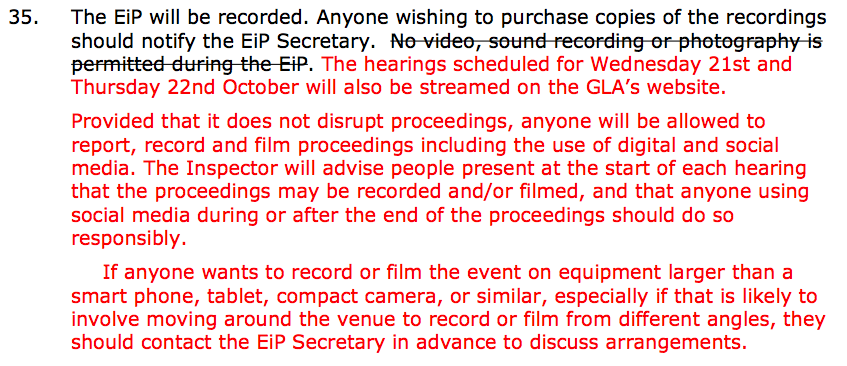
Since the first public hearings about GLA London Plans a decade ago, community groups and activists have protested against bans on photography and recording of sessions and complained that the City Hall webcast system is switched off during the hearings. Finally the Planning Inspectorate which runs the events (Examinations in Public – EiPs) and the Mayor’s office have agreed to meet these demands:
This page records activity up to mid-2018. The story since then is taken up on the front (news) page as blog posts and most recently by the page on the Examination in Public: Hearings / EiP / 2019
Vision statements
This is one of a number of pages/topics about the work of Just Space groups preparing positions and demands for what goes in the next London Plan. The “Next London Plan” menu takes you to them. Below (most recent first) is a listing of Just Space statements which cover the plans as a whole:
12 December 2016 Just Space response to the Mayor’s A city for all Londoners, his first statement of the policies he proposes to pursue in all his strategies.
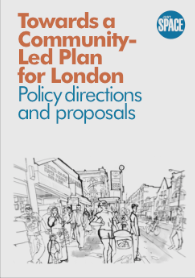
Towards a community-led London Plan: policy directions and proposals,
August 2016 This 74 page intervention is the outcome of more discussion by working teams of JustSpace organisations and another conference, all building on the February document below. Download: Just Space A4 Community-Led London Plan
Towards a community-led London Plan: ideas for discussion and debate. A 24-page A3 newspaper launched in Feb 2016 is here to download.
Community Vision – this is the summary of demands and proposals which emerged from the July 2015 Community Conference. A draft has circulated among participants and comments incorporated in this (October 2015) version. The Vision can be downloaded as a PDF file: https://justspace.org.uk/wp-content/uploads/2015/10/jsvisions20152.pdf
Comments may be made on the separate topic pages. This page has comments switched off.
This page and its sub-pages record the work done by Just Space in the years leading up to the Examination in public of a new draft plan in 2019:
The main work of Just Space and its member groups is to develop ideas about what a London Plan would be like if it were to prioritise — or at least protect — the interests of its citizens, its environment and its smaller, interlinked economies.
Since 2000 when a Mayor for London was re-instated, citizens have been allowed to comment on the final version of each Mayor’s London Plans – and Just Space groups did that to good effect. With a new Plan under Mayor Sadiq Khan, Just Space was determined that London communities should take the lead in forming a plan at a much earlier stage.
In 2015-6 the work being done was aimed at feeding good ideas to the candidates for the Mayor & Assembly election. After the election we worked to shape research and policy development by the GLA planning teams, who were starting a full review of the London Plan and the Mayor’s other strategies.
Going backwards in time, here are some of the pieces of work:
(Summer 2017) Just Space wrote a concise statement of the Community-led Plan which the GLA invited us to submit for consideration in their evaluation of strategic options: part of the ‘Integrated Impact Assessment’ (IIA). A detailed agreed report of the 2 August meeting with GLA is here (PDF): JS LP IIA meeting 20170802
Just Space comments (21 March 2017) on the draft scoping study for the Integrated Impact Assessment of the next London Plan: Impact Assessment: is it real?
Topic-by-topic material on the many parallel engagements between Just Space or its various member groups with politicians and officers at City Hall up to 2018. The third tier of this menu lists these topics.
A provisional set of demands(“vision”) arising from the July conference and the earlier work of JustSpace, designed to inform the selection of the next Mayor and Assembly and the work of the City Hall planning team. (Released on 12 October 2015) and subsequent Just Space documents.
Just Space conference 10 and 11 July 2015 at the Bromley by Bow Centre
Programme: reproduced below together with content (being added as it becomes available). The programme leaflet can be dowloaded as a PDF here: JS conf prog 2015 m
The relationship between neighbourhood planning and strategic city-wide planning
David Farnsworth, founder member of Bristol Neighbourhood Planning Network, a voluntary self-help network of over 40 community groups JS Conference 2015 – David Farnsworth Localism & Strategy and Video
Workshop B: Community Technical Aid How can the technical expertise of of planners, architects and engineers be made accessible to communities?
Architects for Social Housing (ASH)
Concrete Action
UCL Engineering Exchange
Architecture sans Frontières
Panel: Just Space Economy and Planning Group – building other ways of thinking about London’s real economy
Facilitated by Lucy Rogers, East End Trades Guild
Michael Edwards – overall strategy JS conference – Economy issues and Video
Eileen Conn Video and Roy Tindle Video – Losses of employment land and workspace
David Fell – greening the economy Video Discussion: Just Space conference 2015 Friday 6 Economy notes
Workshop: Overcoming the fragmentation of environmental issues in London Planning
Case studies from interviews with groups campaigning on food growing, air quality, biodiversity, green spaces and community energy (Xaviera) Link to report
Community Food Growers Network JS Conference 2015 – community food growers network
CPRE (Campaign for Protection of Rural England)
Audio recording MP3 of workshop:
Final Plenary
Ugo Hayter, Leigh Day Solicitors, Supreme Court ruling on consultation principles Video
Background briefing by FoE JS conf – Right to participate 2015 FoE
Lucy Rogers on the Reclaim.London manifesto and campaign Reclaim London Manifesto JSN july 2015 and video
Proposal for a recall conference at City Hall to present and debate policy proposals for the next London Plan on 4 February 2016
Volunteering to join working groups on the various topics
Videos thanks to Larissa Alves Martins and colleagues at Spectacle
Conference organisation support by Sue Ansarie, but she was not responsible for the late arrival of conference documentation.
May 2017. Member-organisations in Just Space worked on what should be in the next London Plan, due in 2017, following the election of a new Mayor in May 2016. There have been various workshops and meetings, plus support documents. A major community conference in July 2015, which is fully documented here, led to a set of broad demands, released here in October as Community Visions for the next London Plan: key demands [download JSVisions2015 ] Subsequent meetings led to the two versions of Towards a community-led plan for London. (see Publications)
In 2017 Just Space has focused on using every opportunity granted by City Hall to be actively involved in the production of the Mayor’s various strategies, responding to drafts and so on. The story since then is taken up on the front (home) page as blog posts and brought together by the page on the Examination in Public: Hearings / EiP / 2019
Some of the supporting documents have been prepared with or by groups of students in UCL, guided by Just Space member organisations. These can be downloaded here.
Just Space has told the GLA that a good infrastructure plan for London and its wider region would be a great innovation — but this is not it.
In a document of 6 November 2014, to which many Just Space organisations contributed, and which draws together our thinking and evidence over recent years, Just Space said:
a. long-term planning for infrastructure is a good thing;
b. this is not a good example of planning, however, because…
c. it appears to be based in investor demands rather than Londoners’ needs;
d. the Board proposed to oversee implementation has no community representation and important questions concerning London’s governance are not addressed;
e. removing Infrastructure issues into a relatively private sphere means there is much less public scrutiny than we have for the London Plan with its EiP system;
f. there are methodological failings in the forecasting which prevent this plan from being an exploration of alternative futures;
g. equalities dimensions are comprehensively missing;
h. reducing the need to travel has insufficient emphasis, indeed the anticipated concentration of jobs in the centre alongside the sacrifice of employment space in the suburbs would take London in the opposite direction.
We do not consider that the proposals in the Infrastructure Plan (IP) amount to a strategy for sustainable development for a variety of reasons elaborated below.