Category: Industry and the Economy

  • London Plan update

    London Plan update

    We hear, indirectly that the GLA’s public. consultations on the next London Plan are to be delayed. A ‘High Level Strategy Paper’ had been promised for March 2025 as the first step in this consultation. Now we hear that it will be April.

    This news comes via someone who was at a meeting of the All Party Parliamentary Group on London which took place on 4 February despite not being mentioned on the relevant web site. If anyone has more information please get in touch.

    Meanwhile City Hall will be launching a London Growth Plan. This follows a document Towards a London Growth Plan which is already published at https://www.london.gov.uk/programmes-strategies/business-and-economy/mayors-priorities-londons-economy-and-business/london-growth-plan

    This link now redirects to the actual growth plan. Towards… (it) has disappeared.

    M.E. 26 July 1015

  • Defend our markets

    Defend our markets

    The enormous importance of street markets is often not appreciated. They provide the cheapest food, often the freshest food, social engagement among customers and traders and employ a lot of people. But they have been coming under relentless pressure from developers and often from the councils which manage or regulate them. This conference is supported by Just Space and should help those all over London in the defence of their markets.

    Learning from East End Street Markets

    1-day conference

    Date: Monday 21st August 2023, 10am-5pm

    Place: Hason Raja Centre, Whitechapel E1

    One-day conference learning from the historic East End Street Markets: the threats, the challenges and what community value means today

    The post-Covid 19 cost-of-living crisis has shown the importance of street markets for economic resilience in London’s embedded communities, yet East London’s historic street markets are increasingly under threat due to land speculation, changing public policies and shifts in consumer behaviour.

    This conference follows on from June 2019’s ‘The Future of London’s Street Markets’ held in Brixton. We will hear from East London’s longest standing market campaign, the Friends of Queen’s Market (Newham) to identify future threats and key issues facing markets in ‘ethnic majority’ areas of London.

    The Just Space Network’s Community-led Recovery Plan and the University of Leeds research findings on the community value of street markets (2022) will set the grounds for afternoon workshops, with input from East End campaigners facing pressures from the financial city and hardline gentrification.

    Afternoon group workshops will examine the current position of street markets in understanding the historic East End, its diverse communities and evolving landscape, as places that foster community cohesion to address isolation, provide affordable food for healing and wellbeing and examine the threats to market livelihoods today.

    BOOKING: Free to attend. Booking essential. Limited places. Book your place through this Eventbrite link: http://streetmarkets.eventbrite.com and there is a video at

    checked M E July 27 2025

  • M88 Centres 15 May

    M88 Centres 15 May

    EiP 15 May Notes

    Draft London Plan Examination in Public (EiP):
    Town Centres, High Streets and retail policy

    Warning: Just Space and UCL are trying to make available some sort of record of what happens in the EiP for the benefit of community members. Notes are being taken by students and checked/edited so far as possible by more experienced staff and others. Neither Just Space nor UCL offers any guarantee of the accuracy of these notes. If you wish to depend on what was said at the EiP you should check with the speaker or with the audio recordings being made by the GLA. If you spot mistakes in these notes please help us to correct them by emailing m.edwards at ucl.ac.uk 

    Admin announcement from GLA: Won’t be individual responses from GLA on comments made in the EiP. There will be a vresion of the draft plan consolidating ALL the suggested minor amendments, but no date announced.

    Panel questions: M88. Is the town centre network set out in the Plan justified and would it be effective in ensuring that identified needs for main town centre use developments are met in appropriate locations in accordance with national policy? In particular:
    a)  Is the existing town centre network classification of (i) international, (ii) metropolitan, (iii) major and (iv) district centres illustrated on Figure 2.17 and set out in Table A1.1 justified?
    b)  Given the definitions of the classifications of town centres set out in Annex1 and Figure 2.18, is the identification of centres other than “international” and “metropolitan” in the Plan justified and consistent with national policyrelating to town centres and compliant with legislation relating to the purpose of a spatial development strategy?
    c)  Are the future potential changes to the town centre network illustrated on Figure A1.1 and set out in Table A1.1 justified?
    d)  Are the classifications, as set out in Table A1.1 and described in Annex 1, for (i) night-time economy functions, (ii) commercial growth potential, and (iii) residential growth potential justified?

    Matter M88 town centre network.GLA opens: Longstanding approach to have this hierarchy in the Plan. District town centres allows more comprehensive evidence base. Goes through potential reclassification of Stratford and Shepherds Bush. Shift towards the polarisation of retail.

    Sometimes high streets have no ‘town centre’ designation. Boroughs should look closely at high streets and consider their designation. Could also designate them as business areas or local parades.

    Panel: “Consider the protection of out-of-centre high streets” is not very clear, make a note to change it.

    London Forum: Strongly support the whole approach to town centre hierarchy. Most robust set of policies in the whole spatial framework.
    A local detail on Night Time NT labels: South Ken NT1 designation is incorrect. Should be NT3.

    Just Space: Pleased to see inclusion of high streets in th policy. Key concern is the protection of workspace and local services to reduce the need to travel. Particularly in smaller town centres. Many high streets are not captured or protected in the Plan. Employment space is under threat from residential.

    In some instances classification lacks complexity and ignores the diverse rnage of centres we have. Green Street in Southall, for example, provides for many Asians from far and wide, and should be classified as international.

    Policy needs to be flexible to allow more specialist centres to emerge in London.

    Historic England: Would be helpful to have more clarification on high streets from GLA.

    Merton: Colliers Wood centre designation is unjustified because it is based on inaccurate evidence. Town centre classification only measured two sites, only measured two sheds. Should classify it as a district centre.

    GLA: Night time economy classification for South Ken is due to Royal Albert Hall.

    To Just Space, keen to encourage protection of workspace. SD7 does this. Policy E1 too. Interested to hear more about the town centres that we may have overlooked but would expect Boroughs to do this better, health check can only go so far.

    London Forum: Classification will encourage an even greater move to A3 uses. Needs all the support possible to support retail functions.

    Just Space: On specialisms, would like to see recognition of diversity of ethnicity. Queens Market East Ham and Ridley Road market are other examples.

    Chair:Moving on to M89-90.

    Panel questions: M89. Would policies SD6, SD7, SD8, SD9 and E9B provide an effective strategic framework for the preparation of local plans and neighbourhood plans relating to town centres and all types of main town centre use development (including bulky goods retailing), that is consistent with national policy?
    M90. Is the approach to development management set out in policies SD6, SD7, SD8, SD9 and E9BA justified and consistent with national policy and would it be effective in terms of:
    a)  ensuring that identified needs for all forms of main town centre uses, including bulky goods, are accommodated in appropriate locations in accordance with national policy;
    b)  requiring large scale commercial development (over 2,500sqm of A Use Class floorspace) to support the provision of small shops and othercommercial units (including “affordable units” where there is evidence oflocal need); and
    c)  supporting Policy GG4 “delivering the homes Londoners need”?

    GLA: About 400k m2 of comparison goods floorspace in the pipeline. We don’t look at these too closely because there are many uncertainties.

    Retail is a main town centres use and should dominate there.

    Could have gone further on out-of-centre conversion to residential use.

    No definition of affordable commercial workspace in plan. Un-affordability tends to be concentrated in inner London.

    Smaller units inspired by High Streets for All publication.

    Further suggested change from last week under policy SD7 welcomed by Just Space but might have further comment after study.[ 2.7.3A It is important that boroughs plan positively to meet the needs of their communities. Being able to access convenience retail, specialist shops and services is important for supporting the daily lives of Londoners and for creating and sustaining strong and inclusive communities. Many town centres and high streets and marketsserve specific communities, for example they may provide specialist food or clothing that meet the cultural or religious needs of one or more particular group often drawn from wide geographic areas. Boroughs should use their evaluation of the area and engagement with local communities and stakeholders to draw up local development plan policies, designations and site allocations, and develop town centre strategies that seek to meet the needs of their communities. ]  The words in red in the above are insertions which Just Space suggested in an email at the time. They may or may not be accepted.


    Sainbury’s: Presumption against out-of-centre retail development. Inconsistent with national policy. Currently looking to redevelop Hendon centre on Edgeware Road. ‘Discourages’ should be removed from the policy.

    Accessible Retailing: Plan is not supportive enough of out-of-town retail. Rise of online is making retail parks more attractive to chain traders who are trying to compete. This means that out-of-town should not be considered as soft targets for change of use. Out-of-town and retail park retailing provide roughly a third of retail employment.

    Just Space: Our position is from the standpoint of reducing the need to travel and meeting more employment needs locally. Extremely glad to see the inclusion of high streets. Experian report indicates a range of floorspace demand, GLA takes the top of the range. Parts of centres which are lost in ‘consolidation’ are often the secondary and tertiary areas where ethic minority, small and innovative businesses flourish. Concern that there will become just primary cores of town centres remaining.

    JS comment To Accessible Retailing, retailers have no need for the airspace above out-of-town retailing centres, which could be turned to housing or other uses.

    Just Space Lucy: market policy is not effective (E9) or justified. Evidence that is available has not been used. Markets Board report on markets not reflected in the policy. Referring back to the document is not sufficient. No mention of traders. Preserving markets like Ridley Road not possible with current paragraph in the Plan.

    ‘Support’ is the only word used. Strategic role needs to be elaborated on, only role mentioned is a tourist strategic role. Searchable list of markets should be referred to in the plan, instead of just naming a few. Wording for the protection of markets should be included.

    Markets are being threatened; emphasis should be on keeping the existing ones. Key is protection and understanding of the role of markets within town centres and elsewhere.

    London Forum: Clean up the policy.

    Assembly Planning Committee: Comments on SD6 and SD9. We support the need to promote residential development in town centres but policy needs to provide adequate social infrastructure where this happens. And mayor should include support for community engagement. Just Space mentioned 47% employment within or near high streets, we have concerns that this type of use needs to be protected in policy. SD9 should be strengthened, to require re-provision of non-designated employment sites.

    GLA: Contracting demand for retail from Just Space, the GLA is closer to Just Space than it appears on this, we do talk about the demand issues in London. For retail, we think that the comparison goods will continue to decline. We’re careful to state ‘declining demand’. We’ll support town centres through diversification (although unclear what type of diversification).

    On markets, we take a similar approach to the Markets Board.

    On London Forum: we do recognise the importance of social infrastructure in town centres, SD9 includes wording around community engagement.


    Afternoon

    M91, hot food takeaways:  Panel questions

    M91. Are policies E9C and E9D relating to proposals containing hot food takeaways justified and consistent with national policy and guidance about healthy communities and limiting the proliferation of certain use classes in identified areas22. In particular:

    a)  Is the development of hot food takeaways and associated planning conditions a matter of strategic importance to London, or a detailed matter that would be more appropriately dealt with through local plans or neighbourhood plans?
    b)  What evidence is there indicating high levels of obesity, deprivation and general poor health in London?
    c)  What evidence is there of over-concentration and clustering of hot food takeaways in London?
    d)  Would restricting development of hot food takeaways within 400 metres walking distance from the entrances and exits of existing and proposed primary and secondary schools positively support the delivery of policyGG3 “creating a healthy city”?

    GLA: Only four London boroughs have obesity levels below the rest of England. Strategic approach is needed – not at the individual level. Concentration of takeaways around schools is worst in London.

    Only 5% of the meals on offer from the main 6 fast-food outlets are below recommended meal calorie level. Children less likely to go to full restaurants than hot-food takeaways.

    Boroughs don’t all have the resources to conduct their own research on this. This is why they’ve asked the mayor for help on this.

    Evidence that if there are lots of takeaway outlets that are further away they are less likely to be used by schoolchildren. Where the balance is mixed and not just fast-food there is likely to be a healthier diet.

    Waltham Forest have not published any data on changes on behaviour with regards to their fast food policy. Childhood obesity has increased there, but might have increased more without.

    Policy could potentially have an impact on minority ethnic businesses, and in some areas would have a disproportionate impact. Won’t result in closing down vendors.

    Street markets are beyond what can be controlled with this policy.

    Proliferation of takeaways outside school zones is a potential unintended consequence. But local authorities have policies that can control clustering under E9BA9 and also E9D.

    A1 uses provide a broader range. If we see a significant impact and they change their use type we’d have to address that in a future London Plan.

    London First: E9C is a blunt policy tool, takes an overly simplistic approach to a complex problem. Unhealthy options are available from A1, A3 and A4. Ban targeting just A5 will not address the root cause. Prevents the healthier hot food takeaways coming forward, which is a growing sector.  Plan is overly detailed and prescriptive. It sets an unwelcome policy precedent. More nuanced geographically specific approach needed, set by Boroughs.

    British Retail Consortium: Support the statements of London First. In effect this is a London-wide ban. It’s anti-competitive, locks in place existing A5 uses and makes them more viable. Much better to have a locally focused approach. Croydon found similar policies unsound. Support the healthier catering commitment (HCC), more targeted and effective direction to take.

    KFC: Would like first two sentence of E9C to be deleted. Perceived unhealthy foods are also available from A3 and A1 outlets. Unintended consequences would impose a blanket ban, would prevent healthy hot food vendors. Not consistent with national policy, which is to promote competition and town centre uses. Best approach is to add A1 and A3 to apply to the HCC. Include the HCC to the appendix so that it can be scrutinised.   A1 and A3 suppliers constitute 80% of children’s out-of-home calories.

    McDonalds: E9 a blunt instrument. Oxford Study did not find any strong evidence for proximity limitations. Support the HCC going forward.

    Accessible Retail: Causal link has not been established.

    London Councils: Support GLA’s position. Welcome profile raising of HCC across food businesses in London.

    SHA London: Consider this to be a strategic issue for the London Plan. Obesity emergency is deep in London. Higher than in other wealthier countries. Sutton Council prides itself but has childhood obesity of 32%. One of the proposals is to put more weight on the HCC. One problem is that not enough research is done into this. Three supplies for all the independent takeaways. Hard to get independent outlets to follow HCC – can’t rely on HCC.

    Research from SE London, parents saw fast food outlets as a problem. Mayor has to understand how to incorporate grass roots voices.

    Just Space: Welcome the attention to concept of deprivation that has been associated with childhood obesity; need for systematic approaches to food and health. Wonder if it is mainly a symptom of deprivation and whether targeting a symptom will solve it. Independents from a range of ethnic communities (Caribbean, Moroccan etc.) not much attention to relationship between these and their neighbourhoods.

    Want a more nuanced approach to hot food takeaways, think it should be strategic at London level. But need to go back to the drawing board to see how it relates to deprivation and inequality.

    Hot food outlets do provide jobs. If you do restrict them, you’ll take-away employment options for people. International centres are underpinned by hot food outlets (eg McDonalds, Westfield). With children spending their leisure time in these types of centres they are likely to consume these foods – there is a contradiction from the GLA here by supporting larger centres.

    Guy’s and St Thomas’ Charity: Supportive of the policy. Deprivation gap in obesity is significant. Causative associations will always be limited. Important to look at lived experience in these cases, in our study issues around money and time availability influence families to choose less healthy options. Often on journey from school to home that visits are made.

    London Forum: NPPF talks about restaurants without making the distinction. Most of the main representatives here operate with A3s, not A5. At what point of the decision making do you add the HCC? Can only make it when the planning decision is being made.

    British Retail Consortium: Problem with the policy, it is not about being near schools but across most of London. London has a high density of everything.

    KFC: New policy will impact smaller independents – this is why it should be an annex to the plan so that others can make comments. GLAs evidence, although good, does not link together to support the policy direction.

    McDonalds: Our locational strategy is directed by high footfall and high population, not by schools. Many of our restaurants have mixed A3/A5 designations.

    London Forum: Thinks that the policy is tractable.

    Just Space: No overall vision for food in Good Growth, there should be. Also, what is intended to replace the hot food businesses?

    KFC: A lack of causation evidence is not unavoidable, the GLA could conduct longitudinal studies.

    Guy’s and St Thomas’ Charity: Don’t forget the urgency of this issue.

    GLA: The government has supported our approach. More deprived areas have higher densities of hot food takeaways. KFC and McDonald’s – you’re looking for gold-plated evidence, this is unrealistic.

    Notes by Sam Colchester, mainly.

    Back to EiP main page: https://justspace.org.uk/hearings-eip-2019/#M88

  • M60 Affordable workspace March 20

    M60 Affordable workspace March 20

    Warning: Just Space and UCL are trying to make available some sort of record of what happens in the EiP for the benefit of community members. Notes are being taken by students and checked/edited so far as possible by more experienced staff and others. Neither Just Space nor UCL offers any guarantee of the accuracy of these notes. If you wish to depend on what was said at the EiP you should check with the speaker or with the audio recordings being made by the GLA. If you spot mistakes in these notes please help us to correct them by emailing m.edwards at ucl.ac.uk

    Low Cost and Affordable Business Space (panel questions)
    M60. Are policies E2 and E3 justified and would they be effective? In particular:

    a)  Are they necessary to address the strategic priorities of London, or do they extend to detailed matters that would be more appropriately dealt with through local plans or neighbourhood plans?
    b)  Would they be effective in helping to ensure that the accommodation needs of all micro, small and medium sized businesses, including those wishing to start up or expand, could be met in all parts of London?
    c)  Or would that objective be better achieved by market forces in the context of other policies in the Plan, including E1A, E4A, E4H, E5C and E6, as well as any relevant policies in local plans and neighbourhood plans?
    d)  How would policies E2 and E3 affect the implementation of policy GG5 “growing a good economy”?

    A brief note from outcomes of 20 March discussion on low cost business and affordable workspace.
    1.  The arrangement of speakers around the table (anticlockwise) was :
    •  .GLA officers
    • Assembly members  (Pro affordable workspace)
    • London Property Alliance, London First, Canary Wharf Group , Workspace group (Anti)
    • FSB, London Forum, Vital OKR, JustSpace, Hear   (Pro)
    2. Inspector indicated he didn’t want repeat of written submissions but additional material to address his points and to improve clarity. Policies E2 and E3 were taken in turn separated by a break.
    3. Panel took input for E2 Anti clockwise.
    4.   The GLA came under pressure from inspector to explain:
     a) Why use classes B2 and B8 were excluded.  GLA made it clear that their approach had been to draft policies according to use class:  E2/E3 = B1 use class, E4-E7 policies were B2 and B8.
     b)  lack of clarity on how they were meant to be implemented: Development plan documents, planning management policies or on case by case basis?


    The anti group made three main points: –
     – E2 refers to local effects so need to be dealt with locally.  It’s not a strategic issue  (and they didnt buy evidence of need for policies),
    –  LPA arguing it shouldn’t apply to CAZ
     – low cost business space was generally offered in old tired buildings so this was condemning developments to remain old and tired
     – policy was too prescriptive.
    The pro group made a number of points:
     – The evidence points to lack of low cost business space
     –  policies were strategic (and undeveloped from NPPF), and prescriptive nature recognised differences in application at the local level, disingenious to say localised effects mean a local policy is needed
     – E2 needed to be extended to B2 and B8
    – Assembly members came out strongly in favour of policy
     – redevelopment could occur and still provide affordable space: the anti group had already indicated there was a range of prices offered
    Overall Inspector seemed to be leaning towards:
     –  the policy might present an additional barrier to redevelopment
     –  the policy application of : “where it can  be demonstrated that there was a shortage of low cost business space, it should apply to all types of business space i.e. not just low cost business space
     – needed to include B2 and B8.
    Anti groups didn’t do well on this one and raised the prospect of restricting the application of policy in practice using viability assessments
    E3  (speakers taken clockwise after GLA questioned)
    GLA was under pressure to  explain how E3 A to F was meant to work (step by step assessment or simultaneously) and inspector raised concerns about clarity.
    Pro groups argued that there is market failure to address – lack of access and affordability.
    Anti groups argued the policy was wholly unnecessary, interference in market, anti competitive, smacked of state aid (so could be illegal) (workspace) no market failure to address and even if policy was adopted, it was too prescriptive and particularly E3 F was limiting. Workspace argued that if policy was adopted it needed to be more prescriptive (i.e. limited in its application)
    Assembly members argued strongly for links to GG1 and GG5.
    LPA managed to be made to backtrack by Hear and Just Space by saying of course there was a need to consider voluntary, community & third sector workspace in CAZ as part of strategic function of CAZ  (from which it follows this policy justifies providing affordable workspace in CAZ as well)
    Overall it seemed that:
    Inspector saw it could be implemented by S106 agreements, section F needed widening
    Inspector called for more references to evidence, saw the policy as needing to be evidence driven and called for probably a re-write from GLA to improve policy wording and clarity
    Overall a GOOD DAY FOR PRO LOBBY
    The anti lobby intend to look for ways to limit at the viability stage so this will be a key upcoming fight.
    Michael Parmar, Just Space
  • M62 Industrial land 19 March

    M62 Industrial land 19 March

    Warning: Just Space and UCL are trying to make available some sort of record of what happens in the EiP for the benefit of community members. Notes are being taken by students and checked/edited so far as possible by more experienced staff and others. Neither Just Space nor UCL offers any guarantee of the accuracy of these notes. If you wish to depend on what was said at the EiP you should check with the speaker or with the audio recordings being made by the GLA. If you spot mistakes in these notes please help us to correct them by emailing m.edwards at ucl.ac.uk

    Panel questions:  M62. Are policies E4, E5, E6 and E7 consistent with national policy and would they be effective in helping to ensure that sufficient suitable land and premises are available to meet the quantitative and qualitative needs for all foreseeable types of industrial15 activity over the plan period? [Reference to “industrial” or “industry” in these matters includes all types of economic activity referred to in policy E4A(1)-(9A) incorporating the Minor Suggested Changes.]
    In particular: M62. Are policies E4, E5, E6 and E7 consistent with national policy and would they be effective in helping to ensure that sufficient suitable land and premises are available to meet the quantitative and qualitative needs for all foreseeable types of industrial1 activity over the plan period? In particular: (sequence changed in final agenda, as follows):

    Need for industrial land

    a) Are the industrial job growth projections and associated estimates of land and floorspace requirements justified?

    e) Is the approach to assessing floorspace and yard space capacity set out in paragraph 6.4.5 – 6.4.5B based on existing floorspace or floorspace assuming a 65% plot ratio (whichever is greater) justified and would it be effective?

    Meeting the need for industrial land

    b)  Is the aim of ensuring no overall net loss of (i) industrial floorspace capacity and (ii) operational yard space capacity across London in designated Strategic Industrial Locations (SIL) and Locally Significant Industrial Sites (LSIS) justified and realistic, and would achieving that objective ensure the availability of a sufficient quantity of land and premises for industrial uses?

    c)  Are the borough-level capacity categorisations (“retain”, “provide”, or “limited release”) set out in Table 6.2 justified, and would the proposed approach ensure a sufficient quantity of land and premises in different industrial property market areas?

    d)  Are there parts of London where significant amounts of additional industrial land are likely to be needed in addition to that which is currently in use and/or designated?

    f) Is the approach set out in Policy E7D towards “non-designated industrial sites” (36% of total amount of industrial land2) justified and consistent with national policy?

    j) What evidence is there about the feasibility of delivering schemes on industrial land that would lead to the provision of net additional industrial floorspace along with the provision of significant numbers of new homes on the same site?

    E7F – wider South East

    i) Is Policy E7F, along with Policy SD2, likely to be effective in terms of facilitating the substitution of some of London’s industrial capacity to related property markets beyond London’s boundary, and would achieving such an objective contribute to the achievement of sustainable development?

    Effect of E4-E7 on meeting housing needs

    k) How would policies E4-E7 affect the implementation of Policy GG4 “delivering the homes Londoners need”?

    Are E4-E7 effective, or unduly detailed, prescriptive and complicated

    1. g)  Would policies E4-E7 provide an effective strategic context for the preparation of local plans and neighbourhood plans?
    2. h)  Are policies E4-E7 clear about how they would be implemented through the determination of planning applications, particularly in terms of the role of“planning frameworks3” and “a co-ordinated masterplanning process incollaboration with the GLA”, and the relationship between policies E5D andE7B?

    GLA (Gerard Burgess) opening, stressing diversity in economy, too much has been lost in past, demand will grow. No net loss of floorspace is the key policy. Plan to intensify, but release some, subject to careful planning. Complex issue.Recent minor changes deal with yard space and vulnerability of non-designated industrial land.

    Starting with demand/need forecasts

    Panel: Is decline of manufacturing demand reversing? A: employment-based projection doesn’t suggest growth in employment; P: shouldn’t population be the main determinant of warehouse/logistic space demand? A: We do expect econ growth to be big influence but not directly proportional. 0.4% p.a. is our best estimate. Overall need for +100 ha turns into -230 ha because of the amount of vacant land (AECOM), much in estuary.(Total 10% vacant, compared with the 5% needed for market to work.)[Lots more detailed number-work. Listen to the audio for all of it.] Table 5.25 in SHLAA shows switches to housing. [Suggest check numbers with GLA written statement.]

    Panel: plot ratio 65% assumption (90% within inner London)but Panel says many recent developments have lowed plot ratios. A: further minor change introduced to allow for exceptions where more yard space really needed. P: how does urban greening factor fit? A: we did ask consultants to consider that.

    Nicky Gavron (Assembly Planning Committee): 1. the plan has office growth projections for each borough; why not for industry?
    2. 230 ha for release: does this take account of PD rights? Does it take acccount of new and emerging indusries? 3. New thinking about supply and demand audits: who will be responsible for them? 4. Are the non-designated sites part of the 230ha?

    Peter Eversden (London Forum) About 1/3 of ind land is unprotected and we are concerned. In East London the expansion is going to have to be carefully considered. Break of bulk is land-hungry. Statement on OAs makes us worried about what the OAs are going to produce. What is the balance between building upwards and sideways? All very well for GLA to talk of ‘plan-led’ approach but boroughs are not being guided on whether or how to study/understand these things.

    Ferm (Just Space): it does seem that there will be shortfall. Our comment is that evidence base broadly OK but not satisfied that firms will be able to cope.

    Prologis:  How adequate is the treatment of online sales, esp for firms which don’t have physical shops (Ocado, Amazon, etc) And can the distribution system cope with the massive population growth.

    Y?? More on growth of online sales. Worried that Thames gateway is miles away from where the consumption is. Transport plan not synced with LP.

    FSB: affordability is the key concern for our members. Firms simply can’t afford the space on offer. They employ local people. No good telling them to move from Paddington to Dartford! And no monitoring.

    Freight Transport Assn: more vans replace vast numbers of cars. Plan understates need for yard space: need won’t be met at 65%. Lots of the industrial land is in the wrong places.

    Amazon: (very hard to follow speaker) …

    (Barrister on behalf of) LB Bexley which is promoting a riverside site in OA. Land is SIL. 90% protected designations. They want to resist the growth in demand which is based on the rate of growth between 2000 and 2008 which was a boom period.

    BRENT LB: Not enough detail in plan to support the classification of boroughs to levels of release. Thinks demand is overestimated; logistics sector needs particular types of sites which we just don’t have much of. Why can’t more of the need be met outside London?

    London First: So much uncertainty. Plan needs much better and more frequent monitoring.

    ??Z we think intensification is going to be rare. Can’t be relied upon. Ditto co-location will be very limited. Suggests 40-45% plot ratio more approriate. There must be NO NET LOSS OF LAND. Finally how does “no net loss” actually work? no way to tell as you go along whether it is working.

    GLA responds: Audits: mix of GLA and boroughs; + sometimes developers.
    PD rights were considered by AECOM and boroughs would need to look in more detail.
    New sectors: we do expect more data centres; e-commerce is a major growth area…
    Monitoring: KPIs include annual review of “no net loss” policy.

    How would the needs be met?

    GLA (burgess) defending GLA adoption of floorspace and yardspace as both important and plot ratio (the ratio of the 2) a key indicator of efficiency.

    “No net loss” policy. Panel seeks clarifications…  GLA Says it could be applied to individually to SIL and LSIS sites, or at a borough level where land swaps could apply.
    [SIL=Strategic Industrial Land;  LSIS=Locally Significant industrial Sites.]

    300 ha of Thames Gateway releases, only 50ha actually embodied in plans or permissions.

    Note that boroughs can choose to designate more non-designated sites to protect it.

    Panel: intensification of industrial sites: GLA: Yes. This is the main source of new supply. Panel: how confident can we really be? GLA: the GLA studies of intensification and the LP viability study have both demonstrated that it can be done ‘viably’. Jennifer Peters: if we find it isn’t working in a couple of years we’ll have to consider a review of this policy. “We’re good at reviews” – laughter all round. Burgess: our pilot projects are designed to demonstrate to developers and occupiers what can be achieved.

    Bexley: we need more flex in plot coverage to reflect our special geographical situation”: bad access needs staff parking space // flood plain requires???
    Notes tightened approach to industrial land contrasting with removal of numerical controls on density and replacement by “design considerations”.
    We’ll be unable to meet our housing targets of industrial land is so strongly connected.

    Brent: Most of our developments are 45% plot ratio.  Mixing of uses is crucial to the viability of workspace provision. Why can’t we have mezzanine floors? We’ll have t quadruple the floorspace on the sites which DO come forward to meet our industrial space target.

    Enfield: we have 3rd amount, 2nd in low vacancy; and we are classified as a “provide” borough in the plan. Massive requirement if we are to do this. We try to do “no net loss” but…   London Plan viability study shows Enfield in lowest value band which is why viability is so poor. See our statement. Impossible for us to meet all our needs we need a borough-wide approach, including green belt. (A very lucid and powerful statement – ed)
    Some of our green belt adjoins M25

    Sutton: Table 6.2 hasn’t prevented excessive losses of industrial land. It doesn’t work. Furthermore there are silly cross-border problems where a SIL overlaps boroughs which have different classification. As yard space shrinks, staff parking will be displaced on to spine roads but that will just congest already-inadequate capacity.

    H Group: No net loss will drive coach and horses through Bexley local plan. High vacancy rates should put Bexley in “limited release” category. Greenwich is supposed to provide more floorspace….  Grave doubts on feasibility.

    Amazon: high plot ratio not an indicator of efficiency! Yard space can be a big contributor to efficient operation – for storage, staff parking, etc.

    Ballymore: we can make co-location work, best with SMEs.  But 65% is a challenge. Combining all this with the 50% thresholds on viability fast track.

    DB Cargo: (huge operator of freight trains, and in London esp for construction-related traffic. 40% of aggregates come by train; Take 70 HGVs off the road per train. Need for rail freight sites to support handing, sorting and processing of aggregates and construction wastes; many of our customers want to be on the same sites. Welcomes agent of change policy but… boroughs are very inconsistent in treatment of rail freight. DB believes specific policy support required for rail freight (as for water freight).

    FSB: nothing here for micro and small business. Intensification and c0-location forces up costs and rents. Most of what gets built is unsuitable for re-making and re-working, and much is too far away.

    Freight Transport Assn: Suspect that some of apparent vacancy may be land banking in hope of switch to residential use. Small pockets of land very important indeed, including a lot of non-designated land, including CAZ.  Logistics sector works antisocial hours so workers need to get to work all night and thus car parking often essential. Don’t push the big sites too far out, keep the small sites in the centre.

    xx  Board..   Intensification should just be treated as a windfall.

    HBF: on the supply side: interested by Panel’s parallel with small sites housing policy:  like that, this is a high risk strategy. Rather theoretical, not required by national policy. 45% of housing supply is going to come on land not specifically identified (small sites + intensification and co-location in industry). Mayor desperate to avoid strategic review of green belt and is proposing an unsound plan. This is not the right balance in terms of sustainable development. Development industry s not geared up.

    London First: monitoring …. flexibility … our members concerned about the risks of co-location and they would like some financial incentives to do it, especially H6.

    NNN  We think much more land needed to reach equilibrium. Doesn’t like the “exception” system for the plot ratio. Multi-level concept awaits proof of concept, even at Heathrow. Could maybe do it on green belt where land cheaper.

    SEGRE: Multi-level unproven.  We have delivered (millions…) and average plot ration has averaged 45% (range 20 – 65). Lots of examples and case stories of tenant resistance to high plot ratios. Multi-storey will be only in a few places.  We are doing a co-location in Hayes, with green space, we demolished 1m sq ft factory, but couldn’t have done it with no net loss. Beside he H+H station so it worked.

    Just Space, Kaymet / Just Space.  More precision needed: ancillary offices, why exclude mezzanine; operational yard ARE part of operational space. Borough benchmarks based on ALL industrial land, and no-net-loss should apply to that.  The policy must apply to all 2500 ha of non-protected industrial land. We being asked to trust the GLA that they and boroughs will become tough SOON.  In our area (Southwark) they have clearly decided that the new LP is too imprecise to prevent them from reducing … (lots of figures) This is a huge potential loss which the LP is not strong enough to resist.  LP must get clearer and stronger. No sign of City Hall showing southwark a red card.

    London Forum. Precautionary Principle should apply.  – co-location should be treated as a windfall.  ALL booroughs should pursue no net loss. There should be reference to the Mayor before ANY release. Every London plan has failed on this. Need also to pre-empt Brokenshire threat to Permit redevelopment of offices as housing!  No net loss should apply also to ex-transport and ex-utility land.

    Gavron: Assembly cautiously agree with no net loss.  We are cautious because of the huge losses of LSIS in recent years. Densities must be increased in industrial areas. Paris examples as well as Tokyo. Has to be an early review. Assembly aware non-designated sites are behind high streets all over London. Huge raft of innovation and local employemnt. In aggregate they are strategic AND they provide the footfall for high streets. Switch to residential damaging.  PD rights only introduced for industry in late 2018 and we don’t know the outcomes yet. Could be repeats of the wholesale evictions we had with  offices. The encouragement to switch non-designated employment space to housing should be removed, or qualified by 100% replacement.  Remove alse the ‘market signals’ passage because it’s an incentive for  owners to keep premises vacant.

    GLA response:
    Viability: refs to LP Viability Study and pilot studies.
    on 65% SEGRO and other objections on plot ratio insists…
    may not be possible in all cases. But overall aim is to increase efficiency…
    Borough categorisations come from strategic studies for property market areas. Bexley comes from the supply/demand studies, as does Greenwich.
    Non-designated sites: yes we agree they are cumulatively important. Boroughs can add more.
    Minor changes have tried to tighten up on phoney attempts at marketing.

    Relations with surrounding regions. GLA explains policy which would govern any “substitutions” in E7F with wide south east. Representative of S E authorities says some of them are worried what it would mean in practice: clarify job types / types of sites / infrastructure help / how would firms be encouraged to move? Enfield: what would the Mayor’s role be? Enfield is dominant industrial district in its market area…  lots about Broxbourne, Welwyn-Hatfield… We do not consider we’ll succeed with this: the answer is NO.

    Effect of all this on housing supply. 8% of dwellings in SHLAA housing capacity is on designated industrial land. 288ha. + Mixed use (T 5.25) is more like an approx estimate. Enfield: GG4: we can’t meet our housing targets with these constraints. supply of premises for SMEs will dry us with rising rents;  there will be losses of diversity as large occupiers push out smaller and traditional firms; push out of London would lengthen trips… Less homes  or OA reduction or re-categorise us…  //  Bexley barrister again, core strategy has 50ha of industrial land for housing. No net loss would be a heavy millstone round their necks. How can we expect developers to complete employment development before even starting any housing.  Newham: we can’t meet housing targets without taking more industrial land or pushing up densities on housing sites already identified. Brent also very concerned about collision between industrial land policy and housing targets.

    GLA Gerard: affordable workspaces policies deal adequately with protection of SMEs etc (ref Enfield).

    Just Space (Ferm): 2 remaining key points. Policies as worded undermine NPPF “Plan-Led” approach…  we ar evry concerned by “Master Plan” as legitimating a proper plan. There needs to  be an insistence on statutory plans as a precuror of land loss. Note also the conflcit of interest between Mayor as a party to the developments and Mayor as decision make on referral cases.
    Monitoring doesn’t work yet.  Try quarterly reporting?

    Prologis: …..?

    M63 Freight, Deliveries and Servicing

    M63. Would Policy T7, along with policies E4-E7, provide an effective strategic framework to ensure that suitable sites and infrastructure are provided for all types of freight, deliveries and servicing in an integrated and sustainable manner in all parts of London? In particular:
    a)  are all of the requirements of Policy T7 necessary to address the strategic priorities of London, or
    b)  do they extend to detailed matters that would be more appropriately dealt with through local plans or neighbourhood plans?

    GLA team
    josh gibson GLA and AN Other (inaudible)
    ??inaudible TfL
    joe boyd-wallace TfL

    Panel: §10.7.2 says ‘regional consolidation…at the edge of London are needed, coupled with with micro-centres….” but then partly deleted by minor changes.??

    GLA Gibson: as London grows it’s crucial to supply the growing city and its population while fostering efficient use of road space, especially by bikes, walking and buses… and so on.

    Just Space (Del Brenner) Title should be freight industry. T7 omits taking traffic off the roads. Re-delivery is mentioned. But nothing on empty and half-full trucks moving round. (Inspector interrupts to say LP only concerned with land use.) Making better use of waterways is crucial and this is not dealt with. Thames and 100 miles of canal are omitted and should be reinstated. Should also emphasise coastal shipping and short-haul  traffic within London.

    Sainsbury’s 2 issues. Agents of change and how it affects on-street servicing. Reading the policy suggests all servicing should be off-street. Deeply unhelpful. Not appropriate in a strategic plan. Should be in local plans and then dealt with in development management. Inhibits investment. NB also it’s too vague: does it include loading bays specially designed. Majority of our shops are in second-hand / old premises. Plan should just talk about minimising conflict. Servicing functions of established users should be protected by Agent of Change principle.

    UK Warehouse association. T7 too detailed. Omit it, and cross-refer to MTS and Freight Strategy.

    Road Haulage Assn. Some needs for detail. HGV traffic has dropped 4% but vans up 27%n causing more congestion on red routes. Where to park for rest breaks? Where to stop for pre-delivery? Places all gone. Seek consistency for pollution charges between cities. NIC report of dec 2018 refers to “freight blindness”.

    Freight Transport Assn: T7 is too detailed. Averse to borough patchwork  of freight policy.  TfL need to play strong role.  The vast majority of vans on the road in London are servicing – mobile toolboxes – and wrong to apply policy which assumes they are all deliveries of internet orders.  Very few places where drivers can take their statutory breaks, especially securely.

    FSB: T7 too detailed.

    DB cargo: want yet more changes to emphasise environmental benefits of rail freight – esp for aggregates and construction waste/spoil. Word rail-head should be replaced by ‘rail-linked…” because we need vertical integration onsite  including space for DB customers. Danger of adjacent residential users inhibiting rail freight terminals. Need a specific policy on rail freight and we have drafted one.

    London Forum (Andrew Bosi) crucial to shift freight to environmentally better modes. Also omitted: benefits via freight as network electrified – enabling freight to be hauled by electricity too.

    2 Academics (from Southampton & Westminster Professor Tom Cherrett) support freight strategies. NOTE data missing to enable flows to be understood. Need better methods for forecasting freight and servicing trip generation. Scared that Agent of Change principle could prevent the re-opening of freight sidings where housing has been built. Need to review and update all the time restrictions. Some are archaic.  Also important to work on how delivery/sorting/storage/collection etc should be integrated into residential and non-residential buildings.

    [note taker comment: is this a unique example of academics commenting on a bit of the plan spontaneously – not as representing others or as contractors to GLA. LSE London is rather different.]

    John Cox Just Space: today Govt announced on last mile…  and (another topic). Don’t take anything out of T7 because it makes for consistency across London.  Seeks clarity on why the discussion is counterposing HGVs against floods of vans.   Calls for railway tracks/routes/sidings on private land should remain parts of protected railway networks.

    GLA responding:

    Title of policy: (waffles without answering). On whether it’s strategic: gives reasons why it’s strategic (but doesn’t discuss the level of detail – e.g. the Sainsbury’s point). TfL: Sainsbury’s point is a long-run issue. It’s only inviting developers to try to get trucks off street. [Sainsbury’s: that’s not what the Plan says!] TfL seems to be agreeing to soften it. Sainsbury’s being very tenacious about this.  Similarly DB Freight being dogged in their determination not to be constrained by new passenger proposals which are merely “planned”.

    [comment by note taker:  nobody has mentioned the proposal to move Smithfield, New Covent Garden and Spitalfields markets all on a former  power station site at Barking.]


    Back to EiP main narrative page


  • M9 notes 16 January

    M9 notes 16 January

    London Plan EiP Week 1  16 January 219 M9

    Warning: Just Space and UCL are trying to make available some sort of record of what happens in the EiP for the benefit of community members. Notes are being taken by students and checked/edited so far as possible by more experienced staff and others. Neither Just Space nor UCL offers any guarantee of the accuracy of these notes. If you wish to depend on what was said at the EiP you should check with the speaker or with the audio recordings being made by the GLA. If you spot mistakes in these notes please help us to correct them by emailing m.edwards at ucl.ac.uk

    M9 Good Growth

    M9. (a) Are Good Growth policies GG1 to GG6 consistent with national policy and/or justified, and would they help ensure that the Plan provides an effective strategic framework to achieve sustainable development? [Bold: Questions posed by the Panel in advance.]

    GLA:A few more amendments we intend to make.

    –  Correct an omission of GG1 (FA), race should have been on the list.

    –  GG5, to recognize importance of environmental issues shaping the economy – reconsider benefits of circular low carbon economy

    –  GG1 – a new clause for engagement

    Just Space: a number of these changes are very welcome. However, not having the precise wording in front of us makes it difficult to comment. Not clear whether amendments are to policy or text. Will you be able to tell us when the amendments will be published online?

    London Forum: GG2 jumps immediately to a design led approach without assessing accessibility. Should start with priorities, then accessibility, and then the design led approach. No logic to current sequence. 
[14:24]

    Footwork Architects: Such a re-ordering is needed. There is a lack of priority.

    London Friends of Greenspace: GG2D is currently “protect and enhance open spaces” it should be protect, enhance and expand. Addressing deficiencies is important.

    Just Space: See omissions in good growth principles:

    –  GG1, issue around governance – relating to support and resourcing of community networks

    –  GG2, we would like to see food growing and access to healthy food added to green infrastructure

    –  GG3, healthy cities needs improvement

    –  GG4, we would like to see reference to ensuring access at all income levels and specialist needs and should mention participation of London communities in housing (re Grenfell)

    –  GG5, no reference to supporting local, diverse economies

    –  GG6, issue around low-income households and fuel policy needs adding .


    Peckham vision: We need to have a consistent policy in London in the way that the community sector is involved in planning.

    Footwork:Omission in GG4 – London remains an inclusive place. Our general point is whether it translates into policies. One aspect of this is preventing displacement of existing communities (no mention of this).

    London Tenants Federation: Housing that meets the needs of low-income communities should be included in GG1 and GG4 
[14:46]

    Aitch Group: In the intro there is a reference to the housing crisis, but later on, the objective to ‘ensure that more homes are delivered’ is weak.

    Just Space: It would be helpful if GG amendments are published so that we will be informed for future hearings.

    GLA:They will be published as early as possible for future sessions.

    London Forum: In previous plans the suggested changes were mentioned in the morning.

    Aitch Group: If GGs are policies would expect them to be more specific in terms of linking to other parts of the plan.

    London First: Defining policies as objectives is needed. Difficult as development management policies.

    SD Commission: Rather than aspirations we want more specific language that integrates metrics and targets.

    Assembly Planning Committee: effective policy would include a clear vision with a set of objectives. The GG policies have neither of these. GGs should be redefined as strategic objectives. Insufficient weight is given to social inclusivity and environmental improvement, which are the drivers to economic prosperity, not fetters of it.

    Just Space: GGs are objectives. It’s not clear in chapter 1 what the vision is and what the objectives are. In foreword the mayor mentions: rebalancing development, a socially integrated and sustainable city where people have more of a say (we like these aims). But see that this is not followed through.

    Neighbourhood Planners London: GGs seem to be objectives, perception across London that neighbourhood planning has not had an impact since 2012. We think they (NPs) are good at identifying small housing sites and infill sites. Think that the GLA has a bit of a blind spot when it comes to neighbourhood plans.

    Just Space: ‘A city that works for all Londoners’ is mentioned by the Mayor but not defined. Would like to see this defined. There is an extremely important issue around migrants (they do not feel that they have equal rights). Would be good to have definition that includes all migrants in for ‘all Londoners’ definition.

    The glossary now provides a different definition of Sustainable Development from NPPF 2012’s clear definition. The NPPF definition provides 5 guiding principles. Changes shouldn’t throw out good governance; planning within environmental limits; and using sound science responsibly. Would like to see the 5 principles restored.

    Footwork:The social role is not sufficiently applied. Use the NPPF definition for being proactive about SD.

    Just Space: We support the good growth approach – it’s an excellent change. What I said earlier was around the usability of the plan.

    (b) Are the policies in chapters 2 to 12 of the Plan appropriately informed by and consistent with Good Growth policies GG1 to GG6?

    [16:08] London First: GG1-6 cover a huge range of objectives but there is no prioritisation. Housing provision has no reference.

    London Tenants Federation: Opportunity Areas are an unwelcome thread in the London Plan. Not brownfield sites often, often where people work. In contradiction with many of the good principles that we have been elaborating on. Exclusive housing developments for high end that do not meet the need of the people living there. Push out businesses that meet the needs of the people that live there, new jobs don’t meet local needs. Want the mayor to make a close examination of Opportunity Areas to see how they have impacted the people in the areas already living there.

    Footwork: GG policies don’t satisfactorily translate through to the chapters.

    Assembly Planning Committee: Making the link between GG and the chapters has bedevilled the plan. We are hoping that the GG policies will be reframed as strategic objectives. We feel that there are inconsistencies (H12) which pushes one-bedroom studios and lacks provision for family housing. G8 for tall buildings does not refer to the energy efficiency of constructing and maintaining tall buildings.

    London Forum: If there were cross-references from the GG to the rest of the plan then that would be a checklist to see if you have policy coverage.

    Peckham Vision: In the GG section local knowledge and experience in neighbourhoods is omitted. This has an impact all the way through.

    Just Space: Lack of expression of strategic importance of food in GG policies. Earlier I proposed a GG7 just to focus on food. Mention of it is focused on problem of childhood obesity. Absence of in- depth appreciation of food security.

    London Forum: Tendency among some of us to make this a managerial document rather than an aspirational document.

    Just Space: Would like to see monitoring: is London a fair and inclusive city; equalities and development of civil society (depth and diversity of engagement); the levels of trust in authorities that people feel. What determines homes and housing in the London Plan?

    Footwork:Aims are socially very ambitious but then don’t quite translate into the policy. If there is no policy to monitor and scrutinise them, then you devalue their significance.

    London Forum: Has not been a cross check between key principles and monitoring.

    Peckham Vision: Focus on development has been about clearing out and replacing. We have proved in Peckham that this does not need to be the case.

    Just Space: Conflicts around monitoring surround the lack of clarity by what ‘Londoners’ means.

    Notes made by Lyuboslav Petrov and Sam Colchester

    Back to the EiP narrative page

    On to the next blog post: scope of the plan and consistency with national policy M7&8


  • EiP Tech Seminar notes 6 Nov

    EiP Tech Seminar notes 6 Nov

    6 Nov. These are live notes taken during the first of 2 “technical seminars”  on the London Plan. Caution: there may be mistakes and we’d be glad of corrections. Thanks to Yinuo Hu for many corrections from her notes. Notes from the second seminar are gradually coming together here.

    There is a webcast here. 

    Is this useful? Will it be useful to Just Space member group if we do some blog reports on the EiP itself (starting in January)?  Please comment at the end of this post.  Press never reports EiP proceedings and, so far as we know, there is no way to follow what is happening, though congratulations that this time the GLA is doing webcasts.

    Employment projections

    First off Melissa Wickham on the employment projections. Her presentation is here, along with others later in the day.  Read her presentation (not summarised here)

    Cristina Howick (Peter Brett Associates) asks on Borough breakdowns. A: it’s trend-based, essentially, informed by knowledge of office capacity & then constrained to add up to London totals. Includes a breakdown between employees and self-employed.

    Michael Edwards (Just Space) asks for clarification on the population/worker basis, and on using productivity as a key variable. Melissa stresses the basis of the numbers in jobs; and productivity she accepts is perhaps not robust given the uncertainty about whether the recent flattening of productivity is a structural (permanent) change or a blip. She points out that their past projections have turned out to be accurate.

    Duncan Bowie (Highbury Group) asks about employment capacity assumptions, given land losses; what assumptions are made about commuting in and out of Greater London. Answer not very clear. Can anyone clarify? Answer that this was more a policy than a technical question.

    Ian Gordon: Growth of employment has been so concentrated in 7 central boroughs and I’m uncomfortable that we don’t understand what has been going on. Huge uncertainties about Brexit immensely important for these central boroughs. Central London has done incredibly well in last few years; quite unprecedented and not yet well-understood; seems risky to extrapolate that. Answer: GLAE not sure. Partly productivity in the City had been treated simply as a feature of professional services but now subject to stagnation. We combine the extrapolation with careful thought about what the sectors have been doing. (Clarify.)

    Someone asks about the health economy where the stresses are unprecedented. A: Some attention paid to health as affecting employment, but no attention to Brexit effects.

    Jeffrey Lever from LSBU: investment appears to be far more important than productivity growth in producing output growth. What if a Labour govt increased public investment, or Brexit lowered investment? Answer: these questions are not explicitly addressed.

    Demography.

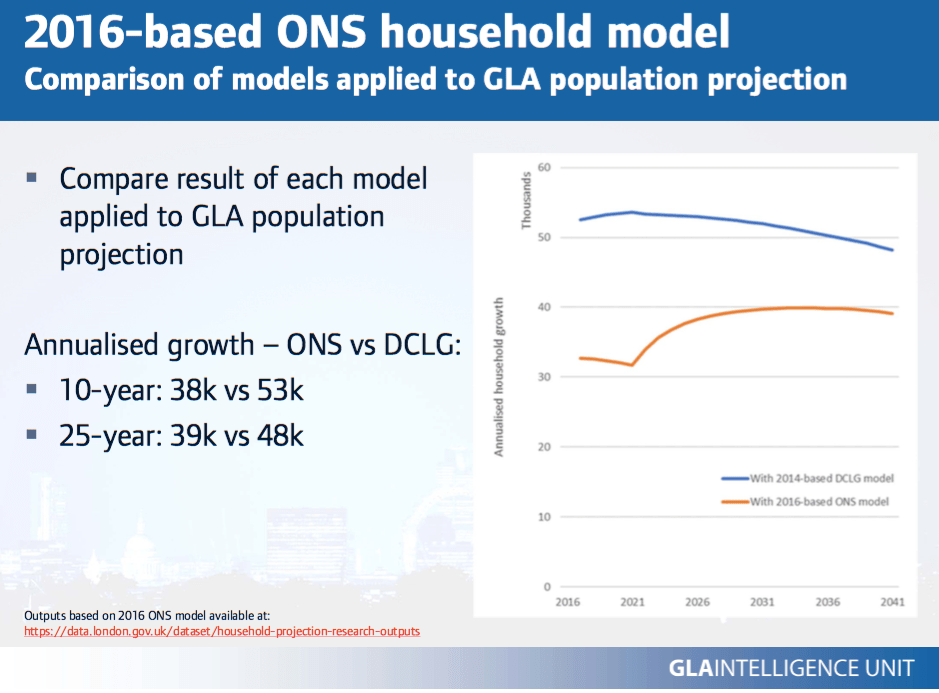
    Ben Corr speaking. See his presentation. Plan based on 2016-based projections, using the trend-based ones. Method comparable with Office of National Statistics (ONS). We convert from population to households using the hh size work of MHLG (now taken over by  ONS). Cohort survival model of standard kind is used. Use 5/10/15 year histories of migration, producing very different results.

    10-year trend chosen for GLA projections. Detail in the presentation. Rich and useful. Read it carefully.

    Latest ONS projection produces estimate 700,000 lower than previous one (slide 40) for 2030.  But the ONS mehod of constraining sub-national forecasts to fit the national total can make a difference of 800,000 to London population!

    Choice between the 2 projection makes a huge difference (slide 50)

    demog slide 50

    Questions probe reliability of input data. GLA admits it is all rather fragile & they do a lot of cross-checks. No explicit attention to rents/prices and their effects though clearly their effect is embedded in household formation rates.  Christina Howick asks whether London Plan will be amended in light of latest estimates. Answer (in effect) NO.   Another Q is whether the new reversal of life expectancy among poor people was being taken into account. A: the projections assume that mortality improvements stall, but not that they go into reverse.

    Careful Q on the recent growth of migration out to rest of UK. Answer: 10-year trend missses or dilutes this change. We haven’t yet tried a 5-year basis. We’ll monitor and see.

    Bowie asks how much the projections are constrained by housing supply: A: not explicitly. The borough-level figures are published but we don’t recommend boroughs use these but instead make housing-led projections themselves based on their detailed local knowledge of what is being built.

    Christine Whitehead (LSE) on the assumption that all relationships in the future are like the past. Why not try to relate it to the alternate economic scenarios? Interesting idea, replies Ben. We could look at it, “going forward” says Ben. We have done some experiments.  CW says duration of residence a big determinant of whether people become households / churn & turnover. A: we are looking at consumer data on turnover/churn.   Hope to get much deeper into it.

    Richard Lee (Just Space). Doesn’t demog mean more than just quantity – like race, ethnicity, social class. To work on housing need we need this material, e.g. for the boroughs with majority of BME people; and massive gentrification is transforming social class. Refers to equality-testing of the work. A: that’s partly for the policy people to answer. The Intelligence Unit is working on social class & ethnicity but I can’t tell you how that feeds into planning policy.  In our projections there is NO analysis for distinct ethnic or class groups.

    Ian Gordon: By assuming future will be like the past, you are assuming London continues to fail to build enough;  what if the plan succeeded? Wouldn’t more households form? A: Ben compliments Ian Gordon on his work prior to the previous plan, and hopes to be able to look better at it in the future.

    [comment: the treatment and presentation of demography is so good, compared with economy.  Clear that the people responsible love their work and want to get it right.]

    Lunch break now. Housing need/demand (SHMA) next; then Land Availability (SHLAA). Both presentations are online – see top of this page.

    Housing need and demand (SHMA)

    Previous Strategic Housing Market Analysis (SHMA) 2013 had proposed 49,000 dw/yr, 52% affordable.  Then slides have details.

    3 main elements: household growth; affordability; backlog. (figures in slides) yielding need for 55,000 pa. net additions of dwellings. The table of need (table 7) is result. But the tenure mix in that table is just a reflection of the existing tenure divisions.

    Backlog carefully explained. (Comment: Doesn’t appear to base it explicitly on affordability (only indirectly via arrears). handling of backlog over 25 years. Reasons for this long phasing utterly un-reasonable – quote below)

    • the size of the backlog,
    
    • its growth since the previous SHMA
    
    • the difficulty of clearing it while also meeting needs of demographic growth

    Assuming 3.8% of future stock would be vacant or second homes.

    Student need 171,000 in 2041, (compared with 83,000 in 2016).

    Gypsies & travellers: don’t propose a London-wide approach but do urge boroughs to gather local need data. (!)

    MHCLG new method produces a need for 72,000 p.a.; standard method using 2016 ONS projections yields annual need of only 50,000.

    Bowie Q: govt guidance was to solve backlog over 5 years; First London Plan used 10 years; latest had 20 years. Now you are proposing 25 years! It would need output of 95,000 p.a. if you reverted to 5 years!  Answer: it would be nice. But we never meet it. Realistic.

    Bowie: Why do you assume (among concealed hh) that single people will always be single? Some may form relationships or have children once enabled to form a household of their own.  A: yes, but we don’t know how they would behave so have.

    James Stephens (HBF) Your adjustment for affordability is not an addition to the 65,000p.a. target is it? Answer not clear to this scribe.

    Christine Whitehead: both 10-year backlog, & size backlog, vacate units. So is it net additional need? Answer: only the concealed ones.

    Jed Stephens LSBU when will London be too big? (Great Q)

    John Hoeny CRS advising Assembly. No of one-bed units is staggeringly huge. How have the assumptions made that? Depends heavily on assumptions about under-occupancy. Table 7 should shown the effect of different assumptions. Need much more detail.

    Andy Black PRP on older people. 3 dragons stresses need, across all tenures. Why does the new plan stop making borough-level targets? Another questioner stresses affordability barriers to many old people downsizing.

    Ilinca Diaconescu (LGT) It’s a policy, not a technical, descision to exclude Gypsy & Traveler needs from the London study. The earlier study is still in use and the EHS excludes gypsies and travellers. Will be GLA consider doing innovative work which really addresses this great need. Answer: yes that old work was good, but it worked because the boroughs did it.  As a regional authority we couldn’t do this without boroughs.

    Sharon Hayward (LTF) 162,000 backlog is for social renting. How long do households have to wait? People below median income levels, paying very high proportions of income in private rent…   Also you fly in the face of studies on downsizing in Social renting. A: by 2041 we assume that each household will be in an appropriate-size dwelling.

    (Comment: lack of data on why people move out of London, role of rent/price etc is responsibility of GLA, surely.)

    SHLAA – supply / capacity

    Andrew presenting the GLA work.  Slide show is a good summary, well illustrated.

    Questioner stressing the obscurity of how much health NHS land is being assumed for housing. A: it is not separately identified in the report, though there is some info on how much is ‘public’ land.

    Edwards: How much land is assumed from employment? from social housing? A: there is info on ‘Industrial’ land take, but not on former employment use more widely. Some of the estate regeneration sites are shown but not all. GLA offers to supply more detail on request.

    Bowie fierce on low probability of getting family-size housing in high density schemes, e.g. especially those in Opportunity Areas because densities there are planned to be especially high. A: GLA insists that family housing can be provided in high densities, for example 10-strey perimeter blocks.

    Ian Gordon asks how much of the extra capacity (measured in dwelling units) results simply from upping density in the 2013 site estimates. This scribe missed the answer.


  • Defending housing and industrial estates

    Defending housing and industrial estates

    Just Space has written to the Mayor and the GLA planners, responding to a call for suggestions for potential large housing sites:

    To: London SHLAA <LondonSHLAA@london.gov.uk>
    Cc: Mayor of London <mayor@london.gov.uk>
    Subject: Re: London SHLAA – Call for Sites

    Dear Sir or Madam

    I am making these comments on behalf of Just Space, a network of groups aiming to get more of the community involved in matters relating to planning.

    We are concerned that the call for submission of large sites will lead to the submission of housing estates and industrial estates.  These are often described as brownfield land.  However, they are not, because they are already in use, either as homes or as work places.

    The process of redeveloping these sites, usually as expensive blocks of flats or offices, is leading to the loss of housing that Londoners can afford to live in, and the loss of small or medium sized businesses that provide many Londoners with work, as well as providing services to many other London people and businesses.

    Just Space has done extensive research on this question and has much evidence of this destructive process.

    We urge due consideration of this aspect when examining the sites that are proposed.

    Yours sincerely

    Pat Turnbull – on behalf of Just Space

    Background:
    On 18 May 2016, at 18:17, London SHLAA <LondonSHLAA@london.gov.uk> wrote:

    The GLA is undertaking a new housing capacity study to inform the next London Plan. This study is known as the London Strategic Housing Land Availability Assessment (SHLAA) and is prepared in partnership with local planning authorities in London.

    As part of this process we are currently running a Call for Sites. This allows stakeholders and individuals to submit potential housing sites for consideration as part of this housing capacity assessment. Deadline 30 June.

    Further information on the Call for Sites is available on the GLA’s website: https://www.london.gov.uk/what-we-do/planning/london-plan/london-plan-full-review/call-sites-2016-shlaa

  • Latin Elephant: the future

    Latin Elephant: the future

    Published on 6 June 2016, The Case for London’s Latin Quarter: Retention, Growth and Sustainability  (Authors: Patria Roman-Velazquez and Nicola Hill) sets out a strategic vision for the development of the existing Latin American business cluster at Elephant and Castle (EC) in the Borough of Southwark, London.

    It is supported by a series of development proposals which together seek to maximise opportunities arising from the process of urban change. It also identifies existing barriers to growth for this business cluster and provides recommendations to overcome these so that the valuable entrepreneurial activity of migrant ethnic businesses (MEBs) can continue whilst helping to maintain social cohesion.

    The existing Latin Quarter is widely regarded as an integral part of the current and future retail offering for EC. However, small migrant and ethnic businesses require alternative models for retention, economic growth and sustainability in light of regeneration. These have been considered throughout the study and are outlined in the report accordingly.

    The report includes one chapter on Migrant and Ethnic Businesses and Urban Change, and sets 3 priority areas and 10 recommendations for engaging with and increasing participation of migrant and ethnic retailers under intense processes of urban regeneration. It presents evidence on MEB’s and some definitions for migrant entrepreneurship, ethnic entrepreneurs and migrant and ethnic economies.

    Executive Summary: http://latinelephant.org/wp-content/uploads/2015/03/ExSum-The-Case-for-Londons-Latin-Quarter-FINAL-web.pdf

    Full Report: http://latinelephant.org/wp-content/uploads/2015/03/The-Case-for-Londons-Latin-Quarter-WEB-FINAL.pdf

    This is the blog post with condensed summary & links to the report: http://latinelephant.org/the-case-for-londons-latin-quarter-retention-growth-sustainability-3/  You can follow developments on this site.

    Coverage in The Guardian 7 June: https://www.theguardian.com/uk-news/davehillblog/2016/jun/07/latin-southwark-seeks-its-place-in-elephant-and-castles-future

    This initiative is in tune with the Just Space proposals for understanding the diverse economies of London – made in our response to GLA Economics in the previous post on this blog.

    Checked M E 21 07 2025

  • Just Space Conference 2016 April

    Just Space Conference 2016 April

    Community / university conference

    Just Space has been working for 9 months towards producing a Community-led Plan for London, or at least key elements of it, to be ready in the early weeks of the new Mayor and Assembly.

    Very good progress was made following discussions at community conferences in July 2015 and on 4 February this year. The tabloid publication produced for the February conference plus write-ups of workshops and videos of sessions are all available here.  —specially valuable for those who could not attend in February and want to get up to speed. There was a further conference at UCL on Thursday 28 April to bring together community groups, students and academics with the following aims:
    1.  To share the results of the February conference workshops
    2. To discuss further work that has been done on the Private Rented Sector, Opportunity Areas, Participation and Inclusion.
    3. To focus on the following key economic issues:
    – Policies to support balanced economic development between London and other regions
    – Policies to support a green economy
    – The economic evidence base: an analysis of meetings between Just Space Economy and Planning group (JSEP) and GLA Economics

    4.To mobilise further academic support for the final stages of the work which needs to be completed during May/June.
    5. To reflect further on the potential of University students and staff to support community based policy development at a London wide level.

    This page contains video and other records of 28 April event. Thanks to Spectacle Media for the videography.

    Opening Plenary: Re-thinking the economy of London

    Introduction to the work of Just Space and the aims of today’s event (M.Edwards)

    Notes on this plenary and on an economy workshop later in the day are here JS Conference notes econ Apr 28
    Prof John Tomaney (Bartlett UCL) on alternatives to London’s endless growth and implications for the North East and other regions

    Just Space at UCL – Morning session 1 from Just Space on Vimeo.

    David Fell (Brook Lyndhurst) on Greening the economy of London

    Just Space at UCL – Morning session 2 from Just Space on Vimeo.

    Patria Roman (Latin Elephant) on Ethnic and Migrant Businesses

    Just Space at UCL – Morning session 3 from Just Space on Vimeo.

    Breakout groups held in the middle of the day are not available on video. Other material will be posted as it becomes available:
    Workshop on Economic Evidence Base are the later part of JS Conference notes econ Apr 28
    Workshop on Old Kent Road opportunity area
    Workshop on private rented sector
    Workshop on Opportunity Areas and Participation
    Workshop on student housing
    Workshop on mapping

    Closing plenary: university contributions to a community-led London Plan

    Robin Brown (JS) on experience with UCL masters module g007 Community Participation in Metropolitan Planning; then Nicolas Fonty (one of the participants) reports on work done by a group this year, mapping the actual economy of Harlesden, adjoining Old Oak Common [report here]; finally Eileen Conn (Peckham Vision) reflects on working with student groups.

    Just Space at UCL – Closing Session 1 from Just Space on Vimeo.

    Richard Lee, coordinator of JustSpace, introduces the Protocol we wrote 4 years ago to try and get more from community / university collaborations and avoid the pitfalls. He introduces reflections from Barbara Lipietz (DPU) and Sarah Bell (UCL Engineering Exchange).

    Just Space at UCL – Closing Session 2 from Just Space on Vimeo.

    Final discussion

    Just Space at UCL – Closing session 3 from Just Space on Vimeo.

    Programme now finalised here programme 20160427

    checked M.E. 8 August 2025