Category: London Plan 2024–

  • New plan out 16 July

    New plan out 16 July

    Finally the GLA is releasing the draft London Plan on Thursday 16th July in the morning. There is an invited audience.

    Nothing for the voters.

    A 20 minute slide show with voice over explaining the new plan with voiceover is available on the GLA draft London Plan website (see link below) and on YouTube; https://youtu.be/cjjg_T7vWZI?si=yatSN57Kb0VpQn-Z .

    The details, including the download request, at this page: https://www.london.gov.uk/programmes-strategies/planning/london-plan/next-london-plan/draft-london-plan-consultation/draft-london-plan-consultation-resources

    Watch our EVENTS page for further events, starting on 22 July.

  • Launch of Caring City

    Launch of Caring City

    Launch speech by Peter Apps, plus Interviews with participants at the launch of
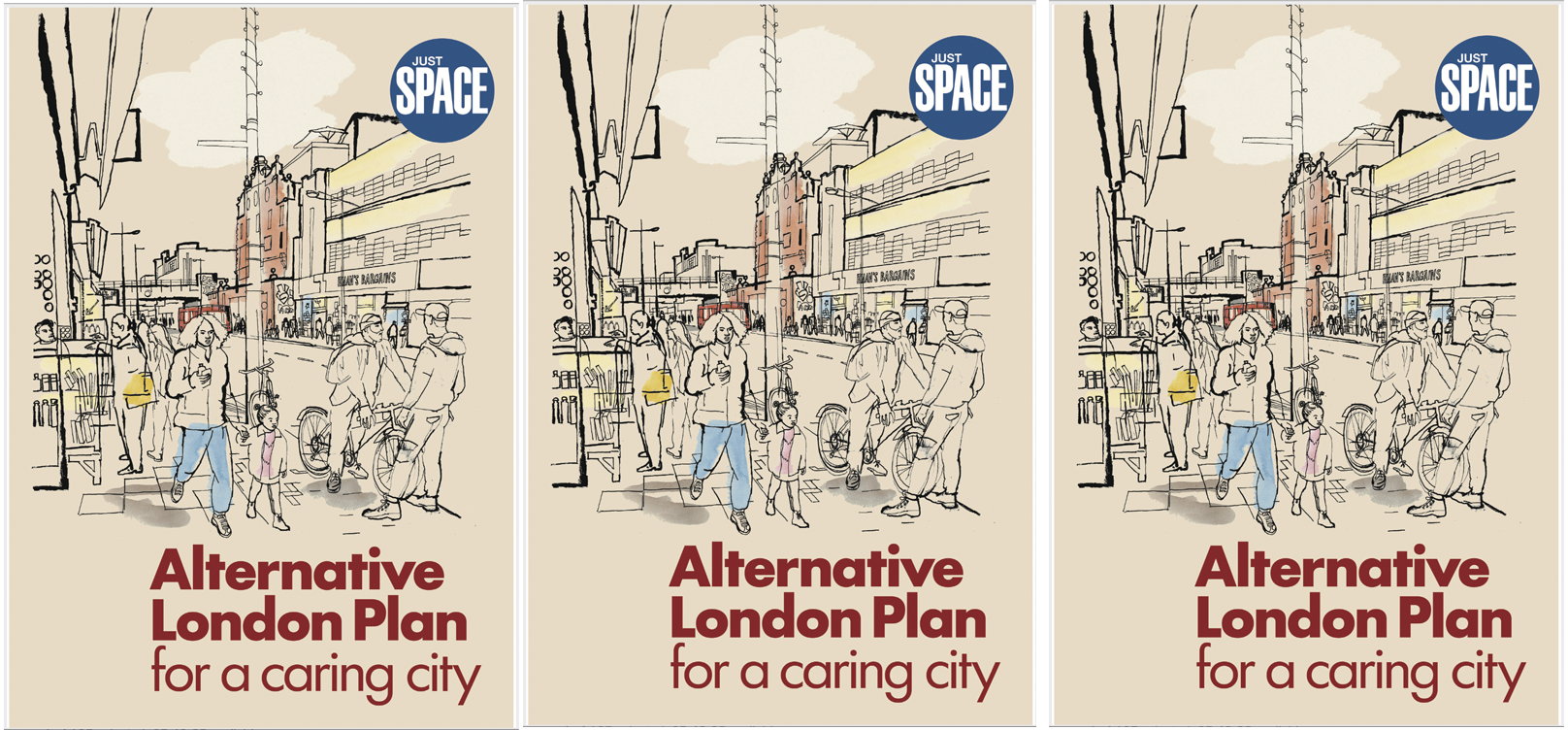
    The Alternative London Plan for a Caring City

    Thanks to Doug Bounds for the video

    More on the Caring City Plan

    Full transcript of Pete Apps’ talk and of the rest of the meeting. https://justspace.org.uk/wp-content/uploads/JS-Caring-City-launch-checked-transcript-14-Apr-2026.docx

  • launch of just space’s alternative london plan for a caring city

    launch of just space’s alternative london plan for a caring city

    This is the first account of the launch meeting. A full transcript is now available as well.

    Over 50 Just Space members from communities across London attended the launch of our alternative plan on Tues 14th April, which has taken nine months of focused meetings and re-writing to emerge as a collective vision for a Caring City. We were joined by Peter Apps, contributing editor of Inside Housing and acclaimed author of ‘Homesick’ and ‘Show Me the Bodies: How we let Grenfell Happen’

    This is an edited version of the speech and discussion held with Peter Apps on the launch of Just Space alternative London plan – thanks to Peter and all who joined us

    What we are launching is the result of collective work — community groups, campaigners, researchers and residents coming together, sharing knowledge, and coordinating across the networks you all belong to. This alternative London Plan shows what becomes possible when communities take the lead and set out a strategic vision for the city we want.

    We are at a moment of real transition in London’s housing system. The development model that has shaped the city for the last decade — driven by domestic and international investment — is breaking down. Housing delivery has collapsed, and there is clear anxiety in government because the old model no longer works, even on its own terms. Yet instead of accepting this, there are attempts to shock the same failing system back to life. We need to be honest: that approach has failed. New ideas are urgently needed.

    The private rented sector has reshaped London — how people live, how communities form, and what it means to have any stability. Section 21 evictions have pushed rents up and pushed people out. That system is now faltering too, but what replaces it could be even more extractive, as we’ve seen with the rapid expansion of short‑term letting platforms. Without intervention, the pressures on renters will intensify.

    We are also in a period of political change. New parties and independent candidates are gaining ground across London. They may win councils, but they will still inherit authorities with limited resources and limited powers. Without a clear alternative vision, they will face the same constraints that have shaped London for years.

    At the same time, we are seeing the re‑emergence of far‑right narratives around housing — particularly around who is “allowed” to live in council homes. Real frustration about housing shortages is being channelled into division and racialised blame. This makes it even more important to set out clear explanations of what has gone wrong and to identify the real structural drivers of the crisis. There are powerful interests shaping London’s housing system, and they are rarely named.

    Housing has always been a challenge in London, but since the pandemic every indicator has worsened. Homelessness and long‑term temporary accommodation have risen sharply. Councils are now spending extraordinary sums — millions of pounds every day — simply to keep people housed. The current trajectory is unsustainable. The status quo cannot continue.

    And the pressures ahead are significant. Climate change will reshape London: hotter summers, flood risk along the Thames, clay soils that crack, and a built environment full of glass buildings that overheat. These are not abstract risks — they are already affecting people’s homes and health. We need planning that responds to these realities.

    This is also a moment to challenge the dominant economic story that has shaped housing policy for decades. One example is the so‑called vacancy‑chain effect — the idea that building any home, at any price, will eventually “filter down” through a chain of moves until homelessness is solved. This belief remains influential among most economists and policy advisers, even though it ignores spatial realities, second homes, investment properties, and speculative demand. It treats housing as a commodity first and a human need second. And it has been used to justify policies that have deepened the crisis rather than solved it.

    Meanwhile, the housing lobby — developers, mortgage lenders, estate agents — remains extremely powerful. Their interests are often treated as economic common sense, while community‑led alternatives are dismissed as unrealistic. But other cities show that different systems are possible. In places like Zurich, housing cooperatives are embedded directly into local plans. Non‑speculative housing is mainstream, not marginal.

    London’s viability system has long been used to argue that developments cannot afford affordable housing, even when they are profitable. Now, with rising construction costs and fragile supply chains, viability is failing again. Even with reduced affordable housing requirements, the numbers do not work. We need a model that is not driven solely by profit.

    So the question is: what do we do next? This alternative plan is not just a document; it is a tool for organising. There are several concrete steps we can take together:

    1. A London‑wide meeting in late May

    We should set a date — ideally late May, after the 7th May local elections — for a London‑wide gathering. The aim would be to bring newly elected councillors together with community groups and planning officers from the GLA, to build understanding and momentum around this alternative plan. In the last we were able to organise events at the City Hall — with community groups leading sessions on different themes and where members of the Mayor’s team were able to engage with the ideas proposed. A large, open, city‑wide event would help bring these proposals into the mainstream of London planning.

    2. Parliamentary engagement

    There is scope to work with the All‑Party Parliamentary Group on Housing, alongside organisations such as Shelter and Defend Council Housing. There is research from a few years ago on the state of council housing that could be revisited and linked to this plan. This would help bring the issues raised here into national discussion.

    3. European networks

    We are part of a wider European coalition on housing, including partners in cities like Bologna. Sharing this plan through that network strengthens the case for non‑speculative, community‑led housing models across Europe.

    4. International advocacy

    The document can be shared with the UN Special Rapporteur on Housing in Geneva, accompanied by a cover letter. A statement timed for the London elections would help highlight the international relevance of London’s housing challenges.


    Planning is often invisible — even to many people working within it. That invisibility allows the system to be shaped without public scrutiny. With new councillors arriving after May 7th, we have an opportunity to change that. We can hold local discussions, help them understand planning in London, and support them to use the powers they have. Power is lost when it isn’t exercised. Too many decisions are made by a small group, with others simply following. We need to break that pattern.

    New councillors will need to understand planning. Communities need to be connected to decision‑makers. And together we need to build a different future for London.

    This alternative plan is a step toward that future.

    Download a copy of the new Alternative Plan for a Caring City here: https://justspace.org.uk/caringcity/

    Daniel Fitzpatrick, UCL

    A later version of this report is here and that will be the place where onward links and discussions are placed.18 April 2026

  • London Plan update

    London Plan update

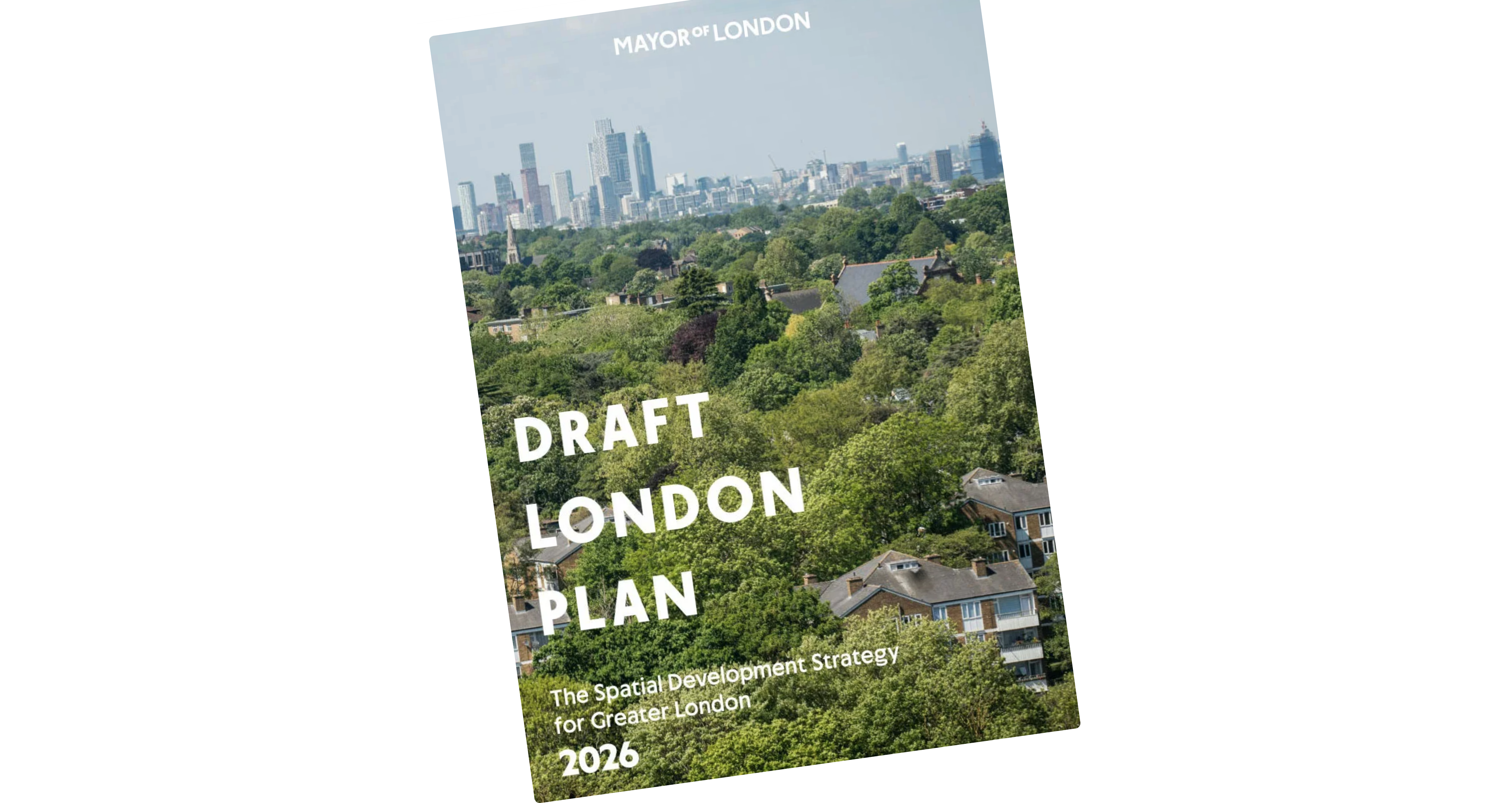
    We hear, indirectly that the GLA’s public. consultations on the next London Plan are to be delayed. A ‘High Level Strategy Paper’ had been promised for March 2025 as the first step in this consultation. Now we hear that it will be April.

    This news comes via someone who was at a meeting of the All Party Parliamentary Group on London which took place on 4 February despite not being mentioned on the relevant web site. If anyone has more information please get in touch.

    Meanwhile City Hall will be launching a London Growth Plan. This follows a document Towards a London Growth Plan which is already published at https://www.london.gov.uk/programmes-strategies/business-and-economy/mayors-priorities-londons-economy-and-business/london-growth-plan

    This link now redirects to the actual growth plan. Towards… (it) has disappeared.

    M.E. 26 July 1015

  • 2024 New Plan inputs

    2024 New Plan inputs

    11 October 2024: The GLA has published all the submissions made in response to its open call for evidence last year. The material can all be found and downloaded here . For some reason our submissions (all at the bottom of this page) are not listed and we have today sent them again with a protest.

    September 16 2024 We protest to the London Plan team about the narrowing down of participation opportunities. Our letter here.

    Manifesto 2024 download here (13 April)
    Slides shown at manifesto launch PDF
    Agenda and feedback sheet for launch event
    Legal advice from Jed Holloway on challenging an application

    Papers from 2 March conference:
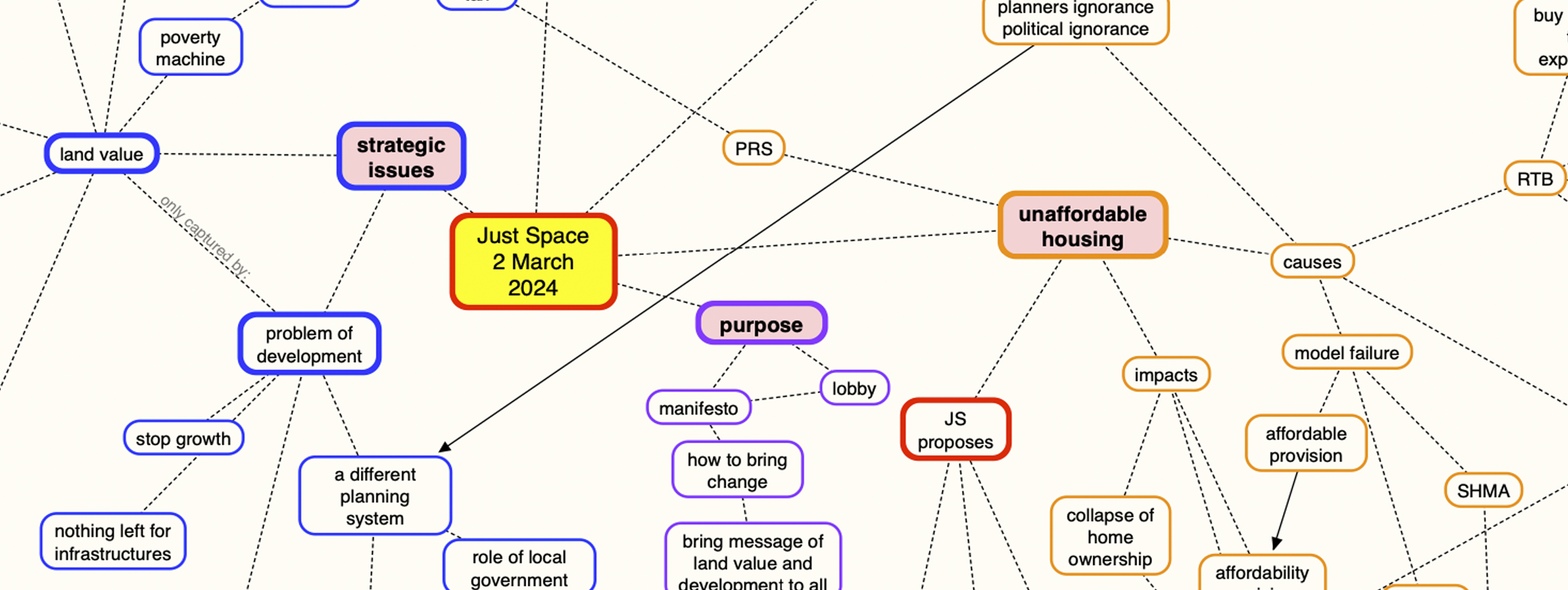
    All the issues are connected: Mind Mapping of the discussion thanks to Elena Besussi: (alternative high-resolution version is fully readable here)

    Slide presentations part 1 (PDF)
    Slide presentations part 2 (PDF)

    Agenda
    Housing
    Overall linking strategy
    Climate change, biodiversity, green space
    Carbon city
    Tall Buildings, density
    Town centres, street markets, industrial, class E
    Social infrastructure, health, caring city
    Inclusion, participation, fairness

    Longer version of STRATEGY note (corrected)

    This year work starts on a new London Plan. London and Londoners face unprecedented urgency in dealing with poverty, inequality, housing, health, climate and ecological breakdowns. Just Space has started contributing to the GLA’s gathering of inputs and evidence and this page will bring all these ideas together.

    Just Space is a cooperation network of community, resident and activist groups, many of which will be developing their own demands and submissions to the GLA. We’ll link those here too if we are told of them: please send them in. Just Space itself will debate and agree its shared positions on the key issues during the year so statements placed here are provisional and subject to change. There was a JustSpace conference about this on Saturday 2 March 2024.

    Most recent material at the top of the page.

    New Year’s Day submissions 2024

    The GLA London Plan team asked for submissions by the turn of the year. Just Space has sent in the following (all downloads here as PDFs):
    Climate change and a supporting case study
    Affordable workspace and class E
    Affordable housing
    Spatial strategy
    Spatial strategy – additional comments
    Tall buildings
    Equality

    end

    Later events and reports on the new London Plan are gathered at
    JustSpace.org.uk/towards

  • News: Londoners vary

    News: Londoners vary

    9 August 2023 Though GLA didn’t have the decency to tell us – or anyone else (?) – when they actually published findings from the winter’s “deliberative/engagement” Planning for London sessions , these did actually appear in the location where they said all the material would be. The findings are write-ups by the GLA’s consultants (2cv) of discussions held with carefully-chosen participants representative of London’s diversity. Our first impression is that the emphasis is on how much Londoners and their opinions vary. There does not seem to be any emphasis on which variations are particular to which population groups.

    Covering page: 
    https://consult.london.gov.uk/planning-for-london-deliberative-events

    Event 1 : A Green and Fair Economy:    how and where London’s businesses should start, grow and create jobs; how to support high streets and town centres; how we upgrade London’s existing homes and make new buildings to be greener; and what the impacts of large-scale redevelopment on existing businesses are.
    https://consult.london.gov.uk/24854/widgets/70359/documents/45348

    Event 2: Sustainable transport and public spaces:  how we can turn spaces into places where people want to spend time; how we prioritise competing demands for limited public space and streets; how we reduce traffic in a way that is fair; and what our public transport priorities should be.
    https://consult.london.gov.uk/24854/widgets/70359/documents/45347

    Event 3:  Housing: who housing is for, where it should be located, how it should be designed and the impacts on existing communities.
    https://consult.london.gov.uk/24854/widgets/70359/documents/45349

    Event 4: Places and communities: how to plan for large-scale development with finite space and funding; night-time activities; green spaces; Outer London; and how to create strong communities in a changing city.
    https://consult.london.gov.uk/24854/widgets/70359/documents/45350

    Checked by Michael Edwards 21 07 2025

  • GLA, planning and housing update

    GLA, planning and housing update

    14 July 2023: there is news from City Hall which is important for Just Space members.

    Draft guidance on ‘Affordable’ housing and on Viability Assessment: consultations close on 24th July.

    The Mayor produced two new London Plan Guidance (LPG) documents in draft and seeks comments before they are finalised. These documents cannot, by law, change the policies which are embedded in the London Plan but they can and do elaborate them and toughen them up through the details of implementation.

    The London Tenants Federation (LTF) has submitted their very careful and detailed commentary on both LPGs and has kindly agreed that we can share it with other members of Just Space who may be preparing their own submissions, or who may want to write to the GLA supporting the LTF.

    The LTF makes a refreshed and powerful case for focusing planning policy as much as possible on maximising the production of social housing at council rents and not the other, more expensive, forms of so-called “affordable” housing. It refers back to the latest GLA study of London’s housing needs in 2017 which showed how overwhelming was the need even then for secure, low rent, housing which only social/council housing can provide and it points to the extremely low levels of actual production which have been achieved since then, suggesting many ways in which more could be done.

    The response welcomes some of the GLA proposals to tighten up loopholes which enable developers to avoid or minimise their obligations and pushes for a bolder insistence on delivery of at least 50% ‘affordable’ housing on land previously in public ownership.

    The Viability analysis LPG is all about the details of a rotten system which the LTF and Just Space have always criticised – establishing developer profitability as the dominant criterion governing what gets built and for whom. But for the moment the provision of most social housing depends on private developers and housing associations being forced to provide it as a condition for getting planning permission. The rules and procedures for testing what developers can afford are the subject of this LPG and the Tenants Federation is very shrewdly pointing out further ways in which developers’ manipulation of the figures could be limited and the whole process be made more transparent.

    The LTF response to the two LPGs is here and will also be on their own site LondonTenants.org (now under repair)

    The GLA’s draft LPGs are at Affordable Housing and at Viability along with means to comment.

    Remember: 24 July 2023 is the closing date for comments.

    Planning For London programme

    Just Space and many community groups consider that the last London Plan was a bad plan and it’s is now very old. Drafted in 2016, it would have been adopted in 2020 (though it was pushed into 2021 by the Secretary of State) and has in many ways become even more irrelevant to London’s real needs as a result of the pandemic, the fresh round of austerity, now a recession and the accelerating reality of climate and biological breakdown.

    We argued that the City Hall planners could and should have got down to some urgent work to get a new plan under way but the Mayor apparently decided that no start should be made until after the next mayoral election in May 2024. So instead City Hall has devised this Planning for London programme in which they are gathering the views of citizens and organisations while declaring that this is not part of making the next plan.

    They have just held the first two events at which they met with citizens and organisations (we are called “stakeholders’) and they promise to publish what that have gleaned from listening to the many round-table discussions they orchestrated. They are also going to publish their learnings from an earlier series of focus-group-type (‘deliberative’) events to which they invited a statistically representative selection of Londoners. The whole programme is set out on the City Hall web site here. There will be a stage where they invite our inputs on how they should do impact analysis. That’s a process which they made a serious mess of last time and had to try to make good in the middle of the public Examination so it is very important that we all help.

    Just Space told its member organisations about these two recent public events so quite a few of us took part and we are gradually comparing notes about what happened. We’ll post our summary here. Meanwhile one of our members wrote a personal blog post here which you might want to look at.

    If you have comments or observations or took part in these events and want to offer your reactions, please get in touch or use the comments below.

    checked by M E. July27 2025