Category: London Plan 2016-21

  • West Kensington & Gibbs Green

    West Kensington & Gibbs Green

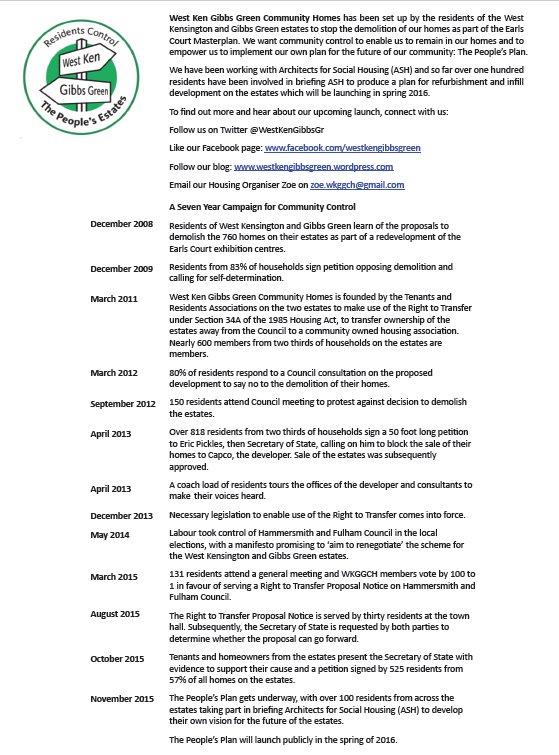
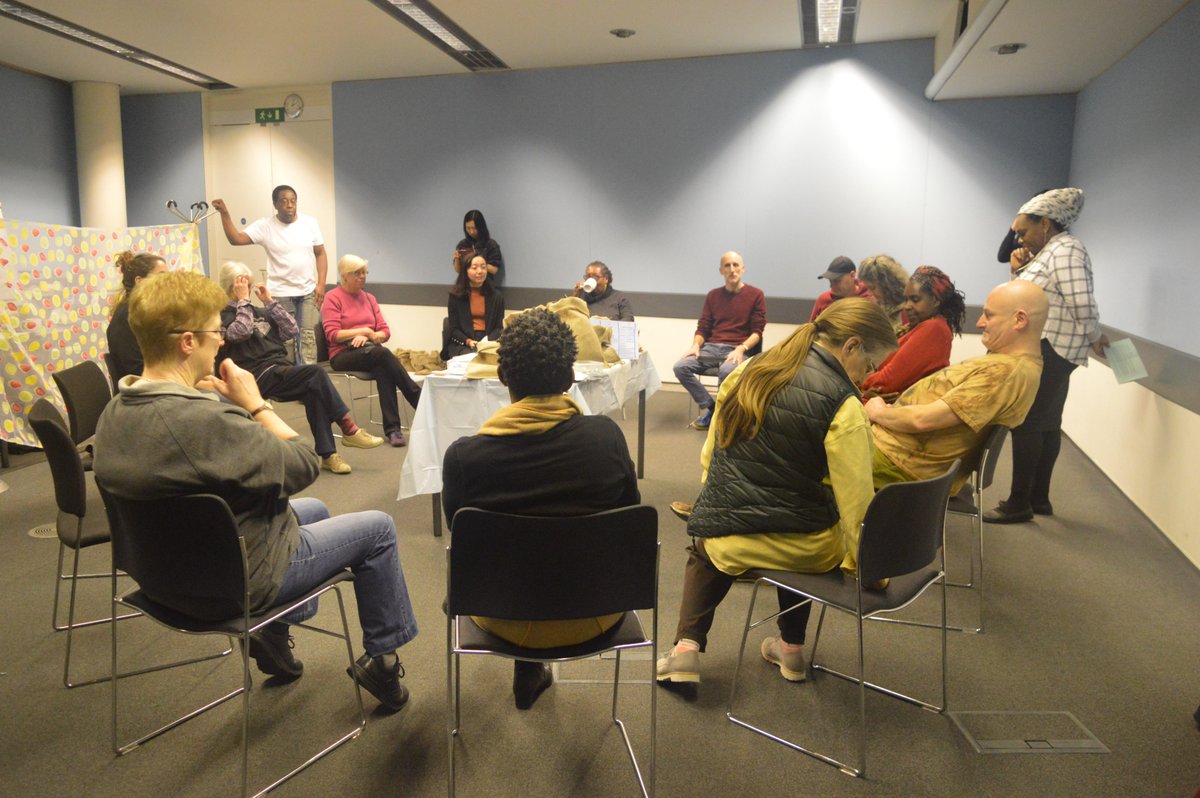
    WKGG3ashArchitects for Social Housing (ASH) exhibited its proposals for the West Kensington and Gibbs Green estates, which are threatened with full demolition and redevelopment by Hammersmith and Fulham Council in collaboration with Capco property developers. ASH’s proposals are part of the feasibility study for The People’s Plan, which in turn is part of the residents’ application for a Right to Transfer from the local authority to a community-owned, resident-controlled housing association.  This exhibition formed the basis for a workshop on their methods.
    Following extensive consultation with residents, ASH is proposing a significant number of additional homes on the estates, from 1-3 bedroom flats and houses, including disabled accommodation. The sale of a percentage of these on the private market will generate the funds to refurbish the 760 existing homes, improve the existing landscape, and provide many new communal facilities.
    ASH believes their architectural proposal for The People’s Plan is a model of home and community building that can be exported across London and the UK, and a genuinely sustainable and financially viable response to the housing crisis.
    Architects for Social Housing (ASH) was set up in March 2015 in order to
    respond architecturally to London’s housing ‘crisis’. We are a working collective of architects, planners, housing campaigners and activists operating with developing ideas under set principles. First among these is the conviction that infill, build-over and refurbishment are more sustainable solutions to London’s housing needs than the demolition and redevelopment of the city’s council estates. To this end, we propose architectural alternatives to demolition that both increase housing capacity on estates as well as generating funds for the renovation of the existing homes, while leaving the communities they house intact.
    WKGGtimelineASH
  • Value capture, ‘viability’

    Value capture, ‘viability’

    This page records activity up to mid-2018. The story since then is taken up on the front (news) page as blog posts and most recently by the page on the Examination in Public: Hearings / EiP / 2019

    New chapter of the Community-led London Plan published 20 January 2018
    Land Reform Just Space Land reform chapter draft & Land policy chapter slides

    Just Space conference on the draft London Housing Strategy 1 Nov 2017

    Slide show on land values, taxation etc: JS land value 20171101

    Crowd-sourced reading list, started October 2017, which anyone can edit
    https://docs.google.com/document/d/1ghMo36UYm0p_2tNUsZzpbG_O_ii5GXLCx8qEKAMgzC0/edit

    Summer 2017: a group of masters students at UCL has prepared a report for Just Space: Opportunity For Whom? How Communities Engage With Land Value Capture in Opportunity Areas. It is available to download at ucljustspace.wordpress.com  The authors are Amy Curtis, Jessica Cargill Thompson, Lidija Honegger, George Kafka, Wenlin Liu, Alessia Montero, David Mountain, Johanna Salmi and Naomi Seow

    Towards a community-led plan for London 4/2/2016

    Workshop session briefing note here. Scroll down to green heading for notes of the workshop discussion.

    LAND VALUE CAPTURE / viability assessments / S106 etc

    The market value of land and property in London is very high and has risen very fast in recent decades.

    Crossrail 2 will cost £27bn & would create property value uplift of £15bn (TfL) for housing alone.

    Massive state investment in infrastructure boosts values; so does investment in buildings and services. Hardly any of this is taxed or captured to pay for London’s services and needs.

    Long-term / big issues

    1. Taking land out of the the market by compulsory purchase at existing use value, thus socialising the uplift on that land.
    • What would be the benefits and disadvantages of moving towards a system of taxing land and property values across London?
    • Which of these current taxes could be replaced?
      1. Council Tax
      2. Business rates (NNDR)
      3. Capital gains tax
      4. Stamp Duty on transactions (SDLT)
      5. Others?
    • Could it replace taxes levvied just on new developments?
      1. Section 106 agreements
      2. Borough Community Infrastructure Levy (CIL)
      3. Mayor of London’s CIL
    • Would site value taxation
      1. Encourage owners to develop?
      2. Be feasible without strict zoning which the UK does not have?

    More immediate issues:

    • making Council tax fairer
    • incentives for developers to build faster
    • transparency and enforcement of S106 social housing %
    • securing social infrastructure and timely services


    Conference document statement (in the housing section):

    The policy objectives are:

    1. Bring land forward for development at lowest possible cost

      2. Ensure most effective use of land and property in relation to public policy objectives

      3. Land and property value appreciation should be captured for public policy objectives

    Further research is needed to inform debate on the policy options that include:-

    • Tax on land that has been consented for development but not started on site,
    • Higher council tax rates for higher value properties and council taxes related to level of occupation,
    • Capital gains taxes
    • Land value tax.
    • Local Plans should be explicit as to the land use for any development site, including specification of density, tenure mix, affordability, bedroom size mix and built form
    • Boroughs should designate land for housing and then have powers to acquire the land at existing use value through a Compulsory Purchase Order if necessary.
    • Boroughs to retain equity stakes in development to ensure that the public benefit from the uplift in value.


    Justification

    The land issue is central to debates about planning. A systematic review of the relationship between planning, land ownership and development is critical to securing the housing supply and infrastructure that is needed. To ensure that housing is affordable to those on lower incomes, the profit requirement and the dependence on development finance need to be taken out of the equation.


    Further information:

    Turner, George 2016 http://www.georgenturner.com/surveying_the_crisis

    Colenutt, B., A. Cochrane and M. Field (2015) “The rise and rise of viability assessment” Town and Country Planning 64(10): 453-458

    Duncan Bowie, Revisiting the Land Issue, 2016 forthcoming, IJURR

    TCPA (2014), ‘Garden city principles’, available at http://www.tcpa.org.uk/data/files/TCPA_Garden_City_Principles_Note_20140411.pdf

    Edwards. M (2015), ‘Prospects for land, rent and housing in UK cities’, Government Office for Science, London, societycould.wordpress.com

    http://www.lincolninst.edu/pubs/2026_Value-Capture-and-Land-Policies

    http://www.futureoflondon.org.uk/futureoflondon/wp-content/uploads/downloads/2015/04/2050-Capturing-value-web1.pdf

    Francesca Medda, Land value capture finance for transport accessibility: a review, Journal of Transport Geography 25 (2012) 154–161, www.elsevier.com/locate/jtrangeo (probably ££, so obtain via a university or other library)

    http://www.georgenturner.com/the-battle-for-waterloo

    and https://www.byline.com/column/49/article/772

    Notes of discussion at the workshop 4 February 2016. Read on here, or download PDF
    JS conf worskshop LVT viability 201602014

    Working groups on housing in recent months considered that a wider discussion of land values, land value capture and taxation would be a valuable element in the conference, as a deeper way of approaching “viability”, Section 106, CIL and so on. After all, those devices are all attempts to “capture” bits of land value growth for collective purposes.

    London’s communities engaged with planning have become more and more involved with issues surrounding S106 and land values and how these affect the delivery of social housing and social facilities. Property values in London are astronomical and they have been growing incredibly fast and recovered quickly after the property crash. There is now a new property boom; the largest growing occupational category in London is estate agents. There needs to be a discussion about how to get around these issues in a more strategic way and in the broader framework of social benefits to London people, rather than on a case-by-case basis. The mayoral campaign is also an opportunity to elaborate what we can do in the next months. (Michael Edwards, facilitator, opening discussion.)

    Duncan Bowie: The history of land nationalisation and land value taxation to support civic infrastructures goes back a long way. In London value capture worked well between 2004 and 2008 but started to fail after the recession.

    In London the battle to extract more value from developments has become very hard due to the very high value of land.

    – Local authorities should have more powers to acquire land at pre-housing costs (i.e. non-residential use values) in order to build what they need at low cost.

    – S106 and CIL do not capture long term value increases.

    – Property and land taxation must be calibrated so that land gets developed.

    – Capital gain on property should be taxed especially where land /properties are underused.

    – Need more research on this.

    George Turner explained what viability is and its importance in relation to the discussion of value capture. The Planning system is the mechanism to share land values, so the land value uplift might not matter if it is better redistributed. The planning system has been obliged to subsidise development when it is likely to produce profits below private developers’ expectations. The subsidy takes the form of a reduction in duties under S106 or duties to provide affordable housing or social infrastructures.

    – Viability studies are the mechanism to assess whether a development is below profit expectations. The fact that developers in London are not building social infrastructure and still making profit demonstrate that the mechanism is not working. Developers are being dishonest in their assessment.

    – Confidentiality is not inscribed in legislation but it has become standard practice for local authorities’ officers to deny full disclosure of viability studies to the decision makers and the public. The practice has also been upheld by a number of court judgements such as the Shell Centre case.

    The system is designed to facilitate corruption.

    -Recent campaigns have put councils and councillors under pressure to disclose assessments and some London’s boroughs have developed policies for this (Islington, Southwark, maybe Hackney). Southwark’s council will only request disclosure if the development chooses to go below the 35% share of “affordable” housing.

    – Nicky Gavron is proposing that the mayor should introduce such policy and JS should ask all candidate mayors to do so. (Note Nicky Gavron letter to the Mayoron behalf of Assembly Planning Committee a few days ago)

    Pat Turnbull. (HA but previously) Council tenant, involved in two regeneration schemes in Hackney since 1999. The residents worked on a scheme that was put on hold during the recession after several years of discussions. The council now wants to proceed but “viability” demands increase in density with two new 16-20-storey towers

    Bonnie Vandesteeg. Negotiation on viability can include changes to the hectarage of the development (see Bishopsgate Goodsyard and Kentish Town)

    Stephen Hill. Viability studies are done by a variety of professionals. Some are qualified surveyors; some have no training.

    – the charter of RICS requires its members to work in the public interest. It goes back to the 19th century and requires them to get the optimum use of land for social and economic value. Residents and campaigners should take issues with the professional bodies to the High Court and challenge that, even if they are not doing anything illegal or corrupt, they are behaving against the public interest.

    Catherine MacArthur. Suggested that Agenda 21 is the reason why local authorities are against social housing. Their interpretation of the Agenda is supportive of high density residential hubs around transport nodes.

    xxxxx: If land is owned by the council, its value should not be included in the valuation of the costs of development.

    Duncan Bowie: local authorities are now going against their own planning policies in order to get as much money value as possible from disposals of their own land. Short-termism is understandable due to cuts to councils’ budgets. TfL is doing the same on its own land with the collaboration of the London Mayor.

    Duncan Bowie, Steve Birak and others on the role of planning in land value.

    – Local authorities should keep their land and if they don’t they should get longer term benefits. (This must be wrong – ed)

    – A stronger planning system can restrict those transfers of value from social to private.

    – Our main demands should be to keep our land in public ownership or occupy it if needed.

    Anne Gray: Haringey Council has based its evidence for the local plan on data and figures taken during the recession, so can it be considered unsound because of not-up-to-date values? Duncan Bowie says yes.

    xxxxxxx: adequate information is essential, especially on land valuation: how value arises in the first place and becomes part of the circulation. The terms of land buying and selling are crucial.

    – Most valuable short-term tactics is to get more information. (Michael Edwards replied that Just Space will engage with the production and circulation of more information)

    Glenn Power

    – law that allows Local Authorities to sell land or interest in land at below market value is extended to TFL and Network Rail.

    – Housing associations did not have to pay for the land when the transfers from local authorities were made. HA should now be required to deliver much more than the 35% that is requested from private developers who have to pay for the land.

    Anne Gray and others on privatisation of housing deliver.

    – Hackney is building housing on their land but they have to sell to private market 1.5 units for every 1 social housing unit they build.

    – Haringey willing to give public land to a joint venture company that is 50% private and 50% public. It is a threat to public accountability.

    END – note by Elena Besussi

    The following had signed up in advance for this workshop, though not all took part. Others may have joined in as well.

    Michael Edwards – Bartlett Planning UCL Workshop facilitator

    Duncan Bowie – University of Westminster

    Robin Hawkes- West Ken & Gibbs Green

    Betsy Dillner – Director Generation Rent

    Anne Gray – Our Tottenham, Haringey Green Party

    Steven Boxall – FORGE/ Regeneration X

    Melissa Fernandez – LSE London

    Dee Searle – Green Party/ IF project

    Glenn Power – Tower Hamlets Tenants Federation

    Stephen Kenny – Grove Park Neighbourhood Forum

    Santa Pedone – Ubele

    Bonnie Vandesteeg – Tower Hamlets Renters

    Alastair Murray – Housing Justice

    Barbara Lipietz – UCL DPU

    Timothy Toh

    Daniel Fitzpatrick – UCL Planning

    David Farnsworth – Freelance Consultant

    Sarah Sackman – Barrister, Francis Taylor Building

    Catherine MacArthur – Bruce Grove Residents Network

    Kathleen Egan – Age UK London

    Pat Turnbull – London Tenants Federation

    Marie Bernard

    Maddie Guerlain – Sustain

    Tony Linforth-Hall

    Beth Stratford

    Robin Grey – Three Acres and a Cow

    Kathryn Johnson – Sustainable Hackney

    Jo Meehan – Old Kent Road People

    Isabella Coin – Shared Assets

    Elena Besussi – UCL Bartlett

    Liam Kelly

    Rob Logan – Community Food Growers Network

    Michel Prigent – London Housing Federation

    Dr Michael Parmar – DharArt Ltd

    Stephen Hill – Future Planners

    David Boardman – Kennington Oval and Vauxhall Forum

  • Opportunity Areas

    Opportunity Areas

    This page records activity up to mid-2018. The story since then is taken up on the front (news) page as blog posts and most recently by the page on the Examination in Public: Hearings / EiP / 2019

    On 20 January 2018 Just Space published a draft of a new chapter of the Community-led Plan for London, aimed primarily at Opportunity Area proposals where we have long argued the need for Social Impact Assessment Social Impact Assessment draft chapter

    Some thoughts, OAs comments Oct 2017, formulated as work in progress on behalf of Just Space, have been submitted to the GLA at a recent roundtable discussion (25 October 2017) on the operation and outcomes of OAs. Just Space would welcome informed contributions to a critical review of OAs in London’s plan-making, particularly those relating to case studies of impacts and to social, cultural  and governance aspects. Please comment or email to Robin Brown, hayescanal at hotmail.co.uk.

    Just Space Working Group: Opportunity and Intensification Areas: briefing for 4 Feb 2016 conference

    What are ‘Opportunity Areas’? 

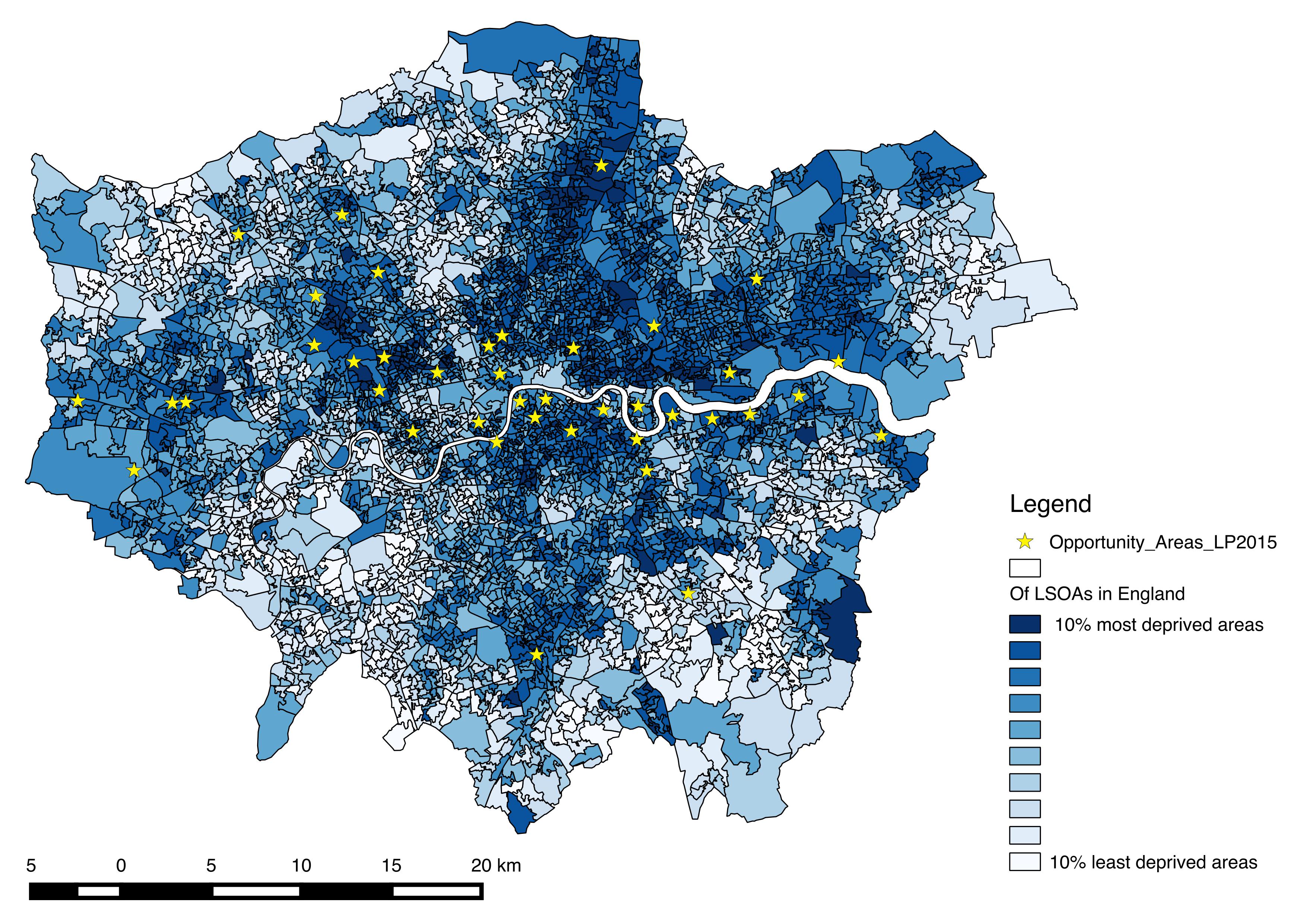
    ‘Opportunity Areas’ (OAs) in the London Plan are large areas designated by the Mayor as places where large scale development can provide space for high numbers of jobs and homes, typically 5,000 jobs and 2,500 homes. There are currently 38 Opportunity Areas along with 10 ‘Intensification Areas’, which have a similar, but lesser role.

    When an Opportunity Area is designated, it quickly attracts a larger scale of development and encourages high density projects which might not get approval in other places.

    The Opportunity Areas have their own planning guidelines, called ‘Opportunity Area Planning Frameworks’ (OAPFs) which are largely conceived and written from City Hall, in tandem with the Boroughs.

    The OAs and OAPFs are at different stages of completion across London, from Cricklewood / Brent Cross in the late stages of development to ‘Kensal Canalside’ which is a new area.

    Negative Impacts

    Opportunity and Intensification Areas are seen to have a negative effect on the people who live and work in an area in a number of ways.

    They encourage the provision of expensive, high density housing which does not meet the needs of local communities, especially of families, as family housing tends to be discouraged in the OAs. In many cases new housing is provided at the expense of existing social rented housing, of which there is already a serious shortage.

    They threaten community facilities such as community halls and inexpensive sports facilities. It becomes harder for community based groups such as youth groups, tenants’ or pensioners’ organizations to find places to meet.

    They encourage speculative office development which, in scale, density and character, may be inappropriate to the local community, and which may replace other buildings and amenities that more readily serve that community

    Shops, cafes and service providers that serve the local community are priced out of the area by soaring rents.

    Around the outside of the OA boundaries we see a similar scale of development piggybacking on the Opportunity Area and extending these negative effects.

    Key Problems with the Opportunity Areas

    Opportunity and Intensification Areas are designated from above without informing, let alone ensuring the effective participation of the people who already live and work in the area. The central mechanism that drives them takes no account of the aspirations of people to be involved in the redevelopment of their neighbourhoods and to benefit from changes that take place. They do not currently include consideration of the existing land uses as a viable alternative option for the future.

    The main question being asked about the current development of London – why is it not providing the kind of housing that we need? – is seen on a dramatic scale in the Opportunity Areas, where growing numbers of new towers and acres of cleared land are not providing even the minimum amount of ‘affordable’ housing while much social and affordable housing is being lost in these areas.

    Opportunity Areas are planned in such a way as to require extensive infrastructural investment (new roads, bridges, rail links, tube stations) to increase the permitted densities of development. Some of this is recoverable through S106 planning gain arrangements (which lowers the amount of affordable housing which can be delivered in the area); some comes directly from government investment (e.g. TfL, or borrowing against future expected revenues such as business rates uplift). We are concerned that large amounts of public money are being spent for little public benefit.

    The current financial and planning models in Opportunity Areas encourage the continuing role of a limited number of favoured Volume Developers who require large cleared sites, entailing clearance of existing housing and businesses and the decanting of communities. High profit expectations and secret viability reports lead to agreements which drive down the delivery of social and affordable housing, and in some cases have led to the suspension of CIL charges. Smaller developers and smaller scale developments could often meet the actual housing demand more effectively without such dramatic negative effects and should be given an equal part to play.

    Some concerns

    There has not been a comprehensive documentation, review and assessment of the impact of Opportunity Areas (OAs) on London’s development against the principles of the London Plan. These would expect OAs to balance economic and social development, and environment, and to have regard to the health of Londoners, the sustainable development of the UK, and equality of opportunity.

    Community based evidence suggests overwhelmingly negative effects and indicates that in their current form they should be reconsidered.

    As planned, Opportunity Areas could deliver over 300,000 homes and 575,000 jobs. They are making the London of the future; they need to meet the needs of local residents and deliver high quality environments for current and future residents of the city.

    Given the impact of these OAs on the city, the highest standards of public participation should be expected, including early and full public information and consultation prior to their designation and effective participation early in the planning process.

    There has also not been an effective review of the role Opportunity Areas play in shaping the current spatial model for London’s development. The spatial and environmental sustainability of large transport investments to produce dense high-rise housing (dormitory neighbourhoods with unaffordable housing) around well-connected nodes, generating significant additional travel requirements is questioned. Alternatives which encourage more mixed-use live-work environments and which build on rather than eradicate the existing qualities and diversity of London’s neighbourhoods should be prioritised.

    Questions for Debate

    1. Perhaps there should be no place for Opportunity and Intensification Areas in a new London Plan because our experience suggests they make it harder to meet the real needs of the majority of Londoners? OA’s do not appear to be a particularly effective way to encourage the net addition of homes for Londoners, specifically genuinely affordable homes.
    2. If they continue, how can Opportunity Areas be made to function more democratically and effectively? Just Space proposes stipulations requiring a Social Impact Assessment for OA/IA developments. Such an Assessment would serve as a framework to address environmental impact and social and community infrastructure in Opportunity Areas. This would involve the GLA carrying out detailed analysis of what an area already contains: its housing, jobs, community facilities, locally appreciated buildings, and so on. A report on existing land and building uses should be prepared for public consultation. Existing uses must be evaluated and made a part of evaluating the viability of any new plans. Involving People in the Plans must be central to the Opportunity Areas and they should be subject to strict community involvement principles.

    Should public land within OAs be identified and dedicated to borough affordable and social-rented housing projects, remaining in public ownership?

    1. How can Opportunity Areas deliver the kinds of neighbourhoods Londoners need? Guidelines could promote redevelopment in the model of lifetime neighbourhoods or sustainable communities, supporting and maintaining existing local character, and indicate that such redevelopment should maximize the provision of social and affordable housing.
  • Community visions for London

    Community visions for London

    Community visions for the next London Plan: Conference on 4 Feb

    Just Space groups are developing proposals for what should be in the next London Plan and the next step is a conference of community groups on 4 February 2016.

    Now out (3 Feb): 24-page conference document: Towards…final

    All the London Plans since the GLA was created in 2000 have been drafted by the Mayor and Londoners have only been able to comment, not initiate proposals. This time London’s community groups are insisting that they influence the formative stages: identifying London’s problems and needs and formulating policies.

    In July 2015, the Just Space network organised five days of workshops, walkabouts and a conference to kick-start the process of creating a Community-led Plan for London and produce an initial Vision document. Since then, six working groups have been developing ideas that cut across all the Mayor’s responsibilities – housing, air quality, health, economy, climate change, transport – and have implications beyond planning. The objective is to submit a draft plan to the new Mayor during his or her first days in office in May 2016.

    Space at the conference is limited and priority is being given to community groups: we’d particularly like to encourage more voluntary sector and community groups to attend.  There may also be some places for others. More details about the event and about applying for tickets are here.

    Press release Media release Just Space

    Checked by Michael Edwards 21 07 2015

  • Just Space Community Conference 2016 Feb

    Just Space Community Conference 2016 Feb

    4 February 2016 at City Hall   #JustSpace

    extract banner

    This February conference, a sequel to one held in July 2015, is part of the the process in which community groups across London are working on what sort of London Plan is needed to meet the needs of citizens, and how it should be prepared.

    The programme is here:
    JUST SPACE at CITY HALL 4 Feb programme

    Towards thumb
    A 24-page conference document is here  If you are not attending and want copies, email us. Printing the PDF needs care if the double-page spreads are to work properly.


    Conference opening plenary from Just Space on Vimeo.

    Environmental Plenary – panel from Just Space on Vimeo.

    Environmental Plenary – Q&A from Just Space on Vimeo.

    Closing Plenary – panel from Just Space on Vimeo.

    Closing Plenary – Q&A from Just Space on Vimeo.

    Press release here: Media release Just Space

    During the day there were plenary and workshop discussions on Environment, Housing, Regeneration,Transport, Economy, Social Inclusion and Participation.  These drew on developing ideas from 6 working groups as part of the process of creating a Community-led Plan for London.  Issues for debate included land taxation, community ownership, whether there is a place for Opportunity Areas in the next London Plan. The menu above under Next London Plan leads to the details.

    Throughout the day there was an exhibition by ASH (Architects for Social Housing) which also formed the basis for a workshop.  More details are here.

    A workshop on Food Policy was held as part of the conference by the Community Food Growers Network and others and their write-up is here http://www.cfgn.org.uk/2016/02/community-food-growing-food-production-policies-recommendations-for-the-london-plan-draft-february-2016/

    The Future of London Food System – panel from Just Space on Vimeo.

    The Future of London Food System – Q&A from Just Space on Vimeo.

    The conference contained the launch event for Switched On London which is a coalition of organisations including trade unions, faith groups, community energy organisations and environmentalists campaigning for an  affordable, democratic and environmentally sustainable alternative to the Big Six energy companies. “We’re calling on the Greater London Authority – in collaboration with London boroughs – to set up a new, people-powered energy company. We want an energy company that cuts bills and cuts polluting carbon emissions. A company under public ownership, selling energy for the common good, not for profit. A company with social justice, clean energy and democracy at its core.”

    Switched On London. Workshop from Just Space on Vimeo.

    Places are limited and invitations were sent first to community groups which have already been involved in working groups and preparations. Others who wanted to take part were offered places where space permitted.  This policy meant the exclusion, in particular, of a lot of students and staff from universities and another event designed equally for them is being planned for 28 April. Details & booking here.

  • Governance, participation

    Governance, participation

    This page records activity up to mid-2018. The story since then is taken up on the front (home) page as blog posts and most recently by the page on the Examination in Public: Hearings / EiP / 2019

    This is one of a number of pages/topics about the work of Just Space groups preparing positions and demands for what goes in the next London Plan. A list of the topics is here.

    This working group will span issues about how London is governed, how democracy works (or fails to work) at various levels, especially in relation to planning and urban development processes (provisional words).

    Some of the materials from the July community conference will be relevant. This is the section of the vision statement which came out of the conference:

    “The preparation of previous London Plans has been a process dominated by property development interests, with a reluctance to pay serious attention to community needs. The participation of voluntary sector and community groups has been a fraction of the contribution that could be made. The Mayor has not even produced a Statement of Community Involvement for the London Plan.

    We want to be effectively involved in the creation of the next London Plan, not just “consulted” on a draft plan produced in detail in semi-secret.

    Involvement has to be over a period of time to allow understanding, consideration, debate and the search for consensus. Therefore we seek agreement with the GLA on a programme of effective and continuous community engagement that includes:

    Community groups involved in the early formative stages of the preparation of the London Plan, working together with planning officers and decision makers in a spirit of co-production. This includes reaching out to community groups who do not play an active part in most consultations.
    The resourcing of community groups so they have access to plain language information, networking opportunities and research support. This includes community technical aid from architects, planners, engineers, and other specialists.
    The evidence base studies and impact assessments underpinning the London Plan to be accessible, open for public deliberation and to reflect the real issues on the ground including impacts on health and well being, equity and on the social and cultural aspects of communities. Community groups to be supported to gather their own evidence through citizen science initiatives (use of technology, participatory mapping and online platforms).”

    Briefing for 4 Feb conference:

    Just Space Working Group: Public Participation and Community Involvement in Planning 

    Community Involvement in Planning

    Participation of local communities in any planning activity is crucial for ensuring public support. The rights of local communities to participate are recognized by planning authorities and the courts but in practical terms this is often undertaken too late and involves top-down consultation rather than a genuine effort to have local communities’ input in decision making processes. For participation to be effective, it should value local knowledge and experience in the formulation, design, and implementation of any proposal, plan or decision. Thus, it should enable local communities to make informed decisions about the issues that affect their lives, neighbourhoods, and their city as a whole. For effective participation, communities should be involved from the very beginning; treated as equal co-producers of the plan; be provided with a full range of options for development; agree to the criteria by which choices are made; and agree how community views are to be weighted in the decision, or if they are not to be considered given cogent reasons why not.

    The London Plan

    Just Space has participated in all London Plan Examinations in Public (EiPs) since 2007, for example supporting 64 different representative residents’ and public interest groups to present evidence at the 2010 EiP hearings. Some aspects of Just Space proposals have been incorporated into the London Plan as a result; however, Inspectors have been variable in their willingness to admit community-based evidence at this stage. Moreover, while the Mayor has consulted informally with business groups and developers, who together with a range of institutional stakeholders have had an early role in shaping the Mayor’s strategic priorities and direction, there has been no attempt to ensure the early participation of community groups. The EiP process, while valuable in itself as a quasi-judicial-style hearing on the soundness of the London Plan, is too limited a forum for effective participation. We indicate below how our proposed principles of effective participation might be applied to the London Plan preparation process.

    Specific Proposals for Discussion

    1. A Mayoral Statement of Community Involvement (SCI)

    A Mayor’s SCI would apply to:-

    • the Mayor’s Strategies, Supplementary Planning Guidance (SPG), research and toolkits
    • the Planning Frameworks for Opportunity Areas and Regeneration Areas
    • the Annual Monitoring Report (AMR)
    • major planning applications referred to the Mayor’s Decisions Unit;

    and would set a strategic expectation for standards of effective community involvement across London’s planning system, including boroughs, neighbourhoods and development sites.

    The SCI should include: preparation of a database of consultees, and set out how the database will be developed and added to; a statement of engagement methods appropriate to the needs of different groups and different levels of involvement; the resources that will be available to ensure everyone who wishes to have the capacity to participate, such as administrative support and access to technical advice and training [perhaps following the example of technical support for Neighbourhood Planning under the Localism Act]. Monitoring and review of the SCI through the London Plan’s monitoring mechanism of Key Performance Indicators (KPI) and AMR should include a voluntary and community sector perspective.

    We consider community participation and the facilitation of the localism agenda an essential strategic issue for the Mayor and the London Assembly. It is a London-wide issue not just about process, but is a policy and institutional issue on which the legitimacy of plans and decisions depends.

    1. Early and continuing involvement in London Plan

    The GLA should collaborate with London Boroughs to generate an open register of representative groups of residents, and community-based and public interest organisations who should be informed about the London Plan process and involved in early processes of participation and consultation related to its preparation. There should be a level playing field of participation of all stakeholders in the London Plan – stakeholders should have equal access to informing the London Plan preparation process from its earliest stages; to achieve this, appropriate technical support and information, as well as resourcing of community groups, should be provided to enable their effective participation. Effective early public participation in metropolitan strategic planning presents its own challenges of scale and technical knowledge but there are examples of how to achieve this, including: city-wide delegate forums leading on from local public meetings; surveys to canvas public opinion; sector-based or topic-based open meetings; high level meetings with key stakeholders across all sectors; orchestrated city-wide early consultation on priorities to feed directly into the planning process; general public meetings for information; Inclusive Management processes e.g. stakeholder steering committee that includes representatives of different interests across sectors and areas to inform the planning process and enable ongoing debate of priorities throughout the process.

    1. Planning Decisions

    Statements of Public Consultation should be submitted with development proposals and should explain how the principles of effective involvement have engaged communities and relevant user groups, and how the results have been integrated into the proposed development. Relevant community and user groups should be enabled to submit their own statements regarding public consultation on development applications.

    1. Some Key Principles of Effective Community Involvement

    Inclusive invitations; Regular provision of information and feedback; Continuity, collaboration and co-production; Early Involvement; Presenting realistic and feasible options including proper assessment of current land uses and the full range of impacts; Transparency and confidentiality; Measuring, monitoring and evaluating the effectiveness of community involvement.

     Summary

    Should the Mayor:

    1. Enter into a Social Compact with Londoners setting out the principles of effective involvement
    2. Develop a Mayor’s Statement (or Principles) of Community Involvement
    3. Include a KPI on Community Involvement in the London Plan
    4. Identify and provide resources to facilitate the informed involvement of communities and user groups
    5. Ensure that principles of early and effective participation are applied to the preparation of the London Plan and continue throughout its implementation.


  • Implementation

    Implementation

    This page records Just Space activity up to mid-2018. The story since then is taken up on the front (home) page as blog posts and then by the page on the Examination in Public: Hearings / EiP / 2019

    This is one of a number of pages/topics about the work of Just Space groups preparing positions and demands for what goes in the London Plan (the one finally adopted in 22021). A list of the topics is here.

    This working group will span issues about how the various policies in the Plan would be put into effect, how the effectiveness of policies is measured and how the results of monitoring the state of London will feed into later revisions of the Plan.

    Some of the materials from the July community conference will be relevant.

    Just Space Working Group: Implementation briefing for 4 February 2016

    Background: Some issues with the current Implementation of the London Plan

    Financing

    Evidence prepared for the London Infrastructure Plan 2050 outlines a significant funding gap in the infrastructural needs of London’s future development. For example, the funding gap for schools, based on population growth predictions very similar to those used by the Mayor’s team for the last London Plan, indicate a 33% shortfall in funding for this essential public service. The Mayor has proposed significantly enhanced devolution of funding to London government. While an expanded capacity for metropolitan wide financing of development might solve some of the significant problems associated with London’s current project based development model (where the actual provision of and/or the funds for social/societal elements of a project must come from the added value to be realised in that project), this proposal exposes the democratic deficit in the current rather weak arrangements for accountability in London (a London Assembly which essentially only reviews and has a very limited veto power).

    The problems with the project based financing model which has dominated in London for some decades are currently exacerbated by the large scale and dense developments planned across London in Opportunity Areas and Mayoral Development Corporations which rest on very expensive infrastructure requirements (for example, Vauxhall Nine Elms; Old Oak Park Royal; and developments across LB Southwark). Under the current funding model, sourcing these extensive infrastructure costs (such as the £1billion extension to the Northern line) from within the project through developer contributions (Community Infrastructure Levy (CIL) and ‘planning gain’ S106), as well as through the borrowing through Tax Increment Financing (TIFs) based on business rates uplift places an undue burden on the capacity of the relevant authority to deliver social and environmental sustainability. In the short term, using CIL funds for transport infrastructure undermines the capacity of London Boroughs to provide local social and community services and affordable housing. In some developments the CIL rate has anyway been set at a zero rate of levy. In the longer term, borrowing against future income streams undermines the ability of future generations of Londoners to provide for themselves. This model of development is not able to deliver a sustainable future for London.


    As illustrations of the effects of this funding model, the Southwark Council schedule for Opportunity Area funding in that borough shows social, health and educational needs to be largely unfunded; and in the Vauxhall-Nine Elms development there was a substantial rolling back of commitments to social-rented and affordable housing. Too often viability agreements are produced secretively and enable developers to avoid the expected obligations; too much risk is assumed by the public purse and the social benefits of developments are eroded. An open book principle on development financing arrangements should be agreed across London.


    We are concerned that CILs are being used effectively to fund developer gains (as infrastructure investments allow developers to build at scale and height and enhance their overall absolute gains in profit) rather than to support social and environmental requirements for the large new areas of London which will be built out over the next decades. We also point out the risk-related and inter-generational consequences of further borrowing against business rates uplift are significant, potentially undermining the capacity to deliver on the London Plan in future years. Business rates uplift depends on maintaining growth in economic activity, and there is significant jeopardy of repeating borrowing on this basis across London as it is an integrated functional economic area, where interdependent fortunes mean any downturn will potentially undermine the feasibility of all TIFs across the city at the same time.


    Delivery

    Statements in the London Plan regarding participation from different stakeholders currently have neither guidance as to effective participation, nor monitoring to ensure its implementation; a strong statement regarding principles and procedures of effective community engagement needs to be included in the London Plan. The GLA assumes a larger role in planning in collaboration with London Boroughs in Opportunity Areas; and assumes planning authority in Mayoral Development Corporations. Strong lines of democratic representation need to be maintained in all cases, including in relation to London Boroughs and their democratically agreed plans, and in relation to meeting the expectations of our proposed principles of community involvement. The provisions for assuming these responsibilities – whether to demarcate an Opportunity Area or to establish a Mayoral Development Corporation – should meet the standards of public involvement and the statutory purposes and duties of the GLA and Mayor laid out in the GLA Acts. These should be in line with the criteria of the GLA Acts i.e. promoting environmental and social sustainability, equality of opportunity, not causing harm to the health and wellbeing of Londoners, taking a balanced approach regarding economy, social needs and the environment; and in line with the agreed strategic aims of the London Plan e.g. valuing London’s diverse population and lively neighbourhoods.

    Some Points for Debate:

    1. A sustainable funding model for development should be considered, with effective use of public assets (land) to support affordable housing provision; an open book approach to viability assessments; and the front-loading of social infrastructure and affordable housing in all developments. Borrowing against future uplift should be strictly limited and CIL and business rates should be used to ensure the delivery of socially and financially sustainable developments, rather than for expansive infrastructure delivery which only enhances developer profits.


    1. Governance arrangements for delivery of the London Plan, demarcating OAs and establishing MDCs, should meet expectations for public consultation and in the purposes and duties of the GLA Acts, and conform to agreed principles of effective public involvement.


    1. Key Performance Indicators (KPIs) within the London Plan as monitoring measures need to ensure that principles of community involvement are addressed.


    1. The impact of the delivery mechanisms (Opportunity Areas; MDCs; financial models) should be routinely evaluated through KPIs. Evidence is currently not prepared to evaluate e.g. the vast social and health impacts of Opportunity Areas in terms of social displacement and lack of affordable housing.


    Questions

    1. Should there be a Key Performance Indicator (KPI) to monitor effective community participation in the preparation and implementation of the London Plan?
    2. Should financing models be reviewed and options sought which meet the required balanced goals of the GLA Acts, which are sustainable in the long term and which enable delivery of sufficient affordable housing and social facilities?
    3. Should the governance arrangements for delivery of strategic large scale development be aligned with the expectations of the GLA Acts in terms of consultation with members of the public and the achievement of sustainable development etc.; effective working with democratically elected boroughs and their plans for the areas; and early effective public participation in planning and delivery?


  • Economy

    Economy

    This page records activity up to mid-2018. The story since then is taken up on the front (news) page as blog posts and most recently by the page on the Examination in Public: Hearings / EiP / 2019

    This is one of a number of pages/topics about the work of Just Space groups preparing positions and demands for what goes in the next London Plan and associated strategies.

    On 20th January 2018 a draft was published of an additional chapter for the Community-led Plan for London:  Industrial Strategy Just Space industrial strategy chapter draft

    All the Just Space statements contain proposals for economic policy for London and the Economy and Planning group hoped to meet with the City Hall team preparing the London Economy Strategy during the spring of 2017.

    In addition there have been exemplary consultations between GLA Economics and the Just Space Economy and Planning Group during 2015/16 about the content of what is called the Evidence Base. The final version of this document is now published (Autumn 2016) and the Just Space inputs are outlined here.

    Some of the earlier deliberations follow.

    Some of the materials from the July community conference will be relevant. The first block of text below is the expanded statement being debated at (and after) the conference on 4 Feb 2016.

    After that, with a blue heading, are the February conference workshop notes.

    Stop press: 22 Feb 2016. GLA Economics has just published its draft of the Economic Evidence Base, for which Just Space had made many suggestions. Download at https://www.london.gov.uk/business-and-economy-publications/draft-economic-evidence-base-2016

    Dr Jessica Ferm briefing for JustSpace April conference on JS  negotiations with GLA Economics is here: Commentary on EEB for JS conference 28th April 2016

    Aims for London’s economic development

    The London Plan —as part of an integrated GLA strategy— is designed to enable the economy of London to…

    1.    Expand the material welfare and wellbeing of all who live or work in the city as part of a balanced development of the UK as a whole, based on cooperation with government and other countries and regions to secure this balance.
    2.    Contribute to the fairer distribution of the benefits of economic activity among Londoners and, in particular, support the growth of productivity and earnings of those in low-pay occupations.
    3.    Support the diversification of the London economy away from excessive dependence on financial and business services, and on real estate, encouraging the success of manufacturing and of service sectors which meet the needs of other productive sectors and of citizens across the city – ranging from the repair and maintenance of equipment and buildings to the care of elderly and vulnerable groups in the society.
    4.    Taking advantage of the need to de-carbonise and ‘green’ the whole economy by pioneering and innovating in repair, maintenance and re-use of buildings and equipment, retro-fitting the building and vehicle stock for better environmental performance and fostering the labour force developments this will entail.
    5.    Building upon the ethnic and cultural diversity of economic activity in London, re-directing urban regeneration to build upon the economies we have, rather than erasing and displacing it in each new regeneration scheme.
    6.    Foster a more polycentric distribution of job opportunities in London to reduce the need for travel, especially the need to travel by private cars, and the need for deliveries, making more efficient use of infrastructure and reducing the need for costly new infrastructure.

    Overview

    London Plans and the strategy documents emerging from the London Enterprise Panel (LEP) and London First have hitherto focused on fostering growth of high profile globally-oriented sectors of the economy and growth of property-related interests.  This approach has given London an economy with growing in-work poverty, poor prospects for businesses and workers in low-wage, small-firm and BME sectors, lengthening work trips for many people and thus increasing hardship.

    1. The further development of economic strategies for London should be based on early-stage consultations with a much wider range of interests including small- business, ethnic minority and social enterprises and trades unions. Policy should be guided by analysis of jobs lost as well as jobs gained in new development, by studies of proximity of jobs to homes and by much better understanding of the functional interdependence of production, maintenance, distribution and service activities in localities, city-wide and in the wider region which is functionally strongly integrated with the GLA area. Just Space is delighted to be involved already in consultations with the GLA Economics team preparing the Economic Evidence Base for the Mayor’s strategies. [link to follow]
    2. There is an urgent need for evidence and analysis of the supply and demand for premises to accommodate a diverse and sustainable London economy. The availability and affordability of space has been squeezed by an out-of-control housing market and by policies designed to maximise housing output. These issues should be a primary consideration in evaluating plans to redevelop industrial areas, high streets and town centres to increase housing supply. We now have a lot of powerful evidence on this.
    3. The tendency of current practice to expel production, maintenance and logistics activity towards (and beyond) the edge of Greater London increases the mileage of (mostly diesel) vehicles delivering goods between firms and to households. This is a cost to the economy and a serious threat to the health of Londoners which needs to be fully reflected in policy and the evidence on which it is based.

    Not all the economic objectives of this London Plan can be achieved through the Town and Country Planning powers with which the London Plan is mainly concerned. There will need to be close integration with the Mayor’s Economic Development, Transport and other Strategies and cooperation with relevant bodies beyond the GLA boundary.

    The success of London’s economy is at present threatened by the progressive weakening of controls over change of use through ill-considered government relaxations of the General Development Order and Use Classes Order. These changes have been particularly damaging to the economy of London and the Mayor will seek to represent London’s needs to the English authorities and/or secure devolved powers over these statutory instruments.

    Policies we need:  a broad policy statement on economic strategy (perhaps based on 1-3 above).

    Sectors and branches of activity

    The old distinctions between ‘sectors’ of the economy have become less and less useful because of the growth of out-sourcing by ‘manufacturers’, ‘public services’ and others to firms which are themselves invariably classified as services, e.g. in cleaning, catering, security, delivery, maintenance and even core activities like prisons, education and evaluating planning applications.  What London needs instead is a reorganisation of data and analysis around clusters of interdependent activities. This would, for example, highlight the importance of lift repair depots to the functioning of the building stock, of food preparation to restaurants, shops, hospital and institutional caterers, of model-makers to the design professions. The business imperatives of many such enterprises coincide with the public interest in minimising travel distances.  Of particular importance is the booming logistics and delivery business which spans some large enterprises through to private individuals ferrying deliveries in private cars and bikes. Britain’s world-leading growth of internet shopping calls for creative forward planning to maximise the effectiveness of this activity and to minimise the growth of (mostly diesel) vehicle-miles.

    The financial services ‘sector’ with its attendant professions in law, accountancy and advice, is a distinctive British ‘success’ story but London needs to diversify to become less dependent on activities which are so vulnerable to instability and crisis (and —in the case of banking— demand such high bail-out costs), and also to international measures which may impose tougher regulation on financial practices and tax avoidance. The salary and bonus practices of these businesses may also have contributed strongly to excess demand in some housing markets and thus to housing price inflation.

    Associated with these, essentially financial, activities is London’s pre-eminent cluster of built-environment professions: architects, engineers, planners and designers and their linked research and teaching universities. This is an outstanding resource both for international trade and for the nation and the city. While presently much absorbed in serving the needs of developers in a rent-seeking economy, these skills would be invaluable in tackling some of London’s major challenges: raising the environmental performance of the building stock, building and renovating homes and re-configuring settlement and urban patterns for a just society in a low-carbon world.

    [similar paras on medical/bio, education, tourism….]

    Of special concern to the GLA and London planning is the future of caring activities, both salaried and voluntary/unpaid. Britain is relatively backward in the availability and standards of care available to citizens in need – children in care, including unaccompanied migrants, adults with special needs for physical or emotional support and growing numbers of older, especially very old, people. London faces a challenge of transforming and expanding these services from a patchwork of low-pay insecure jobs to a more highly skilled, respected and non-exploitative set of opportunities. Improving support, both financial and emotional, for family and voluntary care workers is equally important. Progress on these issues will depend partly on national policy – on which the Mayor of London should campaign for change – and on branches of London public services beyond the planning system.  The planning system will, however, assist through the active protection of premises used for care, ensuring the provision of new facilities as part of new developments and putting the concept of ‘lifetime neighbourhoods’ at the heart of borough and neighbourhood planning.

    Finally, the Mayor will ensure that the GLA, the Boroughs, the LEP and other bodies support the actual economy we have in central, inner and outer London instead of – in so many recent developments— sweeping it away and hoping that some relatively expensive retail and business units designed for corporate occupiers will replace those jobs and services. Recent research in Peckham, Southwark, Tottenham, Park Royal (by the GLA) and across London[1] emphasises the diversity of activity with about half of London’s jobs outside the Central Activities Zone, about equal numbers (check) in “town centres” and elsewhere – other high streets, industrial estates and scattered locations. London has some dynamic local concentrations of businesses serving specific ethnic and cultural groups, others which embody rich multi-ethnic mixtures of services. These enterprises are particularly important in offering points of entry and sources of income to newly-arriving migrants and young entrants to the labour market who might otherwise be excluded. Some have also been shown to offer work opportunities for women in cultures where employment in the mainstream economy is frowned upon. About half of the jobs in and around high streets and town centres may be in ‘retailing’, the rest are widely spread through making and repairing, accounting and legal services, auto-trades and miscellaneous business including software and IT production and support, fashion and furniture/building trades. The Mayor and LEP will foster the development of this “Other Economy” and Boroughs will be required to consult with and have regard to the needs of these activities in Local and Neighbourhood Planning and in development management. Workforce development and support for productivity and pay growth will be priorities.

    Active businesses in London are growing faster than the population. Between 2009-2013, Population grew at an average annual rate of 1.5%, while the number of active businesses per 100 population grew at a rate of 2.2%. (ONS) GLA policies and plans need actively to foster the contribution of this growing activity to the city’s prosperity.

    Policies needed:  on sectors and clusters of activity.

    Industrial and employment land

    London has a diverse industrial economy, which is returning to growth after many decades of decline, representing 11% of all jobs in the city and 16% of employment outside the Central Activities Zone (CAZ). 22% of all Small and Medium Sized enterprises – the engines of entrepreneurialism and innovation – are in industrial areas, and many more are located in and around High Streets.

    Output grows faster than employment because productivity is growing and compares favourably with most other sectors.

    But London’s industrial land and buildings are being lost to housing at a damaging rate way and the historic diffusion of business spaces across London, in most neighbourhoods and districts, is disappearing. Meanwhile workspace to replace what is being lost is often not forthcoming, or is not designed to accommodate businesses of the kind that are being displaced. Planning should play a more decisive role, securing work spaces around London able to play a role in economic diversity and adaptability.

    Strong leadership from the top – both central Government and the Mayor of London – is needed to support Local Planning Authorities in safeguarding land and premises for employment, and facilitating more appropriate provision in new development.

    Industrial occupiers pay good rents and industrial premises represent reliable investments due to anticipated rental growth.   Premises are dispersed across the city in industrial estates, high streets and residential areas in various forms – workshops, light industrial units, wharfs, warehouses, studios and sheds. Vacancy rates have declined.

    Since much of the industrial economy is about servicing the city, it grows with London’s population.  However, contrary to the general assumption, even many aspects of industry that do not directly serve London, the parts that were casually predicted to be in terminal decline, are now flourishing in the city: activities such as the making of food, drinks, garments, leather goods, furniture, bicycles, engines, umbrellas, recycled asphalt, plastic recyclate, paint, go-karts, wallpaper, lifts, prosthetics, shoes, brassware and cars.  The growth of e-commerce, the need for sustainable waste management, and the application of new technology to the making of things, all suggest this is a sector of the economy that should grow, given the right conditions, diversifying employment opportunities and improving London’s resilience in the face of global financial crises.

    However, pressure for residential development is rapidly eroding London’s industrial accommodation, putting existing thriving businesses under threat and reducing our ability to embrace opportunities for future growth.

    The land problem

    Since the early 80s, industrial land has halved in London and inner London boroughs have seen the greatest loss, particularly in recent years with the increase in the gap between residential and industrial land values.  In the last 5 years, about 500 hectares of industrial land has been lost to (mostly) housing, which is nearly three times the “release” rate prescribed in the Mayor’s London Plan. Several more hundred hectares would be lost over the coming years unless plans in the ‘pipeline’ are changed..

    Justification for the ‘managed release’ of industrial land is on the basis of employment predictions, which suggest that industrial jobs will continue to decline in line with past trends so sites are wrongly treated as ‘surplus’.  This belies evidence on the ground, which reveals that housing redevelopment is taking place on sites that are home to thriving businesses. Small and large, old and new industrial sites are mostly well occupied.  Where there are vacancies, this is due to a ‘mismatch’ between the supply of premises and what industrial tenants require or to owners holding them vacant with a view to changing use.

    In the face of growing pressure to meet housing targets, local planning authorities are increasingly looking to industrial land and premises as development opportunities.  They are supported by a more relaxed planning framework provided in the London Plan and in central Government guidance. Isolated sites with little planning protection have always been the most vulnerable, but housing development is now even creeping into sites considered ‘strategic’.

    In 2013, the government introduced changes to regulations allowing offices to be converted to housing without the need for planning permission. London has been hit particularly hard: 40% of all such permitted change-of-use across the UK has happened here.  Recently, the government has extended this right to include light industrial buildings and this may be further extended to include buildings for storage and distribution.  Given the gap between residential and industrial land values in London, this is likely to have a damaging impact on the city’s supply of industrial space.

    London’s businesses and entrepreneurs cannot spawn new ventures, evolve and adapt to new markets, and otherwise develop and function, unless there’s the right type of workspace, in the right place and at the right price for them to do so. Expensive office floor plates in prestige or state-of-the-art are not the answer for the majority of the economy.

    The historic diffusion of business spaces across London, in most neighbourhoods and districts, is disappearing. This is reflected in consolidation of enterprise into fewer areas, which is unhelpful socially and fails to take advantage of London’s poly-centric structure, excellent public transport options, broadly viable road-system, and culture of dispersed business activity.  In 2010, it was calculated that 65% of London’s jobs are outside the Central Activities Zone. This dispersed nature of employment should be considered as a sum of parts, added together it is “strategic” for London.

    The latest version of the London Plan predicts that jobs across London could increase from 4.9 million in 2011 to 5.8 million in 2036, representing a growth of 17.6%.  The industrial economy should and could be part of that growth, but the rapid loss of industrial land and premises is undermining its potential.

    Research and policy

    At GLA and borough levels, the robust and fairer development of the London economy requires a major transformation of knowledge about how enterprises (large and small, profit-oriented and social enterprises) actually operate, what markets they serve and people they employ (locally and further away), what transport and travel movements they generate.

    Over the next 3 to 6 months, the GLA and the LEP should be developing policies which will enable London to go on offering diverse types of space appropriate to the needs of its diverse and sophisticated economy. This work needs to include active consultation with community groups in localities (which commonly know more about their local economies than councils do), with SME and employers’ associations and trades unions. Just Space and its economy group is involved in this process and wants to do more.

    Policy needs to span ‘industrial’ and other ‘employment’ land and buildings and to have regard to the fact that dispersed space can be just as strategically important as concentrated space. If there is to be planned release of employment space there must be an implementation mechanism to ensure that borough and Mayoral decisions conform to GLA policy.

    Policy in the London Plan should embed a requirement that substantial development proposals must be preceded by better local evidence documenting existing economic activity so that planners have a deeper and richer idea of what could be lost through change-of-use and redevelopment. Local communities and business groups could have an important role to play here, perhaps facilitated through Neighbourhood Planning (see our recent Handbook: “London for All” for guidance on what local groups can do). Community engagement is no longer narrowly “residential” . All dimensions of place making are relevant including the role of established businesses in reinforcing local society. Local community organisations can often help identify local business organisations and facilitate better understanding by planning authorities. The GLA should also consider how to strengthen and support the capacity of SMEs to organise and represent their collective interests.

    Where there are not already existing local business groups, ways need to be found to better support and enhance business representation and communication on industrial estates and high streets, building networks who together could provide a stronger voice in the face of redevelopment?

    But, given the immediacy and extent of the housing crisis, the GLA should start to explore a range of design solutions, showing how industrial  and business premises can be better accommodated within new housing development, to meet the needs of occupiers who could co-locate with housing, if practical and design challenges were met.  We will also need to explore the barriers to implementing these solutions when redevelopment opportunities arise, and how to counteract the negative impacts of introducing the weak designation “mixed use”, in particular the effect on land values. At present this term simply means market housing with minimal and poorly specified ground floor units.

    In addition, given that some industrial uses are genuinely incompatible with housing, we also need to consider alternative, and genuinely strategic ways to increase housing capacity that leave London’s endowment of useful industrial space intact. Politically this may suggest unpalatable decisions have to be taken.

    Monitoring the London Economy

    To measure the success of the London Plan and related Mayoral strategies at delivering against the economic aims listed above, the following indicators are recommended for discussion: the recently published ‘five headline indicators’ that NEF has proposed be used nationally to measure success. These are all measured by existing agencies such as the ONS, so should be easily feasible to collect data on:

    • Good jobs: % of the labour force that has a secure job that pays at least the living wage (using ONS Labour Force Survey Data)
    • Wellbeing: average life satisfaction on scale of 0-10 (using ONS Measuring National Wellbeing survey)
    • Environment: Carbon emissions in relation to the minimum limit set to avoid dangerous climate change (using DEFRA data); similarly for air quality
    • Fairness: ratio between after-tax incomes of top 10% and bottom 10% of households (using ONS data on The Effects of Taxes and Benefits on Household Income Data
    • Health: % of deaths avoidable through good quality health care / public health interventions (using ONS Avoidable Mortality statistics

    http://www.neweconomics.org/publications/entry/five-headline-indicators-of-national-success

    That list was derived mainly for national-level economic monitoring. For London and local monitoring additional indicators would be needed, covering —for example—

    • Financial success of households, after meeting housing costs
    • diversity of business sectors
    • strength of local supply chains
    • sustainability of resource use
    • reducing environmentally-damaging travel and transport generated by economic activity (work-trips, logistics, air-travel)

    Indicators of this kind should be expressed as modified or additional Key Performance Indicators (KPIs) in the Mayor’s strategy documents.

    Annex: Just Space research proposals discussed with GLA Economics in autumn 2015.

    Diversity and inter-dependencies

    1. Dedicated sections analysing the contribution and characteristics of SMEs, social enterprises, self-employment etc
    2. Include area-based quantitative studies and qualitative studies to offer a different perspective to the macro modeling and sector-based analysis (Park Royal and LLDC studies may be good models).
    3. Consider the potential for productivity gains and wage growth across all parts of the economy – not just highest GVA sectors in which London may have a specialism but employment may not be so high.
    4. A dedicated section dealing with the inter-dependence of economic activity – local supply chains, local investment multipliers, resilience and adaptability, outsourcing, local and London-wide (and wider) spatial links – and its implications for economic development approaches.

    What kind of economic development do we want?

    1. a) From the start, and throughout, a much broader range of economic indicators considered, beyond London’s sectoral specialisms. For example, employment, income levels, progression opportunities and other economic outcomes across age/ gender/ ethnic/ disability groups.
    2. b) Analysis of the implications of the economic geography of London’s projected growth for worker travel patterns, including emissions and access to work for low-paid/part time workers and those with caring responsibilities, and for local supply chains, including emissions and road congestion.
    3. c) Historic and projected analysis of the losses and gains in types of enterprises and jobs as London’s economy changes over time, and the analysis of these changes in relation to key economic, social and environmental issues.

    Workspace under pressure

    1. a) Land use categories are not helpful for analysing the economic functions of employment land. There needs to be acknowledgement and consideration of this.
    2. b) We would like to see an analysis of the existing and forecast impact of existing and potential extension of permitted development rights. What are the implications of these new flexibilities for the Mayor’s approach to managing the release of employment land and GLA/borough capacity to plan more generally? What analysis and monitoring needs to be undertaken?
    3. c) We would like to see an analysis of the sensitivity of enterprises to rent levels and locations included.
    4. d) Current “projection” approach assumes coefficients etc stable.  However the long history of excess and release should not be carried forward and better modeling would enable alternative releases to be tested.

    Workshop notes from 4 February community conference: download as PDF JS Economy workshop 20160204 notes or continue reading here:

    Introduction

    Michael Edwards (ME) opened the workshop, thanking Myfanwy Taylor for her work in the past two years leading the work of Just Space Economy and Planning, and explaining that she couldn’t attend the workshop as she is on maternity leave. ME explained that there were a number of strategic questions guiding the workshop:

    • Do we pursue growth? If so, how much growth? Growth of what?
    • How do we produce an economy that is fairer, that reduces inequalities (wages/jobs)?
    • Should London continue to pursue growth at the expense of Britain?

    The workshop would also focus on some of the more familiar issues of loss of workspace and the diversity of the economy.

    Discussion – strategic questions:

    Participant x: We need to consider the global context for the economy.

    Eileen Conn (Peckham Vision): If we are to influence the mayoral election, we need to link with partners e.g. NEF

    Rachel Laurence (NEF):

    • NEF is starting to pull together thoughts on London Mayoral election (and other Mayoral elections outside London too). Currently topics include: 1. The unpaid economy (caring, childcare etc). 2. Energy/environment. 3. Regional banking. 4. Community economic development. NEF may prioritise one or more of these topics but those decisions have not yet been made.
    • Important question to be asked is this: Is London’s economy about generating growth for the UK, or benefits for London? The mainstream view is around the former. London does this very well. If we are to argue against this mainstream view, we need to be able to demonstrate how it’s doing badly for Londoners. We need to develop different ways of measuring impact (on well-being for example).

    Michael Parmar: At the social inclusion workshop (earlier), we discussed social value rather than economic value and that social value needs to be elevated as a criterion in Planning. We need broader measures of success.

    Someone argued that London is undermining its own economy by the way it develops, that the rush for ‘development’ of property has a major downside for the rest of the economy.

    Tom Chance: Advice on influencing Mayoral elections. Do it now (or a month ago). Candidates have already written their manifestos. Focus on two different types of asks: 1. Visionary. 2. Once we get a Mayor, can we get follow-through on pledges (London Citizens are very good at this).

    Can we show, or show there is not, a trickle down effect? Workers are sleeping in parks, in beds in sheds.

    Can we ask candidates to commit to working with us to do a full review of the London Plan?

    Roy Tindle (LTGF) – We need to challenge conventional methods of measuring success.   For example, the London Plan sees no value in industrial land. But if all suppliers move too far away, London dies. This is not being taken into account by economists. It is crucial that goods & services remain close to London.

    Michele? – those in power never do what they say they are going to do. We need critical theory.

    David Boardman (Oval/Vauxhall) – we are constantly fighting planning applications, where decisions are being made that are contrary to the local plan. In Lambeth, the borough is only meant to lose 0.4 ha a year of industrial land, but there are disused gasholders that needs redeveloping, which would lead to a loss of 5 years’ supply.

    David Farnsworth – Central question is surely whether London needs to grow for the benefit of the UK. And we need to focus more on at what cost (social, environmental etc)? Could those jobs not be created elsewhere at less cost? We need to address that London mentality that everything starts and ends in London.

    Sofia – the increasing emphasis on viability studies means that we are focusing on the monetary value – which is seen as hard evidence – at the expense of other softer factors.

    Jane Clossick (CASS Cities) – If we have evidence, where do we put it so that it is visible to policymakers?

    ME – JSEP has been having discussions with GLA Economics team to discuss/influence what evidence they should be collecting for the next review of the London Plan.

    People are spending half their income on rent and the rest on travel. What sort of an economy is that?

    We need to focus less attention on the provision of transport infrastructure and more on promoting closer proximity between live and work.

    ME – Bartlett Planning public lecture last week by Michelle Dix on Crossrail 2. Asked the question about what TfL was doing to get homes closer to jobs. She acknowledged that would involve a very different type of transport network (with an emphasis on the orbital), but his impression that TfL seems to have given up on that strategy.

    Corinne Turner (Peckham Vision) – there is a concern that workers in London have become service workers only.

    Krissie Nicholson (EETG) – NEF is doing some work on alternatives to GVA, could they please elaborate?

    Rachel Laurence – The mainstream view of the economy is that the purpose of the economy is to increase national productivity (GVA/worker). It does do that. The problem we have in fighting this mainstream argument is that our goals are different, therefore it is very difficult to win the argument. First you need to redefine the terms on which you judge the economy. At NEF, we are suggesting using “headline indicators” instead of GVA – focusing on things like human well-being, good jobs, environmental benefits. We need to first get them to commit to the same outcomes. This is all available on NEF’s website. ME confirmed that there is also a link to NEF’s website on the JSEP document prepared for the workshop.

    Jenny Robinson (UCL) – We need to bring in the city context. London is undermining its capacity to be a good city. To what extent is the rush for development about trying to save the UK’s economy? London is being sacrificed not just in local terms. The Mayor is obliged to balance these things.

    David Farnsworth – The London growth machine is being subsidized by the UK taxpayers’ money e.g. transport, bailout of the City of London

    Land use issues

    ME – There are two main planning issues: 1. Loss of employment land. 2. Targeting of high streets and town centres for massive redevelopment. Both driven by the housing imperative.

    Jessica Ferm (UCL) – update on main issues around loss of employment land. Latest research commissioned by the GLA is confirming loss is around three times the rate of ‘managed release’ prescribed in the London Plan; in inner London it is up to 8 times the target. Also focus in London Plan has been to consolidate employment into larger centres – so for example Strategic Industrial Land (the larger industrial estates), and the larger Metropolitan centres (for retail). This has meant a loss of finer grain employment across London over time.

    ME – what do we do next?

    We need to add policy proposals in the document to deal with the issues we have identified.

    Can we introduce a requirement for an assessment of what is already there? Questions around who/when should so such studies need to be resolved.

    David Farnsworth – Can we ask for a mechanism to be involved in co-producing the Plan, rather than producing an alternative London Plan? There is no Statement of Community Invovlement for the Mayor at all.

    JS strategy is to focus on process as well as propose alternatives.

    Tom Young – Planners cannot know whether a business that is currently on the periphery will become a world leader in the future or not. We don’t know the future, this is the market system. WE don’t know if a start up in Hendon is going to one day be a big employer. Planning has to have the flexibility to allow for uncertainty.

    Eileen Conn – suggest that the paragraph on ‘participation’ in the Just Space conference handout be revised. It sounds like a bleat for extra resources for community groups. We need to be careful.

    David Boardman(Vauxhall) – As a practitioner (at public inquiries) I need policies for encouraging employment and defending employment. Focus normally is on floorspace. WE do not need floorspace in order to get employment (coffee and internet is fine for many businesses). We need protection and encouragement policies (clusters, nodes). ME asked if David could put these suggestions in an email.

    ME – we need to be careful not to make the mistake in assuming that start ups are only interesting if they turn into big enterprises later. In fact, we have been trying to defend enterprises that don’t prioritise growth, they just want to produce and stay put but are a valuable part of the local economy.

    David Farnsworth – Practical suggestion: Go to each of the Mayoral candidates and ask them to commit to five principles, including the principle of community involvement. Include Assembly candidates too?

    Jane Clossick – in Old Kent Road (Southwark), the business consultation and the residents’ consultation was held on different days. Run by Southwark.

    ME – recounted Mark Brearley’s (CASS Cities & proprietor of Kaymet manufacturing business in Old Kent Road) experience with the London Chamber whose Chair is Mr Pidgley (of Berkeley Homes, also Chair of the LEP). Reveals that business interests are being represented by real estate people. There is a real representation problem of the non-real-estate business sector.

    Eileen Conn – there is no requirement for local authorities to consult business groups, only community groups. There should be.

    Market Traders Association feel completely powerless also.

    Could we team up with the FSB to make our asks? Should we make an ‘ask’ to the LEP?

    Nicky Gavron (London-wide Assembly member). For small businesses, Permitted Development Rights is a real problem. The current government is dismantling the current planning system. Homes – and the wrong sort of homes – are trumping affordable workspace. We are losing 3,000 artists studios in the process. NG suggested engaging with the process of preparing “Towards a London Plan” which will be the first step for the new Mayor.

    Jane Clossick – should we propose strategic high street locations as well as strategic industrial locations?

    Jessica Ferm – cautioned the introduction of more hierarchies in policy, which somehow give planners the impression that it is okay to lose ‘non-strategic’ retail or industrial. Issue of cumulative loss being strategic in outcome.

    Ilinca Dianconescu (LGTU)– urged members of the workshop to provide their email addresses if they would like to be on the JSEP email circulation list. Email: ilincadiaconescu@gmail.com to get added.

    It was also pointed out that the “economy” work needs to cross-check at least with the groups working on opportunity areas and on social inclusion.

    END   notes by Jess Ferm

    The following had signed up in advance for this workshop, tho’ were not all present. Others may have been present too.

    Jane Clossick – CASS Cities

    Michael Edwards – Bartlett School of Planning, UCL

    Patsy Cummings- Crystal Palace & Upper Norwood Neighbourhood Forum

    Jonathan Rosenberg – West Ken & Gibbs Green

    Lisa Greensill – London Voluntary Service Council

    Glenn Power – Tower Hamlets Tenants Federation

    Sofia Roupakia – Migrants’ Rights Network (MRN)

    Heather Gillmore – Deptford Neighbourhood Action

    David McEwan

    Dee Searle – Green Party/ IF project

    Mama D – Ubele, CFGN

    Stephen Kenny – Grove Park Neighbourhood Forum

    Santa Pedone – Ubele

    Rachel Laurence – NEF

    Daniel Fitzpatrick, Bartlett, UCL

    David Farnsworth – Freelance consultant, Bristol

    Clare Moore – LTF

    Sarah Sackman – Barrister, Francis Taylor Building

    Duncan Bowie – University of Westminster

    Nicolas Fonty – UCL Geography

    Ilinca Diaconescu – London Gypsy and Traveller Unit

    Jessica Ferm – UCL Planning

    Teresa Hoskyns – University of Sheffield

    Luisa Vallejo – Clitterhouse Farm Project

    Alessandra Mossa

    Jo Meehan – Old Kent Road People

    Corinne Turner – Peckham Vision

    Adrian Glasspool – Elephant Amenity Network

    Tamsin Curno – Disability Action Islington

    Eva Psychriani – LTF

    Ade Sawyer – Ubele, Diversity and Community Engagement, COMA.

    Dr Michael Parmar – DharArt Ltd

    Roy Tindle – London Thames Gateway Forum

    David Boardman – Kennington Oval and Vauxhall Forum

  • Transport

    Transport

    This page records activity up to mid-2018. The story since then is taken up on the front (news) page as blog posts and most recently by the page on the Examination in Public: Hearings / EiP / 2019

    This is one of a number of pages/topics about the work of Just Space groups preparing positions and demands for what goes in the next London Plan. A list of the topics is here.

    Consultation on the Mayor’s draft Transport Strategy (MTS) ended on 2 October 2017 and Just Space submitted 15 pages of detailed commentary, based on a close reading of the Mayor’s draft and its evaluation against the Just Space Towards a community-led Plan for London which was the product of 85 groups and 3 conferences.

    Just Space is very critical of the timing of this consultation, arguing that —on the current timetable for adoption of the MTS— key transport decisions including Crossrail 2 could pre-empt the full public debate on the London Plan next year and thus fail to conform to the regulations and court judgements which set out the requirements for valid consultation.

    The relationship with other strategies, especially the London Plan, is also criticised for the failure of TfL to place adequate emphasis on reducing the need to travel, on the development of Lifetime Neighbourhoods and Lifetime suburbs and a wider lack of precise and binding targets which could then be the focus of monitoring.

    The response, welcoming many of the transport aims and aspirations of the Mayor, has many suggestions for increasing the precision of proposals and ensuring that text discussion is fully reflected in firm policies. It seeks firmer and more precise commitments on many topics, notably full wheelchair-accessibility of the whole public transport system.

    The full Just Space response is here (download): MTS Consultation 2017 Just Space Responses final

    22 March 2017 Just Space comments on the scoping study for the IIA (Integrated Impact Assessment) for the Mayor’s Transport Strategy: IIA Scoping Report for a Revised Mayoral Transport Strategy comments by Just Space

    8 November 2016: Just Space comments on the draft scoping study for the IIA (Integrated Impact Assessment) for the Mayoral Transport Strategy: IIA Scoping Report for a Revised Mayoral Transport Strategy comments by Just Space

    This is what the October Visions document said about Transport:

    London’s population is expected to increase considerably, but the London Plan has not been doing enough to reduce the need for people to travel and to maximise uptake of walking and cycling before bringing forward mega transport projects. It is even pursuing new roads and river crossings for vehicles, which would add to the problems of traffic congestion and pollution, without non-road alternatives being properly considered. Poor attention is being given to social and environmental factors, such as carbon emission targets, air quality, public transport fares and local employment.
    The London Plan needs binding policies to bring essential changes in our transport habits.

    1. Reduce the need for people to have to travel by providing key amenities and job opportunities locally and more balanced economic development between the Central Area and the rest of London.
    2. More investment in walking and cycling, and public transport services in Outer London, particularly bus services and Orbital Light Rail
    3. Strong road traffic reduction targets, implementing road pricing, strengthening Low Emission requirements and avoiding traffic generating transport schemes.
    4. Shift road freight to rivers and canals by implementing the Blue Ribbon Network

    Some of the materials from the July community conference will be relevant.

    Just Space Working Group: Transport (briefing for 4 Feb conference)

     The Problem: London’s population is expected to increase considerably, but the London Plan has not been doing enough to reduce the need for people to travel and to maximise uptake of walking and cycling before bringing forward mega transport projects. It is even pursuing new roads and river crossings for vehicles, which would add to the problems of traffic congestion and pollution, without non-road alternatives being properly considered. Poor attention is being given to social and environmental factors, such as carbon emission targets, air quality, public transport fares and local employment.

    The London Plan and the Mayoral Transport Strategy need binding policies to bring essential changes in our transport habits.


    Transport Objectives:

    Reduce the need for people to have to travel by providing key amenities and job opportunities locally and more balanced economic development between the Central Area and the rest of London.


    More investment throughout London in walking, cycling and accessible transport, and in Outer London in public transport services, particularly bus services and Orbital Rail.


    Strong road traffic reduction targets, implementing road user charging, strengthening Low Emission requirements and avoiding traffic generating transport schemes.


    Promote an integrated approach to freight with a network of consolidation hubs and managed distribution for the final leg of delivery. Shift road freight to rivers and canals by implementing the Blue Ribbon Network.


    Transport Policies include:

    Introduce lifetime suburbs in Outer London, scaling up lifetime neighbourhoods, to reduce the need to travel by greater share of jobs, services and homes


    International examples such as.Transit Oriented Developments (TODs) show how mixed multifunctional communities focused on public transport hubs can achieve sustainable development.


    Support and improve throughout London walking, cycling, public transport facilities, including their affordability and accessibility. Road space reallocation including reducing or eliminating car travel lanes in specific areas to create additional space for walking, cycling and the public realm.                                                            

    Creating safe, liveable and fully accessible routes, places and public transport for all also requires consideration of affordability as low paid workers are disproportionately affected by rising transport costs.


    Transport issues for discussion and debate

    Road user charging, particularly London wide, would change travel behaviour and tackle congestion and pollution, but could be a regressive tax favouring those who can pay, penalise those who need a car or those lacking good public transport and adding costs to commerce.

    Road user charging, particularly London wide (with higher charges during peak periods) would change culture and behaviour. As well as tackling congestion and pollution, this may well fit in with a current context: the loss of support for buses; competition on resources to fund mega schemes; and the Chancellor’s Autumn 2015 Spending Review which will reduce annual monies to TfL by £650m in next few years.

    Furthermore, it is still in the current London Plan 2015 – para 6.39A: “…principle of road-user charging as a demand management tool may need to be examined”. Berlin City charges a fuel levy, hypothecated for transport improvements. . However, ‘road pricing’ is a regressive tax favouring the wealthier, penalises those who need a car for mobility and those lacking good public transport and adds costs to commerce. Nevertheless, potential instrument for routes/areas that must have traffic reduction, despite diversion consequences.


    Efforts to mainstream cycling as a mode of choice are unambitious, partial or unsuitable to many cyclists and potential cyclists. A game-changing implementation strategy is needed. But current proposals, such as the cycle super highways, quiet ways and Mini – Hollands (cycle friendly low traffic areas) have yet to demonstrate critical mass take off.

    Cycling network should be comprehensive (fine grained) and segregated covering all cycling needs and potentials, and not only super cycle highways, which are very high level. Quiet ways on the back streets are not being used and not achieving critical mass. The ambition should be to achieve a take-off in everyday ‘civilised continental style’ cycling. Modal share is only 2% now and the current aim is for 10-20% by 2040 which is not aspirational enough; TfL says that this could be achieved by 2025. Proportion of trips target should be reviewed given changing demography, ambitions and needs.                                     Therefore, the objective, policy and implementation should be to ‘normalise’ or ‘mainstream’ cycling as the mode of choice . This would require political & popular buy-in, behaviour and practice change. Consequently, it may be more appropriate to avoid numerical targets, but to require a transformational/game-changing implementation strategy that progressively builds up modal share for cycling.

    Note that, presently, there are only 3 mini-Hollands proposals which are to be located in Outer London. They have 20% of trips as their target. Before rolling out to all 32 Boroughs, their suitability as an implementation mechanism should be evaluated.


  • Social inclusion

    Social inclusion

    This page records activity up to mid-2018. The story since then is taken up on the front (news) page as blog posts and most recently by the page on the Examination in Public: Hearings / EiP / 2019

    This is one of a number of pages/topics about the work of Just Space groups preparing positions and demands for what goes in the next London Plan. A list of the topics is here.

    5 February 2018: an important meeting on Equalities aspects of the draft London Plan was held at City Hall by JustSpace with the GLA. Presentations and notes from that meeting are here:
    New London Plan – GLA presentation Equality event 5 February 2018
     New London Plan Equality event – presentation Women’s Resource Centre
     New London Plan Equality event – presentation supplementary schools

    workshop 20180120

    Workshop on Social Inclusion and the next London Plan at the community conference 20 January 2018.

    Scroll down to the red heading to find the workshop report of 4 February 2016

    Social inclusion covers the inclusion / exclusion of people from the process of planning their city and locality, and from the equal enjoyment of the city and its opportunities – ranging from housing to green space, accessibility, clean air, places to meet…  Issues covered by this working group will include systematic exclusions by virtue of ethnicity / gender / ability-disability / age / citizenship and so on.

    Some of the materials from the July community conference will be relevant. This is the section of the vision statement which came out of the conference:

    Social inclusion
    For many Londoners, the day-to-day reality is feeling insecure about their future, isolated, not heard, their needs overlooked and marginalised. The current London Plan oversees the break up of communities, despite having a policy “ensuring equal life chances for all”.
    From our experience, there is a serious lack of commitment to this policy coupled with a failure to implement. To decision makers, social inclusion and justice is a vague concept which is treated as a tick-box exercise. There is very little serious evidence being gathered about the circumstances of people from different communities, with their different needs and experiences. There is no adequate assessment of the impacts that the plan has on Londoners, sufficient to judge whether this policy approach has ever worked or whether it has contributed to the exact opposite of the stated goal.

    Key issues are:
    1. The London Plan to be based on evidence and impact assessments which take into full account the diversity of needs across London’s communities, particularly those usually marginalised and excluded. Through this approach, social justice will be at the heart of the London Plan and communities in London will contribute to its making.
    2. Progressive standards for community consultation and involvement must be set through the London Plan, to be implemented by the GLA, development corporations, boroughs and developers. Making planning policy documents more accessible and relevant for communities is also essential to create meaningful and effective participation. To achieve true diversity in these processes, a variety of resources should be targeted at young and older people, disabled people, Black, Asian and Minority Ethnic people and indeed everyone.
    3. To protect the spaces in the city which are available to Black Asian and Minority Ethnic (BAME) groups – whether this be community space (for example, the Ubele Initiative), residential space (as argued by London Gypsy and Traveller Unit) or business space (such as Latin Elephant).

    Briefing for session at 4 Feb conference:

    Social Inclusion and Valuing Spaces Essential for Diverse Groups Workshop

    Introduction

    Opportunity for everybody to introduce themselves and outline why they are interested in this workshop.

    Opportunity to hear initial reasons for holding this workshop/what the aims are for this workshop.

    Discussion Topic 1

    • What do we mean by the term social inclusion and why do we think it is important for this issue to be addressed within the London Plan?

    Outcomes:

    • To tease out the central components of a definition of social inclusion.
    • Highlight the central reasons why we think social inclusion is an important issue to address within the London Plan.

    Discussion Topic 2

    What should a policy about social inclusion look like within the context of the London Plan?

    Outcomes:

    • Identify what we would hope to achieve by developing a social inclusion policy within the London Plan.
    • Highlight what themes a social inclusion policy should focus on.

    Discussion Topic 3

    • How can we measure the social value we attach to spaces and buildings in the city?
    • What kind of policy measures should be developed within the London Plan to support BME communities and other marginalised communities to protect and enhance the spaces and buildings of value to them?

    Outcomes:

    • Identify potential ways to capture the social value of spaces and buildings that are important to communities.
    • Identify what planning tools are/should be made available for communities to make use of to protect and enhance the spaces and buildings of value to them.

    Identify what support communities need to make use of these planning tools.

    Proposed definition of Social Inclusion for London Plan

    “Social inclusion recognises, values and gives voice to the diversity of needs across London’s communities, particularly the needs of those usually under-represented or completely excluded.. These include for instance young and older people, working class communities, disabled people, Black Asian and Minority Ethnic (BAME) communities, LGBT communities and Gypsies and Travellers.

    Social inclusion is an active and empowering term, concerned with processes that will enable usually under-represented or completely excluded groups to also play a powerful role in shaping development policies and plans within London. Through this process social inclusion aims to achieve outcomes that will make a difference to the lives of London’s diverse population.  This requires each policy in the London Plan to include mechanisms whereby social inclusion can be achieved.”

    Community Assets and Impact Assessments – Policy Proposals

    1. The Mayor places a high importance on the protection of existing community infrastructure provision and will encourage initiatives that promote the resilience of community assets.
    2. Where re-provision of community infrastructure is required, this will include conditions enabling the existing users of the space to resume their use of the space on equivalent terms.
    3. Boroughs will have policy on valuing the ‘irreplaceability’ of some community assets, establishing a requirement on valuing ‘uniqueness’ Planning applications that do not enhance this ‘uniqueness’ of place will not be supported.
    4. Boroughs will support and work with community assets networks to empower community organisations and ensure the sustainability of their social infrastructure. These networks will, in alliance with research organisations, evaluate the socio-economic value of community assets ensuring the participation of members and users of community assets in the collection of information (example – mapping techniques for demonstrating community centres users statistics)
    5. Boroughs will publicise their corporate asset management strategy and lists of assets available for transfer to community groups including BAME groups.
    6. The Mayor will work with Boroughs and the Voluntary and Community Sector to develop consistent impact assessment criteria to be used in decision making processes, with the presumption to protect and enhance existing community assets that meet the needs of particular communities.

    Localism Act 2011 – The Ubele Report

    The Ubele report (by the Ubele Initiative) shows that so far very few BAME communities have benefited from tools like the community right to bid. Interviews with some London BAME community assets managers and users have shown that the applications they submitted to their local authorities to have their community assets designated as assets of community value, have been ignored or refused on grounds not entirely sound.

    Just Space conference at City Hall 4 Feb 2016
    Social Inclusion workshop: Summary of discussion

    The workshop on social inclusion was attended by 40 people from a wide range of different civil society organisations, community groups and academia. It was facilitated by Yvonne Field (The Ubele Initiative) and Cecil Sagoe (UCL). This summary of the debate is meant to outline the main questions discussed and give a sense of the richness of the contributions received.

    Firstly, we discussed whether ‘social inclusion’ as a concept is useful in order to tackle the lack of participation and engagement of under-represented and marginalised communities.

    The definition elaborated so far, is the following:

    “Social inclusion recognises, values and gives voice to the diversity of needs across London’s communities, particularly the needs of those usually under-represented or completely excluded. These include for instance young and older people, working class communities, disabled people, Black Asian and Minority Ethnic (BAME) communities, LGBT communities and Gypsies and Travellers. Social inclusion is an active and empowering term, concerned with processes that will enable usually under-represented or completely excluded groups to also play a powerful role in shaping development policies and plans within London. Through this process social inclusion aims to achieve outcomes that will make a difference to the lives of London’s diverse population.  This requires each policy in the London Plan to include mechanisms whereby social inclusion can be achieved”

    Some people argued that social exclusion is always linked with class and economic disadvantage, therefore any other differences regarding ethnicity, gender, sexuality or disabilities would only create a divide that is not helpful in creating a more inclusive London Plan.

    Others argued that social exclusion is a complex problem and should be not flattened to class issues, because various types of disadvantages exist, which lead to marginalisation. These disadvantages intersect with class but they should be recognised as different layers of disadvantage in order to address different needs.

    It was suggested that the Equality act 2010 has some implications for planning but its potential has not been widely explored in the planning context yet. Therefore, the concept of social inclusion, if underpinned by the Equality Act, could be a powerful tool in order to modify the planning process for the better by making it more participative. It was proposed that more work on the Equality Act and its implications for planning is needed.

    Following from this, participants highlighted that the overall governance of the London plan should be modified, in order for community groups to be represented on the different planning boards of the GLA.

    The issue of the invisibility of some of these communities was raised. For instance, migrant communities or people with disabilities are particularly invisible to the planning process. It was then suggested that the London plan should be written in an accessible language and also pictorially illustrated. Planning language tends to be full of jargon and not really accessible to ordinary Londoners, let alone to people who speak English as second language.

    Some data from the GLA London DataStore were used to create some maps illustrating that most opportunity areas are located in London’s most deprived areas – therefore the people living in these areas are the most affected by planning (fig. 1). This is a good reason why an increased and better engagement of marginalised communities should be a priority of the London plan.

    Map_1

    From these first maps, some data on ethnicity was extracted and it was found that in the most deprived areas, the average percentage BAME population is 53% (fig. 2); whilst, in the least deprived areas, the average percentage BAME population is just below 19% (fig. 3).

    Map_3

    Map_4
    It was suggested that if the recognition of different needs leads to higher participation, targeted interventions to include specific communities with specific needs should be proposed.

    The second part of the discussion tackled the following question:
    “How should social inclusion policies look in a community-led plan for London? And what place should they have in the overall structure?”

    The debate was rich with a plethora of proposals and a general agreement was reached around the suggestion that instead of having a specific section on social inclusion, all policies should be tested through the lens of social inclusion. Therefore, social inclusion should be a guiding principle of a community-led plan for London – a principle that is visible throughout the plan.

    However, in order to test every policy through the lens of social inclusion, we need precise mechanisms that make every policy socially inclusive. These mechanisms should be able to measure also the unintended consequences of any policy.

    A few interesting ideas were advanced. It was proposed to put a monetary value on the costs of excluding specific communities. For instance, in the case of new housing developments that involve the demolition of existing council estates, the social and health costs of breaking up communities through displacement should be measured. The loss of important social networks, which residents of those estates have built up over many years, should also be considered.

    Similarly, in the case of social infrastructure, the cost of losing benefits coming from the network of volunteers and the range of activities that this important infrastructure provides, should be measured. Therefore, planning decisions should also be based on the results coming from these mechanisms which are able to measure such costs.

    It was broadly suggested that we need a social dimension to add to the economic dimension that dominates planning policy. More specifically, it was highlighted that there is a need for a long term vision, with the primary objective of building strong communities, instead of focusing merely on the short-term economic objectives.

    In terms of sustainability, participants proposed to flip the current hierarchy whereby planning decisions are taken primarily on economic considerations, followed by social considerations and lastly environmental considerations. Instead we should establish that developments should first succeed environmentally, secondly are socially inclusive and beneficial for all those affected, and only then should economic benefits be considered.