Category: London Plan 2016-21

  • London Plan topic pages

    London Plan topic pages

    Topic-by-topic material on the many parallel engagements between Just Space or its various member groups with politicians and officers at City Hall up to 2018. The third tier of this menu lists these topics which are:
    Vision
    Housing
    Economy
    Environment
    Implementation
    Transport
    Social Inclusion
    Governance, participation
    Opportunity Areas
    Value Capture, viability
    Health

    Later work on these topics is reported under the main heading London Plan 2021 which covers the Just Space representations about the draft plan, the Examination in Public of the draft, theReport of the Panel of Inspectors and the final adoption of the Plan in 2021.

    london plan pack shot

  • Hearings / EiP / 2019

    Hearings / EiP / 2019

    This page chronicles the Hearings at the Examination in Public (EiP) of the draft New London Plan. It will follow the topics and arguments as they happen, from 15 Jan to May 2019. This page is a good page to bookmark and come back to, or to find a topic. The front page of the website will continue to have news stories

    Equality of Opportunity
    M2. Does the Integrated Impact Assessment and Addendum Report (NLP/CD/04 & 05) indicate that the Plan will help to advance equality of opportunity between people who share a “protected characteristic” as defined in the Equality Act 2010 and those that do not share it and further the other two aims of the Act? In particular, which policies of the Plan will achieve this? [“Protected characteristics” are age; disability; gender reassignment; pregnancy and maternity; race; religion or belief; sex and sexual orientation.]
    Just Space Response: 
    Were the plan to proceed on the basis of the current IIA it would do so unlawfully.   M2 JS equalities response in full
    The Trust for London is especially critical of the failure of the IIA to explore the impacts of policies on specific protected groups, citing as a key example the adverse effects of estate regeneration on specific ethnic and disability groups. 
    Notes from the examination session

    Note. Further information has been published by the GLA on equalities known as “The Supplementary Information on Equality Assessment. The panel invited further submissions on this additional material and the seven responses received are at https://www.london.gov.uk/what-we-do/planning/london-plan/new-london-plan/examination-public-draft-new-london-plan/written-statements/supplementary-written-statement-matter-2

    Habitat Regulations Assessment
    M3. Does the Habitat Regulations Assessment Update Report (NLP/CD/07) meet the requirements of the Conservation of Habitats and Species Regulations 2017 and relevant national policy and guidance? In particular:
    a) Does it adequately address whether the Plan would adversely affect the integrity of European conservation sites either alone or in combination with other plans or projects?
    b) Has it taken sufficient account of relevant case law including People Over Wind and Wealden?
    c) Does the Plan incorporate any recommended mitigation measures or alternative solutions?

    Participants invited for M1-M3:
    Brethren’s Gospel Trusts
    Buckinghamshire District Councils and Buckinghamshire Thames Valley LEP Equality & Human Rights Commission
    Friends of the Earth England, Wales and Northern Ireland
    HEAR Equality and Human Rights Network
    Just Space
    Lands Improvement Holdings
    London Borough of Enfield
    London Community Neighbourhood Co-operative
    London Gypsies and Travellers
    London School of Economics
    My Fair London
    National Alliance of Women’s Organisations
    Natural England
    Trust for London

    Week 1 Wednesday 16 January : Legal and procedural matters: Duty to Cooperate and Consultation [M4-M6]
    Duty to Cooperate
    M4. Does the duty to cooperate set out in section 33A of the Planning and
    Compulsory Purchase Act 2004 apply to the Mayor’s preparation of the Plan?
    Notes from the session
    M5. Irrespective of matter M4, did the Mayor engage constructively, actively and on an on-going basis during the preparation of the Plan:
    a)  with all relevant local authorities and other prescribed bodies in London;
    and
    b)  all relevant local authorities and prescribed bodies outside London on strategic and cross boundary matters in the wider South East?
    Notes from the session
    Consultation and Engagement
    M6. Was the consultation carried out during the preparation of the Plan in accordance with relevant legislation, and did it involve early and meaningful engagement and collaboration with the community, local authorities, organisations and businesses? Just Space responds in relation to community consultation. It has not been sufficiently sustained or systematic. Detailed proposals are made for bringing it up to standard. 
    Just Space written statement 2019 M6 Consultation and Engagement 2718
    Notes from the examination session

    Participants invited for M4-M6

    Access Association
    Buckinghamshire County Council
    Camden Conservation Area Advisory Committees
    CPRE London
    East of England Local Government Association
    HEAR Equality and Human Rights Network
    Highways England
    Home Builders Federation
    Just Space
    London Borough of Bromley
    London Borough of Hillingdon
    London Chamber of Commerce and Industry
    London Forum of Amenity and Civic Societies
    London Tenants Federation
    Natural England
    South East England Councils / South East Strategic Leaders

    Week 1 Wed afternoon 16 January:  Good Growth M9
    M9. (a) Are Good Growth policies GG1 to GG6 consistent with national policy and/or justified, and would they help ensure that the Plan provides an effective strategic framework to achieve sustainable development? (b) Are the policies in chapters 2 to 12 of the Plan appropriately informed by and consistent with Good Growth policies GG1 to GG6?
    Just Space response: even with the welcome addition of ‘good=inclusive’, the good growth concept is too imprecise to guide the Plan; the sentiments in the chapter are not carried through into the substance and policies and additional indicators are needed so that the plan’s achievements can be measured.  M9 JS Good Growth response in full
    Notes from the examination session
    Transcript (almost): EiP 2019 Matter 9 GG transcript
    Audio:

    Participants invited for M9:

    Aitch Group (Davies Murch /Barton Willmore) British Property Federation
    Home Builders Federation
    Footwork Architects Ltd
    Just Space
    London Assembly Planning Committee
    London Councils
    London First
    London Forum of Amenity and Civic Societies
    London Friends of Greenspaces Network
    London NHS Clinical Commissioning Groups / NHS London Healthy Urban Development Unit
    London Property Alliance
    London Sustainable Development Commission
    London Tenants Federation
    Neighbourhood Planners London
    Peckham Vision


    Week 1 Friday 18 January: Format, Scope and Content of the Plan
    M7.
    Does the Plan set out a spatial development strategy in accordance with relevant legislation and national policy? In particular:
    a)  Does the Plan deal only with matters which are of strategic importance to Greater London?
    b)  Would the policies in the Plan provide an effective strategic framework for the preparation of local plans and neighbourhood plans in London?
    c)  Does the Plan address detailed issues that would be more appropriately addressed in local plans and neighbourhood plans?
    d)  Is the approach to planning in London described in paragraphs 0.0.21 and 0.0.22, particularly with regard to the relationship between the spatial development strategy and local plans, neighbourhood plans and the Boroughs’ development management responsibilities, justified and consistent with national policy and legislation?
    Just Space response: the draft new Plan compares unfavourably with the existing (previous) plan in some respects and it seriously underplays the role of Neighbourhood Planning. M7 JS Format, Scope and Content response in full
    Notes from the examination session (M7 and M8 combined)

    M8. Given the legal requirement for the Mayor to have regard to the need to ensure that the Plan is consistent with national policies, is it justified for certain policies to deviate from national policy and guidance?
    Just Space response: the Plan could and should have gone much further in showing where London’s needs cannot be served by the direct application of national policy, especially on housing issues, land values and high streets. M8 JS national policy and guidance response in full

    Participants invited for M7-M8:

    Aitch Group (Davies Murch /Barton Willmore)
    Catalyst Housing Limited (CBRE)
    Fairview New Homes
    Home Builders Federation
    Just Space
    London Assembly Planning Committee
    London Borough of Bexley
    London Borough of Bromley
    London Borough of Hammersmith and Fulham
    London Councils
    London First
    London Forum of Amenity and Civic Societies
    London Friends of Greenspaces Network
    London Property Alliance
    London Sustainable Development Commission
    Ministry of Housing, Communities and Local Government
    Neighbourhood Planners London
    Retirement Housing Consortium
    RTPI

    Week 2 Tuesday 22 January:  Overall spatial development strategy [M10-M13]
    M10. Should the vast majority of London’s development needs be met within London?
    a)  Is the approach of seeking to accommodate the vast majority of identified development requirements between 2019 and 2041 within London justified and would so doing contribute to the objective of achieving sustainable development?
    b)  Alternatively, would accommodating more of London’s development needs in the wider South East and beyond better contribute to the objective of achieving sustainable development?
    c)  If so, is there a realistic prospect that such an approach in London and the wider South East could be delivered in the context of national policy and legislation?
    Just Space response: the draft Plan has to pretend that almost all growth needs can be met within the GLA boundary but can only do so by extending the catch-up of housing need backlogs over an unacceptable 25 years, diverting land from other uses and intensifying land use to a seriously damaging degree. The imperative generated by this aspiration would impose unacceptable costs on Londoners, especially low- and middle-income Londoners, and would increase the backlog of unmet need for low-rent homes. Pushing unmet needs to areas outside the boundary —either through just letting it happen, as before, or through bilateral deals with local authorities— would probably increase the amount of travel and have adverse social and environmental effects.  Just Space full response: M10 JS contain growth within GL
    GLA response defends the Plan, locating the origin of its spatial approach back with the Infrastructure Plan and stakeholder events before Mayoral election.
    Bovis Homes argue Green Belt already being used and more should be developed, making a particular case for land at Purley Way in Croydon (covers Matter 11 too).
    CPRE supports the plan, stressing the amount of ‘brownfield’ land available in London.
    Lichfields (for Lousada/Dylon) argue ALL of London’s estimated housing need should be met within GL, not just most. Furthermore the 66,000p.a. estimate is too low. Alternatives including GB/MOL review within GL (but not outside) should have been evaluated in IIA.
    East of England Local Govts say no alternative involving more overspill were discussed with them, or evaluated in IIA. Such a strategy would have to be consulted on and evaluated next time around.
    FoE insists that the Plan should prioritise social need over market demand for housing and set much higher environmental aspirations for whatever growth is accommodated. Stresses need for re-balancing between UK regions.
    Home Builders Federation views plan as a fantasy since capacity based on land availability which neither Mayor nor Boroughs can/will deliver. Wider regional plan would help if there were a machinery.
    Barton Willmore (for a consortium of developers) argues London housing output will fall short of need by 26-37,000 p.a.. Excess must be met in wider south east and London Plan should propose where, then cooperate to implement.
    Bromley Council says (at great length) that GLA (&IIA) has failed to consider the adverse effect on existing communities of intensification. Favours new towns etc in wider region.
    London Assembly Planning Committee seems to like the plan, though expresses mild concern about some details.
    London First doubts whether targets will be met on Small Sites; fears for industrial land losses & regards the Plan as too rigid on Green Belt. Urges more regional cooperation.
    London Forum views target as extremely unrealistic, foresees far more people having to move outside GLA boundary & calls for wider regional plans.
    LSE London points out failure of successive “compact city” plans to deliver actual output, suggests added emphasis on intensification may not make significant difference. Plan should be honest & launch systematic regional studies.
    S E England Councils welcome attempt to meet need within GL, are sceptical about outcome, stress constraints on some of their LAs & willingness of other to be ‘partners’. Insist Mayor has not been transparent & inviting about this.
    Notes from the Examination session M10-M13

    M11. Is the strategic approach to accommodating development needs within London justified and consistent with national policy? In particular:

    a)  Is the focus on the Central Activities Zone, Town Centres, Opportunity Areas and through the intensification of existing built-up areas in inner and outer London whilst protecting the Green Belt and Metropolitan Open Land justified and would it be effective in meeting identified needs and achieving sustainable development?
    b)  Alternatively, should some of London’s development needs be met through reviewing Green Belt and Metropolitan Open Land in London?

    Just Space response: London is growing in ways which impact especially badly on low- and moderate-income people and vulnerable equality groups. Alternative and more egalitarian spatial strategies have not been explored and the mechanisms proposed in the plan are not based on evidence. M11 JS strategic development response in full

    Notes from the Examination session M10-M13

    M12. Is the broad spatial distribution of housing and employment development proposed in the Plan, including between inner and outer London10, justified and would it contribute to the objective of achieving sustainable development particularly in terms of minimising the need to travel and maximising the use of sustainable transport modes; building a strong, competitive economy; creating healthy, inclusive communities; and respecting the character and appearance of different parts of London?
    Just Space response: in a dense and careful response JS explains why London is becoming over-centralised with damaging economic, social and environmental consequences; the community alternative spatial strategy should have been evaluated within the IIA. The distinction between inner and outer London is becoming obsolete and the policies of intensification (including incremental intensification) need careful evaluation in both areas before they are adopted on the proposed blanket scale. The malign effect of viability considerations is to make lower-price land in the suburbs seem least attractive for low cost rental housing development and this reinforces segregation. M12 JS spatial development response in full
    Notes from the Examination session M10-M13

    M13. Would the Plan be effective in ensuring that adequate physical, environmental and social infrastructure is in place in a timely manner to support the amount and type of development proposed? In particular:
    a)  Is the development proposed in the Plan dependent on the provision of the infrastructure identified in the London Infrastructure Plan 2050 [NLP/EC/020]?
    b)  If so, is the strategy justified and would it be effective, bearing in mind that the delivery of some of the infrastructure projects is not certain and that there is an identified infrastructure funding gap of at least £3.1billion per year?
    c)  What, if any, strategic infrastructure other than that identified in the London Infrastructure Plan 2050 is likely to be needed to support the development proposed in the Plan?

    Just Space response: The Infrastructure Plan 2050, although 4 years old, has never been subjected to EiP. As we argued in a detailed critique at the time, it is a highly unsatisfactory document, lacking in even the most basic evaluation of alternatives and weak on social infrastructure. The draft Plan is heavily dependent on infrastructure (both elements in the IP 2050 and others) but funding for much of this is insecure or could only be secured through over-development. M13 JS infrastructure response in full.
    Notes from the Examination session M10-M13

    Participants invited for Overall spatial development strategy [M10-M13]

    Barton Wilmore (housebuilders consortium)
    Bovis Homes Limited
    Buckinghamshire District Councils and Bucks Thames Valley LEP
    Catalyst Housing Limited (CBRE)
    CPRE London
    The Crown Estate and Merton College
    East of England Local Government Association
    Friends of the Earth England, Wales and Northern Ireland
    Home Builders Federation
    Just Space
    London Assembly Planning Committee
    London Borough of Barnet, Enfield or Hillingdon
    London Borough of Bexley, Bromley or Croydon
    London Borough of Richmond or Royal Borough of Kingston
    London Borough of Newham or Wandsworth
    London Chamber of Commerce and Industry
    London First
    London Forum of Amenity and Civic Societies
    London School of Economics
    Lousada Plc
    South East England Councils / South East Strategic Leaders


    Week 2 Wed 23 January : Opportunity Areas
    M14.
    Are the Opportunity Areas identified on the Key Diagram and Figures 2.4 to 2.12 likely to deliver the indicative number of additional homes and jobs assumed in the Plan in a way that is justified and consistent with national policy? In particular:

    a)  Are sites likely to be available in the Opportunity Areas with sufficient capacity to accommodate the expected scale of development?
    b)  Have the Opportunity Areas been chosen having due regard to flood risk in accordance with national policy?
    c)  To be effective in preventing unacceptable risk from pollution and land instability and ensuring that development only takes place on sites that are suitable for the use proposed, is it necessary for the Plan to set out a strategic approach to dealing with despoiled, degraded, derelict, contaminated and unstable land in Opportunity Areas?
    d)  How would the development proposed be likely to affect the character and appearance of existing places within and around the Opportunity Areas including with regard to heritage assets and their settings?
    e)  Is the necessary transport and other physical, environmental and social infrastructure likely to be in place in each of the Opportunity Areas in a timely manner?
    f)  Would the development proposed in the Opportunity Areas support policyGG1 “building strong and inclusive communities” and Policy SD10 “strategic and local regeneration”?
    g)  Would Policy SD1 provide an effective strategic context for the preparation of local plans and neighbourhood plans?
    h)  Is the approach to development management set out in SD1 consistent with national policy and would it be effective particularly in terms of therole of “planning frameworks”?
    Just Space response: This element of the plan is fundamentally unsound and not evidence based. Furthermore, the process of delimiting, determining targets and preparing OAPFs for Opportunity Areas is not in conformity with the national planning framework. The panel’s main question cannot be answered because the targets are set without transparency or criteria. OAs commonly damage communities and pre-existing local economies. JS calls for a review of OA experience to date and a moratorium on further designations until that review is complete. In short the Plan’s main implementation mechanism is deeply deficient. M14 JS Opportunity Areas in full.
    Notes from the examination session

    Participants in Matter 14 Opportunity Areas
    4 Estates Forum
    Ballymore Group
    Bengali East End Heritage Society
    Camden Civic Society
    Canary Wharf Group
    Catalyst Housing Limited (CBRE)
    Environment Agency
    GLA Industrial BIDs Group
    Historic England
    Home Builders Federation
    Just Space
    London Assembly Planning Committee
    London Borough of Camden
    London Borough of Enfield
    London Borough of Wandsworth
    London Chamber of Commerce and Industry
    London Forum of Amenity and Civic Societies
    Save Earl’s Court Campaigners and Save Earl’s Court Supporters Club
    Sustrans
    Thames Estuary Partnership


    Week 2 Wed 23 January afternoon: Strategic and Local Regeneration

    M15. Would the Plan be effective in ensuring that development contributes positively to regeneration where it is needed and the building of strong and inclusive communities in accordance with Policy GG1? In particular:
    a)  Would Figure 2.19 provide an effective and justified strategic framework for the identification of regeneration areas in local plans and neighbourhood plans?
    b)  Would Policy SD10 provide an effective and justified strategic framework for the preparation of (i) policies in local plans and neighbourhood plans and (ii) regeneration strategies and programmes?
    Just Space response: Draft policies exclude all references to the creative, pro-active, role of communities in bringing forward regeneration plans and in subsequent implementation. Material in the supporting text should be re-phrased and incorporated in policy. M15 JS strategic and local regeneration response in full
    Notes from the examination session

    Week 2 Friday 25 January morning: The Wider South East and Beyond
    M16. (a) How, if at all, should the Plan address the matter of development and growth in the wider South East?
    (b) Are policies SD2 and SD3 necessary, and would they be effective in assisting in implementation of the Plan and/or informing a future review of the Plan?
    Just Space response:  The Mayor should press successive governments to facilitate the development of alternative strategies for the wider South East and other regions and nations to be prepared with full public participation, genuine Impact Assessment of environmental, social and economic effects and transparent governance arrangements, led by elected local or regional governments. Ad- hoc bilateral deals with self-selected local authorities are anti-democratic and unlikely to lead to ‘good growth’ or sustainable development. This approach would be consistent with the Mayor’s obligations to pursue the sustainable development of the UK and would take some of the pressure off London. M16 JS Wider South East response in full.
    Notes from the examination session
    Blog on this day’s debate from worker-owned consultancy Lichfields

    Barton Wilmore (housebuilders consortium)
    Buckinghamshire County Council
    Buckinghamshire District Councils and Buckinghamshire Thames Valley LEP CPRE London
    CBI
    East of England Local Government Association
    Gatwick Diamond Group of Local Planning Authorities
    Home Builders Federation
    Just Space
    Legal and General Capital
    London Assembly Green Party Group
    London Assembly Planning Committee
    London Borough of Bromley
    London Borough of Wandsworth
    London Forum of Amenity and Civic Societies
    London School of Economics
    London Stansted Cambridge Consortium
    Natural England
    South East England Councils / South East Strategic Leaders
    Thurrock Borough Council
    Town and Country Planning Association


    Week 3 Tuesday 5 February all day: Housing requirement  [ livestream / webcast  at https://www.london.gov.uk/london-eip-housing-strategy-2019-02-05 ]
    M17. Is the need for 66,000 additional homes per year identified by the Strategic Housing Market Assessment (SHMA) justified and has it been properly calculated for market and affordable housing having regard to national policy and guidance? In particular:
    a) What weight, if any, should be given to the revised household projections published in September 2018?
    b) What weight, if any, should be given to the potential impact of Brexit?
    c) Has the Mayor adequately considered increasing the total housing figures in order to help deliver the required number of affordable homes in accordance with the PPG (ID 2a-029-20140306)?
    Just Space response: This central feature of the Plan is wrong: the pursuit of maximum total housing numbers in the belief that prices and rents could thus be lowered is mistaken, could reinforce price inflation and worsen the accumulated backlog of unmet need which is overwhelmingly for low cost rental housing. The effects would be most severe on poorer people among whom are many protected equalities groups. Conserving inherited stocks of low cost housing and building more should be the imperative.
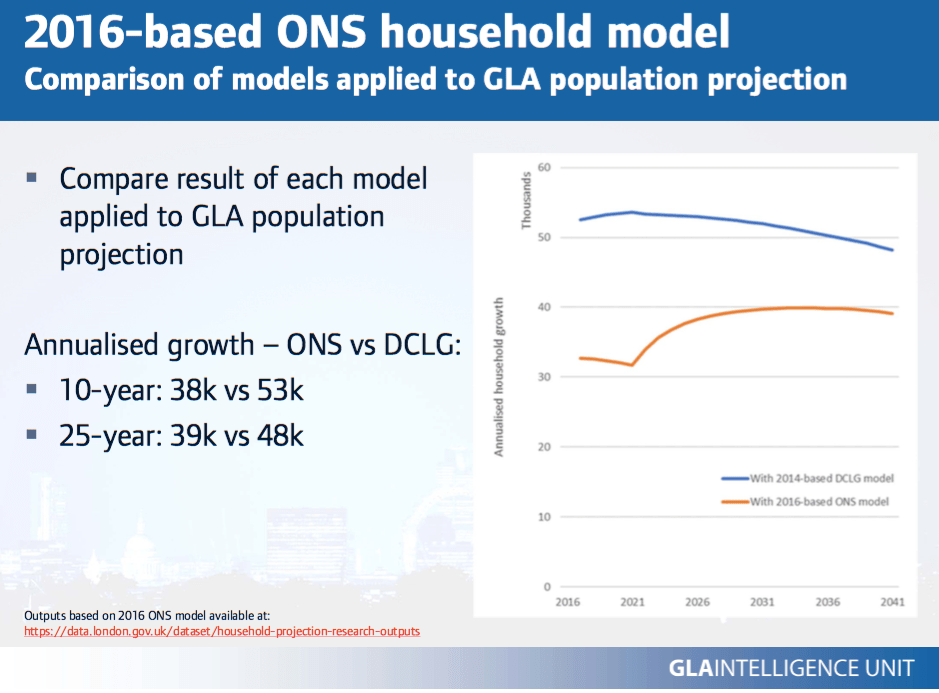
    Even in its own terms the ‘need’ for 66,000 net additional dwellings a year in the draft Plan flies in the face of the GLA evidence. 
    Big uncertainties surround many elements in the calculation: notably migration and household formation rates. On top of that Brexit could further shrink or grow the economy and wages. These wide ranges of uncertainty should have been explored in the Plan.   Download  response in full: M17 JS housing requirement
    Participants:
    GLA [ statement ]
    Barton Wilmore (housebuilders consortium) [ statement ]
    CPRE London [ statement ]
    Crest Nicholson PLC [ no statement ]
    East of England Local Government Association [ statement just says “no comment” ]
    Highbury Group [ statement ]
    Home Builders Federation [ statement ]
    Just Space [ linked above ]
    Kent Council Leaders  [  no statement ]
    Lands Improvement Holdings  [ no statement ]
    Legal and General Capital (How Planning) [ no statement ]
    London Assembly Planning Committee [ statement ]
    London Borough of Barnet [ no statement ]
    London Borough of Ealing [ no statement ]
    London Borough of Harrow [ no statement ]
    London Boroughs of Richmond & Wandsworth [ no statement ]
    London School of Economics [ statement ]
    London Tenants Federation [ statement ]
    Luton Borough Council  [ no statement ]
    Ministry of Housing, Communities and Local Government [ statement ]
    organisations not invited to participate which submitted statements: LB Newham | LB Sutton | London Forum | Pocket Living |
    Blog from the day’s discussion
    Blog by Christine Whitehead, LSE, on today’s discussion

    Week 3 Wednesday 6 February all day: Housing strategy
    M18  Will the housing policies achieve the good growth objectives in Policies GG1, GG2, GG3 and GG4 relating to building strong and healthy communities, making the best use of land, creating a healthy city and delivering the homes Londoners need? In particular how will the provisions of GG4E regarding ambitious and achievable build-out rates be put into effect? Will the provisions of Policy H1 B-F provide an effective strategic context for the preparation of local plans and neighbourhood plans?
    Just Space Response: Due to the draft London Plan’s single-minded focus on the quantity rather than quality and appropriateness of new housing completions, as well as greatly increased densification and intensification of land, we believe that there is a real risk that the housing policies laid out in the Draft London Plan will not only fail to achieve Good Growth, as we understand it, but actively undermine it. The policies will tend to undermine communities, divert land from crucial green, recreational and community uses, fail to contribute to a healthier city and damage the economy.  Detailed JS response M18 JS housing strategey
    Participants:
    Ballymore Group
    CPRE London
    Halfords Limited
    Hammersmith & Fulham Federation of Tenants and Residents Association
    Highbury Group
    Home Builders Federation
    Just Space
    Lands Improvement Holdings
    London Assembly Planning Committee London Borough of Hillingdon
    London Boroughs of Richmond & Wandsworth
    London First
    London Forum of Amenity and Civic Societies
    London NHS CCGs /NHS London Healthy Urban Development Unit (HUDU)
    London Tenants Federation
    Ministry of Housing, Communities and Local Government
    National Housing Federation
    RTPI
    South East Strategic Leaders
    Blog from the day’s discussion


    Week 3 Friday 8 and Monday 11 February all of both days: Housing supply (SHLAA) and targets [M19] [ livestream / webcast ]
    M19. Are the overall 10 year housing target for London and the targets for the individual Boroughs and Corporations set out in Policy H1 A and in Table 4.1 justified and deliverable? In particular: (Just Space comments in red)
    a) Are the assumptions and analysis regarding site suitability, availability and 
achievability and development capacity for large sites in the Strategic Housing and Employment Land Availability Assessment (SHLAA) reasonable and realistic? 

    No. JS has been critical from the outset because the capacity estimates include lots of estate ‘regenerations’ not yet approved by residents or by planning & a lot of employment land; then the SHLAA applied excessive densities…
    b) Have the environmental and social implications of the proposed increase in housing targets been fully and properly assessed?
    No, nor the economic impacts…
    c) Policy H1 B 2) a)-f) identifies various sources of capacity. Will these be sufficient to meet the ten years targets and what proportion of housing is expected to be delivered by means of the different types? How much is expected to be delivered on existing industrial land in the context of Policies E4-E7?
    The Plan must be far more explicit/transparent. Impact on jobs, products and services very destructive, e.g. evidence from Vital Old Kent Road; densification round suburban centres very badly drawn.
    d) Will the focus on existing built up areas rather than urban extensions using GB/MOL provide sufficient variety of house types and tenure?
    Do protect open land. But Plan should specify house types/tenure irrespective…
    e) Is the emphasis on development in outer London consistent with the intention in Policy GG2 that seeks to proactively explore the potential to intensify the use of land on well-connected sites?
    Yes, but…
    f) Does the Plan adequately consider the cumulative impacts of other policies on the deliverability and viability of housing?
    No…

    Break for weekend. Resuming Monday:
    g) What is going to bring about the step change in delivery implied in the Plan compared to the current one? What are the tools at the disposal of Boroughs in 1.4.6?
    Mayor has accepted that major new powers and budgets would be needed. Just Space argues that a whole range of changes in land policy, taxation and powers are required and spells these out.
    h) Is it realistic to expect this to occur from 2019 or should there be a stepped or transitional arrangement? Should Table 4.1 include targets for different types and tenures of housing? 

    Yes, the Boroughs should be given separate targets for social rented housing in Table 4.1 given the serious [past] under–performance…
    i) Should the target be for longer than 10 years given that the plan period runs to 2041?
    Yes, at least in outline. Otherwise…
    j)  How and where is the shortfall between the identified need of 66,000 additional homes a year and the total annualised average target of 64,935 to be made up? Will LPAs outside London in the wider south east be expected to deal with this on an ad hoc basis and is this realistic? 


    This difference is tiny and less than the margin of error in any data. Most likely that under-supply within the GLA boundary will be born through overcrowding and unplanned movement to destinations near and far outside the boundary, with all the associated travel costs and environmental damage, as before. 
    k)  Does paragraph 4.1.8A adequately explain how Boroughs are to calculate a target beyond 2028/29? 

    Yes. But, … not how much low cost rented housing.
    l)  What will be the implications for London Boroughs if the Plan targets are adopted which increase the requirement in recent development plans? 

    Complete Just Space response: M19 JS housing supply targets
    Participants:
    Mayor [ statement ]
    Berkshire Strategic Planning Group [ no statement ]
    Chris Philp MP Croydon [ statement Croydon target too big; give inner London more ]
    CPRE London [ statement ]
    Crest Nicholson PLC [ no statement ]
    East of England Local Government Association [ statement ]
    Hammersmith & Fulham Fed of Tenants and Residents Association [ no statement ]
    Home Builders Federation [ statement ]
    Just Space [ statement linked just above participant list ]
    London Assembly Planning Committee [ statement ]
    London Boroughs of Barnet, Brent, Ealing, Harrow & Hillingdon (West London Alliance)
    London Borough of Bexley or Bromley
    London Borough of Newham
    London Councils [ statement ]
    London First  [ statement ]
    London Forum of Amenity and Civic Societies [ statement ]
    London School of Economics [ statement ]
    London Tenants Federation [ statement ]
    Ministry of Housing, Communities and Local Government [ statement ]
    Retirement Housing Consortium [ statement ]
    Royal Borough of Kingston, London Borough of Merton, London Borough of Sutton & London Borough of Richmond [ joint statement ]
    South East Strategic Leaders [ statement ]
    Statements by organisations NOT participating: Highbury
    Blog from the discussion on 8 and 11 Feb
    Short overview of 11 and 13 Feb discussions

    Week 4 Wednesday 13 February all day : Housing policy for small sites
    M20. Are the presumption in favour of small housing developments of between 1 and 25 homes in Policy H2 and the targets in Table 4.2 justified and deliverable and will the policy be effective? In particular:

    a) Is the modelling of delivery from small sites in the SHLAA justified, including reliance on PTALs?

    Just Space nutshell: Town centre radius huge and worsened by revision;
    We want to cut down on need to travel while PTAL emphasis assumes people will travel; we welcome addition of specialist old people’s housing, but seriously worried by limits on other community housing forms which would likely generate less travel – especially for home-working and less economically active people.
    b)  Is it realistic to expect the small sites target to be achieved in the outer London Boroughs?
    Certainly arguments need to be had about what sort of “growth” London agrees to pursue and which aspects it wants to avoid. That’s what the Good Growth agenda should be about.  But there is no room for individual boroughs or districts to claim exemption from whatever is agreed. 
    c)  Has adequate consideration been given to the cumulative impacts of this policy on, amongst other things, infrastructure, affordable housing provision and the character of some neighbourhoods as referred to in paragraph 4.2.5?
    No, especially on social infrastructure…  and a growing proportion of suburban homes are now owned by PRS and HMO landlords. It’s a reasonable assumption that they will be more financially-motivated, less attached to roses and fruit trees, than owner-occupiers, so a lot of PRS space may be lost, and even beds in sheds. This could be a serious loss of relatively low-rent accommodation and thus displace relatively poor people. 
    d)  Is the policy support for infill development within the curtilage of a house consistent with national policy in paragraph 53 of the NPPF which refers to resisting inappropriate development of residential gardens?
    We… welcome the minor amendment which encourages the replacement of hardstandings with permeable or green surfaces.  However we do NOT accept that green roofs or green walls should be allowed to count towards green space: you can’t play on either, or walk the dog.
    e)  Will the provisions of Policy H2 provide an effective strategic context for the preparation of local plans and neighbourhood plans including support for custom-, self-build and community-led housing? Are the detailed criteria necessary and would they provide an effective basis for development management? Are the qualifications at Policy H2 HA-HC justified in themselves and would they effectively eliminate the positive presumption for small housing developments? 

    Multiple detailed comments including warning that the presumption in favour would inflate prices; need for much stronger support for all forms of community-led housing on small and awkward sites.
    f)  Based on the historic delivery from sites below 0.25 hectares (whether allocated or windfalls) how will the Plan’s expectations for delivery be achieved? 

    It is hard to predict how a diverse collection of site owners and potential developers will respond to the inducements offered by the draft Plan so much will depend on careful monitoring.  See M22.
    g)  What will happen in the interim pending the work to prepare area-wide design codes referred to in Policy H2 B 2)? 

    …even if the panel agrees with the scrapping of the density matrix (D6), its upper density limits should be enforced on small sites until acceptable design codes are in place, and that these codes must specify rigid density maxima in order to discourage speculative bidding-up of land prices.
    h)  Are the provisions of Policy H2 H) relating to affordable housing requirements for minor developments justified, notwithstanding that they are inconsistent with national policy?
    We consider that London needs to have affordable housing onsite in all schemes larger than a single home in order to ensure area diversity and prevent the displacement of low- and middle-income people from rich areas. Cash in lieu should… be very exceptional.

    Complete Just Space response here: M20 JS small sites
    Last-minute changes from Mayor: M20 Further Suggested Changes to Policy H2 PDF
    Participants
    :
    Catalyst Housing Limited (CBRE)
    CPRE London
    Fordyce Limited
    Hadley Wood Neighbourhood Planning Forum
    Home Builders Federation
    Just Space
    Levitt Bernstein
    London Assembly Planning Committee
    London Boroughs of Barnet, Brent, Ealing, Harrow & Hillingdon (West London Alliance)
    London Borough of Bexley or Bromley
    London Borough of Enfield or Havering
    London Borough of Camden or Islington
    London Chamber of Commerce and Industry
    London First
    London Forum of Amenity and Civic Societies
    London NHS CCGs /NHS London Healthy Urban Development Unit (HUDU) London Tenants Federation
    Ministry of Housing, Communities and Local Government
    Petts Wood & District Residents Association
    Royal Borough of Kingston, London Borough of Merton, London Borough of Sutton & London Borough of Richmond
    Transport for London
    Blog on the small sites discussion
    Short overview of 11 and 13 Feb discussions
    Blog on the small sites discussion from consultants Lichfields – mainly pessimistic

    Week 4 Friday 15 February morning [ livestream / webcast ]
    Gypsy and Traveller Accommodation

    M21.Does Policy H16 make adequate provision for meeting the need for gypsy and traveller accommodation including pitch provision and monitoring? In particular:
    a)  Is Policy H16 a justified strategic framework for the preparation of local plans?Should accommodation assessments be undertaken at Borough level or should this be done London-wide?
    No: a London-wide approach is essential and leaving it to boroughs demonstrably does not work. Former policy should be reinstated, with borough-level targets.
    b)  Is it justifiable to have a different definition to that in Annex 1 of the Planning Policy for Traveller Sites for gypsies and travellers in London?
    Yes. There is a clear evidential basis for a definition appropriate to London
    c)  Is sufficient account taken of the need for temporary stopping places? 
    No…
    d)  Is sufficient account taken of the needs of travelling showpeople?
    No…
    e)  Is sufficient account taken of the accommodation needs of boat dwellers?
    No. This is a distinct set of needs which should be met, preferably as a specialist from of housing within Policy H14  M21 JS on Gypsy and Traveller sites response in full.
    Last minute changes from Mayor: M21 Further suggested changes to Policy H16
    Participants:
    Community Law Partnership Solicitors
    Just Space
    London Borough of Bromley
    London Borough of Camden or Newham or Lambeth
    London Borough of Hillingdon
    London Borough of Wandsworth or Richmond or Merton
    London Gypsies and Travellers
    London Gypsy and Traveller Forum
    National Bargee Travellers Association
    Mobile Homes Sales and Management Peabody
    Showmen’s Guild of Great Britain (Ray Smith)Trust for London


    Week 4 Friday 15 February afternoon [ livestream / webcast ]
    Monitoring housing targets
    M22. Does Policy H3 provide an adequate basis for the monitoring of housing targets?
    Just Space proposes that additional paragraphs are added to policies H3 and H8 to require monitoring that includes not only the total net delivery of homes by borough (planning authority), but also the categories or products that make up the total to be clearly and unambiguously monitored.The London Plan identifies delivering more affordable housing as a strategic objective. The absolute numbers by categories/products of affordable homes delivered should therefore be monitored to make sure that the percentages set out in policies H5 and H6 are being met.
    In particular:
    a)  Does Policy H3 BA provide an adequate basis for differentiating between the small sites target as a component of the overall housing target?
    b)  Are the provisions in Policy H3 C and D regarding how net non-self-contained accommodation should be counted justified?
    c)  What measures should be taken if relevant targets in the London Plan are not met?
    Targets set in successive London Plans regularly fail to be met by boroughs, especially targets for social and affordable housing. Just Space proposes detailed policy changes to ensure that the Plan can be enforced. M22 JS monitoring housing response in full.
    Participants:
    Benhill Residents
    East of England Local Government Association Gladman Developments
    Home Builders Federation
    Just Space
    Levitt Bernstein
    London Borough of Richmond
    London Borough of Wandsworth
    London Forum of Amenity and Civic Societies London Tenants Federation
    Silvertown Homes

    Meeting Housing Needs

    Week 5 Tuesday 26 February all day : Affordable Housing
    Written statements in response to M24 may be up to 2,000 words in length per policy (H5 to H8).
    M24. Would policies H5 to H8 provide a justified and effective approach to delivering affordable housing to meet the good growth objectives set out in Policy GG4? Overall, would they provide an effective strategic framework for the preparation of local plans and neighbourhood plans in relation to affordable housing? In particular, in relation to each policy:

    Policy H5 Delivering Affordable Housing
    a)  Would the definition of ‘genuinely affordable housing’ and the Mayor’s ‘preferred affordable housing tenures’, include the affordable homes needed?
    No. The definitions do not meet housing need. Affordability needs to be re-defined in relation to lower quartile incomes.
    b)  Would the strategic target of 50% of all new homes to be genuinely affordable be justified in light of the identified need?
    The target is set for the wrong thing: the target should be for social rent and these dwellings should be at least 62% of total new output. The proportions in the draft Plan do not even match up to the SHMA evidence.
    c)  In requiring major developments which trigger affordable housing requirements to provide affordable housing through the threshold approach, would the policy be effective in delivering the quantum of affordable housing required?
    The threshold should be set at 50% right away and social rent proportions defined.
    d)  Would the approach to affordable housing providers, public sector land and industrial land be justified and effective?
    No. The Plan should be much more demanding, requiring 100% of housing built on public land to be affordable. The experience of the St Anne’s Hospital site in Tottenham provides strong supporting evidence.
    e)  In requiring on-site affordable housing generally, would the policy provide adequate flexibility to take account of local circumstances?
    We strongly support this policy that off-site affordable housing should be prevented except in very exceptional cases. We are concerned, though, that exceptions are proposed for small sites and that the equivalent policy in the current plan is not being enforced.
    f)  Does the approach taken in Policy H5 provide sufficient flexibility to take account of local circumstances?
    g)  Overall, would the policy be effective in delivering the affordable homes needed?
    No, for the reasons given. Just Space response in full m24 affordable housing just space 2718

    Participants for matter 24:
    Catalyst Housing Limited (CBRE)
    CPRE London
    Design Council
    Elephant Amenity Network (35% Campaign)
    Home Builders Federation
    Just Space
    London Assembly Planning Committee
    London Borough of Barnet
    London Borough of Brent
    London Borough of Camden
    London Councils
    London First
    London Forum of Amenity and Civic Societies
    London Housing Directors
    London School of Economics
    London Tenants Federation
    Ministry of Housing, Communities and Local Government
    National Custom and Self Build Association
    National Housing Federation
    NHS Property Services (NHSPS), NHS England (NHSE), NHS Improvement (NHSI) and Community Health Partnerships (CHP)
    RTPI
    Town and Country Planning Association

    Policy H6 Threshold Approach to Applications
    a)  Would the threshold approach to viability, with a fast track route and viability tested route, as set out in policy H6, be justified and effective? Would the threshold level of affordable housing as set out in Policy H6B be justified and effective?
    The use of viability testing to regulate levels of affordable housing has been to diminish the amount delivered and the threshold approach as it stands will not correct this. The threshold (B1) should be set at full policy compliance, that is 50% (or higher as we propose). B2 and B3 should be amended to 65% or 70%.
    b)  Would it provide a framework to increase delivery of affordable homes to meet the full range of identified need?
    No.
    c) Would the approach taken to scheme amendments be effective in increasing delivery of affordable homes?

    All scheme amendments should require a full revised financial appraisal and it needs to be stated in the text that financial reviews can lead to an increase in affordable housing.  The process must be fully transparent and we seek an amendment in order to achieve this.
    d)  Would the approach taken to determining benchmark land value be justified?
    e)  Would the requirement to seek grants to increase the level of affordable housing to access the fast track route be effective in increasing speed of delivery?
    No, grants should not be made available to help achieve 35% affordable housing, nor should grants be available for intermediate housing products.
    f)  Would the review mechanism as set out in Policy H6E2 be justified and effective in increasing delivery?
    Just Space response in full m24 affordable housing just space 2718

    Participants for H5 – H8:
    Catalyst Housing Limited (CBRE)
    CPRE London
    Design Council
    Elephant Amenity Network (35% Campaign)
    Home Builders Federation
    Just Space
    London Assembly Planning Committee
    London Borough of Barnet
    London Borough of Brent
    London Borough of Camden
    London Councils
    London First
    London Forum of Amenity and Civic Societies
    London Housing Directors
    London School of Economics
    London Tenants Federation
    Ministry of Housing, Communities and Local Government
    National Custom and Self Build Association
    National Housing Federation
    NHS Property Services (NHSPS), NHS England (NHSE), NHS Improvement (NHSI) and Community Health Partnerships (CHP)
    RTPI
    Town and Country Planning Association

    Policy H7Affordable Housing Tenure
    a)  Would Policy H7 be effective in delivering the tenure of affordable housing to meet the objectives of Policy GG4?
    No.  The targets are set far too low… 
    b)  In light of the identified need for low cost rental homes, would the split of affordable products in this policy be justified and effective? Would it provide sufficiently for boroughs to determine tenure locally to meet local needs and reflect local circumstances?
    The split is not justified or effective as it is likely to decrease further the amount of social rented housing.  The provision of low cost rented homes is a London wide strategic need which cannot be left to the discretion of the Boroughs
    c)  Would the preferred affordable housing tenures be justified and effective in meeting identified need?
    No.  The descriptions in paragraphs 4.7.3 onwards are deficient and they provide public funds to home ownership products, when public funds must prioritise the most urgent needs until there is evidence that these needs are being met.
    d)  Would the mechanism for review of the preferred tenures through supplementary planning guidance in 2021 be justified and effective?
    If the housing products preferred by the Mayor are not deleted at this opportunity, we support a review mechanism leading to policy change through Further Alterations to the London Plan, not an SPG.
    Just Space response in full m24 affordable housing just space 2718

    Policy H8 Monitoring Affordable Housing
    a) Would Policy H8 provide an effective framework for boroughs to monitor affordable housing?
    The Mayor must gather data and report annually on the total stock, additions and losses, of social rent dwellings, taking account of Right to Buy sales, transfers from Local Authorities to Housing Associations and their disposals, tenancies switched from social rents to higher “affordable” levels or to market levels
    Blog by Haringey DCH (Just Space)
    Our blog notes 
    Our front page about this day


    Week 5 Wednesday 27 February morning: Housing Quality and Standards 
    [ livestream / webcast ]

    M36. Would Policy D4 provide a justified and effective strategic framework for delivering quality housing? In particular:

    a)  Would Policy D4 focus on matters of strategic relevance? In this respect, would it provide appropriate flexibility in relation to housing standards in light of the planned amount of quality housing and local circumstances? (outdoor space, internal space, balconies, single aspect) Would it effectively address matters of daylight and sunlight?
    b)  In this respect, would it provide an effective and justified strategic framework for the preparation of local plans and neighbourhood plans in relation to this matter?
    c)  Would it accord with national policy particularly in light of the Nationally Described Space Standards?
    m36 housing standards just space 2718 response in full

    Participants for Matters 36-38:
    Ballymore Group
    Canary Wharf Group

    Catalyst Housing Limited (CBRE)
    Design Council
    Equality & Human Rights Commission
    Gill, Tim
    Home Builders Federation
    Inclusive Design and Access Panel
    Just Space
    London Assembly Planning Committee
    London Borough of Camden
    London Councils
    London Forum of Amenity and Civic Societies
    Ministry of Housing, Communities and Local Government RTPI
    Retirement Housing Consortium
    Town & Country Planning Association
    UNITE Group Plc (ROK Planning Ltd)
    ZCD Architects

    Accessible Housing and Visitor Accommodation
    M37. Would Policy D5 provide a justified and effective strategic framework for delivering accessible housing? In particular:
    a)  Would Policy D5 provide an effective and justified strategic framework for the preparation of local plans and neighbourhood plans in relation to this matter?
    b)  Would it provide an effective framework for development management? In this regard, would the requirements set out in Policy D5A, in relation to meeting Building Regulations requirement M4(3) and M4(2) be justified? Would this be an effective approach?

    M38. Are the requirements for accessible bedrooms in visitor accommodation set out in Policy E10G justified, and do they relate to a matter which is of strategic importance to London?

    Week 5 Wednesday 27 February afternoon: Particular types of housing 
    [ livestream / webcast ]


    Specialist Older Persons Housing
    M31. Would Policy H15 provide a justified and effective approach to meeting the housing needs of older people in London? In particular:
    a)  Would the approach to affordable housing requirements be effective and justified in supporting the delivery of housing for older people? Would thedefinition of the different types of older persons’ accommodation in termsof use class (class C2 and C3) be effective and justified? Would it be appropriate in a strategic document?
    b)  Would the ‘benchmark numbers’ set out in table 4.4 be justified?

    c) What would be the mechanism for monitoring this policy and would it be effective?
    d) Overall, would Policy H15 meet the objective of Policy GG4 in delivering the homes Londoners need?
    m31 specialist older persons housing just space 2718

    Student Accommodation
    M32. Would Policy H17 provide a justified and effective approach to the provision of purpose built student accommodation (PBSA) in London? In particular:
    a)  Would the criteria set out in Policy H17A be justified and effective in delivering PBSA to meet identified need?
    b)  Would the approach to affordable student accommodation be justified and effective?c)  Would the approach to living space and layout provide good design in PBSA to meet the objectives of good growth policies GG1 to GG4?
    d)  Overall, would Policy H17 meet the objective of Policy GG4 in delivering the homes Londoners need?
    m32 student accommodation just space 2718 JS response in full


    Week 5 Friday 1 March all day:  Other housing matters [ livestream / webcast ]

    Meanwhile Use as Housing
    M23. Would Policy H4 provide a justified and effective approach to encouraging meanwhile uses of sites for housing? In particular:
    a)  Would it make an effective contribution to meeting the London wide housing need? Would it be likely to impact on the provision of permanent homes? In the absence of a time frame for meanwhile uses, would it be effective? How would it ensure the provision of homes that provide good living conditions for occupiers?
    b)  Would it provide an effective and justified strategic framework for the preparation of local plans and neighbourhood plans in relation to this matter?
    Participants for matters 23 and 25-28
    Anthology
    Catalyst Housing Limited (CBRE)
    Centre for Accessible Environments
    Inclusive Design and Access Panel
    CPRE London
    Design Council
    Footwork Architects Ltd
    Home Builders Federation
    Just Space
    London Assembly Conservative Group
    London Assembly Planning Committee
    London Borough of Barnet, Brent, Harrow or Hillingdon
    London Borough of Merton, Richmond or Sutton
    London Borough of Newham or other inner London Borough
    London Councils
    London Forum of Amenity and Civic Societies
    London Property Alliance
    London Tenants Federation
    Ministry of Housing, Communities and Local Government
    New Policy Institute
    NHS Property Services (NHSPS), NHS England (NHSE), NHS Improvement (NHSI) and Community Health Partnerships (CHP)
    Retirement Housing Consortium


    Vacant Building Credit
    M25. Would Policy H9 be consistent with national policy? Is the approach taken justified?

    Redevelopment of Housing and Estate Regeneration
    M26. Would Policy H10 provide a justified and effective approach to the redevelopment of existing housing and estate regeneration? In particular, would the approach to affordable housing be justified? In light of Policy H5, would the requirements be clear? In the context of local need and objectives for redevelopment or estate renewal, would it be effective? What is the justification for provision of affordable housing floorspace rather than units? Would it provide sufficient flexibility to reflect local circumstances and support housing and estate regeneration? Overall, would the approach taken meet the objective of Policy GG4 in delivering the homes Londoners need?
    m26-estate-regeneration-just-space-2718 response in full

    Ensuring the Best Use of Housing Stock
    M27. Would Policy H11 provide a justified and effective approach to ensuring the best use of housing stock? In particular:
    a)  Would this policy deal with a strategic planning matter?
    b)  Would the approach taken to ‘buy to leave’ and short term holiday accommodation be justified?

    c) Overall, would Policy H11 be effective in sustaining London’s existinghousing stock and would it meet the objective of Policy GG4 to deliver the homes Londoners need?

    Housing Size Mix
    M28. Would Policy H12 provide a justified and effective approach to achieving the dwelling size mix to meet London wide and local needs? In particular:
    a)  Does the dwelling size and mix identified in the 2017 SHMA provide a robust and realistic assessment of London wide needs?
    b)  Would policy H12 provide an effective and justified strategic framework to deliver the mix of homes needed? What is the justification for preventing boroughs from setting prescriptive dwelling size mix requirements for market and intermediate homes and would this approach be effective? Would it provide sufficient flexibility to meet local needs? In light of this and the need to optimise density would it make a sufficient contribution towards family homes?
    c)  Overall, would it meet the objective of Policy GG4 to deliver the homes Londoners need?
    m28 housing size mix just space 2718 response in full

    Blog post on Friday 1 March topics – rough draft

    Week 6 Tuesday 5 March morning: Delivering good design

    M34. Would policies D1 and D2 provide a justified and effective approach to delivering good design? In particular:
    a)  Would the approach to delivering good design meet the good growth objectives set out in policies GG1, GG2, GG3 and GG4?
    b)  In light of the requirements of policies D1 and D2 would they be effective in achieving the level of growth envisaged?
    c)  Would policies D1 and D2 provide an effective framework to protect the distinctiveness of different parts of London, with particular regard to their social, economic, cultural and residential characteristics?
    d)  Would the approach taken to design scrutiny be justified and effective? Would the proposed use of masterplans and design codes, as set out in Policy D2D, help to bring forward development and ensure high quality design? Would the proposed use of design review, as set out in Policy D2F, be justified and effective? In this regard, would the policies deal with strategic planning matters?

    e)  Bearing in mind the resource implications for boroughs in carrying out Policy D2A1-11, would it be effective?
    f)  How would the policies be monitored, given the nature of many of the requirements?g)  Overall, would the policies provide an effective and justified strategic framework for the preparation of local plans and neighbourhood plans and development management in relation to this matter?
    m34 good design just space 2718 response in full
    Blog post on Design sessions

    Inclusive Design 
    M35. Would Policy D3 provide a justified and effective strategic framework for delivering inclusive design? In particular:
    a)  Would Policy D3 address matters that can be delivered and enforced through the planning regime, in particular the requirement for emergency evacuation? Would it strike the right balance between providing for inclusive design and delivering the planned level of growth?
    b)  Would it be effective in ensuring the diverse needs of all Londoners are integrated into development proposals from the outset? Would it be effective in ensuring that the experience and views of all Londoners, particularly excluded groups, are taken into account in the evaluation of development proposals?
    c)  In this respect, would it provide an effective and justified strategic framework for the preparation of local plans and neighbourhood plans in relation to this matter?
    m35 inclusive design just space 2718 response in full
    Blog post on Design sessions

    participants for Good design and inclusive design (Policies D1, D2 and D3) [M34-M35]
    Centre for Accessible Environments Inclusive Design and Access Panel City of London Corporation
    CPRE London
    Design Council
    Environment Agency
    Equality & Human Rights Commission
    Friends of the Earth England, Wales and Northern Ireland
    Footwork Architects Ltd
    Home Builders Federation
    Inclusion London
    Just Space
    London Assembly Planning Committee
    London Councils
    London First
    London Forum of Amenity and Civic Societies
    London NHS CCGs /NHS London Healthy Urban Development Unit (HUDU) London Property Alliance
    London Tenants Federation
    Ministry of Housing, Communities and Local Government
    RTPI

    Week 6 Tuesday 5 March afternoon: Density
    M39. Would Policy D6 on optimising density be effective in achieving the intentions in Policy GG2 on making the best use of land and is the policy approach justified especially bearing in mind the cumulative impact on the environment and infrastructure? In particular:
    a)  Would the provisions of Policy D6 provide an effective strategic context for the preparation of local plans and neighbourhood plans? Would the detailed criteria provide an effective and justified basis for development management, are they all necessary and do they provide sufficient clarity about how competing considerations are to be reconciled by the decision- maker?
    b)  Will leaving density to be assessed on a site-by-site basis compared to the matrix in The London Plan of 2011 be effective?
    m39 density just space 2718
    Provisional blog post from M. Edwards. Fuller note to follow here.
    LSE blog post by Prof Ian Gordon here

    participants for Density (Policy D6) [M39]
    Mayor/GLA   defend their position and add new policy wording
    Ballymore Group
    CPRE London
    Edwards, Michael
    Friends of the Earth England, Wales and Northern Ireland
    Galliard Homes
    Highbury Group
    Home Builders Federation
    Just Space
    London Assembly Planning Committee
    London Borough of Barnet
    London Borough of Bromley
    London Councils
    London First
    London Forum of Amenity and Civic Societies
    Monks Orchard Residents Association
    Retirement Housing Consortium
    Southern Housing Group
    Turnbull, Pat

    statements from non participants: Catalyst Housing, LSE London

    Week 6 Wednesday 6 March, morning: Tall buildings, public realm and basements

    Public Realm
    M40. Would Policy D7 provide a justified and effective strategic framework for delivering high quality public realm? In particular:
    a)  Would Policy D7 relate to strategic planning matters, particularly in relation to street furniture and management and ongoing maintenance of the public realm?
    b)  Would the criteria of the policy be justified and effective, in relation to matters such as sunlight, the natural environment and meanwhile uses?
    c)  Overall, would it provide an effective and justified strategic framework for the preparation of local plans and neighbourhood plans in relation to this matter?
    m40 public realm just space 2718 response in full

    Tall Buildings Written statements in response to M41 may be up to 3,000 words in length.
    M41. Would Policy D8 provide a justified and effective strategic framework for the development of tall buildings? In particular:
    a)  Would the local definition of what is considered a ‘tall building’ provide an effective strategic framework to guide the location of tall building development?
    b)  Where there is no local definition of what is considered a ‘tall building’, would the definition at paragraph 3.8.2 be justified and would it be effective?
    c)  Would Policy D8, generally provide an effective framework to guide the location of tall building development, taking account of its wider surroundings and any cumulative effect?
    d)  Would it provide an effective strategic framework for the assessment of the impact of tall building development?

    e) Overall, would Policy D8 provide an effective and justified strategic framework for the preparation of local plans, neighbourhood plans and development management in relation to this matter?
    m41 tall buildings just space 2718 response in full

    Basement Development
    M42. Would Policy D9, in addressing the negative impacts of large scale basement development below existing buildings relate to a matter of strategic importance to London? Would it provide an effective strategic framework to ensure the best use of land whilst protecting the local environment and the living conditions of residents?

    Week 6 Wednesday 6 March, afternoon:
    Safety and security, fire safety, agent of change and noise

    Safety, Security and Resilience
    M43. Would policies D10 and D11, in addressing matters including fire safety, refer to strategic planning matters? In particular, would policies D10 and D11 provide an effective and justified strategic framework for the preparation of local plans and neighbourhood plans in relation to this matter?
    m43 fire safety just space 2718 response in full

    Noise and Nuisance
    M44. Would policies D12 and D13 provide a justified and effective strategic framework to mitigate the impacts of existing noise and nuisance generating activities or uses on proposed new noise-sensitive development and reduce, manage and mitigate noise in relation to new development? In particular:
    a)  Would Policy D12, in setting out the ‘agent of change’ principle, benecessary in light of paragraph 123 of the NPPF?
    b)  Would the identification and protection of ‘Quiet Areas’ be effective, as set out in Policy D13B? Would it be justified?
    c)  Would policies D12 and D13 provide an effective and justified strategic framework for the preparation of local plans and neighbourhood plans in relation to these matters?

    Week 6 Friday 8 March morning : Heritage and Culture
    Conserving and Enhancing the Historic Environment

    M45. Would Policy HC1 provide an effective and justified approach to conserving and enhancing the historic environment? In particular:
    a)  Would Policy HC1 provide an effective and justified strategic framework for the preparation of local plans and neighbourhood plans in relation to the historic environment?
    b)  Would it provide sufficient detail to guide London boroughs in developing evidence that demonstrates a clear understanding of London’s historic environment?
    c)  Would the approach to development management be effective, justified and consistent with national policy in relation to designated and non- designated heritage assets?
    m45 heritage and culture just space 2718


    World Heritage Sites

    M46. Would Policy HC2 provide an effective and justified approach to the conservation, promotion, active protection and interpretation of the outstanding universal value (OUV) of world heritage sites (WHS)? In particular:
    a)  Would Policy HC2 be an effective and justified strategic framework for the
    preparation of local plans and neighbourhood plans in relation to the WHS? Would it provide sufficient guidance to London boroughs on the need for policies in Local Plans to protect OUV of WHS?
    b)  Would Policy HC2 provide sufficient detail on the approach to ‘setting’ and ‘buffer zones’? In this respect paragraph 7.2.4 refers to supplementaryplanning guidance? What is the up to date position on this? Would the policy be effective without this?
    c)  Would the approach taken be consistent with paragraphs 132-134 of the NPPF, which sets out the way in which proposals affecting heritage assets should be assessed?
    m46 world heritage sites just space 2718

    Strategic and Local Views
    Written statements in response to M47 may be up to 3,000 words in length.

    M47. Would policies HC3 and HC4 provide an effective and justified approach to protect and enhance the composition and character of strategic views and their landmark elements in London? In particular:
    a)  Would Policy HC3 be an effective and justified strategic framework for the preparation of local plans and neighbourhood plans in relation to the protection of those views?
    b)  Policy HC3G and para 7.3.6 refer to local views. Are ‘local views’ a strategic matter? If so, what is the justification for giving such views the same degree of protection as strategic views? In this regard, would the policy be effective?
    c)  Would the criteria in policy HC4 provide an effective and justified basis for development management? Would they provide sufficient clarity to enable a decision maker to reconcile competing considerations?

    Friday 8 March afternoon : Culture and Creative Industries
    M48. Would Policy HC5 provide an effective and justified approach to supportingthe continued growth and evolution of London’s cultural facilities and creativeindustries? In particular:
    a)  Would it provide an effective and justified strategic framework for the preparation of local plans and neighbourhood plans in relation to those matters?
    b)  Would the identification of ‘cultural quarters’, comprising locally-distinct clusters of facilities, venues and related uses, be justified as set out inPolicy HC5A2?
    c)  Would it be effective in supporting the diversity in London’s cultural venues, facilities and uses?
    d)  Would the identification of ‘creative enterprise zones’ be effective in supporting creative industries? What justification is there that such anapproach would ‘help boost the local economy of more deprived areas andsupport regeneration’?
    m48 culture and creative industries just space 2718 response in full

    Night Time Economy
    M49. Would Policy HC6 provide an effective and justified approach to supportthe growth and diversification of London’s night time economy (NTE)? In particular:
    a)  Is the definition of ‘strategic areas of night time activity’ as set out in table A1.1 effective and justified?
    b)  Does it strike the right balance between supporting the NTE and protecting the living conditions of residents and nearby uses in terms of anti-social behaviour, noise pollution, health and wellbeing and other issues?
    m49 night time economy just space 2718 response in full

    Public Houses
    M50. Would Policy HC7 address detailed issues that would be more appropriately dealt with in local plans and neighbourhood plans? Would it provide an effective and justified strategic framework for the preparation of local plans and neighbourhood plans in relation to the protection of existing public houses and support for new public houses?
    m50 public houses just space 2718

    Participants for Culture and creative Industries, night time economy and public houses (Policies HC5-HC7) [M48-M50]
    AEG Europe
    Bengali East End Heritage Society
    CAMRA
    Community Food Growers Network
    Historic England
    Institution of Lighting Professionals
    Just Space
    London Assembly Green Party Group
    London Assembly Planning Committee London Councils
    London Culture Forum
    London Forum of Amenity and Civic Societies London Property Alliance
    London Wildlife Trust
    National Trust London
    Showmen’s Guild of Great Britain (Ray Smith)Theatres Trust
    U+I


    Tuesday 12 March afternoon: extra session for matters not discussed on Feb
    M29. Build to Rent
    M33. Large Scale Shared Living Development
    M30. Supported and Specialised Housing

    Build to rent
    M29. Would Policy H13 provide a justified and effective approach to build to rent housing to meet housing need? In particular:
    a)  Would the criteria to define build for rent set out in Policy H13B be justified and would they be effective in supporting delivery?
    b)  Would the approach to affordable housing requirements be justified and effective? Would it be effective in meeting local needs? Would the approach to discounted market rent homes be effective? Should the discount level be defined locally to take account of local circumstances?
    c)  Are there specific design requirements of this type of housing and would the policy be effective in delivering them?
    d)  Overall, would it meet the objective of Policy GG4 to delivering the homes Londoners need?
    m29 build to rent just space 2718 Just Space response in full
    Participants for matters 29-33:
    Access Association
    Audley Group
    British Property Federation
    Canary Wharf Group
    Cass and Claredale
    Downing
    Equality & Human Rights Commission
    Elysian Residences
    Get Living London
    Home Builders Federation
    Just Space
    London Assembly Planning Committee
    London Borough of Camden
    London Councils
    London Federation of Housing Cooperatives London First
    London Forum of Amenity and Civic Societies
    London Tenants Federation
    NHS England
    PRP
    Retirement Housing Consortium
    RICS
    University College London
    University of London

    Supported and Specialised Housing
    M30. Would Policy H14 provide a justified and effective approach to the delivery, retention and refurbishment of supported and specialised housing? In particular, would it meet the objective of Policy GG4 to delivering the homes Londoners need?
    m30 supported and specialised housing just space 2718 Just Space response in full


    Large Scale Shared Living Development
    M33. Would Policy H18 provide a justified and effective approach to the delivery of large scale purpose built shared living accommodation in London? In particular:
    a)  Would the criteria set out in Policy H18A be justified?
    b)  In the absence of the application of defined space and amenity standards, would it be effective and justified in delivering good design and the objectives of policies GG1 to GG4?
    c)  Would the size of development defined in paragraph 4.18.3 be justified?
    d)  Would the affordable housing requirements be effective and justified?
    e)  Overall, would it deliver the planned level of growth to meet the objectives of good growth policies GG1 to GG4?
     Blog on today’s discussion

    Monday 18 March morning: Central Activities Zone, Offices, Industry and Freight

    Central Activities Zone including Isle of Dogs (north) (“CAZ”)
    M58. Would policies SD4 and SD5 be effective in ensuring an appropriate mix of housing, offices [footnote says Table 6.1 of the Plan indicates 367,700 additional office jobs in the CAZ 2016-2041 ] and other development in different parts of, and outside, the CAZ to support:
    a)  the “strategic functions” of the CAZ (paragraph 2.4.4);
    b)  “locally orientated uses” in the CAZ (paragraph 2.4.5) and Policy GG1“building strong and inclusive communities”;
    c)  Policy GG4 “delivering the homes Londoners need”; and
    d)  Policy GG5 “growing a good economy”?
    Just Space submission in full: M58 CAZ Just Space

    participants: Central Activities Zone including Isle of Dogs (north) (policies SD4 and SD5) [M58]
    Canary Wharf Group
    Catalyst Housing Limited (CBRE)
    City of London Corporation
    The Crown Estate
    GLA Industrial BIDs Group
    Historic England
    Just Space
    London Assembly Green Party Group
    London Assembly Planning Committee London Borough of Camden
    London Chamber of Commerce and Industry London First
    London Forum of Amenity and Civic Societies London Property Alliance
    London Tenants Federation
    New West End Company
    Trust for London
    Waterloo Community Development Group


    Monday 18 March afternoon : Offices
    M59. Is Policy E1 justified and would it be effective in ensuring that identified needs for additional office floorspace are met in appropriate locations in accordance with national policy? In particular:
    a)  Are the figures in Table 6.1 for projected office employment growth and office floorspace demand 2016-2041 in different parts of London justified?
    b)  Would the locations identified in parts C and D have sufficient capacity and be likely to deliver the amount of additional floorspace required such that needs in all parts of London can be met?
    c)  Are the “office guidelines” set out in Figure A1.4 justified, and is the way in which they are intended to be used in the implementation of part D2 clear?
    d)  Would policies E1D4 and SD7A1 provide an effective approach for office development in town centres that are not identified as having potential for speculative and/or mixed use office development in Figure A1.4?
    e)  Is the proposed use of Article 4 Directions set out in parts E and F clear and is it justified having regard to national policy, bearing in mind the minor suggested change to paragraph 6.1.6?
    f)  How would Policy E1 affect the implementation of Policy GG4 “delivering the homes Londoners need”?
    g)  deleted from final agenda. Would policy E1(G) be effective in ensuring the availability of an adequate supply of low cost and affordable office space [Note that policies E2 and E3 are considered under M60]
    Just Space submission in full: M59 Offices Just Space

    Participants:  Offices (Policy E1) [M59]
    Canary Wharf Group
    CBI
    DTZ Investors
    Federation of Small Businesses
    GLA Industrial BIDs Group
    Home Builders Federation
    Just Space
    London First
    London Forum of Amenity and Civic Societies
    London Property Alliance

    Tuesday 19 March morning
    M62 Land for Industry, Logistics and Services to Support London’s Economic Function
    Written statements in response to M62 may be up to 4,000 words in length.
    The Mayor published a further suggested change relevant to Matter 62 on 8 March [FSC/13]

    M62. Are policies E4, E5, E6 and E7 consistent with national policy and would they be effective in helping to ensure that sufficient suitable land and premises are available to meet the quantitative and qualitative needs for all foreseeable types of industrial15 activity over the plan period? [Reference to “industrial” or “industry” in these matters includes all types of economic activity referred to in policy E4A(1)-(9A) incorporating the Minor Suggested Changes.]
    In particular: M62. Are policies E4, E5, E6 and E7 consistent with national policy and would they be effective in helping to ensure that sufficient suitable land and premises are available to meet the quantitative and qualitative needs for all foreseeable types of industrial1 activity over the plan period? In particular: (sequence changed in final agenda, as follows):

    Need for industrial land

    a) Are the industrial job growth projections and associated estimates of land and floorspace requirements justified?

    e) Is the approach to assessing floorspace and yard space capacity set out in paragraph 6.4.5 – 6.4.5B based on existing floorspace or floorspace assuming a 65% plot ratio (whichever is greater) justified and would it be effective?

    Meeting the need for industrial land

    b)  Is the aim of ensuring no overall net loss of (i) industrial floorspace capacity and (ii) operational yard space capacity across London in designated Strategic Industrial Locations (SIL) and Locally Significant Industrial Sites (LSIS) justified and realistic, and would achieving that objective ensure the availability of a sufficient quantity of land and premises for industrial uses?

    c)  Are the borough-level capacity categorisations (“retain”, “provide”, or “limited release”) set out in Table 6.2 justified, and would the proposed approach ensure a sufficient quantity of land and premises in different industrial property market areas?

    d)  Are there parts of London where significant amounts of additional industrial land are likely to be needed in addition to that which is currently in use and/or designated?

    f) Is the approach set out in Policy E7D towards “non-designated industrial sites” (36% of total amount of industrial land2) justified and consistent with national policy?

    j) What evidence is there about the feasibility of delivering schemes on industrial land that would lead to the provision of net additional industrial floorspace along with the provision of significant numbers of new homes on the same site?

    E7F – wider South East

    i) Is Policy E7F, along with Policy SD2, likely to be effective in terms of facilitating the substitution of some of London’s industrial capacity to related property markets beyond London’s boundary, and would achieving such an objective contribute to the achievement of sustainable development?

    Effect of E4-E7 on meeting housing needs

    k) How would policies E4-E7 affect the implementation of Policy GG4 “delivering the homes Londoners need”?

    Are E4-E7 effective, or unduly detailed, prescriptive and complicated

    1. g)  Would policies E4-E7 provide an effective strategic context for the preparation of local plans and neighbourhood plans?

    2. h)  Are policies E4-E7 clear about how they would be implemented through the determination of planning applications, particularly in terms of the role of“planning frameworks3” and “a co-ordinated masterplanning process incollaboration with the GLA”, and the relationship between policies E5D andE7B?

    Just Space statement in full: M62 Land for Industry Just Space

    Blog post on this topic.


    Participants for Industry, logistics and services to support London’s economic function [M62]
    Amazon UK Services Limited
    Ballymore Group
    DB Cargo UK Limited
    East of England Local Government Association
    Federation of Small Businesses
    Freight Traffic Control 2050 project
    Gazeley UK Ltd
    GLA Industrial BIDs Group/ London Industry and Logistics Sounding Board
    Home Builders Federation
    Just Space
    London Assembly Planning Committee
    London Boroughs: three from Bexley, Brent, Ealing, Enfield, Richmond Sutton and Wandsworth
    London Chamber of Commerce and Industry
    London First
    London Forum of Amenity and Civic Societies
    London Waste and Recycling Board
    Prologis
    ROCA Investments
    SEGRO
    South East England Councils / South East Strategic Leaders

    Tuesday 19 March  afternoon
    Freight, Deliveries and Servicing
    M63.
    Would Policy T7, along with policies E4-E7, provide an effective strategic framework to ensure that suitable sites and infrastructure are provided for all types of freight, deliveries and servicing in an integrated and sustainable manner in all parts of London? In particular:
    a)  are all of the requirements of Policy T7 necessary to address the strategic priorities of London, or
    b)  do they extend to detailed matters that would be more appropriately dealt with through local plans or neighbourhood plans?
    Just Space submission in full: M63 Freight Just Space

    Participants for Freight, Deliveries and Servicing [M63]
    Amazon UK Services Limited
    British Retail Consortium
    DB Cargo UK Ltd
    Federation of Small Businesses
    Freight Transport Association
    GLA Industrial BIDs Group
    John Lewis Partnership
    Just Space
    London Forum of Amenity and Civic Societies
    London Industry and Logistic Sounding Board
    London Sustainability Exchange
    Road Haulage Association Ltd
    Sainsbury’s Supermarkets Ltd
    SEGRO
    Sustrans
    Transport for London
    United Kingdom Warehousing Association
    UPS

    Wednesday 20 March morning

    Low Cost and Affordable Business Space
    This matter will be dealt with by considering policy E2 and E3 in turn. There will then be the opportunity to make any further contributions related to sub questions (a) to (d) that have not already been covered.

    M60. Are policies E2 and E3 justified and would they be effective? In particular:

    a)  Are they necessary to address the strategic priorities of London, or do they extend to detailed matters that would be more appropriately dealt with through local plans or neighbourhood plans?
    b)  Would they be effective in helping to ensure that the accommodation needs of all micro, small and medium sized businesses, including those wishing to start up or expand, could be met in all parts of London?
    c)  Or would that objective be better achieved by market forces in the context of other policies in the Plan, including E1A, E4A, E4H, E5C and E6, as well as any relevant policies in local plans and neighbourhood plans?
    d)  How would policies E2 and E3 affect the implementation of policy GG5 “growing a good economy”?
    Just Space submission: M60 Low Cost and Affordable Business Space Just Space

    Blog Post from this day’s discussion

    Participants for
    Low cost and affordable business spaces (Policies E2 and E3) [M60]
    British Property Federation
    Canary Wharf Group
    CBI
    Federation of Small Businesses
    HEAR Equality and Human Rights Network
    Just Space
    Lendlease
    London Assembly Green Party Group
    London Assembly Planning Committee London Borough of Brent
    London First
    London Forum of Amenity and Civic Societies London Property Alliance
    Vital OKR
    Workspace Group (Lichfields)
    Workspace Providers Board

    Wednesday 20 March afternoon
    Visitor Infrastructure
    M61. Is Policy E10 justified and consistent with national policy and would it be effective in ensuring that the need for accommodation and other infrastructure for visitors can be met in appropriate locations? In particular:
    a)  Is development of accommodation and other visitor infrastructure a matter of strategic importance to London, or a detailed matter that would be more appropriately dealt with through local plans or neighbourhood plans?
    b)  Would Policy E10D support the “strategic functions” of the CAZ (paragraph 2.4.4) and “locally orientated uses” in the CAZ (paragraph 2.4.5)?
    Just Space submission in full: M61 Visitor infrastructure Just Space

    Participants for Visitor Infrastructure (Policy E10) [M61]
    Access Association
    GLA Industrial BIDs Group
    Highgate Society
    Just Space
    London Assembly Planning Committee
    London Borough of Brent or Ealing
    London Borough of Richmond or Wandsworth
    London Borough of Sutton
    London Forum of Amenity and Civic Societies
    London Hotel Group
    London Property Alliance
    West End Partnership

    Tuesday 26 March March morning
    Green Infrastructure and Natural Environment
    Green infrastructure, open space and urban greening
    M64. Would the policies for green infrastructure assist in creating a healthy city in accordance with Policy GG3 and will they provide an effective strategic context for the preparation of local plans and neighbourhood plans? Are Policies G1, G4 and G5 and their detailed criteria justified and necessary and would they provide an effective basis for development management? How would they affect the implementation of Policies GG4 and GG5 on delivering the homes Londoners need and growing a good economy? In particular:
    a)  Is the Mayor’s target of making more than 50 percent of London green by 2050 and its designation as a National Park City justified and achievable?
    b)  Do the policies adequately reflect the qualitative differences and value of different types of green infrastructure, including open and green space and the role of waterways (blue space) and the access to it?
    c)  Given the All London Green Grid is it necessary for Boroughs to prepare green infrastructure strategies in accordance with Policy G1 B?
    d)  Does Policy G4 provide sufficient protection for the amount and quality of all green and open space including private gardens and allotments and on housing estates? Is the categorisation in Table 8.1 justified? Should the policy refer to the improvement of existing spaces?
    e)  Is the expectation that Boroughs develop an Urban Greening Factor based on Policy G5 and Table 8.2 justified with particular regard to viability and practicality? (NB question e deferred to Wednesday morning – tomorrow)
    Just Space submission in full: M64 green infrastructure Just Space
    Blog on this topic

    Tuesday 26 March afternoon
    Green Belt and Metropolitan Open Land
    M65. Would Policies G2 and G3 provide an effective strategic context for the preparation of local plans and neighbourhood plans? Are the policies and detailed criteria justified and necessary and would they provide an effective basis for development management? In particular:
    a)  Is Policy G2 on London’s Green Belt consistent with national policy and, if not, is this justified?
    b)  Is the ‘swapping’ of Metropolitan Open Land (MOL) referred to in paragraph 8.3.2 and allowed for by Policy G3 AC justified? Do the other detailed criteria provide sufficient clarity about inappropriate development and how any boundary alterations should proceed? Should parts of the River Thames be designated as MOL?Biodiversity, trees, food growing and geodiversity
    See the Just Space submission of March 2018.

    Wednesday 27 March morning
    Urban greening M 64 and e from yesterday morning.


    Wednesday 27 March afternoon Biodiversity, trees, food…

    M66. Would Policies G6-G9 assist in creating a healthy city in accordance with Policy GG3 and will they provide an effective strategic context for the preparation of local plans and neighbourhood plans? Are the individual policies and detailed criteria justified and necessary and would they provide an effective basis for development management? In particular:
    a)  Will Policy G6 be likely to achieve net gains in biodiversity and consistent with national policy? Are specific provisions relating to European sites in BA necessary give other legislative requirements?
    b)  Will Policy G7 be effective in protecting trees and woodland especially ancient woodland and veteran trees and in increasing the extent of London’s urban forest?
    c)  Does Policy G8 provide sufficient encouragement to food growing and urban agriculture?
    Just Space submission in full: M66 Biodiversity and food growing Just Space

    Week 8 Friday 29 March all day
    Sustainable Infrastructure
    Minimising Greenhouse Gas Emissions, Energy Infrastructure and Managing Heat Risk
    Written statements in response to M67 may be up to 3,000 words in length.

    M67. Would Policies SI2, SI3 and SI4 assist in creating a healthy city in accordance with Policy GG3 and provide an effective strategic context for the preparation of local plans and neighbourhood plans? How would they affect the implementation of Policies GG4 and GG5 on delivering the homes Londoners need and growing a good economy? Are these policies and their detailed criteria justified and necessary and would they provide an effective basis for development management? In particular:
    a)  In seeking to minimise greenhouse gas emissions does Policy SI2 provide sufficient clarity about the zero-carbon target and how and when it is to be achieved? Is the target justified and consistent with national policy and other policies in the draft London Plan? Are all the criteria and supporting text necessary
    b)  How are unregulated emissions and whole life-cycle carbon at Policy SI2 DA and DB to be calculated and is this justified?
    c)  Are the provisions in Policy SI3 relating to energy masterplans justified? Should they be limited to large-scale development locations and is the list of items to be identified comprehensive?
    d)  Are the provisions in Policy SI3 relating to major development proposals within Heat Network Priority Areas justified? Is the sequence and content of the heating hierarchy justified having regard, amongst other things, to greenhouse gas emissions?
    e)  Would Policy SI4 adequately address the contribution of the design of outdoor space to urban cooling without creating other adverse impacts and does it consider overall thermal comfort?
    f)  What is the justification for the cooling hierarchy as set out in Policy SI4B?
    g)  Do the policies place sufficient emphasis on the use of renewables and energy efficiency?
    Just Space submission in full: M67 Greenhouse emissions Just Space
    Blog on today’s session


    Tuesday 30 April all day
    Waste and Circular Economy

    The Mayor responded to the Panel’s Preliminary Question PQ14 relating to waste management on Friday 7 September 2018.

    M68. Would Policy SI7 provide a justified and effective approach to reducing waste and supporting the circular economy? Would it further the aims of Good Growth policies GG1-GG6? Would it focus on planning matters of London wide importance? In particular:
    a)  Would the definition of ‘circular economy’ as set out in paragraph 9.7.1 be justified and would it be effective in reducing waste, increasing material reuse and recycling and reductions in waste going for disposal?
    b)  Would Policy SI7 provide an effective and justified strategic framework for the preparation of local plans and neighbourhood plans in relation to this matter? In particular what is the justification for the waste to landfill and recycling targets set out in Policy SI7A4? Could these be effectively monitored? Bearing in mind the timescales involved would these be effective?
    c)  Would it provide an effective framework for development management? In particular, would the requirement for a Circular Economy Statement in relation to referable applications be effective and justified?
    Just Space submission: M68 Waste and Circular Economy Just Space


    Written statements in response to M69 may be up to 3,000 words in length.

    M69., Would Policy SI8 and SI9 provide a justified and effective approach toproviding for London’s waste and promoting net waste self-sufficiency? In particular:
    a)  Is the target of net self-sufficiency by 2026 as set out in Policy SI8A1 realistic? What is the justification for excluding excavation waste within the net self-sufficiency target? In light of this would it be justified?
    b)  Are the Borough forecast arisings of household and commercial and industrial waste as set out in table 9.1 based on robust evidence? What waste streams are excluded and what is the justification for excluding them? In light of this are they realistic and justified?
    c)  Is the apportionment of waste to be managed in Boroughs, as set out in table 9.2, justified? What waste streams are excluded from the apportionments and what are the provisions to deal with those waste streams? As some waste streams are not included would the apportionments be effective in ensuring that the waste targets in Policies SI7 and SI8, the Borough apportionments in table 9.2 and the aspirations for net self-sufficiency and shifting towards a low carbon circular economy would be met?
    d)  Would they provide an effective framework for development management? In particular, would the criteria in Policy SI8C accord with national policy? Would Policy SI8D provide an effective and justified framework for the evaluation of proposals for new waste sites or to increase capacity of existing waste sites?
    e)  Would they be effective in safeguarding existing waste sites particularly in relation to Policy SI9C?
    See the Just Space submission of March 2018.


    Wednesday 1 May morning
    Aggregates

    M70. Would Policy SI10 provide a justified and effective strategic framework for the steady and adequate supply of aggregates to support construction in London? In particular:
    a)  Would the approach taken to land-won aggregates accord with national policy? What is the justification for the landbank apportionment in the four boroughs identified? Would the approach taken be effective in ensuring an adequate supply of aggregates to meet the level of growth envisaged?
    b)  In the absence of a target for recycling/reuse of construction, demolition and excavation waste by 2020 and the recycling of that waste as aggregate, would the policy be effective?
    c)  Would the approach taken to safeguarding resources and facilities, as set out in SI10C, be effective in ensuring the steady and adequate supply of aggregates to support construction in London?
    d)  Would Policy SI10 adequately address the full range of environmental and other impacts of aggregate facilities?
    e)  Would it provide appropriate, justified and effective guidance on development management matters?
    See the Just Space submission of March 2018.


    Hydraulic Fracturing

    M71. Would Policy SI11 be consistent with national policy in respect of the exploration, appraisal or production of shale gas via hydraulic fracturing? If not, what is the justification for the approach taken? [footnote: National policy as set out in the NPPF PPG Minerals and the WMS Planning for Onshore Oil and Gas: Written Statement (16 September 2015) and Energy Policy: Written statement (17 May 2018)]
    Just Space statement in full: M71 Hydraulic Fracturing Just Space

    Wednesday 1 May afternoon
    Flood Risk Management
    M72. Would Policy SI12 provide a justified and effective strategic framework for flood risk management in London? In particular:
    a)  Would it provide a justified and effective strategic framework for the preparation of local plans?
    b)  Would it provide appropriate, justified and effective guidance on development management matters?
    c)  Overall, would it provide for the timely delivery and funding of flood risk management?
    See the Just Space submission of March 2018.


    Sustainable Drainage
    M73. Would Policy SI13 provide a justified and effective approach to sustainable drainage in London? In particular:
    a)  Would it provide a justified and effective strategic framework for the preparation of local plans?
    b)  Would it provide appropriate, justified and effective guidance on development management matters? In particular, what is the justification for the drainage hierarchy as set out in Policy SI13B? Would it be appropriate, justified and would it be effective?
    c)  What is the justification for developments to achieve ‘green field run off rates’? Is this based on robust evidence? Would this be an effectiveapproach to sustainable drainage in London?
    Just Space statement in full:   M73 Sustainable Drainage Just Space


    Friday 3 May, morning
    Social Infrastructure
    Delivering Social Infrastructure
    M51. Would Policy S1 provide an effective and justified approach to thedevelopment of London’s social infrastructure? In particular would it be effective in meeting the objectives of policies GG1 and GG3 in creating a healthy city and building strong and inclusive communities? In particular:
    a)  Would Policy S1, in requiring a needs assessment of social infrastructure and encouraging cross borough collaboration provide an effective and justified strategic framework for the preparation of local plans and neighbourhood plans in relation to the development of social infrastructure?
    b)  Would it provide a justified definition of social infrastructure?
    c)  Would it provide an effective development management framework for boroughs, particularly with regard to Policy S1D, F and G?
    Just Space submission in full: M51 Social infrastructure Just Space

    Health and Social Care Facilities
    M52. Would Policy S2 provide an effective and justified approach to support the provision of health and social care facilities in London? In particular:
    a)  Would Policy S2 provide an effective and justified strategic framework for the preparation of local plans and neighbourhood plans in relation to the provision of health and social care facilities?
    b)  Would it adequately provide for preventative health and social care to meet the aims of Policy GG3 ‘creating a healthy city’?
    c)  Would it provide effective and justified guidance on development management matters with appropriate flexibility to reflect local circumstances?
    d)  Overall, would it meet the aims of Policy GG3DA, in respect of planning for appropriate health and care infrastructure?
    Just Space submission in full: M52 Health and social care Just Space


    Education and Child Care Facilities

    M53. Would Policy S3 provide an effective and justified approach to support the provision of good quality education and childcare facilities in London? In particular:
    a)  Would it provide an effective and justified strategic framework for the preparation of local plans and neighbourhood plans in relation to good quality education and childcare facilities?
    b)  Would it provide appropriate guidance on development management matters taking account of local circumstances? Does it take account of the impacts of poor air quality on the provision of good quality education and childcare facilities in accordance with Policy GG3 DB? Should Policy S3A3 include a development size threshold to ensure a strategic approach to the policy? In the absence of a size threshold, would this be realistic, particularly in light of Policy H2, which increases the role of small sites in meeting London’s identified housing need?
    See the Just Space submission of March 2018.

    Friday 3 may, afternoon
    Play and Informal Recreation
    M54. Would Policy S4 address strategic matters of London wide importance relating to play and informal recreation? In particular:
    a)  Would Policy S4 provide an effective and justified strategic framework for the preparation of local plans and neighbourhood plans in relation to play and informal space?
    b)  In light of the need for increased densities and differing local contexts, would requirements as set out at Policy S4B2 be justified, particularly a space standard per child for accessible on site play provision? Overall would it provide sufficient flexibility to reflect local circumstances?
    Just Space statement in full: M54 Play spaces Just Space

    Sports and Recreation Facilities M55. Would Policy S5 provide an effective and justified strategic framework for the preparation of local plans and neighbourhood plans in relation to sports and recreation facilities? In particular:
    a)  Would it provide appropriate strategic guidance on development management matters?
    b)  Should it make specific reference to elite sports, stadium and playing fields?
    c)  Would it strike the right balance between provision of good quality sports and recreational facilities and protection of green spaces?
    d)  Would it be effective in protecting existing sports and recreation facilities?
    See the Just Space submission of March 2018.

    Public Toilets
    M56. Would Policy S6, in relation to public toilets, address a strategic matter of London wide importance?
    a)  If so, would it provide an effective and justified strategic framework for the preparation of local plans and neighbourhood plans in relation to the
    provision of public toilets?
    b)  Would it be effective in ensuring the provision and future management of free publically accessible toilets including ‘Changing Places’ toilets as part of development proposals outlined in parts A and B of that policy?c) In light of the community toilet scheme supported by many boroughs, would it be effective?

    Just Space statement in full: M56 Public Toilets Just Space


    Burial Space
    M57. Would Policy S7 provide an effective and justified approach to the provision and reuse of burial space in London? In particular:
    a)  Would Policy S7 provide an effective and justified strategic framework for the preparation of local plans and neighbourhood plans in relation to this matter?
    b)  Would it provide an appropriate strategic approach to guide London boroughs in developing a cross borough approach to this matter?
    There is no Just Space submission


    Week 10 Tuesday 7 May all day
    Transport

    Transport Schemes and Development
    M76. (a) Are all of the transport schemes set out in Table 10.1 necessary and adequate to deliver the development proposed in the Plan?
    (b) In the context of the identified funding gap of £3.1billion per year, is there a reasonable prospect that the transport schemes set out in Table 10.1, and any other essential strategic transport schemes, will be delivered in a timely fashion in relation to the timing of development proposed in the Plan?
    See the Just Space submission of March 2018.

    M77. Would the successful implementation of the policies in the Plan, including delivery of the transport schemes set out in Table 10.1, be likely to achieve
    (a) the target of 80% of all trips in London being made by foot, bicycle or public transport by 2041, and
    (b) the mode shares in central (95%), inner (90%) and outer (75%) London set out in Figure 10.1A?
    See the Just Space submission of March 2018.

    M78. (a) Are all of the requirements of policies T1 to T4 necessary to address the strategic priorities of London, or do they extend to detailed matters that would be more appropriately dealt with through local plans or neighbourhood plans?
    (b) Are the expectations of development proposals relating to the provision of improvements to transport infrastructure and services set out in policies T1A, T2D, T3B-E, T4, and T9 justified and consistent with national policy? [long footnote: Expectations of development proposals include: support and facilitate the transport schemes set out in Table 10.1 (policy T1A(2)); provide mitigation to address any adverse transport impacts, including cumulative impacts (policies T4C and T9C); provide public transport and active travel infrastructure where the ability to absorb increased travel demand has been exhausted and existing public transport is insufficient (policy T4D); mitigate the cumulative impacts of development on public transport and the road network capacity (policy T4E); support capacity, connectivity and other improvements to the bus network (policy T3E); not increase road danger (policy T4F); demonstrate how they will deliver the ten Healthy Streets Indicators set out in Figure 10.1 (policy T2D(1)); and submit Transport Assessments, Travel Plans, Parking Design and Management Plans, Construction Logistics Plans, and Delivery and Servicing Plans in accordance with Transport for London Guidance (policy T4B).]
    See the Just Space submission of March 2018.

    M79. How would delivery of the development proposed in the Plan (particularly the housing and employment development in Opportunity Areas and housing targets in outer Boroughs) and the associated car parking standards affect the

    safety, reliability and/or operation of the motorways (M1, M4, M11 and M25) and strategic trunk roads in and around London? [footnote: The Mayor responded to the Panel’s Preliminary Question PQ12 relating to this matter on Friday 7 September 2018.]
    See the Just Space submission of March 2018.


    M80. How would delivery of the Plan’s transport policies and schemes affect (a) the objectives of Policy GG1 “building strong and inclusive communities” andadvancing equality of opportunity as required by the Equalities Act; and (b) theobjectives of policies GG3 “creating a healthy city”, SI1 “improving air quality”,and SI2 “minimising gas emissions”?
    See the Just Space submission of March 2018.

    Thursday 9 May morning
    Car Parking
    M81. Are all of the requirements of policies T6 and T6.1 to T6.5 necessary to address the strategic priorities of London, or do they extend to detailed matters that would be more appropriately dealt with through local plans or neighbourhood plans? In particular:
    a)  Should the Plan allow local plans and neighbourhood plans to apply the maximum car parking standards flexibly to take account of local evidence including about car ownership and use; parking stress; public transport; walking and cycling; the scale, mix and design of particular developments; the character and appearance of an area; and economic viability?
    b)  Are the requirements of policies T6 and T6.1 to T6.4 relating to the provision of infrastructure for electric or other ultra-low emission vehicles justified and consistent with national policy?
    See the Just Space submission of March 2018.


    Car Parking: Residential
    M82. Is the approach to non-disabled persons residential car parking set out in policies T6 and T6.1A-F justified, and would it be effective in helping to helping to achieve sustainable development? In particular:
    a)  Are the maximum standards set out in Table 10.3 justified?
    b)  Is the requirement for all large-scale purpose-built shared living, student accommodation and other sui generis residential uses to be car-free (other than disabled persons parking) justified?
    See the Just Space submission of March 2018.

    M83. Is the approach to disabled persons residential car parking set out in policies T6B, T6D and T6.1G-H justified, and would it be effective in helping to helping to achieve sustainable development? In particular:
    a)  Is the requirement for a minimum of 3% of dwellings on residential developments of ten or more units to be provided with at least one designated disabled persons parking bay justified (Policy T6.1G(1))?
    b)  Is Policy T6.1G(2), relating to the potential provision of an additional 7% of dwellings being provided with a designated disabled persons bay, justified and would it be effective?
    c)  Are the detailed requirements of Policy T6.1H justified and consistent with national policy, and would they be effective?
    Just Space submission: M83 Car Parking Disabled Residential JS


    Car Parking: Non Residential Uses

    M84. Is the approach to parking for non residential uses set out in policies T6 and T6.2 to T6.5 justified, and would it be effective in helping to helping to achieve sustainable development? In particular:
    a)  Are the maximum standards for offices set out in Table 10.4 justified?
    b)  Is the approach to commuter and operational parking for industrial and storage or distribution uses set out in Policy T6.2C and T6.2F justified and consistent with policies E4-E7?
    c)  Are the maximum standards for retail set out in Table 10.5 justified?
    d)  Is the approach to hotel and leisure uses parking set out in Policy T6.4 justified?
    e)  Are the standards for non-residential disabled persons parking set out in Table 10.6 justified?
    f)  Is the requirement for existing parking provision to be reduced to meet the maximum standards when sites are redeveloped justified (Policy T6I)?
    g)  How would the approach to non-residential car parking affect the objectives of Policy GG5 “growing a good economy” and the vitality and viability of town centres in the context of policies SD6-SD9 and E9?
    See the Just Space submission of March 2018.


    Cycling
    M85. Is Policy T5 justified and consistent with national policy, and would it be effective in helping to helping to achieve sustainable development? In particular:
    a)  Are all of the requirements of Policy T5 necessary to address the strategic priorities of London, or do they extend to detailed matters that would be more appropriately dealt with through local plans or neighbourhood plans?
    b)  Are the minimum cycle parking standards set out in Table 10.2 justified?
    c)  Should the Plan allow local plans and neighbourhood plans to apply the minimum cycle parking standards flexibly to take account of local evidence?
    Just Space submission in full: M85 Cycling Just Space


    Thursday 9 May, afternoon
    Air Quality and Water Infrastructure
    M74. Would the policies for air quality and water infrastructure assist in creating a healthy city in accordance with Policy GG3 and provide an effective strategic context for the preparation of local plans and neighbourhood plans? Are the individual policies and detailed criteria justified and necessary and would they provide an effective basis for development management? In particular:
    a)  Are the requirements in Policy SI1 clear and will they be effective in improving air quality whilst delivering the homes Londoners need in accordance with Policy GG4?
    b)  Will Policy SI5 ensure adequate provision for water infrastructure and encourage a sustainable use of resources? Is the requirement to use the optional requirement of the Building Regulations justified?
    Just Space submission: M74 Air Quality and Water Infrastructure Just Space


    Friday 10 May morning

    Aviation
    The Mayor’s response to Preliminary Question 13 is relevant to this matter.

    M87. (a) Are the requirements of Policy T8 necessary to address the strategic priorities of London and, if so, would they be effective in that regard? (b) Or does policy T8 cover matters that are dealt with by national policy and/or would be more appropriately dealt with through local plans or neighbourhood plans? (c) Are changes to Policy T8 and/or other parts of the Plan necessary to ensure consistency with national policy relating to Heathrow Airport including the

    London Plan EIP 2018-2019: Panel Note 6 Annex 1 Matters (Nov 2018)

    Airports National Policy Statement: new runway capacity and infrastructure at airports in the South East of England (June 2018)? [footnote: The Mayor responded to the Panel’s Preliminary Question PQ13 relating to this matter on Friday 7 September 2018.]
    Just Space submission: M87 Aviation Just Space


    Friday 10 May, afternoon
    Waterways
    M86. (a) Does the Plan contain justified and effective policies to promote and encourage the use of the River Thames and other waterways for the provision of passenger transport services and the transportation of freight? (b) Are all of the requirements of policies SI14 to SI17 necessary to address the strategic priorities of London, or do they extend to detailed matters that would be more appropriately dealt with through local plans or neighbourhood plans?
    Just Space submission: M86 Waterways Just Space


    Monday 13 May afternoon (morning free?)
    Digital Connectivity Infrastructure
    M75. Given that this matter is addressed in the Building Regulations, would Policy SI6, in relation to digital connectivity infrastructure be justified and effective?
    a)  Notwithstanding the above, what is the justification for ensuring sufficient ducting space for full fibre connectivity infrastructure or other affordable 1GB capable connection? Would this adequately provide for digital connectivity to meet the aims of Policy GG5 ‘growing a good economy’?
    b)  Would the criteria in this policy provide an effective framework for development management?
    c)  Would Policy SI6 provide an effective and justified strategic framework for the preparation of local plans and neighbourhood plans in relation to digital connectivity infrastructure?
    There is no Just Space submission


    Wednesday 15 May all day?
    Town Centres and Retailing
    Town Centre Network
    M88. Is the town centre network set out in the Plan justified and would it be effective in ensuring that identified needs for main town centre use developments are met in appropriate locations in accordance with national policy? In particular:
    a)  Is the existing town centre network classification of (i) international, (ii) metropolitan, (iii) major and (iv) district centres illustrated on Figure 2.17 and set out in Table A1.1 justified?
    b)  Given the definitions of the classifications of town centres set out in Annex1 and Figure 2.18, is the identification of centres other than “international” and “metropolitan” in the Plan justified and consistent with national policyrelating to town centres and compliant with legislation relating to the purpose of a spatial development strategy?
    c)  Are the future potential changes to the town centre network illustrated on Figure A1.1 and set out in Table A1.1 justified?
    d)  Are the classifications, as set out in Table A1.1 and described in Annex 1, for (i) night-time economy functions, (ii) commercial growth potential, and (iii) residential growth potential justified?
    Just Space submission: M88 final Town Centre network Just Space 2718

    Notes/blog from the session

    Retailing
    M89. Would policies SD6, SD7, SD8, SD9 and E9B provide an effective strategic framework for the preparation of local plans and neighbourhood plans relating to town centres and all types of main town centre use development (including bulky goods retailing), that is consistent with national policy?
    Just Space submission: M89 Retailing Just Space 2718

    Notes/blog from the session

    M90. Is the approach to development management set out in policies SD6, SD7, SD8, SD9 and E9BA justified and consistent with national policy and would it be effective in terms of:
    a)  ensuring that identified needs for all forms of main town centre uses, including bulky goods, are accommodated in appropriate locations in accordance with national policy;
    b)  requiring large scale commercial development (over 2,500sqm of A Use Class floorspace) to support the provision of small shops and othercommercial units (including “affordable units” where there is evidence oflocal need); and
    c)  supporting Policy GG4 “delivering the homes Londoners need”?
    Just Space submission: M90 development management for retail Just Space 2718

    Hot Food Takeaways
    M91. Are policies E9C and E9D relating to proposals containing hot food takeaways justified and consistent with national policy and guidance about healthy communities and limiting the proliferation of certain use classes in identified areas22. In particular:

    a)  Is the development of hot food takeaways and associated planning conditions a matter of strategic importance to London, or a detailed matter that would be more appropriately dealt with through local plans or neighbourhood plans?
    b)  What evidence is there indicating high levels of obesity, deprivation and general poor health in London?
    c)  What evidence is there of over-concentration and clustering of hot food takeaways in London?
    d)  Would restricting development of hot food takeaways within 400 metres walking distance from the entrances and exits of existing and proposed primary and secondary schools positively support the delivery of policyGG3 “creating a healthy city”?
    Just Space submission: M91 Hot Food Takeaways Just Space

    Notes/blog from the session

    Friday 17 May morning [ livestream / webcast ]

    Funding Gap and Plan Assumptions about Funding Infrastructure (to be continued on 22 May) Revised agenda dated 4 April.
    Policy D1 – Delivery of the Plan and Planning Obligations

    M93.  Is Policy DF1 justified and consistent with national policy, and would it be effective? In particular:
    a)  Would the policy be effective in helping to ensure the timely delivery of infrastructure to support development proposed in the Plan?
    b)  Is the approach to viability assessments set out in parts A, B and C consistent with national policy and is it necessary for this to be set out in the Plan rather than left to be determined at the local level?
    c)  Is the infrastructure prioritisation set out in part D justified?
    See the Just Space submission of March 2018.

    Cumulative Impact of Policy Requirements on Economic Viability

    M92.  Would the cumulative cost of the policy requirements set out in the Plan, along with any other national and local requirements, threaten the economic viability of development and put implementation of the Plan at serious risk?

    Consideration of matter 92 will cover the following, with reference where applicable to different forms of development and particular policy requirements:
    i. Assessing viability at the strategic level – general comments
    ii. London Plan Viability Study methodology
    iii. LPVS development typologies
    iv. Value band areas
    v. Development costs (including developer profit)
    vi. Development values
    vii. Benchmark land values
    viii. Sensitivity tests
    ix. Emerging evidence of effect of draft Plan policies on viability
    x. Conclusion on cumulative impact of policy requirements.

    Just Space submission 12 March: M92 Viability M92

    At the Panel’s request, an additional paper from the GLA has been issued on 8 May, listing disagreements among respondents.  Just Space responded to a draft of this document but our comments have not been incorporated or published. These (1 May) comments can be seen here as continuous text or the same material as insertions in the GLA draft.
    JS comments on viability as text
    JS comments on viability as insertions.2

    Viability for beginners: a guide prepared by students at UCL (Toby Loftin, Blanca Yanez Serrano, Silvia Matisova) Not an inquiry document UCL Viability Group Report 2019


    Participants for M92 and M93
    Greater London Authority Jennifer Peters, John Wacher, Darren Richards, Jane Seymour
    British Property Federation Ian Fletcher
    Heart of London Business Alliance
    Home Builders Federation, James Stevens
    Just Space
    LB Enfield
    London First Sarah Bevan & Robert Fourt, (Gerald Eve)
    London Forum of Amenity and Civic Societies Peter Eversden and Michael Bach
    London Friends of Greenspaces Network,Dave Morris
    London NHS CCGs, NHS London Healthy Urban Development Unit (HUDU)
    London Property Alliance James Wickham (Gerald Eve)
    NHS Property Services (NHSPS), NHS England (NHSE), NHS Improvement (NHSI) and Community Health Partnerships (CHP)
    Retirement Housing Consortium, The Planning Bureau
    RICS
    Sainsbury’s Supermarkets Ltd
    SEGRO Neil Impiazzi
    Tesco Stores Ltd, Berwin Leighton Paisner
    Tide Construction Ltd / Unite Group, Indigo / ROK Planning


    Friday 17 May afternoon [ livestream / webcast ]
    Monitoring
    M94. (a) Would the key performance indicators and measures set out in Table 12.1 ensure that the Plan can be effectively monitored such that the Mayor and others can respond effectively if policies are not delivering the expected outcomes, including those set out in Good Growth policies GG1 to GG6? (b) Should the Plan set out measures that would be taken in the event that monitoring demonstrates that the expected outcomes are not being delivered?
    Just Space submission: M94 Monitoring Just Space

    Tuesday 21 May and Wed 22 may are reserve days. Of these, 22 May has now been allocated for the completion of viability M92/3.  21 May remains in reserve.


    7 November 2018: presentations for the Technical Seminars 6 and 7 November 2018 are now available. Here you can also watch the webcasts of the seminars on both days. https://www.london.gov.uk/what-we-do/planning/london-plan/new-london-plan/examination-public-draft-new-london-plan#Stub-175730   Our notes on 6 November (employment & household projections, housing need and demand, land supply) are here.  On 7 November (Zero Carbon and perhaps Waste to be added) here.

    26 November and 5 December 2018: 2 briefings before the EiP opens. Both started with a background talk for people new to the process and then heard contributions from community and academic speakers. Slides from both sessions are here and there are notes coming soon.  The first session focused on London’s spatial structure, especially on Opportunity Areas, and the second on housing.

  • EiP tech seminar notes 7 Nov

    EiP tech seminar notes 7 Nov

    7 Nov. These are live notes taken during the second of 2 “technical seminars”  on the London Plan. Caution: there may be mistakes and later we’ll check among those of us, making corrections as necessary. There is a webcast athttps://www.london.gov.uk/media-centre/mayoral”> 

    Context for zero carbon

    On carbon reduction the presentation seems to focus strongly on new buildings & the reduction of emissions. Starts with Part L of the building regulations. The presentation is at https://www.london.gov.uk/sites/default/files/zero_carbon.pdf

    emissions ring

    Efficiency in the use of energy comes from windows, insulation, improved heating, cooling, lighting.  Draft London Plan sets targets of 10% and 15% improvement relative to Building regs (residential / non-residential).  Based on studies by Bureau Hapold of referable (to Mayor) schemes; another by AECOM.

    Clean & Green parts of strategy SI2 and SI3 which prioritise cleaner energy sources. summary in the presentation and supporting documents.

    Monitoring required because the designed performance of a building is usually not achieved in actual operation.

    Payments to planning authority for offset is required now for residential and new plan extends it to non-residential. Money ring-fenced for carbon reduction in that borough – often work on the standing stock. These payments require to cover the gap between a development’s achieved reduction and a zero level.

    Q from London First: can the 15% be achieved? Answer, broadly yes, though it varies between uses.

    Q from M Edwards on standing stock of  buildings. A: this presentation focus on new building, just because the London Plan has powers only for development. There is some link via offset payments which can be used to retrofit old stock.

    Q from Kate Gordon (FoE) Offsetting should be a last resort. Answer ??

    Energy Masterplans & heat networks

    An aim is reducing waste of heat, and making local use of it; managing local networks to make more use of decarbonised energy sources.

    heat map

    Some questions on the details of all this. Nothing crucial.

    What about when energy from network is billed at higher price than conventional boiler? A: we have published survey data on this and there are instances of higher and of lower prices. We shall be monitoring it and very concerned if prices can’t be lower than conventional.

    Overheating

    There is a whole section on heat island effects, overheating etc.

    Whole lifecycle emissions analysis DOES include mineral excavation, demolition, etc etc. Seeking nationally-recognised methodology.

    Q: whole life assessment hard to produce at planning application stage. Can it be done at stage 4. A: discuss it at EiP

    Q Waugh Thiselton: on a 17-year analysis embodied carbon is 90% of lifetime carbon & how on earth are we going to implement this?  A: ??

    Jump in carbon emissions risk: air-source heat pumps are just AC machines. If we flood the city with them to generate low-carbon heat, isn’t there a risk that people switch them all on in summer to keep cool and we loose all the emission-reduction.

    Sian Berry: have we ensured that the embodied carbon in buildings being demolished and in the choices with alternatives between refurbishment and demolition. Answer: garbled and hard to follow but seems to be saying that’s not a planning matter. Audience member interjects to say RICS standard energy assessment scheme DOES include energy embodied in demolished buildings – and offers a bonus for retention of previous elements.

    [ Very skilled chairing by Rachael Rooney. ]

  • EiP Tech Seminar notes 6 Nov

    EiP Tech Seminar notes 6 Nov

    6 Nov. These are live notes taken during the first of 2 “technical seminars”  on the London Plan. Caution: there may be mistakes and we’d be glad of corrections. Thanks to Yinuo Hu for many corrections from her notes. Notes from the second seminar are gradually coming together here.

    There is a webcast here. 

    Is this useful? Will it be useful to Just Space member group if we do some blog reports on the EiP itself (starting in January)?  Please comment at the end of this post.  Press never reports EiP proceedings and, so far as we know, there is no way to follow what is happening, though congratulations that this time the GLA is doing webcasts.

    Employment projections

    First off Melissa Wickham on the employment projections. Her presentation is here, along with others later in the day.  Read her presentation (not summarised here)

    Cristina Howick (Peter Brett Associates) asks on Borough breakdowns. A: it’s trend-based, essentially, informed by knowledge of office capacity & then constrained to add up to London totals. Includes a breakdown between employees and self-employed.

    Michael Edwards (Just Space) asks for clarification on the population/worker basis, and on using productivity as a key variable. Melissa stresses the basis of the numbers in jobs; and productivity she accepts is perhaps not robust given the uncertainty about whether the recent flattening of productivity is a structural (permanent) change or a blip. She points out that their past projections have turned out to be accurate.

    Duncan Bowie (Highbury Group) asks about employment capacity assumptions, given land losses; what assumptions are made about commuting in and out of Greater London. Answer not very clear. Can anyone clarify? Answer that this was more a policy than a technical question.

    Ian Gordon: Growth of employment has been so concentrated in 7 central boroughs and I’m uncomfortable that we don’t understand what has been going on. Huge uncertainties about Brexit immensely important for these central boroughs. Central London has done incredibly well in last few years; quite unprecedented and not yet well-understood; seems risky to extrapolate that. Answer: GLAE not sure. Partly productivity in the City had been treated simply as a feature of professional services but now subject to stagnation. We combine the extrapolation with careful thought about what the sectors have been doing. (Clarify.)

    Someone asks about the health economy where the stresses are unprecedented. A: Some attention paid to health as affecting employment, but no attention to Brexit effects.

    Jeffrey Lever from LSBU: investment appears to be far more important than productivity growth in producing output growth. What if a Labour govt increased public investment, or Brexit lowered investment? Answer: these questions are not explicitly addressed.

    Demography.

    Ben Corr speaking. See his presentation. Plan based on 2016-based projections, using the trend-based ones. Method comparable with Office of National Statistics (ONS). We convert from population to households using the hh size work of MHLG (now taken over by  ONS). Cohort survival model of standard kind is used. Use 5/10/15 year histories of migration, producing very different results.

    10-year trend chosen for GLA projections. Detail in the presentation. Rich and useful. Read it carefully.

    Latest ONS projection produces estimate 700,000 lower than previous one (slide 40) for 2030.  But the ONS mehod of constraining sub-national forecasts to fit the national total can make a difference of 800,000 to London population!

    Choice between the 2 projection makes a huge difference (slide 50)

    demog slide 50

    Questions probe reliability of input data. GLA admits it is all rather fragile & they do a lot of cross-checks. No explicit attention to rents/prices and their effects though clearly their effect is embedded in household formation rates.  Christina Howick asks whether London Plan will be amended in light of latest estimates. Answer (in effect) NO.   Another Q is whether the new reversal of life expectancy among poor people was being taken into account. A: the projections assume that mortality improvements stall, but not that they go into reverse.

    Careful Q on the recent growth of migration out to rest of UK. Answer: 10-year trend missses or dilutes this change. We haven’t yet tried a 5-year basis. We’ll monitor and see.

    Bowie asks how much the projections are constrained by housing supply: A: not explicitly. The borough-level figures are published but we don’t recommend boroughs use these but instead make housing-led projections themselves based on their detailed local knowledge of what is being built.

    Christine Whitehead (LSE) on the assumption that all relationships in the future are like the past. Why not try to relate it to the alternate economic scenarios? Interesting idea, replies Ben. We could look at it, “going forward” says Ben. We have done some experiments.  CW says duration of residence a big determinant of whether people become households / churn & turnover. A: we are looking at consumer data on turnover/churn.   Hope to get much deeper into it.

    Richard Lee (Just Space). Doesn’t demog mean more than just quantity – like race, ethnicity, social class. To work on housing need we need this material, e.g. for the boroughs with majority of BME people; and massive gentrification is transforming social class. Refers to equality-testing of the work. A: that’s partly for the policy people to answer. The Intelligence Unit is working on social class & ethnicity but I can’t tell you how that feeds into planning policy.  In our projections there is NO analysis for distinct ethnic or class groups.

    Ian Gordon: By assuming future will be like the past, you are assuming London continues to fail to build enough;  what if the plan succeeded? Wouldn’t more households form? A: Ben compliments Ian Gordon on his work prior to the previous plan, and hopes to be able to look better at it in the future.

    [comment: the treatment and presentation of demography is so good, compared with economy.  Clear that the people responsible love their work and want to get it right.]

    Lunch break now. Housing need/demand (SHMA) next; then Land Availability (SHLAA). Both presentations are online – see top of this page.

    Housing need and demand (SHMA)

    Previous Strategic Housing Market Analysis (SHMA) 2013 had proposed 49,000 dw/yr, 52% affordable.  Then slides have details.

    3 main elements: household growth; affordability; backlog. (figures in slides) yielding need for 55,000 pa. net additions of dwellings. The table of need (table 7) is result. But the tenure mix in that table is just a reflection of the existing tenure divisions.

    Backlog carefully explained. (Comment: Doesn’t appear to base it explicitly on affordability (only indirectly via arrears). handling of backlog over 25 years. Reasons for this long phasing utterly un-reasonable – quote below)

    • the size of the backlog,
    
    • its growth since the previous SHMA
    
    • the difficulty of clearing it while also meeting needs of demographic growth

    Assuming 3.8% of future stock would be vacant or second homes.

    Student need 171,000 in 2041, (compared with 83,000 in 2016).

    Gypsies & travellers: don’t propose a London-wide approach but do urge boroughs to gather local need data. (!)

    MHCLG new method produces a need for 72,000 p.a.; standard method using 2016 ONS projections yields annual need of only 50,000.

    Bowie Q: govt guidance was to solve backlog over 5 years; First London Plan used 10 years; latest had 20 years. Now you are proposing 25 years! It would need output of 95,000 p.a. if you reverted to 5 years!  Answer: it would be nice. But we never meet it. Realistic.

    Bowie: Why do you assume (among concealed hh) that single people will always be single? Some may form relationships or have children once enabled to form a household of their own.  A: yes, but we don’t know how they would behave so have.

    James Stephens (HBF) Your adjustment for affordability is not an addition to the 65,000p.a. target is it? Answer not clear to this scribe.

    Christine Whitehead: both 10-year backlog, & size backlog, vacate units. So is it net additional need? Answer: only the concealed ones.

    Jed Stephens LSBU when will London be too big? (Great Q)

    John Hoeny CRS advising Assembly. No of one-bed units is staggeringly huge. How have the assumptions made that? Depends heavily on assumptions about under-occupancy. Table 7 should shown the effect of different assumptions. Need much more detail.

    Andy Black PRP on older people. 3 dragons stresses need, across all tenures. Why does the new plan stop making borough-level targets? Another questioner stresses affordability barriers to many old people downsizing.

    Ilinca Diaconescu (LGT) It’s a policy, not a technical, descision to exclude Gypsy & Traveler needs from the London study. The earlier study is still in use and the EHS excludes gypsies and travellers. Will be GLA consider doing innovative work which really addresses this great need. Answer: yes that old work was good, but it worked because the boroughs did it.  As a regional authority we couldn’t do this without boroughs.

    Sharon Hayward (LTF) 162,000 backlog is for social renting. How long do households have to wait? People below median income levels, paying very high proportions of income in private rent…   Also you fly in the face of studies on downsizing in Social renting. A: by 2041 we assume that each household will be in an appropriate-size dwelling.

    (Comment: lack of data on why people move out of London, role of rent/price etc is responsibility of GLA, surely.)

    SHLAA – supply / capacity

    Andrew presenting the GLA work.  Slide show is a good summary, well illustrated.

    Questioner stressing the obscurity of how much health NHS land is being assumed for housing. A: it is not separately identified in the report, though there is some info on how much is ‘public’ land.

    Edwards: How much land is assumed from employment? from social housing? A: there is info on ‘Industrial’ land take, but not on former employment use more widely. Some of the estate regeneration sites are shown but not all. GLA offers to supply more detail on request.

    Bowie fierce on low probability of getting family-size housing in high density schemes, e.g. especially those in Opportunity Areas because densities there are planned to be especially high. A: GLA insists that family housing can be provided in high densities, for example 10-strey perimeter blocks.

    Ian Gordon asks how much of the extra capacity (measured in dwelling units) results simply from upping density in the 2013 site estimates. This scribe missed the answer.


  • Equalities event 5 Feb 2018

    Equalities event 5 Feb 2018

    Just Space co-hosted an event as part of the consultation phase on the draft new London Plan at City Hall on 5 February 2018. This event focused on equalities issues and groups. Five workshop reports are now available as downloads:

    London Plan Equalities event Housing workshop notes

    London Plan Equalities event Inclusive communities workshop notes

    London Plan Equalities event Open space workshop notes

    London Plan Equalities Event Regeneration workshop notes

    London Plan Equalities event Transport and public space workshop notes –

  • Community conference 20 January 2018

    Community conference 20 January 2018

    This event was both part of the GLA’s consultation programme on the draft of the new London Plan and a Just Space event to support community organisations in formulating their responses and to help Just Space formulate its collective response.

    Write-ups will appear here. In the mean time you can find a lot on Twitter if you follow @JustSpace7 and #londonplan

    Download programme PDF Just Space Conference programme 20 Jan 2018

    Launch of 4 new chapters (drafts) for the Community Led Plan on
    •   Land Reform Just Space Land reform chapter draft & Land policy chapter slides
    •   Industrial Strategy Just Space industrial strategy chapter draft
    •   Social Impact Assessment Social Impact Assessment draft chapter
    •   Health Just Space Health Policy chapter draft

    Workshop reports etc are on their separate pages:
    Housing
    Environment
    Regeneration
    Inclusive Communities

    JS 20 Jan plenary panorame

  • 10 key points

    10 key points

    10 KEY POINTS FROM THE JUST SPACE NETWORK OF COMMUNITY GROUPS 2017

    The Mayor should…

    1.  …put in place a programme of effective, meaningful and continuous engagement – underpinned by the principles of inclusion and fairness – that enables all Londoners to work with the Mayor and officers in a spirit of co-operation and in co-production of the new London Plan and all the Mayor’s Strategies. Deep changes are needed in the governance of the city and this is a starting point.
    2. …develop a London Housing Bill to give the Mayor devolved powers to bring housing reform in London, especially city wide rent control for private renters, regulation of landlords through mandatory landlord licensing across London and meeting the challenge of providing not-for-profit, social rented housing.   The term “affordable housing” should be removed in any documents produced by the Mayor.
    3.  …care for existing homes, neighbourhoods and communities and respond to high levels of fuel poverty by scaling up refurbishment and retrofit programmes and protecting existing council housing and housing association estates.
    4.  …foster a more localised, fair and green economy that acknowledges the diversity found in high streets and industrial estates such as low cost workspace, light industrial units, warehouses, studios and sheds, as a strength and a driver of the city’s future well being.
    5. …promote affordable and accessible public transport, supported by revenue from road user charging to tackle congestion and pollution.
    6.  …care for the environment by making London a Blue Green City, placing value on the connection and interaction between London’s blue and green assets such as green spaces, waterways, nature and air quality.
    7. …require Social Impact Assessments to be undertaken to measure and calculate the impact of development proposals on existing residents and businesses in neighbourhoods being considered for substantial change.
    8. …support Lifetime Neighbourhoods, scaled up to Lifetime Suburbs in Outer London, providing key amenities and job opportunities locally, thus reducing the need for costly and polluting travel.
    9. …place a moratorium on any moreOpportunity Areas, bringing forward an evaluation and review of successes and failures so far and a new model of regeneration that prioritises social sustainability and social infrastructure and embeds more democratic and participatory mechanisms into the regeneration of areas.
    10. …develop new indicators for measuring the success of the city, such as the % of the labour force that has a secure job that pays at least the London Living Wage, and measuring life satisfaction using wellbeing surveys.

    These 10 Key Points should be read alongside “Towards a Community-led Plan for London: Policy directions and proposals” to gain further details and explanations. Many of the problems Londoners face are cross-cutting, intersectional and require an integrated approach. This relates not only to the themes, but also to linkages between the neighbourhood, borough and city wide levels. Crucial to us is the delivery or implementation of the London Plan.


  • Community alternative

    Community alternative

    GLA to evaluate the Community Plan

     As part of the collaboration between the GLA and Just Space and its member groups there have been meetings with, among others, the London Plan Team at City Hall, including the group working on the Integrated Impact Assessment (IIA) of the forthcoming London Plan and separate meetings with other City Hall teams.

    Notes of these various meetings are posted here as they are agreed.

    Just Space was consulted when the scope of the IIA was being worked out and was able to comment in detail on the Draft Scoping Report.

    The Scoping Report for the IIA explains: “§1.1.4 A key part of reviewing the London Plan is the requirement to undertake an Integrated Impact Assessment (IIA). …[which] incorporates the statutory and non-statutory requirements of:

    • Strategic Environmental Assessment (SEA)
    • Sustainability Appraisal (SA)
    • Equalities Impact Assessment (EqIA);
    • Health Impact Assessment (HIA);
    • Community Safety Impact Assessment (CSIA);
    • Habitats Regulation Assessment (HRA)”

    At a meeting on 2 August Just Space responded to an earlier offer that our proposals embodied in  Towards a Community-Led Plan for London: policy directions and proposals would be further considered for evaluation alongside the GLA’s own alternatives within the IIA. A report of the meeting will be posted here after agreement of a draft record. This document describes what Just Space has put forward for consideration.

    The IIA process includes the exploration of many variants of emerging policies with the IIA team giving feedback to the rest of the London Plan team on the results. The alternatives will include (but not be limited to) the comparison of a number of “spatial options”. Three such Options are set out in the Scoping Study for the IIA and ours would be a fourth. In addition to a different spatial vision, Just Space has a distinctive view about the strategic objectives of the Plan. This document is thus in 4 parts:

    • Spatial Options
    • Strategic Objectives
    • Supplement on laws and guidance about the Impact Assessment process
    • and at the end a proposal agreed with UCL Engineering Exchange concerning Social Impact Appraisal

    Spatial Options

    The 3 Spatial Options already being evaluated within the IIA process are summarised in this extract:  IIA extract 3 spatial options

    Spatial Option 4

    1. The growth challenges facing London require a new geography and a fresh imagination, underpinned by inclusive growth, fairness and diversity of people, businesses and places, therefore avoiding over-reliance on the Central Activities Zone/Isle of Dogs, high-order Town Centres and on a small number of economic sectors.
    2. This new geography for London will be a network of Lifetime Neighbourhoods and Lifetime Suburbs, providing many key amenities and job opportunities locally, thus reducing the need for costly and polluting travel into the Central Activities Zone. Outer London in particular needs lifetime suburbs and a real mixed development strategy   Through a new approach to public and community-owned assets driven by social sustainability objectives, social infrastructure and community spaces in all parts of London will be protected, avoiding the previous decimation of community assets in working class and multi-cultural geographic areas. It will be a Blue Green City, placing value on the connection and interaction between London’s blue and green assets.
    3. The South East region and the other regions of the UK are a spatial context which has to be considered in thinking about the spatial future of London. Inclusive growth, that puts economic fairness, health and well-being and environmental sustainability at the heart of development would require a re-balancing with the rest of the UK economy and involve the Mayor in partnerships and collaborations with other cities and regions. Such negotiations could lead to welcome reductions in London’s need to find space for additional homes or jobs.
    4. It seeks growth by fostering higher pay, investment and productivity in the 50% of London jobs where real wages have been static or falling. It avoids the extinction of viable enterprises in industrial zones, in high streets and local centres and supports the provision of new workspace suitable for diverse activities and sectors, particularly in the foundational economy. This approach offsets the historic sectoral bias in favour of financial and business services in the centre.
    5. To achieve a balanced polycentric development the public transport priorities will be orbital movement plus walking and cycling, with investment directed towards smaller scale infrastructure rather than commuter routes such as Crossrail 2. This connects well with the aim of protecting more workplaces outside the centre and with the Lifetime Neighbourhood and Lifetime Suburbs objectives, increasing accessibility and connectivity locally.
    6. All parts of London (central, inner and outer London and the more affluent geographic areas within Boroughs) will contribute in an equitable way to meeting London’s housing needs. There will be a high percentage of not-for-profit rented homes everywhere, the cessation of estate renewal on current terms (which entails demolition/eviction and big net losses of existing social rented housing in geographical areas where there is a high concentration of working class and minority ethnic communities) and direct development by GLA and Councils of not-for-profit rented housing on public land as a matter of urgency;

    7. A continuous process of engagement will give voice and agency to all Londoners with a geographically dispersed model of hubs instead of all connections and resources being targeted at a central hub. Targeting areas of need will close deprivation gaps by measures that raise the Quality of Life of existing communities rather than through their dispersal/displacement. Programmes will be provided so that areas with a high concentration of working class and minority ethnic communities can access the participation tools that are available, such as community rights under the Localism Act.

    [ Download PDF of Spatial Option 4: London Plan IIA spatial option 4  ]

    GLA officers’ immediate response to an earlier, shorter version presented on  the 13 June was to say that most of the goals we wanted to achieve were already embodied in Option 2. Our reaction to that is

    (i) most of the elements of Option 2 are open to minimal or maximal interpretations because of the use of terms like “more proactive”, “an uplift in…” and “more targeted…”

    (ii) We therefore suggest that Option 4 should test the effects of doing MORE or LESS of key actions than are embodied in Option 2. For example

    • If Opt 2 looses 70 ha of Industrial Land / floorspace p.a, Opt 4 should have zero net loss;
    • If Opt 2 envisages estate regeneration in working class areas yeilding 6000 net additional dwellings p.a. (but with a net loss of 1000 social rent), Opt 4 could test a programme of reduced demolition, more infill, yielding net addition of 3000 dwellings p.a. and zero net loss of social housing;
    • If Opt 2 includes CR2 with a lot of job growth in the centre, Opt 4 would delete CR2, add massive extra (i.e. over and above MTS) investment in cycling, walking and suburban orbital movement, with consequent changes in workplace location away from CAZ growth.

    Strategic Objectives – Just Space draft statements

    The London Plan is likely to be written around 6 “strategic objectives”. Just Space has submitted the folllowing paragraphs, explaining how the Community alternative would interpret each of the GLA’s (provisional) headline objectives.

    The Community-led vision in spatial option 4 above is complemented by 6 strategic objectives ensuring London is a city that:

    Objective 1: Makes Best Use of Land in organising development and shaping growth to meet the needs and aspirations of the people and communities of London in an inclusive, fair and sustainable way, coordinated with development beyond its boundary. New models of development and regeneration will prioritise social sustainability and social infrastructure; the protection of existing settled communities to support Londoners’ attachment to place and sense of belonging; delivered to achieve the decent homes, densities, place-making and sustainable development needed by —and sensitive to— communities and localities.

    A more sustainable pattern of development will be achieved through a greater recognition of a more polycentric geography for London; together with rebalancing employment and housing demands to protect and enhance diverse workspaces and the localised economy; lifetime neighbourhoods and, in outer London, lifetime suburbs, providing many key activities and facilities locally, reducing the need to travel; a crucial role for active travel and public transport, including orbital and smaller scale investments; and meeting challenging environmental limits, targets and opportunities. Implementation with clear impact evaluation and monitoring will optimise delivery.

    Key land use policies (especially those governing densities and essential social & affordable housing provision) will be made firmer (less flexible, less negotiable) to give greater certainty in the land market: specifically aiming to ensure that developers don’t pay more for sites than is consistent with meeting development plan requirements.

    Objective 2: Strong and inclusive communities

    Interaction and participation will play an important role in building a city where all play an active part in the decisions that affect them. They will give voice to the diverse needs across London’s communities, particularly the needs of those under-represented or completely excluded, and make a significant contribution to the reduction of social and economic inequality.

    Neighbourhoods that are healthy and inclusive will have facilities, amenities and community spaces that are accessible and affordable to everyone, now and for future generations. These spaces are highly valued for the opportunities they provide for social interaction, community networking and empowerment and in every neighbourhood they will be audited.

    Engagement with communities will be a meaningful and continuous process, with real opportunities for co-production.

    Objective 3: Healthy City

    A healthy city is one where everyone enjoys a healthy urban environment to live, work, learn and play, regardless of their income, their background, or the part of London they live in.

    Air pollution and active travel

    The London Plan’s policies must act to bring air pollution down to safe levels, while encouraging active travel by making it safer and pleasanter to walk and cycle in the city. In practice, this includes:

    • Reducing the need to travel by continuing to encourage development which contributes to lifetime neighbourhoods
    • Not allowing any new roads in the capital, and restricting any new river crossings to those reserved for public transport, walking and cycling.
    • Widespread pedestrianisation of central London and local town centres, and provision of safe walking and cycling infrastructure along roads
    • Ensuring that new schools, care homes and hospitals are not built near main roads

    Daily access to high quality nature

    There is strong evidence – as noted in the IIA – that people with better access to the natural environment are less prone to mental illness. Access to green space may also increase physical activity. The London Plan must mandate boroughs to ensure that everyone in London is no more than 5 minutes’ walk away from high-quality nature, and maintain the current policy of ensuring that no one is more than 10 minutes from a local park or open space.

    Planning for healthy food

    Planning policies can have a significant impact on access to healthy and unhealthy food. The existing London Plan policy to support boroughs to restrict fast food outlets near schools is positive. This must be strengthened so that as far as possible boroughs are mandated to restrict the opening of such outlets.

    Furthermore, the London Plan must require that all new developments improve local residents’ access to affordable fresh healthy food, or at least maintain it where this access is already good.

    Objective 4: Delivering the homes Londoners need

    In a city for all Londoners, everyone across all household sizes, income levels and specialist needs should be able to live in all parts of London in secure, high quality homes they can afford.

    To meet the full extent of backlog, current and future housing needs for the majority of Londoners, the London Plan will prioritise the delivery of not-for-profit rented homes, including social rented and community-led housing, particularly on land owned by the GLA Group, Local Authorities and other public bodies. There will be significant improvements in the standards for security of tenure, living conditions and rent control across the private rented sector.

    All new homes will be energy positive, built to lifetime home standards and provided at densities which are sensitive to the diverse needs of London’s communities and take into account social and green infrastructure, as well as affordable access to public transport, as part of Lifetime Neighbourhoods and Lifetime Suburbs.

    Caring for all existing homes and communities will be prioritised through investment in energy efficiency infrastructure and sustainable retrofitting and adaptations. Not-for-profit homes will be protected from loss through redevelopment, and proposed regeneration of council and housing association estates will be subject to a ballot of tenants and leaseholders and independent environmental, social and economic impact assessments.

    The delivery of new homes and measures to protect and improve existing homes will apply across the whole range of housing types and sizes, with steps taken to increase provision where there is evidence of consistent shortage and poor living conditions. These processes will ensure the full involvement of all London’s communities in housing decisions, supporting capacity building for social tenants, private renters and groups with specialist needs.

    Objective 5: An inclusive economy

    The economy of London will be managed in ways which foster the reduction of inequality, especially of in-work poverty, sustaining London’s production of goods and services valued by its citizens, by the rest of the UK and for export. It will, in particular, foster and nurture the sectoral and ethnic diversity of economic activity in the interests both of robustness and fairness, paying attention to the social and environmental value of activity alongside private profitability. Growing activity is to be expected in greening the economy, in attending to the safety and environmental performance of the building and vehicle stocks and in moving towards a more circular economy.

    While many of the levers for influencing the economy of London lie in the hands of national government and supra-national bodies, the Mayor and the GLA Family of organisations have substantial powers and influence. These will be exercised in a spirit of cooperation with national and regional bodies and with European institutions where appropriate.

    Land use and transport powers will be used alongside powers to manage and influence education, training and skills through the LEAP and alongside the procurement and employment powers of the GLA Family. Aims there will be to reduce the discrimination against SMEs and ethnic and other minorities (including the disabled), extend the implementation of the London Living Wage and foster good jobs with security and progression prospects, halting the drift towards casual and insecure work which are the source of so much in-work poverty.

    Land use planning will be grounded in a much closer understanding of the social, environmental and interlocking economic value of public and private enterprises across all sectors and localities. This is especially important in respect of Opportunity Areas, Housing Zones, land in and behind High Streets and other localities subject to planned development policy designations by the Mayor and Local Planning Authorities (and in major development applications). In these cases social impact appraisals will be made in advance of decisions, evaluation criteria including the effects of change on jobs being lost as well as gained, travel and emissions impacts and cultural effects. To this end the Mayor will support and strengthen community and employer organisations in their contribution to understanding and policy-making.

    Objective 6: Efficiency and Resilience

    Integrating and delivering on environmental, social and economic goals, to live within environmental limits and a just society that is more resilient to changing circumstances, including extreme weather events and climate change. Strengthening targets in the light of the Paris Agreement 2015, to move away from fossil fuels and fuel poverty by scaling up retrofitting, increasing energy efficiency and renewables, within systems that are democratically controlled locally.

    Making London a Blue Green City, as a cross-cutting approach to sustainable water supply and drainage, flood risk management and green infrastructure. Stewardship of the environment in which biodiversity/nature and community food growing can thrive. Applying the principles of a circular and sharing economy where waste is purposefully used and reused as a resource to maximise the green economy and minimise adverse environmental impacts. Protecting and enhancing the Blue Ribbon Network not only for its amenity and natural qualities but for its transport and economic abilities.

    Supplement: Law and policy framing

    The following are the principal laws and policies which specify or advise how this planning should be done.

    In accordance with the Strategic Environmental Assessment (SEA) Directive, the preparation of the London Plan must allow for a systematic and iterative testing of reasonable alternative options. Government guidance on good practice for the SEA remains the Sustainability Appraisal of Regional Spatial Strategies and Local Development Frameworks (ODPM 2005)

    The GLA term ‘spatial option’ as used in the IIA Scoping Report February 2017 seems to be interchangeable with “strategic option”, “scenario testing” and “reasonable alternatives”. Whichever term is used, the exercise needs to (at least) include the geography of development, capacity, regional role and sectoral bias which were tested for the London Plan adopted in 2004 (see SDS Technical Report 17 – Scenario Testing August 2002).

    The London Plan is required to achieve sustainable development and equality of opportunity so a view needs to be taken of development that goes beyond traditional land use planning and brings together other policies and programmes which influence the nature and function of places and are vital for a socially inclusive and fair city.

    London Planning Statement SPG 2014

    “§ 2.4 The London Plan also provides an overarching framework for the Mayor’s other strategies, by:

    • providing a spatial (geographical and locational) framework and context for his other strategies (such as those on transport, economic development, housing and the environment);
    • bringing his strategies and policies together in a single, comprehensive framework, showing how together they will contribute to the sustainable development of London over the next twenty years; and
    • giving effect to those of the Mayor’s policies that require the planning system for implementation.

    § 2.12 The London Plan will assume a 20 year forward planning period, and:

    – set out the Mayor’s general policies for the development and use of land;

    – incorporate the geographic and locational elements of transport; environmental, economic development and other strategic policies for London, bringing them together in a single, comprehensive framework;

    – adopt an integrated approach, covering all aspects of physical planning, infrastructure, development and other policies affecting or affected by the distribution of activities and promoting their implementation;

    – contribute to the achievement within London of sustainable development, a healthy economy and a more inclusive society. [extract – due to length not all points are quoted]

    GLA Acts

    The London Plan is required under the GLA Acts to achieve sustainable development, equality of opportunity for all people, the promotion of economic development and wealth creation, social development and the improvement of the environment, addressing health inequality and the effect on climate change.

    English national policy: National Planning Policy Framework § 152

    “Local planning authorities should seek opportunities to achieve each of the economic, social and environmental dimensions of sustainable development, and net gains across all three. Significant adverse impacts on any of these dimensions should be avoided and, wherever possible, alternative options which reduce or eliminate such impacts should be pursued. Where adverse impacts are unavoidable, measures to mitigate the impact should be considered. Where adequate mitigation measures are not possible, compensatory measures may be appropriate.”

    European context

    The publication of the European Spatial Development Perspective (ESDP) in 1999 was a key milestone in the development of a strategic spatial vision for the EU territory. The ESDP advocated “a spatial balance designed to provide a more even geographical distribution of growth across the territory of the EU (aiming at cohesion)” with the key policy objective of “polycentric spatial development”. This was mentioned in the London Plan 2004 and is still cited.

    The ESDP was followed by the concept of “territorial cohesion” which became enshrined as a key objective of the EU in the Treaty of Lisbon (2007). In EU documents, the objectives of territorial cohesion are variously referred to as reducing territorial disparities; ensuring a provision of public services which does not disadvantage anyone due to their geographical location; reaching a balanced development of all national, regional and local territories; promoting their diversity and endogenous assets; fostering cooperation between various actors; improving the coherence between the territorial impacts of sectoral and spatial policies.

    The 2015 UN Sustainable Development Goals (extracts)

    1. End poverty in all its forms everywhere; 3. Ensure healthy lives and promote well-being; 8. Promote inclusive and sustainable economic growth, employment and decent work for all; 10. Reduce inequalities; 11. Make cities inclusive, safe, resilient and sustainable; 13. Take urgent action to combat climate change and its impacts.

    Engineering Exchange Project Scope

    Project Name Social Impact Assessment Briefing Note
    Community Group representative/s Just Space
    UCL Team Leader Sarah Bell
    Desired date Start: 1 August End: 31 August
    Details of Project

    Project Background

    The London Plan makes provision for Integrated Impact Assessment (IIA) of policies, plans and development proposals. This includes Environmental Impact Assessment, Equalities Impact Assessment and Health Impact Assessment. Social Impact Assessment (SIA is an established methodology that is not currently included in London planning processes.
    The Greater London Authority (GLA) has committed to enhancing community involvement in IIA. Just Space are interested in exploring the potential for SIA to support community interests in IIA with the GLA.
    Just Space members have previous engagement with SIA expertise, including:
    – Monitoring and Implementation workshop at the 2015 Community Conference
    – presentions at the Integrated Network for Social Sustainability conference in 2016
    – early research by Just Space member group Ubele
    – case studies of SIA for London’s Gypsy and Traveller Communities and Lifetime Neighbourhoods in the Just Space document ‘Towards a Community-led Plan for London’

    Project Aims/Objectives

    This project aims to produce a briefing note on SIA principles, methods and tools. The briefing note will be used by Just Space and its members to inform discussions with the GLA about opportunities to include SIA in IAA for the London Plan. The briefing note will:
    – Outline key principles of SIA
    – Review the state of the art for SIA
    – Focus on the use of SIA in urban planning
    – Identify well established methods and tools for SIA
    – Draw on existing expertise and experience of Just Space members

    Project Deliverables
    The project will deliver:
    – 1 briefing note, 4-5 A4 pages
    – Bibliography of sources for further reading and tools for SIA
    – A review meeting with Just Space members

    Project Team

    Detail the core project team, including community group members and UCL Practitioners.
    Name Role Contact Details
    Charlotte Barrow Project Manager
    Researcher c.barrow@ucl.ac.uk
    Sarah Bell Facilitator s.bell@ucl.ac.uk
    Aiduan Borrion Contributor a.borrion@ucl.ac.uk
    Cathy Baldwin Reviewer cathybaldwin.atkins@gmail.com
    Saffron Woodcraft Reviewer saffron.woodcraft.11@ucl.ac.uk
    Yasmina Beebeejuan Reviwer y.beebeejuan@ucl.ac.uk
    Richard Lee Client richardlee50@gmail.com
    Robin Brown Client hayescanal@hotmail.co.uk

    Project Milestones

    Detail the key project milestones, relative to the project start date (e.g. on-site research complete, report complete, etc). These can be estimated and subject to review as the project progresses. You might also wish to highlight any specific dependencies for each of the milestones.
    Milestone Target Date
    First draft of briefing note for review 9 August
    Review meeting with Just Space members 17 August
    Final draft of briefing note for internal review 23 August
    Briefing note complete 31 August

    Additional Information
    Any other relevant information.

    end    7 August 2017

  • Mayor’s plans need toughening up

    Mayor’s plans need toughening up

    12 December 2016 London Community groups today welcome the new Mayor’s ambitions to make this a city “for all” but his proposals need a lot of sharpening if they are to turn the tide of developer-domination of London’s growth.

    Responses to the Mayor’s first document, A city for all Londoners, closed last night and the Just Space network response is here just-space-response-to-a-city-for-all-londoners The Mayor’s report, together with reports and slide shows from the various consultation events held in November 2016 are all here https://www.london.gov.uk/get-involved/have-your-say/all-consultations/city-all-londoners dead link

    The launch process has been much more open than under Ken Livingstone or Boris Johnson and that is very welcome. Large numbers of community group representatives have been able to take part in one or more of the 8 topic workshops organised by City Hall. What’s more the discussions which took place at each one, at a dozen or so round tables, have been written up quickly and published – all on that same web page. The stage is thus set for a well-informed debate over the coming months as the various City Hall teams draft the Mayor’s strategies for Economy, Housing, Transport, Health Inequalities, Culture, Environment and Policing and the London Plan itself which is meant to bind all these together. Just Space has welcomed this approach and looks forward to playing an active role.

    Ten key points are  made in the Just Space response: The Mayor should…

    1.  …put in place a programme of effective, meaningful and continuous engagement – underpinned by the principles of inclusion and fairness – that enables all Londoners to work with the Mayor and officers in a spirit of co-operation and in co-production of the new London Plan and all the Mayor’s Strategies. Deep changes are needed in the governance of the city and this is a starting point.

    2. …develop a London Housing Bill to give the Mayor devolved powers to bring housing reform in London, especially city wide rent control for private renters, regulation of landlords through mandatory landlord licensing across London and meeting the challenge of providing not-for-profit, social rented housing.   The term “affordable housing” should be removed in any documents produced by the Mayor.

    3.  …care for existing homes, neighbourhoods and communities and respond to high levels of fuel poverty by scaling up refurbishment and retrofit programmes and protecting existing council housing and housing association estates.

    4.  …foster a more localised, fair and green economy that acknowledges the diversity found in high streets and industrial estates such as low cost workspace, light industrial units, warehouses, studios and sheds, as a strength and a driver of the city’s future well being.

    5. …promote affordable and accessible public transport, supported by revenue from road user charging to tackle congestion and pollution.

    6.  …care for the environment by making London a Blue Green City, placing value on the connection and interaction between London’s blue and green assets such as green spaces, waterways, nature and air quality.

    7. …require Social Impact Assessments to be undertaken to measure and calculate the impact of development proposals on existing residents and businesses in neighbourhoods being considered for substantial change.

    8. …support Lifetime Neighbourhoods, scaled up to Lifetime Suburbs in Outer London, providing key amenities and job opportunities locally, thus reducing the need for costly and polluting travel.

    9. …place a moratorium on any more Opportunity Areas, bringing forward an evaluation and review of successes and failures so far and a new model of regeneration that prioritises social sustainability and social infrastructure and embeds more democratic and participatory mechanisms into the regeneration of areas.

    10. …develop new indicators for measuring the success of the city, such as the % of the labour force that has a secure job that pays at least the London Living Wage, and measuring life satisfaction using wellbeing surveys.

    The full response is just 10 pages: just-space-response-to-a-city-for-all-londoners

    checked M E 21 07 2025

  • Just Space Conference 2016 April

    Just Space Conference 2016 April

    Community / university conference

    Just Space has been working for 9 months towards producing a Community-led Plan for London, or at least key elements of it, to be ready in the early weeks of the new Mayor and Assembly.

    Very good progress was made following discussions at community conferences in July 2015 and on 4 February this year. The tabloid publication produced for the February conference plus write-ups of workshops and videos of sessions are all available here.  —specially valuable for those who could not attend in February and want to get up to speed. There was a further conference at UCL on Thursday 28 April to bring together community groups, students and academics with the following aims:
    1.  To share the results of the February conference workshops
    2. To discuss further work that has been done on the Private Rented Sector, Opportunity Areas, Participation and Inclusion.
    3. To focus on the following key economic issues:
    – Policies to support balanced economic development between London and other regions
    – Policies to support a green economy
    – The economic evidence base: an analysis of meetings between Just Space Economy and Planning group (JSEP) and GLA Economics

    4.To mobilise further academic support for the final stages of the work which needs to be completed during May/June.
    5. To reflect further on the potential of University students and staff to support community based policy development at a London wide level.

    This page contains video and other records of 28 April event. Thanks to Spectacle Media for the videography.

    Opening Plenary: Re-thinking the economy of London

    Introduction to the work of Just Space and the aims of today’s event (M.Edwards)

    Notes on this plenary and on an economy workshop later in the day are here JS Conference notes econ Apr 28
    Prof John Tomaney (Bartlett UCL) on alternatives to London’s endless growth and implications for the North East and other regions

    Just Space at UCL – Morning session 1 from Just Space on Vimeo.

    David Fell (Brook Lyndhurst) on Greening the economy of London

    Just Space at UCL – Morning session 2 from Just Space on Vimeo.

    Patria Roman (Latin Elephant) on Ethnic and Migrant Businesses

    Just Space at UCL – Morning session 3 from Just Space on Vimeo.

    Breakout groups held in the middle of the day are not available on video. Other material will be posted as it becomes available:
    Workshop on Economic Evidence Base are the later part of JS Conference notes econ Apr 28
    Workshop on Old Kent Road opportunity area
    Workshop on private rented sector
    Workshop on Opportunity Areas and Participation
    Workshop on student housing
    Workshop on mapping

    Closing plenary: university contributions to a community-led London Plan

    Robin Brown (JS) on experience with UCL masters module g007 Community Participation in Metropolitan Planning; then Nicolas Fonty (one of the participants) reports on work done by a group this year, mapping the actual economy of Harlesden, adjoining Old Oak Common [report here]; finally Eileen Conn (Peckham Vision) reflects on working with student groups.

    Just Space at UCL – Closing Session 1 from Just Space on Vimeo.

    Richard Lee, coordinator of JustSpace, introduces the Protocol we wrote 4 years ago to try and get more from community / university collaborations and avoid the pitfalls. He introduces reflections from Barbara Lipietz (DPU) and Sarah Bell (UCL Engineering Exchange).

    Just Space at UCL – Closing Session 2 from Just Space on Vimeo.

    Final discussion

    Just Space at UCL – Closing session 3 from Just Space on Vimeo.

    Programme now finalised here programme 20160427

    checked M.E. 8 August 2025