Just Space Half-day Conference (in honour of Michael Edwards): Prepare your submission on the draft new London Plan — SIGN UP TO ATTEND
We are bringing community groups and others together to respond to the Mayor’s Draft London Plan, which is out for consultation (deadline 15 October 5pm). The event is designed so that groups can prepare draft responses, with guidance on format and details, and share knowledge.
We will open the day by remembering the late, much loved, Professor Michael Edwards, who helped build and sustain Just Space from the start.
As before, there are urgent concerns about the Plan – which sets the terms for planning across every borough for years to come – especially its proposals on equalities, open space, housing targets, tall buildings, the environment and data centres.
Whether you have been part of Just Space for years or are new to the London Plan, you are warmly welcome. You do not need to arrive with a submission drafted: the aim is that you bring your own knowledge and lived experience to the table and leave knowing how to make a submission.
Conference Venue: The Cruciform Building, Gower Street, WC1E 6BT in Lecture Theatre 1, basement level. Time: 9.30am for 10.00 start until 2.00pm with lunch.
After a two year wait, the new draft London Plan slipped its moorings at an underwhelming event last week, with a 13 week consultation stretching to October.
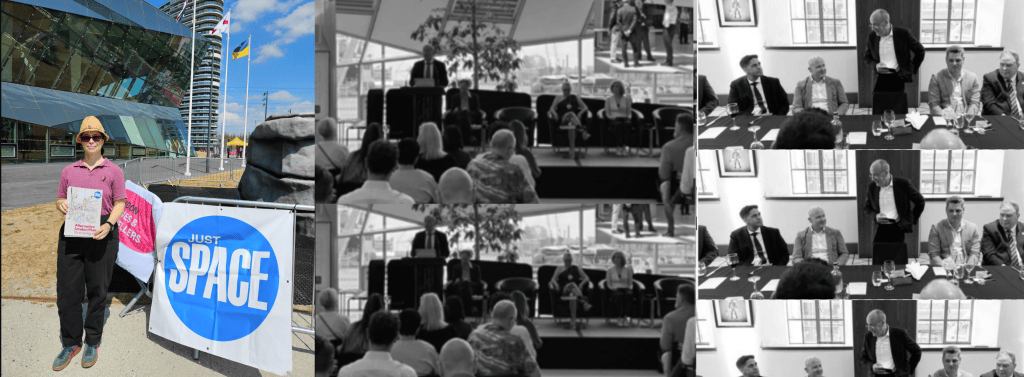
The event at City Hall was poorly attended, with lots of empty seats, invitations having only gone out a few days before – and by the looks of it, only to the usual suspects: assorted politicians, developers and their agents. Just Space and the London Forum were among the very few community groups in attendance.
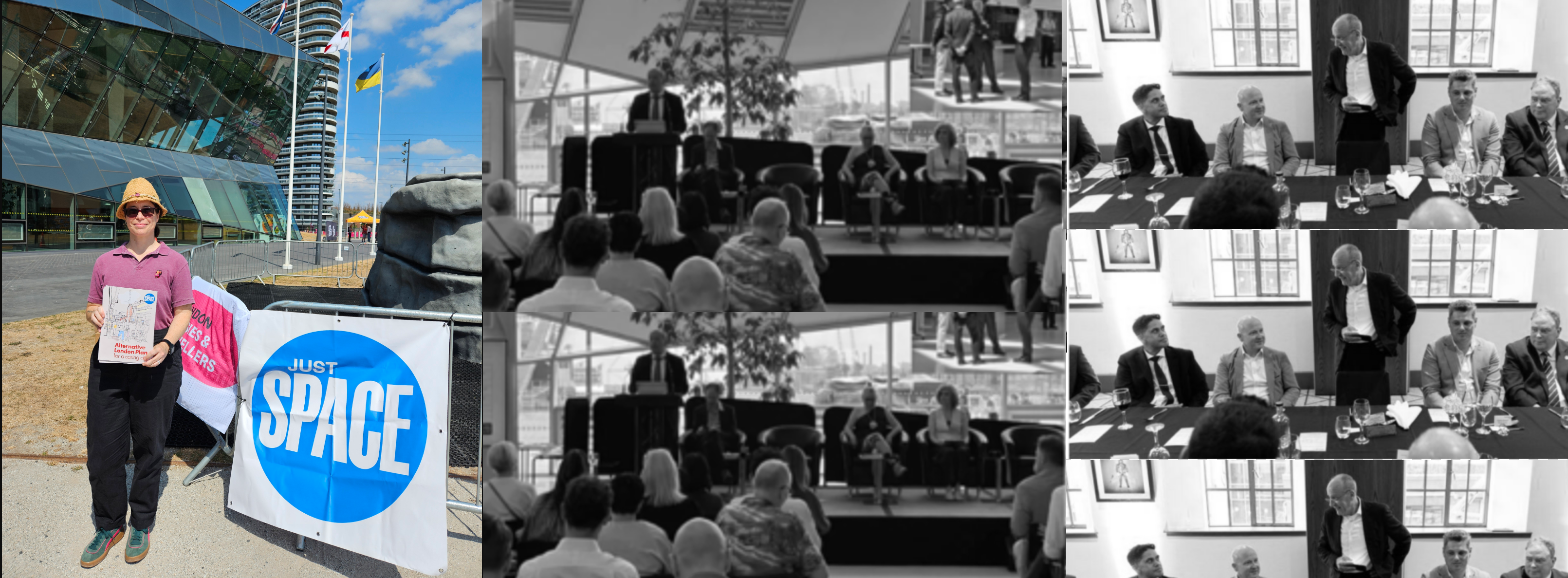
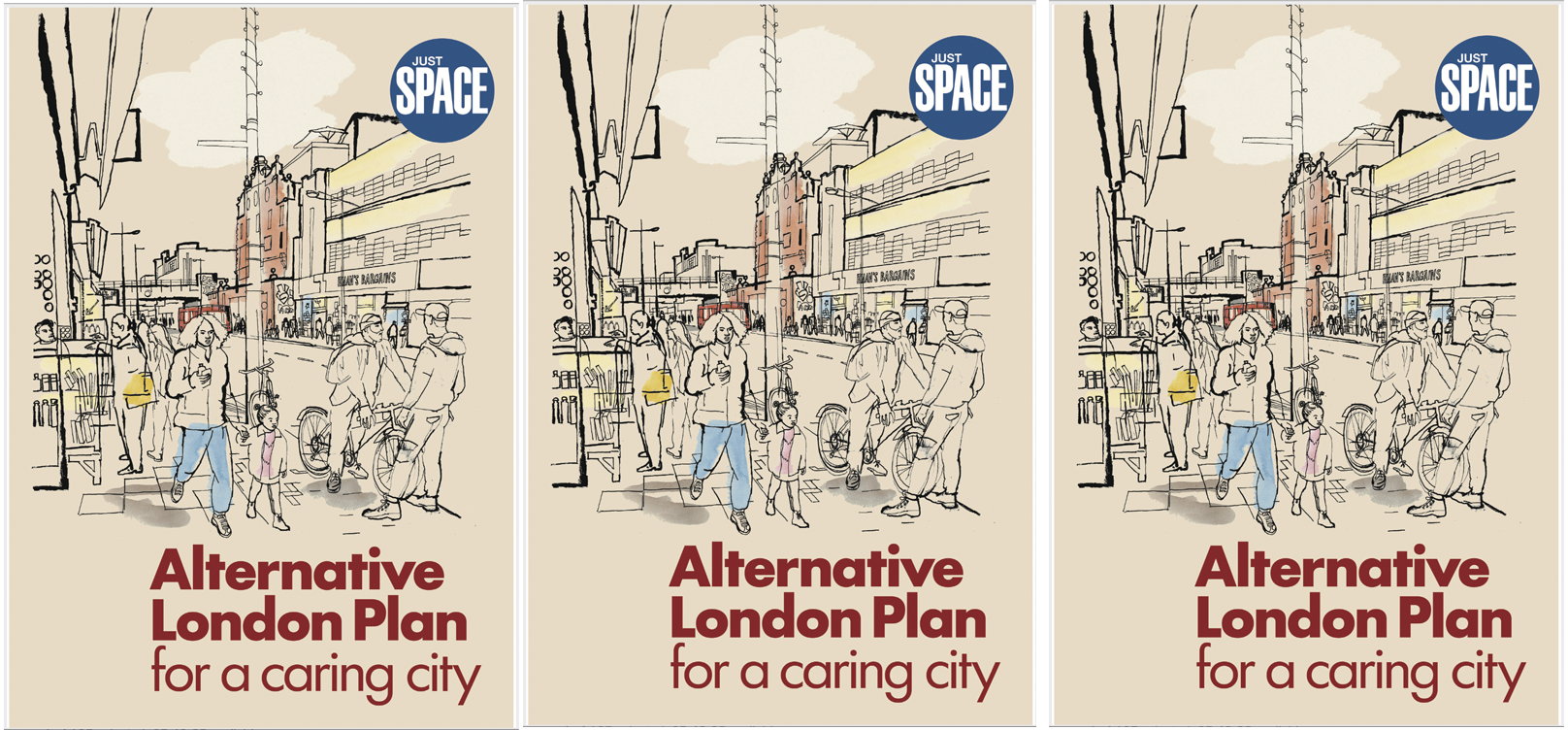
A handful of Just Space members gathered at very short notice to protest outside City Hall at the exclusive event, giving out copies of our Alternative London Plan for a Caring City to attendees, including Jules Pipe, Deputy Mayor of London responsible for Planning.
Nothing was handed out once inside, and the event lasted less than an hour… And yet what was being announced was potentially momentous. Londoners are being subjected to either slow strangulation through rising rents and unaffordable house prices, or unbearable stress as they are threatened with estate demolitions, evictions and homelessness. The GLA official figures show that we need about half of all new homes to be social rent – about 27,000 a year for a decade to address the backlog which leaves 90,000 children homeless in the capital.
The Mayor’s response? More of the same fantasy growth agenda we have been subjected to for 25 years, which has delivered these assorted inhumanities. The Mayor is at least resisting the government’s absurd overall target of 88,000 homes per year – based on voodoo methodology – and is instead setting a target of 56,000 homes annually, based upon a new assessment of need and land availability (the SHLAA and SHMA).
But this is similar to the current housing target, in a city which has averaged 35,000 new homes in recent decades, and has fallen to around 5,000 in 2025. Worse, there isn’t even a target for affordable housing or social homes – just the overall proportionate target of 50%. That is because the Mayor continues to rely on the speculative housing model, which has produced a glut of overpriced 1 and 2 bed flats and a criminal shortfall of genuinely affordable housing.
As the draft Plan admits “Delivering at a rate of circa 56,000 homes a year would mean that London’s affordable housing need is 60 percent of overall supply.”
And even the overall 50% target is officially unachievable, since the Mayor is reducing the proportion required on public land to 40%, and the outer boroughs requirement to just 20%. Only in the inner boroughs is the 35% requirement for ‘Fast Track’ reinstated after the ‘emergency measures’ end in 2028. Jules Pipe added that even these targets would not be achievable if the government didn’t double or even triple the amount of funding for social housing – a direction Burnham has been at least hinting.
There are additional victims: smaller public open spaces appears to be up for grabs, for example. The Green Belt is expected to deliver 56,000 new homes, and, apart from MOL, current protections enjoyed by all open space are being lifted. Instead only ‘Accessible Green Space’ (AGS) designated in Local Plans would continue to enjoy such protection – appearing to leave vulnerable many small, local spaces essential for amenity, including greenspace on estates, unless the local authority identifies and designates every one.
A density matrix of sorts is being reintroduced, as Just Space has been advocating for a decade – but it’s called an ‘Optimisation Framework’ and sets minimum densities, not maximums! Mid-rise is being heavily promoted, but a new category of Major Metropolitan tall buildings over 100m encouraged. 17 Opportunity Areas are being de-designated or rationalised, but dozens of new locations are identified for development as broad locations of growth (BLGs), strategic growth corridors, brownfield-first Opportunity Areas (BFOAs) and Environmental Opportunity Areas, as well as 35 Green Belt locations. More industrial land is being forsaken for non-industrial uses.
But the most worrying failures are sins of omission. Firstly, not once was equalities, inclusion or diversity mentioned in the presentations, and the explicit commitment to these in the very first Good Growth policy to ‘building strong and inclusive communities’ has been unceremoniously dumped.
Secondly, no significant advance on reducing embodied carbon is proposed. London’s development is a scandalous carbon factory, chucking millions of tonnes of carbon into the atmosphere through the continued over-reliance on concrete, and the wilful demolition of perfectly sound, relatively young buildings which could be repaired and retrofitted. But developers are hooked on selling the new London vernacular of ‘cookie cutter’ flats which are mushrooming everywhere across London, and the Mayor is determined to not stand in their way, instead preferring that London’s climate will eventually emulate a desert.
What to do? We have less than 13 weeks to stop this manual for the slow death of London’s communities, and our planet’s descent to the everlasting bonfire. We must muster all the argument and energy demonstrated in the production of our Alternative London Plan and join forces with the many communities and agencies across civil society who are, unsurprisingly, largely unaware of this slow motion car crash.
We appreciate that London is in a housing crisis. The new London Plan will be an opportunity to address this crisis, and Londoners are now invited to give their views on how to make the best of this opportunity. But for some Londoners, there is a crisis-within-the-crisis. Many Gypsies, Roma and Travellers have been excluded from Sadiq Khan’s vision of a thriving, diverse London. We already know that our communities’ children are among the most likely to experience homelessness and environmental racism, nevertheless the latest London-wide assessment of accommodation needs drastically undercounts the needs of members of these ethnic groups. For us, is the London Plan an opportunity that has never really come up enough to even be missed, perhaps?
Representative organisations for Gypsies, Roma and Travellers beyond London have issued the following open letter to the Greater London Authority and particularly to the Mayor of London:
The final report of the London Gypsy and Traveller Accommodation Needs Assessment (GTANA) 2025 was published on Friday 28 November 2025. It provides the evidential base for meeting housing needs of Romany Gypsies, European Roma, Irish and Scottish Travellers, and travelling showpeople for the next ten years. The quality of this evidence is relevant to all those who care about inclusive planning and housing, especially in the context of preparing the next London Plan.
Community representatives and experts on the London GTANA 2025 “steering group” have raised serious concerns about the methodology and accuracy of the research since the GLA-funded project started in 2022. These are their main concerns:
· The Census figures used for Gypsy, Roma and Traveller populations of London are known undercounts.
· The identified housing need arising from overcrowding in Roma households does not reflect the most up-to-date information.
· Most of Gypsies and Travellers’ cultural right and expressed preference to move out of standard housing and into communal sites is discounted.
The Introduction chapter of the GTANA 2025 notes that “some individual members of the GTANA Steering Group do not necessarily endorse all aspects of the methodology or GTANA findings.” London Gypsies and Travellers, Roma Support Group, and Southwark Travellers Action Group have clarified that they are explicitly objecting to the methodology and the findings.
Policy needs to be based on solid evidence to stand up to scrutiny. Community engagement needs to be meaningful to enhance trust in decision-makers’ ability to listen to marginalised voices. Evidence and engagement are pillars of good governance.
As community-based, human rights, planning and housing organisations and professionals, we are in solidarity with our Gypsy, Roma and Traveller allies. We are asking you to act on their recommended corrections and requests.
We ask the GLA to:
· Heed community representatives and experts regarding the London GTANA 2025;
· Deliver a London Plan that works for all Londoners without discrimination.
We collectively stand for an inclusive vision of London which accommodates and celebrates its diversity. We remain hopeful that we can work together with our allies and the GLA to achieve this.
Signed by
Sarah Mann, CEO, Friends Families and Travellers
Michael Edwards, Hon Prof, University College London Bartlett School of Planning
Dr Simon Ruston, MRTPI
Betty Billington, Chair, Kushti Bok
London Renters Union (collective signature)
Joseph Jones, London Federation of Tenants
Bob Green OBE, Head of Operations at Tonic Housing
Josie O’Driscoll, Chief Officer, GATE Herts
Damian Le Bas, author
Laura Vicinanza, Senior Policy and Stakeholder Engagement Manager, Inclusion London
Richard James, Chief Executive Officer, YMCA St Paul’s Group
Ellie Rogers, CEO, LeedsGATE
Pamela Smith, Chair, National Bargee Travellers Association
Nicu Ion, Roma Access Newcastle upon Tyne Association CIC
Simona Lazar, Executive Director, Romani Union Voice
Yvonne MacNamara, Chief Executive, Traveller Movement
Esther Stubbs, Acting Co-Chair, Advisory Council for the Education of Romanies and other Travellers
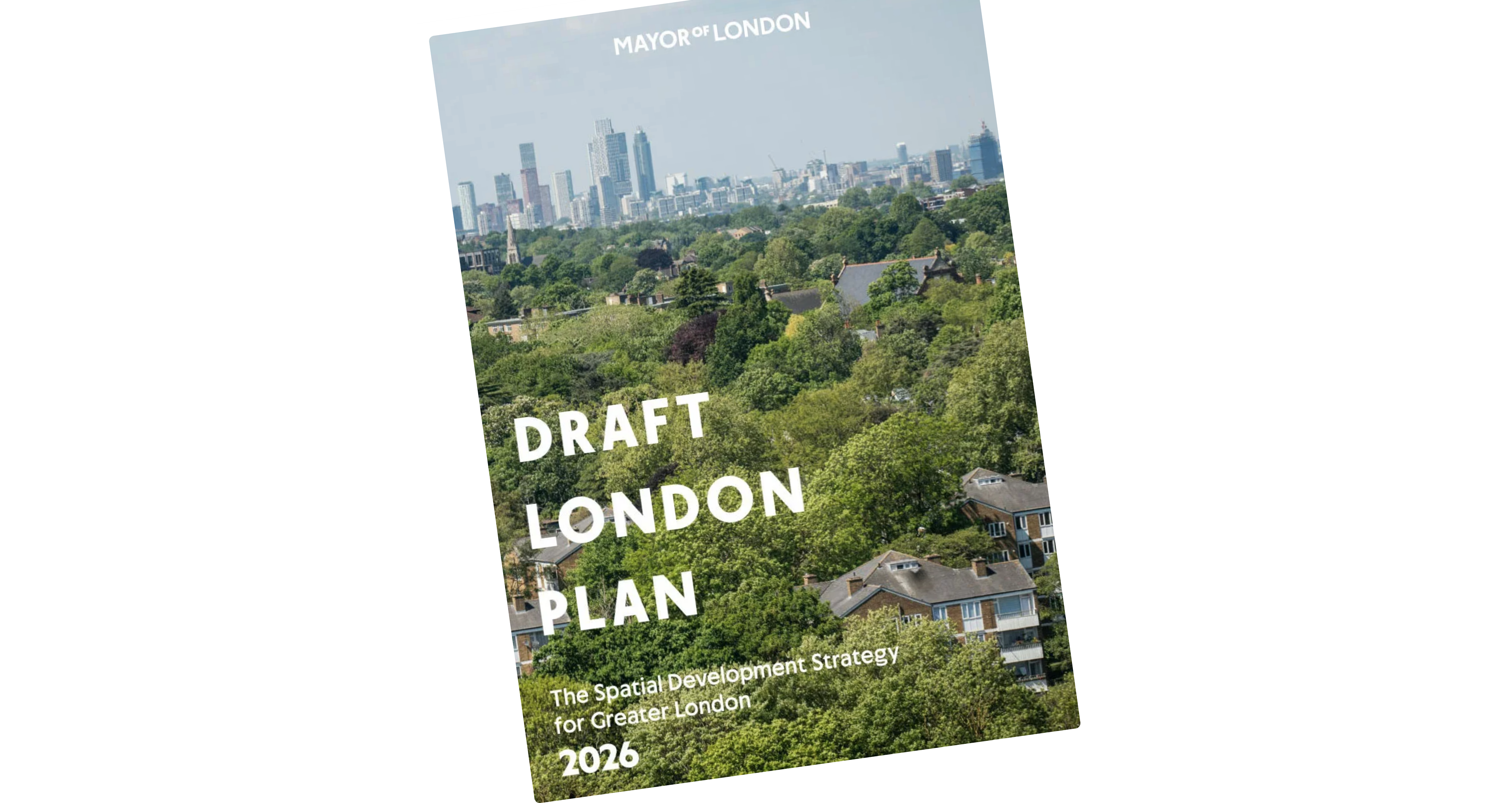
Finally the GLA is releasing the draft London Plan on Thursday 16th July in the morning. There is an invited audience.
Nothing for the voters.
A 20 minute slide show with voice over explaining the new plan with voiceover is available on the GLA draft London Plan website (see link below) and on YouTube; https://youtu.be/cjjg_T7vWZI?si=yatSN57Kb0VpQn-Z .
Minister for Planning Matthew Pennycook MP joined Jules Pipe, London’s Deputy Mayor for Planning, and Tom Copley, London’s Deputy Mayor for Housing, to announce yet more gifts to developers to increase their bank balances
The three people charged with responsibility for responding to the housing affordability crisis in London – and the plight of hundreds of thousands of homeless families and children, as well as the entire planning system – met with thousands of developers and assorted hucksters in the UK’s largest sale of public land in the UK at Leeds earlier this month, known as UKREiiF.
The three politicians were there to explain to their wealthy hosts that the next London Plan will be “streamlined”, jettisoning numerous detailed policies and protections, in an effort to make profitable development easier.
Developers have consistently insisted that the minimum 20% profit which they expect on all projects is jeopardised by requirements to build safe and useful homes. They are particularly annoyed by the Mayor’s attempt to get even a meagre proportion of affordable housing: but they are also keen on removing high standards of quality (such as dual aspect homes, essential in the current heatwave) and post-Grenfell safety requirements.
The Deputy Mayor said that the London Plan would reduce and simplify the rules for developers, making schemes more profitable. The oligarchic housebuilders – who control much identified housing land in London, which they leave empty to keep house prices high – have almost stopped building over the past 18 months, in order to clear the glut of inappropriate yet expensive 1 and 2 bed which they insist on building.
The government blames the Mayor and boroughs for demanding too much from developers and not meeting the government’s imposed target of 88,000 newly built homes a year, a level of build which has never been achieved in the past 100 years.
Jules Pipe explained on behalf of the Mayor that the new London Plan will be “clearer and easier to navigate for the housing industry and councils, stripping away duplication and simplifying policies that have been interpreted oppressively by boroughs”.
Mr Pipe claimed that “building more homes, particularly social and affordable homes, is a top priority for the Mayor. It’s a moral duty for us all to tackle the crisis in homelessness and make housing more affordable for working Londoners” although he promised no new public funds for the essential social infrastructure of council housing; nor did he propose any pressure on the oligarchic landbanking housebuilders to build out the 500,000 homes for which they already have permission.
At the conference, Deputy Mayor for Housing Copley claimed that new powers secured through the English Devolution and Community Act passed last month will allow City Hall a lower threshold for calling in applications. It will also give the Mayor renewed powers to grant planning permission through Mayoral Development Orders. It is understood that officials have been instructed to scope out major brownfield sites near transport hubs that could benefit from this.
Minister Matthew Pennycook concluded that “the case for fundamentally transforming the housing system that we inherited is unarguable. By any metric, it has been an abject failure” – but then promised more of the same “build, build, build” policies pursued by the previous Conservative government, but with rocket boosters attached.
A Just Space members meeting on 19 May discussed the novel and complex process under way in many of the London boroughs as Labour cedes seats but tries not to cede control. Members reported on the coalition-building prospects for a number of boroughs and we shall be adding links to useful analysis as we come accross it. Do use the comments below if you have suggestions.
It is enormously important that we get copies of the Alternative Plan for London as a Caring City in to the hands and minds of newly elected councillors. Members went away with bags full of copies.
The discussion was introduced by a short talk from Michael Ball, coordinator. Download his slides here which contain valuable results, data and maps.
At the end of the week, in which all the bargaining between party groups was completed, the Prime Minister surprised us by banning Labour Councillors from doing deals with Greens
The meeting also heard and discussed a talk by Sarah Goldzweig on the third anniversary of POP – Protect Our Places – a campaign to defend valued community services, including traditional retail markets, many of whom are Just Space members. Download PDF.
The Great British Carve-up with Lambeth’s public land on the menu
London boroughs including Lambeth were fully represented at the UK’s very own public land sale in Leeds all this past week. 15,000 developers, landowners, and asset extractors have been mixing it up with senior officers, Mayors and councillors at UKREiiF, a 3-day swank’n’swill where public land is sold off.
Despite the devastating local elections a fortnight ago, Lambeth have been fully represented with senior officers Dipti Patel, Corporate Director of Growth, Matthew Dibben, Regeneration, and Rob Bristow, Head of Planning. The Greens, who form the largest party in Lambeth, promised in their manifesto that they would:
“Stop the sell off of void properties and council land… Pause and review all housing demolitions… [and] Review all current development schemes based on what benefits they bring to local communities”
Prospectuses of sites in ‘Opportunity London’ included 8 sites in Lambeth selling for up to £6bn. Six Lambeth housing sites were initially valued at £400m but sold to Vistry for £250m last summer.
Lambeth Council are still touting a £2.3bn development of offices and replacement homes beside St Thomas’ Hospital – despite funders Baupost pulling out, and strenuously opposed by local residents and small businesses evicted from Old Paradise Yard. Also on the menu was the ‘Waterloo Station Masterplan’ developed by Lambeth with Network Rail and valued at £3bn.
UKREiiF is the UK’s equivalent of the European MIPIM which descends on Cannes in the south of France each year, where City Mayors and local council leaders procure development of public land. In a flurry of industry buzzwords, UKREiif is described by the owners as:
“Supporting the UK’s property, infrastructure and built environment sectors… driving industry growth through meaningful connections and market insight: UKREiiF provides a unique platform… convening public and private sector leaders we help accelerate development pipelines…; and shaping strategic decision-making through thought leadership”
The Leeds UKREiiF swank started just 7 years ago but has proved enormously profitable: it was sold for £76m in July 2024.
A 6-year by campaign by Aylesham Community Action (ACA) has beaten one of the most successful wealth extractive machines in the country.
On Tuesday a government Inspector refused to allow the destruction of central Peckham by Berkeley Homes, who wanted to demolish the Aylesham Centre and construct towers of unaffordable housing.
The Inspector was called in by Berkeley Homes when Southwark Council failed to approve their plans to tear down the 1980s shops at the very heart of Peckham and build 790 unaffordable homes (along with a niggardly 77 ‘affordable homes’ – just 12%) in a phalanx of towers with fewer shops.
The developers had been in closed discussion with the Council for several years, giving time for the ACA to build a campaign which raised £55,000 – essential to fund full participation as a ‘Rule 6 party’ at the planning inquiry last autumn. They were supplemented by Southwark Council, who got off the fence and opposed the scheme, as did thousands of petitioners and local MP Miatta Fahnbulleh.
The campaign was powered by local people who were determined to stop Berkeley Homes and their plan to destroy Peckham with “gentrification on steroids by displacing communities and local traders, thereby wrecking Peckham’s heritage, economy and heart.”
The planning Inspector agreed that Berkeley Homes’s plans breached the site allocation and policies around design, heritage, tall buildings, and protection of small businesses, and was damning in his condemnation. The proposals would
“rise cliff-like in the townscape… would tower over its setting, dwarfing Purdon House and would forcefully preside over the open bus station… its elevational articulation would be monolithic and unrelenting. The height and massing of the building would be damaging to the townscape from public vantages… I attribute high levels of harm to the Conservation Area, the locally listed Clocktower, 86-88 Peckham High Street and 98-104 Peckham High Street”
The Inspector acknowledged that the affordable housing would be a benefit, but in a stinging conclusion he said
“The circumstances of the case do not lead me to accept new housing and other associated betterments at all costs. [There is] a generational opportunity for Peckham which should be carefully managed to ensure a more optimally designed scheme for future generations.
“For clarity, even with 35% affordable housing as initially proposed in the planning application process and accepting a worsening housing land supply position of less than 5 years… I would still have found that the level of harm in this case would not be overridden.”
The Inspector noted that the site allocation “entails a generationalopportunity for Peckham which should be carefully managed to ensure a more optimally designed scheme for future generations”. He noted the how ACA position around affordable housing was “well-intended” and “with residents welfare in mind”.
This decision will be a blow to those who hoped the Secretary of State’s pro-developer pronouncements to just “build, baby, build” and the government’s attempted neutering of planning would lead to a developer’s free-for-all. It shows that local councils can still refuse terrible schemes – but in this case they only seemed to find the will to do so after the local community had mounted massive protests. Without this, unfortunately, councils from Ealing to Barking and Croydon to Enfield will go on approving thousands of badly designed buildings offering little to the local community.
ACA were very fortunate to have legal and professional support from Jed Holloway at Southwark Law Centre, and Barrister Hashi Mohamed, along with a fantastic team of locals who acted as witnesses covering Planning, Heritage, Viability and S106. They also had support from Southwark Housing and Planning Emergency (SHAPE), Peckham Vision, Peckham Heritage, Latin Elephant, Plush SE15, The 35% Campaign, No price on Culture, Southwark Defend Council Housing and many others.
Ann Lalic, Aylesham Community Action said ‘This is a great victory, and we need it to push for changes in a planning system that doesn’t work for anyone but greedy and voracious developers!’
Siobhan McCarthy, Aylesham Community Action said ‘The inspector, puts it in black and white: this a generational opportunity for Peckham. So there now must be real, comprehensive, lasting, grassroots input from the community on any future plan for the Aylesham site.’
Over the last couple of years construction of new housing in London has, in the words of John Burn-Murdoch, slowed “to a trickle”. The building spree which has seen clusters of new residential towers sprouting around the city has stopped or, as The Telegraph noted in March
…housebuilding has collapsed. Just over 4,100 new homes were started in the capital in 2024-25, down 72pc on 2023-24. Developers have warned that without stronger buyer appetite, London’s new-build pipeline will continue to shrink.
Plans for many more towers exist of course but economic conditions are no longer right for backers to execute them. The government hopes with deregulation work will resume.
Although its fall from grace seemed final in the 70s, high rise housing has made a big comeback since the early 2000s. Planning permission for hundreds of residential towers in London has been granted in the 21st century. Building homes (and student accommodation) in high rise blocks on big, windfall sites is the signature of a growth coalition between developers and politicians. The aims are
more homes on less land
economic growth
foreign direct investment (FDI)
High rise is a key marker of an investable project for foreign investors. The shape of modern London is linked – some might say “obviously” – to the willingness of foreign investors to buy off plan, and their appetite to do so is strengthened by perceived liquidity of standardised residential high-rise. Jeb Brugmann lamented this commodification in the book “Welcome to the Urban Revolution” (2009)
…industrial batch production has been taken to its logical conclusion: growing numbers of large and small investors have participated in the commodification of the city, producing, purchasing, and flipping generic units (i.e., square feet) of “city” for speculative purposes
Selling UK assets to foreign buyers is what Mark Carney called “relying on the kindness of strangers”. Without it, the pound could devalue sharply. Given the UK’s reliance on energy and food imports for example, building towers all over London might be said to keep Londoners warm and fed because it safeguards the buying power of the pound in their pocket. However, Carney was not recommending relying on the practice.
Postwar high rise had nothing to do with FDI or shoring up the pound. The difference is more than economic. Today’s clumps of residential towers are closely packed contradicting the postwar commitment to using towers to free up the ground as parkland or for low and mid-rise family homes, often including houses, a practice known as “mixed development”. Mixed development is exemplified by anonymous estates built in Camden before Sydney Cook came along with his principled rejection of tall buildings. West Kentish Town, Wendling, Bacton, Denton, plus the better known Barrington Court, are estates in Gospel Oak which feature a single tower block or slab surrounded by low-rise.
Although mitigating the trade deficit with capital inflows from foreigners buying up London’s formulaic residential “product” is not an explicit aim of planning policy, it surely affects the regulatory and political environment in which decisions are taken about development.
There are complicated issues here that are beyond my powers of analysis. But, there are some things worth saying if only because they beg questions of those with answers. First of all, the complicated construction of high rise residential towers relies a lot on imported goods which lessens the benefit of selling the end product to foreign buyers. In other words, there’s a growing UK trade deficit in construction materials and components. The Stay Club building on Holmes Road in Kentish Town provides accommodation for foreign students (good for the balance-of-payments) but all its 358 lettable student rooms were imported as pre-fabricated, pre-furnished bedroom pods from China. The same company’s 19-storey Colindale complex has nearly 600 pods.
Secondly, UK cities hawk their “investable projects” to foreign investors all the time. The bizarre Opportunity London website hints at desperation for international capital. Meanwhile, the recent Centripetal Cities report on Manchester’s residential densification shows foreign asset ownership generates revenue which does not make Mancunians richer even as the sale of UK land for development might mitigate the trade deficit.
Lastly, there is a question about spatial planning and UK industrial policy. Current orthodoxy focuses on “site optimisation” but leads to the failing high rise model. The impasse should be recognised as a function of the complexity of high rise buildings which rely on ever more imported finished products, and our town planning culture which lacks a prescription for sensible urbanisation for our times.
A shift away from high rise densification with its import-intensity towards a new housing stock based on simplified construction and a different approach to urbanisation is needed. We need a new idea about an appropriate domestic building type for a new wave of urbanisation in our country – a robust formula to fit our budget .
And before the “compact city” is used to argue for sticking with commoditised residential high rise, we might acknowledge that consumption is the issue, not built form. In other words, the densification of London won’t deliver more sustainable life-styles but guarantees construction becomes more expensive and more difficult.
Our town planning is productivist without either an industrial strategy or a plan for sensible and achievable urbanisation.